
 100% FREE ACCESS
12th Standard CBSE Syllabus & Materials
12th Standard CBSE
CBSE 12th Economics Government Budget and the Economy Previous year Question Papers Study Material - QB365 Set A
NEW12th Standard CBSE
CBSE 12th Computer Science Interface Python with MySQL - New Previous year Question Papers Study Material - QB365 Set A
NEW12th Standard CBSE
CBSE 12th Computer Science Database Concept - New Previous year Question Papers Study Material - QB365 Set A
NEW12th Standard CBSE
CBSE 12th Computer Science Data Communication - New Previous year Question Papers Study Material - QB365 Set A
NEW12th Standard CBSE
CBSE 12th Computer Science Data Structures - New Previous year Question Papers Study Material - QB365 Set A
NEW12th Standard CBSE
CBSE 12th Computer Science Functions - New Previous year Question Papers Study Material - QB365 Set A

Published on: 29/12/2018
12 Class Revision Test
Download CBSE Class 12th Standard CBSE Maths question papers, sample papers, important questions, and previous year solved papers in PDF format. Get free study materials, NCERT solutions, and exam preparation resources for Class 12th Standard CBSE Maths
Questions + Answers key
Take MCQ Maths Test
1.
Find \(\lambda\), if the vectors
\(\overrightarrow a=\overset\wedge i+3\overset\wedge j+\overset\wedge k,\overrightarrow b=2\overset\wedge i-\overset\wedge j-\overset\wedge k\) and \(\overrightarrow c=\lambda \overset\wedge j+3\overset\wedge k\) are coplanar.
2.
Evaluate : \(\int _{ 0 }^{ \frac { \pi }{ 2 } }{ { e }^{ x }(sinx+cosx) } dx\)
3.
If y = tan-1\(\sqrt { \frac { sinx }{ 1+cosx } , } find\frac { dy }{ dx } \)
4.
Find the value of a if tangent to curve y = x2-ax + 7 is parallel to the line 2x - y + 9 = 0 at (- 1, 1).
5.
Prove that sin-1x + sin-1y = sin-1 \((x\sqrt { 1-{ y }^{ 2 } } +y\sqrt { 1-{ x }^{ 2 } } )if{ x }^{ 2 }-{ y }^{ 2 }\le 1\)
6.
How many equivalence relations on the set {1,2, 3} containing (1, 2) and (2, 1) are there in all? Justify your answer.
7.
If \(A=\left| \begin{matrix} 2 & 3 & -1 \\ 4 & 1 & 0 \\ 3 & 3 & 2 \end{matrix} \right| \) , find \(M_{ 12 }\times M_{ 21 }+C_{ 21 }\times C_{ 12 }\) when Mjj called minor and Cjj called co-factors of A.
8.
If matrix A = \([\begin{matrix} 1 & 2 & 3 \end{matrix}]\) write AA' , where A' is the transpose of matrix A.
9.
\(\int _{ 0 }^{ 1 }{ \log { \left( \frac { 1 }{ x } -1 \right) } } dx=0.\)
10.
It is given that:\(\overset { \rightarrow }{ x } =\frac { \overset { \rightarrow }{ b } \times \overset { \rightarrow }{ c } }{ \left[ \overset { \rightarrow }{ a } \overset { \rightarrow }{ b } \overset { \rightarrow }{ c } \right] } ,\overset { \rightarrow }{ y } \frac { \overset { \rightarrow }{ c } \times \overset { \rightarrow }{ a } }{ \left[ \overset { \rightarrow }{ a } \overset { \rightarrow }{ b } \overset { \rightarrow }{ c } \right] } and\ \overset { \rightarrow }{ z } =\frac { \overset { \rightarrow }{ a } \times \overset { \rightarrow }{ b } }{ \left[ \overset { \rightarrow }{ a } \overset { \rightarrow }{ b } \overset { \rightarrow }{ c } \right] } \) where \(\overset { \rightarrow }{ a } ,\overset { \rightarrow }{ b } ,\overset { \rightarrow }{ c } \) are non-coplanar vectors.
11.
Find the integral: \(\int \frac{x^3+3 x+4}{\sqrt{x}} d x\)
12.
Prove that the function f(x) = 5x−3 is continuous at x = 0, at x = −3 and x = 5.
13.
If a matrix has 24 elements, what are the possible orders it can have? What, if it has 13 elements?
14.
How many times must a man toss a fair coin, so that the probability of having at least one head is more than 90%?
15.
Solve the differential equation : \(\frac {dy}{dx} = Y sin 2x, \)given that y(0) = 1.
16.
(Manufacturing Problem) A small firm manufactures gold rings and chains. The total number of rings and chains manufactured per day is atmost 24. It takes 1 hour to make a ring and 30 minutes to make a chain. The maximum number of hours available per day is 16. If the profit on a ring is Rs. 300 and that on a chain is Rs. 190, find the number of rings and chains that should be manufactured per day, so as to earn the maximum profit. Make it as an LPP and solve it graphically.
17.
Find the equation of the perpendicular drawn from the point (1, -2, 3) to the plane 2x - 3y + 4z + 9 = 0. Also find the coordinates of the foot of the perpendicular.
18.
Find the area of the region bounded by the curve x2 = 4y and the line x = 4y - 2.
19.
At what point of the ellipse 16x2+9y2=400,does the ordinate decrease at the same rate at which the abscissa increases?
20.
Find the position vector of foot of perpendicular and the perpendicular distance from the point P with position vector \(2\hat{i}+3\hat{j}+4\hat{k}\) to the plane \(\overrightarrow{r}.(2\hat{i}+\hat{j}+3\hat{k})-26=0.\) Also find the image of P in the plane.
21.
A company produces soft drinks that has a contract which requires that a minimum of 80 units of the chemical A and 60 units of the chemical B go into each bottle of the drink. The chemicals are available in prepared mix packets from two different suppliers. Supplier 5 had a packet of mix of 4 units of A and 2 units of B that costs ~ 10. The supplier T has a packet of mix of 1 unit of A and 1 unit of B that costs ~ 4. How many packets of mixes from 5 and T should the company purchase to honour the contract requirement and yet maintain the minimum cost? Make a LPP and solve graphically.
22.
Let \(A=\left[ \begin{matrix} -2 & 1 \\ 3 & 4 \end{matrix} \right] ,\) then verify the following: A(adj A) = (adj A)A = |A|, where I is the identity matrix of order 2.
23.
If p\(\ne\)0, q\(\ne\)0 and \(\left| \begin{matrix} p & q & p\alpha +q \\ q & r & q\alpha +r \\ p\alpha +q & q\alpha +r & 0 \end{matrix} \right| =0,\) then
using properties of determinants, prove that at least one of the following statements is true:
(a) p, q, r are in G.P.,
(b) \(\alpha\) is a root of the equation px2 + 2qx + r = 0.
24.
Find : \(\int { \frac { { x }^{ 2 }+x+1 }{ (x+1)^{ 2 }(x+2) } } dx\)
25.
Solve the following differential equation :
\(\left( 1+{ y }^{ 2 } \right) dx=\left( \tan ^{ -1 }{ y } -x \right) dy\)
26.
Solve the equation: \(\tan ^{ -1 }{ \sqrt { { x }^{ 2 }+x } } +\sin ^{ -1 }{ \sqrt { { x }^{ 2 }+x+1 } } =\frac { \pi }{ 2 } .\)
27.
Using elementary transformation, find the inverse of the matrix \(A=\left[ \begin{matrix} 8 & 4 & 3 \\ 2 & 1 & 1 \\ 1 & 2 & 2 \end{matrix} \right] \) and use it to solve the following system of lines equations :
8x + 4y + 3z = 19
2x + y + z = 5
x + 2y + 2z = 7
28.
Show that the function f in A = R - \(\left\{ \frac { 2 }{ 3 } \right\} \) defined as \(f(x)=\frac { 4x+3 }{ 6x-4 } \)is one-one and onto Hence find \(f^{ -1 }\)
29.
A trust fund has Rs. 35,000 is to be invested in two different types of bonds. The first bond pays 8% interest per annum which will be given to orphanage and second bond pays 10% interest per annum which will be given to an N.G.O (Cancer Aid Society). Use matrix multiplication, determine how to divide Rs. 35,000 among two types of bonds if the trust fund obtains an annual total interest of Rs. 3,200. What are the values reflected in this question ?
30.
A manufacturer produces three products x,y,z which he sells in two markets.Annual sales are indicated below:
Market Product
I 10,000 2,000 18,000
II 6,000 20,000 8,000.
(a) If unit sale prices of x, y and z are Rs. 2.50, Rs. 1.50 and Rs. 1.00 respectively, find the total revenue in each market with the help of matrix algebra.
(b) If the unit costs of the above three commodities are Rs.2.00, Rs. 1.00 and 0.50 paise respectively, find the gross profit.
31.
Find the derivative of each of the following function w.r.t. x, or find \(\frac { dy }{ dx } \):
y=tan-1\(\left[ \frac { \sqrt { 1+x } -\sqrt { 1-x } }{ \sqrt { 1+x } +\sqrt { 1-x } } \right] \)
1.
\(\left| \begin{matrix} 1 & 3 & 1 \\ 2 & -1 & -1 \\ 0 & \lambda & 3 \end{matrix} \right| =0\)
\(\Rightarrow \lambda=7\)
2.
\(\because \quad \int { { e }^{ x }\left[ f(x\_ +f'(x) \right] } dx\)
\(={ e }^{ x }(f(x)+C\)
\(\because \quad \int _{ 0 }^{ \frac { \pi }{ 2 } }{ e^{ x } } \left[ sinx+cosx \right] dx\)
\(=\left[ { e }^{ x }sinx \right] ^{ \frac { \pi }{ 2 } }_{ 0 }\)
\(={ e }^{ \frac { \pi }{ 2 } }sin\left( \frac { \pi }{ 2 } \right) -{ e }^{ 0 }sin(0)\)
\(={ e }^{ \frac { \pi }{ 2 } }(1)-{ e }^{ 0 }(0)\)
\(={ e }^{ \frac { \pi }{ 2 } }\)
3.
Given, y = tan-1\(\sqrt { \frac { sinx }{ 1+cosx } } \)
y = tan-1\(\sqrt { \frac { 2sin\frac { x }{ 2 } cos\frac { x }{ 2 } }{ 2{ cos }^{ 2 }\frac { x }{ 2 } } } \)
y = tan-1\(\left( \sqrt { tan\frac { x }{ 2 } } \right) \)
y = tan-1
4.
Given, \(y=x^2-ax+7\)
\(\Rightarrow \frac{dy}{dx}=2x-a\)
\(m_1=2x-a\)
Line \(2x-y+9=0\)
\(\Rightarrow 2-\frac{dy}{dx}=0\)
\(\Rightarrow \frac{dy}{dx}=2=m_2\)
for parallel, \(m_1=m_2\)
\(\therefore 2x-a=2\)
\(\Rightarrow 2(-1)-a=2\)
\(\Rightarrow -2-2=a\)
\(\Rightarrow a=-4\)
5.
\({ sin }^{ -1 }x=A\ and\ { sin }^{ -1 }y=B\)
\(\Rightarrow\) x = sin A and y = sin B
\(\therefore cos\ A=\sqrt { 1-{ x }^{ 2 } } ,cos\ B=\sqrt { 1-{ y }^{ 2 } } \)
we have sin (A+B) = sin A cos B + cos A sin B
\(\Rightarrow sin(A+B)=x\sqrt { 1-{ y }^{ 2 } } +\sqrt { 1-{ x }^{ 2 } } y\)
\(\Rightarrow sin(A+B)=x\sqrt { 1-{ y }^{ 2 } } +y\sqrt { 1-{ x }^{ 2 } } \)
\(\Rightarrow A+B={ sin }^{ -1 }\left( x\sqrt { 1-{ y }^{ 2 } } +y\sqrt { 1-{ x }^{ 2 } } \right) \)
\(\therefore { sin }^{ -1 }x+sin^{ -1 }y={ sin }^{ -1 }\left( x\sqrt { 1-{ y }^{ 2 } } +y\sqrt { 1-{ x }^{ 2 } } \right) \)
6.
Equivalence relations could be the following:
{(1, 1), (2, 2), (3, 3), (1,2), (2, 1)} and
{(1, I), (2, 2), (3, 3), (1, 2), (1, 3), (2,1), (2, 3), (3, 1), (3,2)}
So, only two equivalence relations.
7.
We have, \(A=\left| \begin{matrix} 2 & 3 & -1 \\ 4 & 1 & 0 \\ 3 & 3 & 2 \end{matrix} \right| \)
\(M_{ 12 }\left| \begin{matrix} 4 & 0 \\ 3 & 2 \end{matrix} \right| =8-0=8\)
\(M_{ 21 }\left| \begin{matrix} 3 & -1 \\ 3 & 2 \end{matrix} \right| =6+3=9\)
\(C_{ 21 }=-\left| \begin{matrix} 3 & -1 \\ 3 & 2 \end{matrix} \right| =-(6+3)=-9\)
\(C_{ 12 }=-\left| \begin{matrix} 4 & 0 \\ 3 & 2 \end{matrix} \right| =-(8-0)=-8\)
\( M_{ 12 }\times M_{ 21 }+C_{ 21 }\times C_{ 12 }\)
\( 8\times (9)+(-9)(-8)=72+72\)
\(=144\)
8.
\(AA'= \left[ \begin{matrix} 1 & 2 & 3 \end{matrix} \right] \left[ \begin{matrix} 1 \\ 2 \\ 3 \end{matrix} \right] =\left[ 1+4+9 \right] =\left[ 14 \right]\)
9.
Let \(I= \int _{ 0 }^{ 1 }{ \log { \frac { 1-x }{ x } } dx } \)
\(=\int _{ 0 }^{ 1 }{ \log { \left( \frac { 1-(1-x) }{ 1-x } \right) } } dx\)
\(=\int _{ 0 }^{ 1 }{ \log { \left( \frac { x }{ 1-x } \right) } } dx\)
\(=-\int _{ 0 }^{ 1 }{ \log { \left( \frac { 1-x }{ x } \right) } } dx=-1\)
\(\Rightarrow 2I=0\Rightarrow I=0.\)
10.
\(\overset { \rightarrow }{ x } .\left( \overset { \rightarrow }{ a } +\overset { \rightarrow }{ b } \right) +\overset { \rightarrow }{ y } .\left( \overset { \rightarrow }{ b } +\overset { \rightarrow }{ c } \right) +\overset { \rightarrow }{ z } .\left( \overset { \rightarrow }{ c } +\overset { \rightarrow }{ a } \right) \)
\(\\ =\frac { \overset { \rightarrow }{ b } \times \overset { \rightarrow }{ c } }{ \left[ \overset { \rightarrow }{ a } \overset { \rightarrow }{ b } \overset { \rightarrow }{ c } \right] } .\left( \overset { \rightarrow }{ a } +\overset { \rightarrow }{ b } \right) +\frac { \overset { \rightarrow }{ c } \times \overset { \rightarrow }{ a } }{ \left[ \overset { \rightarrow }{ a } \overset { \rightarrow }{ b } \overset { \rightarrow }{ c } \right] } .\left( \overset { \rightarrow }{ b } +\overset { \rightarrow }{ c } \right) +\frac { \overset { \rightarrow }{ a } \times \overset { \rightarrow }{ b } }{ \left[ \overset { \rightarrow }{ a } \overset { \rightarrow }{ b } \overset { \rightarrow }{ c } \right] } .\left( \overset { \rightarrow }{ c } +\overset { \rightarrow }{ a } \right) \)
\(=\frac { 1 }{ \left[ \overset { \rightarrow }{ a } \overset { \rightarrow }{ b } \overset { \rightarrow }{ c } \right] } \left[ (\overset { \rightarrow }{ b } \times \overset { \rightarrow }{ c } ).\overset { \rightarrow }{ a } +(\overset { \rightarrow }{ b } \times \overset { \rightarrow }{ c } ).\overset { \rightarrow }{ b } +(\overset { \rightarrow }{ c } \times \overset { \rightarrow }{ a } ).\overset { \rightarrow }{ b } +(\overset { \rightarrow }{ c } \times \overset { \rightarrow }{ a } ).\overset { \rightarrow }{ c } +(\overset { \rightarrow }{ a } \times \overset { \rightarrow }{ b } ).\overset { \rightarrow }{ c } +(\overset { \rightarrow }{ a } \times \overset { \rightarrow }{ b } ).\overset { \rightarrow }{ a } \right] \)
\(=\frac { 1 }{ \left[ \overset { \rightarrow }{ a } \overset { \rightarrow }{ b } \overset { \rightarrow }{ c } \right] } \left[ \left[ \overset { \rightarrow }{ b } \overset { \rightarrow }{ c } \overset { \rightarrow }{ a } \right] +\left[ \overset { \rightarrow }{ b } \overset { \rightarrow }{ c } \overset { \rightarrow }{ b } \right] +\left[ \overset { \rightarrow }{ c } \overset { \rightarrow }{ a } \overset { \rightarrow }{ b } \right] +\left[ \overset { \rightarrow }{ c } \overset { \rightarrow }{ a } \overset { \rightarrow }{ c } \right] +\left[ \overset { \rightarrow }{ a } \overset { \rightarrow }{ b } \overset { \rightarrow }{ c } \right] +\left[ \overset { \rightarrow }{ a } \overset { \rightarrow }{ b } \overset { \rightarrow }{ a } \right] \right] \)
\(=\frac { 1 }{ \left[ \overset { \rightarrow }{ a } \overset { \rightarrow }{ b } \overset { \rightarrow }{ c } \right] } \left[ \left[ \overset { \rightarrow }{ b } \overset { \rightarrow }{ c } \overset { \rightarrow }{ a } \right] +0+\left[ \overset { \rightarrow }{ c } \overset { \rightarrow }{ a } \overset { \rightarrow }{ b } \right] +0+\left[ \overset { \rightarrow }{ a } \overset { \rightarrow }{ b } \overset { \rightarrow }{ c } \right] +0 \right] \)
\(=\frac { 3\left[ \overset { \rightarrow }{ a } \overset { \rightarrow }{ b } \overset { \rightarrow }{ c } \right] }{ \left[ \overset { \rightarrow }{ a } \overset { \rightarrow }{ b } \overset { \rightarrow }{ c } \right] } =3.\)
11.
\(\int { { \left( \frac { { x }^{ 3 }+{ 3x }+4 }{ { x }^{ 2 } } \right) } } dx\)
\(=\int { { \left( \frac { { x }^{ 3 } }{ \sqrt { x } } +3\frac { x }{ \sqrt { x } } +\frac { 4 }{ \sqrt { x } } \right) } } dx\)
\(=\int { { x }^{ \frac { 5 }{ 2 } }dx+3 } \int { { x }^{ \frac { 1 }{ 2 } }dx+4 } \int { { x }^{ \frac { 1 }{ 2 } }dx } \)
\(=\frac { { x }^{ \frac { 5 }{ 2 } +1 } }{ \frac { 5 }{ 2 } +1 } +3\frac { { x }^{ \frac { 1 }{ 2 } +1 } }{ \frac { 1 }{ 2 } +1 } +4\frac { { x }^{ -\frac { 1 }{ 2 } +1 } }{ -\frac { 1 }{ 2 } +1 } +C\)
\(=\frac { 2 }{ 7 } { x }^{ \frac { 7 }{ 2 } }+{ 2x }^{ \frac { 3 }{ 2 } }+8{ x }^{ \frac { 1 }{ 2 } }+C.\)
12.
\((i)\lim _{ x\rightarrow 0 }{ f\left( x \right) = } \lim _{ x\rightarrow 0 }{ (5x-3) } =0-3=-3\)
\(f(0)=-3\)
\(Thus\ \lim _{ x\rightarrow 0 }{ f\left( x \right) } =f(0)\)
f is continuous at x = 0
\((ii)\lim _{ x\rightarrow -3 }{ f\left( x \right) } =\lim _{ x\rightarrow -3 }{ (5x-3) }\)
\( =\lim _{ h\rightarrow 0 }{ \left[ 5(-3+h)-3 \right] } \)
\(=\lim _{ h\rightarrow 0 }{ (-18+5h) } \)
\(=-18+5(0)=-18\)
\(Thus\ \lim _{ x\rightarrow -3 }{ f\left( x \right) =f(-3) } \)
f is continuous at x = -3
\((iii)\lim _{ x\rightarrow 5 }{ f\left( x \right) = } \lim _{ x\rightarrow 5 }{ (5x-3) } \)
\(=\lim _{ h\rightarrow 0 }{ \left[ 5(5+h)-3 \right] } \)
\(=\lim _{ h\rightarrow 0 }{ (22+5h)=22+0=22 } \)
\(f(5)=5(5)-3=25-3=22\)
\(Thus\ \lim _{ x\rightarrow 5 }{ f\left( x \right) } =f(5)\)
f is continuous at x = 5
13.
We know that if a matrix is of the order m × n, it has mn elements. Thus, to find all the possible orders of a matrix having 24 elements, we have to find all the ordered pairs of natural numbers whose product is 24.
The ordered pairs are: (1, 24), (24, 1), (2, 12), (12, 2), (3, 8), (8, 3), (4, 6), and (6, 4)
Hence, the possible orders of a matrix having 24 elements are:
1 × 24, 24 × 1, 2 × 12, 12 × 2, 3 × 8, 8 × 3, 4 × 6, and 6 × 4
(1, 13) and (13, 1) are the ordered pairs of natural numbers whose product is 13.
Hence, the possible orders of a matrix having 13 elements are 1 × 13 and 13 × 1.
14.
Let the coin be lossed n times.
P(getting a head) = \(\frac { 1 }{ 2 } \)( = p)
P(not getting no head) = \(1-\frac { 1 }{ 2 } =\frac { 1 }{ 2 } \)(=q)
P(at lest one head) = 1-P(0)
= \(1-^{ n }{ C }_{ 0 }{ q }^{ n }{ p }^{ 0 }=1-\left( 1 \right) { \left( \frac { 1 }{ 2 } \right) }^{ n }\left( 1 \right) \)
= \(1-{ \left( \frac { 1 }{ 2 } \right) }^{ n }\)
By the question, \(1-{ \left( \frac { 1 }{ 2 } \right) }^{ n }>\frac { 90 }{ 100 } \)
\(\Rightarrow 1-{ \left( \frac { 1 }{ 2 } \right) }^{ n }>0.9\Rightarrow { \left( \frac { 1 }{ 2 } \right) }^{ n }<1-0.9\)
\(\Rightarrow 1-{ \left( \frac { 1 }{ 2 } \right) }^{ n }<0.1\Rightarrow n\ge 4\)
15.
2 log |y| = - cos 2x + 1 is the required solution.
16.
Let 'x' and 'y' be the number of gold rings and chains respectively.
We have:
\(x\ge 0\) ...(1)
\(y\ge 0\)...(2)
\(x+y\le 24\)...(3)
\(x+\frac { y }{ 2 } \le 16\) ...(4)
The objective function, or the profit, Z is:
Z = 300x + 190y ..(5)
We have to maximise Z subject to (1)-(4).
For solution set, we draw the lines:
x = 0, y = 0, x + y = 24, 2x + y = 32.
The lines x + y = 24 and 2x + y = 32 meet at E (8,16).
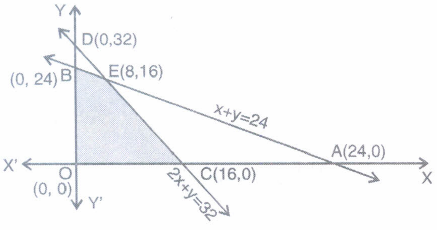
The shaded portion represents the feasible region, which is bounded.
Applying Corner Point Method, we have:
| Corner Point | Z = 300x + 190y |
| O : (0,0) | 0 |
| C : (16,0) | 4800 |
| E : (8,16) | 5440 (Maximum |
| B : (0,24) | 4560 |
Hence, the maximum profit is Rs. 5,440 and it is obtained when 8 gold rings and 16 chains are manufactured.
17.
As line AB is perpendicular to the plane therefore, direction ratios of the line are 2, 3,4 and line passes through the point A( 1, -2, 3)
\(\therefore \) equation of the perpendicular is
\(\frac{x-1}{2}=\frac{y+2}{-3}=\frac{z-3}{4}=\lambda \text { (say) }\)
General point on the line is
\(B(2 \lambda+1,-3 \lambda-2,4 \lambda+3)\)
If the point lies on the plane, then
\(2(2\lambda +1)-3(-3\lambda -2)+4(4\lambda +3)+9=0\Rightarrow 29\lambda =-29\Rightarrow \lambda =-1\)
Substituting in (i), we get foot of the perpendicular as B(-1, 1, -1).
18.
\(\frac { 9 }{ 8 } \) sq units.
19.
Let point be (x, y), then \(\frac{d y}{d t}=-\frac{d x}{d t}\)
Differentiating both sides of the ellipse
16x2 + 9y2 = 400 w.r.t. t, we get
\(16 \cdot 2 x \cdot \frac{d x}{d t}+18 y \frac{d y}{d t}=0 \)
\(\Rightarrow \frac{d y}{d t}=-\frac{16 x}{9 y} \cdot \frac{d x}{d t} \Rightarrow 16 x=9 y \quad \text { \{using (i) }
\)
Substituting in curve, we get
\(16 x^{2}+\frac{256}{9} x^{2}=400 \)
\(\Rightarrow x^{2}=9 \rightarrow x=\pm 3, \text { then } y=\pm \frac{16}{3}\)
Hence, point are \((3,{16\over 3}),(-3,{-16\over 3})\)
20.
Equation of plane: 2x + y + 3z = 26
Normal to the plane = \(2\hat{i}+\hat{j}+3\hat{k}\)
\(\therefore \) < 2, 1, 3 > are direction ratios of the normal to the plane.
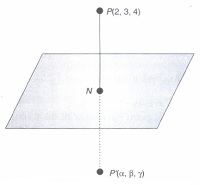
Equation of the line through P(2, 3, 4) and perpendicular to the give plane is
\({{x-2}\over{2}}={{y-3}\over{1}}={{z-4}\over{3}}=\lambda\)
\(\therefore\) Co-ordinates of point N are N \((2\lambda+2,\lambda+3,3\lambda+4)\)
Since N lies on the plane,
\(\Rightarrow\) \(2(2\lambda+2)+(\lambda+3)+3(3\lambda+4)=26\)
\(\Rightarrow\) \(4\lambda+4+\lambda+3+9\lambda+12=26\)
\(\Rightarrow\) \(14\lambda=26-19\)
\(\Rightarrow\) \(14\lambda=7\)
\(\Rightarrow\) \(\lambda={{1}\over{2}}\)
\(\therefore\) Co-ordinates of the foot of the perpendicular i.e., N are
\(\left( 2\left({{1}\over{2}} \right)+2,{{1}\over{2}}+3,3\left({{1}\over{2}} \right)+4 \right)\) i.e., \(\left( 3,{{7}\over{2}},{{11}\over{2}} \right)\)
\(\therefore\) The length of perpendicular form P to given plane is
\(|NP|=\sqrt{{2-3}^{2}+{\left(3-{{7}\over{2}} \right)}^{2}+\left(4-{{11}\over{2}}\right)^{2}}\)
\(=\sqrt{1+{{1}\over{4}}+{{9}\over{4}}}\)
\(=\sqrt{{{14}\over{1}}}\)
\(=\sqrt{{7}\over{2}}\) units
Now, N is the mid-point of PP', where P'\((\alpha,\beta,\gamma)\) is the image of point P.
\(\therefore\) \(\left(3,{{7}\over{2}},{{11}\over{2}} \right)=\left({{2+\alpha}\over{2}} ,{{3+\beta}\over{2}},{{4+\gamma}\over{2}}\right)\)
\(\Rightarrow \) \(3={{2+\alpha}\over{2}};{{7}\over{4}}={{3+\beta}\over{2}};{{11}\over{2}}={{4+\gamma}\over{2}}\)
\(\Rightarrow\) \(6=2+\alpha;7=3+\beta;11=4+\gamma\)
\(\Rightarrow\) \(\alpha=4;\beta=4;\gamma=7\)
\(\therefore\) Image of point P is P'(4, 4, 7).
21.
Let x and y units of packet of mixes are purchased from 5 and T respectively. If Z is the total cost, then
Z = 10x + 4y ...(i)
is objective function which we have to minimize
Here constraints are:
4x + y \(\ge\)80..(ii)
2x + y \(\ge\)60.(iii)
Also, x \(\ge\) 0...(iv)
y \(\ge\)0
On plotting the graph of above constraints or inequalities (ii), (iii), (iv) and (v),
we get shaded region having corner point A, P, B as feasible region. For co-ordinate of P
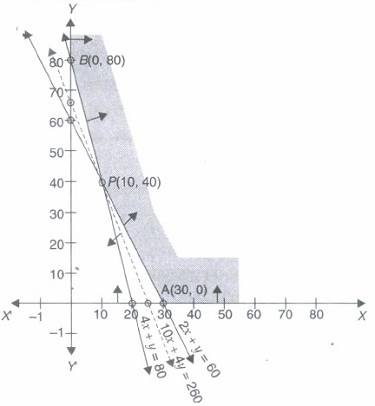
Point of intersection of
2x + y = 60...(vi)
and 4x + y = 80....(vii)
From (vi) - (vii),
2x + y - 4x - y = 60 - 80
\(\Rightarrow\) -2x = -20
\(\Rightarrow\) x = 10
\(\Rightarrow\) y = 40
\(\because\) Co-ordinate of P = (10, 40)
Now the value of Z is evaluated at corner point the following table:
| Corner Points | Z = 10x + 4y |
| A(30, 0) | 300 |
| P(10, 40) | 260(Min.) |
| B(0, 80) | 320 |
Since feasible region is unbounded. Therefore we have to draw the graph of the inequality.
10x + 4y < 260 ...(viii)
Since the graph of inequality (viii) does not have any point common.
So the minimum value of Z is 260 at (10, 40). i.e., minimum cost of each bottle is ~ 260 if the company purchases 10 packets of mixes from 5 and 40 packets of mixes from supplier T.
22.
\(A=\left[ \begin{matrix} -2 & 1 \\ 3 & 4 \end{matrix} \right] \)
then \(adj\quad A={ \left[ \begin{matrix} 4 & -3 \\ -1 & -2 \end{matrix} \right] }^{ T }={ \left[ \begin{matrix} 4 & -1 \\ -3 & -2 \end{matrix} \right] }\)
Taking \(A(adj\quad A)=\left[ \begin{matrix} -2 & 1 \\ 3 & 4 \end{matrix} \right] { \left[ \begin{matrix} 4 & -1 \\ -3 & -2 \end{matrix} \right] }\)
\(=\left[ \begin{matrix} -11 & 0 \\ 0 & -11 \end{matrix} \right] =-11\left[ \begin{matrix} 1 & 0 \\ 0 & 1 \end{matrix} \right] \)
Taking \((adj\ A)A={ \left[ \begin{matrix} 4 & -1 \\ -3 & -2 \end{matrix} \right] }{ \left[ \begin{matrix} 4 & -1 \\ -3 & -2 \end{matrix} \right] }\)
\(=\left[ \begin{matrix} -11 & 0 \\ 0 & -11 \end{matrix} \right] =-11\left[ \begin{matrix} 1 & 0 \\ 0 & 1 \end{matrix} \right] \)
Getting \(\left| A \right| =\left[ \begin{matrix} -2 & 1 \\ 3 & 4 \end{matrix} \right] =-11\)
\(\therefore \left| A \right| =-11\left[ \begin{matrix} 1 & 0 \\ 0 & 1 \end{matrix} \right] \)
A.(adj A) = (adj A).A = |A| Hence proved.
23.
Given equation \(\left| \begin{matrix} p & q & p\alpha +q \\ q & r & q\alpha +r \\ p\alpha +q & q\alpha +r & 0 \end{matrix} \right| =0\)
Given equation \(\Rightarrow \frac { 1 }{ pq } \left| \begin{matrix} pq & { q }^{ 2 } & pq\alpha +{ q }^{ 2 } \\ pq & pr & pq\alpha +pr \\ p\alpha +q & q\alpha +r & 0 \end{matrix} \right| =0\)
\(({ R }_{ 1 }\rightarrow { R }_{ 1 }-{ R }_{ 2 })\)
\(\Rightarrow \frac { 1 }{ pq } \left| \begin{matrix} 0 & { q }^{ 2 }-pr & { q }^{ 2 }-pr \\ pq & pr & pq\alpha +pr \\ p\alpha +q & q\alpha +r & 0 \end{matrix} \right| =0\)
\(\Rightarrow \frac { { q }^{ 2 }-pr }{ pq } \left| \begin{matrix} 0 & 1 & 1 \\ pq & pr & pq\alpha +pr \\ p\alpha +q & q\alpha +r & 0 \end{matrix} \right| =0\)
\(\Rightarrow \frac { { q }^{ 2 }-pr }{ pq } p\left| \begin{matrix} 0 & 1 & 1 \\ q & r & q\alpha +r \\ p\alpha +q & q\alpha +r & 0 \end{matrix} \right| =0\)
\(({ C }_{ 2 }\rightarrow { C }_{ 2 }-{ C }_{ 3 })\)
\(\Rightarrow \frac { { q }^{ 2 }-pr }{ pq } p\left| \begin{matrix} 0 & 1 & 1 \\ q & -q\alpha & q\alpha +r \\ p\alpha +q & q\alpha +r & 0 \end{matrix} \right| =0\)
\(\Rightarrow \frac { { q }^{ 2 }-pr }{ pq } p({ q }^{ 2 }\alpha +rq+pq{ \alpha }^{ 2 }+{ q }^{ 2 }\alpha )=0\)
\(\Rightarrow({ q }^{ 2 }-pr)(2q\alpha +r+p{ \alpha }^{ 2 }+{ q }^{ 2 }\alpha )=0\)
\(\Rightarrow { q }^{ 2 }-pr=0\)
(i.e., p,q,r are in GP) or \(2q\alpha +r+p{ \alpha }^{ 2 }=0\)
(i.e.,\(\alpha\) is a root of the equation 2qx + r + px2 = 0)
24.
Let \(\frac { { x }^{ 2 }+x+1 }{ (x+1)^{ 2 }(x+2) } =\frac { A }{ x+1 } +\frac { B }{ (x+1)^{ 2 } } +\frac { C }{ x+2 } \)
Solving for A, B, C, we get
A = -2, B = 1, C = 3
\(\therefore \frac { { x }^{ 2 }+x+1 }{ (x+1)^{ 2 }(x+2) } dx\)
\(=-2\int { \frac { 1 }{ x+1 } dx+\int { \frac { 1 }{ (x+1)^{ 2 } } } dx+ } 3\int { \frac { 1 }{ x+2 } } dx\)
\(=-2log\left| x+1 \right| -\frac { 1 }{ x+1 } +3log\left| x+2 \right| +C\)
25.
Writing the given differential equation as
\(\frac { dx }{ dy } =\frac { \tan ^{ -1 }{ y } -x }{ 1+{ y }^{ 2 } } \)
or \(\frac { dx }{ dy } +\frac { x }{ 1+{ y }^{ 2 } } =\frac { \tan ^{ -1 }{ y } }{ 1+{ y }^{ 2 } } \)
The above equation is linear in 'x'.
Getting \(I.F.{ e }^{ \int { \frac { 1 }{ 1+{ y }^{ 2 } } dy } }\)
\(={ e }^{ \tan ^{ -1 }{ y } }\)
Multiplying both sides by I.F.and integrating
we get \(x{ e }^{ \tan ^{ -1 }{ y } }=\int { { e }^{ \tan ^{ -1 }{ y } } } \frac { \tan ^{ -1 }{ y } }{ 1+{ y }^{ 2 } } dy\)
\(\Rightarrow x{ e }^{ \tan ^{ -1 }{ y } }=\int { { e }^{ t }.tdt } \)
\(\left( Assuming\quad \tan ^{ -1 }{ y } =t\Rightarrow \frac { 1 }{ 1+{ y }^{ 2 } } dy=dt \right) \)
\(\Rightarrow x{ e }^{ \tan ^{ -1 }{ y } }=t{ e }^{ t }-{ e }^{ t }+C\)
\(\Rightarrow x{ e }^{ \tan ^{ -1 }{ y } }=\left( \tan ^{ -1 }{ y } \right) \left( { e }^{ \tan ^{ -1 }{ y } } \right) -{ e }^{ \tan ^{ -1 }{ y } }+C\)
\(\Rightarrow x=\tan ^{ -1 }{ y } -1+C{ e }^{ -\tan ^{ -1 }{ y } }\)
26.
Given equation exists, if
x2 + x \(\ge\) 0 and 0 < \(\sqrt { { x }^{ 2 }+x+1 } \le 1\)
[\(\because\)x2 + x + 1 is always greater than zero]
Now, x2 + x \(\ge\)0 and x2 + x + 1 \(\le\)1
\(\Rightarrow\) x2 + x \(\ge\)0 and x2 + x \(\le\)0
\(\Rightarrow\) x2 + x = 0 i.e., x(x + 1) = 0
Hence, x = 0 and -1 are the solution of the given equation.
27.
We know that A = I3A
\(\left[ \begin{matrix} 8 & 4 & 3 \\ 2 & 1 & 1 \\ 1 & 2 & 2 \end{matrix} \right] =\left[ \begin{matrix} 1 & 0 & 0 \\ 0 & 1 & 0 \\ 0 & 0 & 1 \end{matrix} \right] A\)
Applying \({ R }_{ 3 }\rightarrow 2{ R }_{ 3 }\)
\(\left[ \begin{matrix} 8 & 4 & 3 \\ 2 & 1 & 1 \\ 2 & 4 & 4 \end{matrix} \right] =\left[ \begin{matrix} 1 & 0 & 0 \\ 0 & 1 & 0 \\ 0 & 0 & 2 \end{matrix} \right] A\)
Applying \({ R }_{ 3 }\rightarrow { R }_{ 3 }-{ R }_{ 2 }\)
\(\left[ \begin{matrix} 8 & 4 & 3 \\ 2 & 1 & 1 \\ 0 & 3 & 3 \end{matrix} \right] =\left[ \begin{matrix} 1 & 0 & 0 \\ 0 & 1 & 0 \\ 0 & -1 & 2 \end{matrix} \right] A\)
Applying \({ R }_{ 2 }\rightarrow 4{ R }_{ 2 }\)
\(\left[ \begin{matrix} 8 & 4 & 3 \\ 8 & 4 & 4 \\ 0 & 3 & 3 \end{matrix} \right] =\left[ \begin{matrix} 1 & 0 & 0 \\ 0 & 4 & 0 \\ 0 & -1 & 2 \end{matrix} \right] A\)
Applying \({ R }_{ 2 }\rightarrow { R }_{ 2 }-{ R }_{ 1 }\)
\(\left[ \begin{matrix} 8 & 4 & 3 \\ 0 & 0 & 1 \\ 0 & 3 & 3 \end{matrix} \right] =\left[ \begin{matrix} 1 & 0 & 0 \\ -1 & 4 & 0 \\ 0 & -1 & 2 \end{matrix} \right] A\)
Applying \({ R }_{ 2 }\rightarrow { R }_{ 2 }+{ R }_{ 3 }\)
\(\left[ \begin{matrix} 8 & 4 & 3 \\ 0 & 3 & 4 \\ 0 & 3 & 3 \end{matrix} \right] =\left[ \begin{matrix} 1 & 0 & 0 \\ -1 & 3 & 2 \\ 0 & -1 & 2 \end{matrix} \right] A\)
Applying \({ R }_{ 3 }\rightarrow { R }_{ 3 }-{ R }_{ 2}\)
\(\left[ \begin{matrix} 8 & 4 & 3 \\ 0 & 3 & 4 \\ 0 & 0 & -1 \end{matrix} \right] =\left[ \begin{matrix} 1 & 0 & 0 \\ -1 & 3 & 2 \\ 1 & -4 & 0 \end{matrix} \right] A\)
Applying \({ R }_{ 1 }\rightarrow { R }_{ 1 }+{ 3R }_{ 3 }\)
\(\left[ \begin{matrix} 8 & 4 & 0 \\ 0 & 3 & 4 \\ 0 & 0 & -1 \end{matrix} \right] =\left[ \begin{matrix} 4 & -12 & 0 \\ -1 & 3 & 2 \\ 1 & -4 & 0 \end{matrix} \right] A\)
Applying \({ R }_{ 2 }\rightarrow { R }_{ 2 }+{ 4R }_{ 3 }\)
\(\left[ \begin{matrix} 8 & 4 & 0 \\ 0 & 3 & 0 \\ 0 & 0 & -1 \end{matrix} \right] =\left[ \begin{matrix} 4 & -12 & 0 \\ 3 & -13 & 2 \\ 1 & -4 & 0 \end{matrix} \right] A\)
Applying \({ R }_{ 1 }\rightarrow { R }_{ 1 }-\frac { 4 }{ 3 } { R }_{ 2 }\)
\(\left[ \begin{matrix} 8 & 0 & 0 \\ 0 & 3 & 0 \\ 0 & 0 & -1 \end{matrix} \right] =\left[ \begin{matrix} 0 & \frac { 16 }{ 3 } & -\frac { 8 }{ 3 } \\ 3 & -13 & 2 \\ 1 & -4 & 0 \end{matrix} \right] \)
Applying \({ R }_{ 1 }\rightarrow \frac { 1 }{ 8 } { R }_{ 1 },{ R }_{ 2 }\rightarrow \frac { 1 }{ 3 } { R }_{ 2 }\) and R3 = - R3
\(\left[ \begin{matrix} 1 & 0 & 0 \\ 0 & 1 & 0 \\ 0 & 0 & 1 \end{matrix} \right] =\left[ \begin{matrix} 0 & \frac { 2 }{ 3 } & -\frac { 1 }{ 3 } \\ 3 & -\frac { 13 }{ 3 } & \frac { 2 }{ 3 } \\ -1 & 4 & 0 \end{matrix} \right] A\)
\({ A }^{ -1 }=\left[ \begin{matrix} 0 & \frac { 2 }{ 3 } & -\frac { 1 }{ 3 } \\ 3 & -\frac { 13 }{ 3 } & \frac { 2 }{ 3 } \\ -1 & 4 & 0 \end{matrix} \right] \)
Matrix representation of given linear equation is
\(\left[ \begin{matrix} 8 & 4 & 3 \\ 2 & 1 & 1 \\ 1 & 2 & 2 \end{matrix} \right] \left[ \begin{matrix} x \\ y \\ z \end{matrix} \right] =\left[ \begin{matrix} 19 \\ 5 \\ 7 \end{matrix} \right] \)
\(\Rightarrow \) AX = B
\(\Rightarrow \) X = A-1B
\(\left[ \begin{matrix} x \\ y \\ z \end{matrix} \right] =\left[ \begin{matrix} 0 & \frac { 2 }{ 3 } & -\frac { 1 }{ 3 } \\ 1 & -\frac { 13 }{ 3 } & \frac { 2 }{ 3 } \\ -1 & 4 & 0 \end{matrix} \right] \left[ \begin{matrix} 19 \\ 5 \\ 7 \end{matrix} \right] \)
\(\Rightarrow \left[ \begin{matrix} x \\ y \\ z \end{matrix} \right] =\left[ \begin{matrix} 0+\frac { 10 }{ 3 } -\frac { 7 }{ 3 } \\ 19-\frac { 65 }{ 3 } +\frac { 14 }{ 3 } \\ -19+20+0 \end{matrix} \right] \)
\(\therefore \left[ \begin{matrix} x \\ y \\ z \end{matrix} \right] =\left[ \begin{matrix} 1 \\ 2 \\ 1 \end{matrix} \right] \)
\(\therefore \) x = 1, y = 2, z = 1
28.
Given f(x) = \(\frac { 4x+3 }{ 6x-4 } \)
To show f is one-one
Let \(f(x_{ 1 })=f(x_{ 2 })\)
then \(\frac { 4x_{ 1 }+3 }{ 6x_{ 1 }-4 } =\frac { 4x_{ 2 }+3 }{ 6x_{ 3 }-4 } \)
\(\Rightarrow (4x_{ 1 }+3)(6x_{ 2 }-4)=(6x_{ 1 }-4)(4x_{ 2 }+3)\)
\(\Rightarrow 24_{ x1 },x_{ 2 }-16x_{ 1 }+18x_{ 2 }-12=24x_{ 1 }x_{ 2 }+18x_{ 1 }-16x_{ 2 }-12\)
\(\Rightarrow -16x_{ 1 }+18x_{ 2 }=18x_{ 1 }-16x_{ 2 }\)
\(\Rightarrow -16x_{ 1 }+18x_{ 2 }=-18x_{ 1 }-16x_{ 2 }\)
\(\Rightarrow -34x_{ 1 }=-34{ x }_{ 2 }\)
\(\Rightarrow x_{ 1 }=x_{ 2 }\)
f is one-one
Let \(y\in B\)
y = f(x)
\(\Rightarrow y=\frac { 4x+3 }{ 6x-4 } \)
\(\Rightarrow y(6x-4)=4x+3\)
\(\Rightarrow 6xy-4y=4x+3\)
\(\Rightarrow 6xy-4x=4y+3\)
\(\Rightarrow x(6y-4)=4y+3\)
\(\Rightarrow x=\frac { 4y+3 }{ 6y-4 } \in B=R-\left( \frac { 2 }{ 3 } \right) \)
For every value of y except y = \(\left( \frac { 2 }{ 3 } \right) \)there is a per image x = \(\frac { 4y+3 }{ 6y-4 } =g(y)\)
29.
Let investment in first type of bond be Rs. x.
\(\therefore\) The investment in second type of bond = Rs. 35,000 - x)
\(\therefore \ \left[ \begin{matrix} x & 35,000-x \end{matrix} \right] \left[ \begin{matrix} \frac { 8 }{ 100 } \\ \frac { 10 }{ 100 } \end{matrix} \right] =\left[ 3,200 \right] \)
\(\Rightarrow \ \frac { 8 }{ 100 } x+\left( 35,000-x \right) \frac { 10 }{ 100 } =3,200\)
\(\Rightarrow \ x=Rs.15,000\)
\(\therefore\) investment in first bond = Rs. 15,000
and investment in second bond
= Rs. (35,000 - 15,000)
= Rs. 20,000
Value : Trust provides financial support to the person who is disable and unable to earn sufficient income to support him or herself.
30.
Method I : Cost Price
\(=\left[ \begin{matrix} 2.00 & 1.00 & 0.50 \end{matrix} \right] \left[ \begin{matrix} 10000 \\ 2000 \\ 18000 \end{matrix} \right] \)
\(=\left[ 20000+2000+9000 \right] \\ \)
\( =\left[ 31000 \right] \)
= Rs. 31,000
Sale price
\(=\left[ \begin{matrix} 2.50 & 1.50 & 1.00 \end{matrix} \right] \left[ \begin{matrix} 10000 \\ 2000 \\ 18000 \end{matrix} \right] \)
\(=\left[ 25000+3000+18000 \right] \)
\(=\left[ 46000 \right] \)
= Rs. 46,000
Profit = Rs. (46,000 - 31,000) = Rs. 15,000.
Method II. Cost Price
\(=\left[ \begin{matrix} 2.00 & 1.00 & 0.50 \end{matrix} \right] \left[ \begin{matrix} 6000 \\ 2000 \\ 8000 \end{matrix} \right] \)
\(=\left[ 12000+2000+4000 \right] \)
\(=\left[ 36000 \right] \)
= Rs. 36,000
Sale Price
\(=\left[ \begin{matrix} 2.50 & 1.50 & 1.00 \end{matrix} \right] \left[ \begin{matrix} 6000 \\ 20000 \\ 8000 \end{matrix} \right] \)
\(=\left[ 15000+30000+8000 \right] =\left[ 53000 \right] \)
= Rs. 53,000
(a) Total revenue = Rs. (46,000 + 53,000)
= Rs. 99,000.
(b) Gross profit = Rs. (15,000 + 17,000)
= Rs. 32,000.
31.
\(\Rightarrow \)y'=\(\frac { 1 }{ 2\sqrt { 1-{ x }^{ 2 } } } \)

12th Standard CBSE Syllabus & Materials
12th Standard CBSE
CBSE 12th Computer Science Python Revision Tour I - New Previous year Question Papers Study Material - QB365 Set A
NEW12th Standard CBSE
CBSE 12th Business Studies Planning Important Questions And Answers Study Material - QB365 Set A
NEW12th Standard CBSE
CBSE 12th Business Studies Business Environment Important Questions And Answers Study Material - QB365 Set A
NEW12th Standard CBSE
CBSE 12th Business Studies Principles of Management Important Questions And Answers Study Material - QB365 Set A



CBSE 12th Standard CBSE Subjects
CBSE Standards










