
 100% FREE ACCESS
12th Standard CBSE Syllabus & Materials
12th Standard CBSE
CBSE 12th Economics Government Budget and the Economy Previous year Question Papers Study Material - QB365 Set A
NEW12th Standard CBSE
CBSE 12th Computer Science Interface Python with MySQL - New Previous year Question Papers Study Material - QB365 Set A
NEW12th Standard CBSE
CBSE 12th Computer Science Database Concept - New Previous year Question Papers Study Material - QB365 Set A
NEW12th Standard CBSE
CBSE 12th Computer Science Data Communication - New Previous year Question Papers Study Material - QB365 Set A
NEW12th Standard CBSE
CBSE 12th Computer Science Data Structures - New Previous year Question Papers Study Material - QB365 Set A
NEW12th Standard CBSE
CBSE 12th Computer Science Functions - New Previous year Question Papers Study Material - QB365 Set A

Published on: 05/03/2019
Matrices Important Questions
Download CBSE Class 12th Standard CBSE Maths question papers, sample papers, important questions, and previous year solved papers in PDF format. Get free study materials, NCERT solutions, and exam preparation resources for Class 12th Standard CBSE Maths
Questions + Answers key
Take MCQ Maths Test
1.
If A is square matrix such that A2 = A, then write the value of (I + A)2-3A.
2.
Prove that every square matrix can be uniquely expressed as the sum of a symmetric matrix and skew symmetric matrix.
3.
Find \(\frac { 1 }{ 2 } \left( A+{ A }^{ \prime } \right) \) and \(\frac { 1 }{ 2 } \left( A-{ A }^{ \prime } \right) \) . If \(A=\left[ \begin{matrix} 0 & a & b \\ -a & 0 & c \\ -b & -c & 0 \end{matrix} \right] \)
4.
Matrix \(A=\left[ \begin{matrix} 0 & 2b & -2 \\ 3 & 1 & 3 \\ 3a & 3 & -1 \end{matrix} \right] \) is given to be symmetric, find values of a and b.
5.
Find the value of x and y in each if AB exist
(i) \({ A }_{ 3\times x },{ B }_{ 4\times y }\) and \({ AB }_{ 3\times 3 }\)
(ii) \({ A }_{ x\times 2 },{ B }_{ y\times 4 }\) and \({ AB }_{ 3\times 4 }\)
6.
Find the value of X and Y if
\(X+Y=\left[ \begin{matrix} 2 & 3 \\ 5 & 1 \end{matrix} \right] ,X-Y=\left[ \begin{matrix} 6 & 5 \\ 7 & 3 \end{matrix} \right] \)
7.
(Uniqueness of inverse) Inverse of a square matrix, if it exists, is unique
8.
If \(\left[ \begin{matrix} a+4 & 3b \\ 8 & -6 \end{matrix} \right] =\left[ \begin{matrix} 2a+2 & b+2 \\ 8 & a-8b \end{matrix} \right] \), write the value of a - 2b.
9.
For any square matrix A with real number entries, A + A′ is a symmetric matrix and A – A′ is a skew symmetric matrix.
10.
Show that all the elements on the main diagonal of a skew symmetric matrix are zero.
11.
If \(2\begin{bmatrix} 1 & 3 \\ 0 & x \end{bmatrix}+\begin{bmatrix} y & 0 \\ 1 & 2 \end{bmatrix}=\begin{bmatrix} 5 & 6 \\ 1 & 8 \end{bmatrix}\), then write the value of (x+y).
12.
For what value of x, is the matrix \(A=\left[ \begin{matrix} 0 & 1 & -2 \\ -1 & 0 & 3 \\ x & -3 & 0 \end{matrix} \right] \) a skew symmetric matrix ?
13.
If \(\left[ \begin{matrix} y & +2x & 5 \\ & -x & 3 \end{matrix} \right] =\begin{bmatrix} 7 & 5 \\ -2 & 3 \end{bmatrix}\), find the value of y.
14.
Using elementary transformations, find the inverse of matrix \(\begin{bmatrix} 1 & -1 \\ 2 & 3 \end{bmatrix}\)
15.
If \(A=\left[ \begin{matrix} 3 & 1 & -1 \\ 0 & 1 & 2 \end{matrix} \right] \) , then show that \(AA\prime \) is a symmetric matrix.
16.
If A,B are symmetric matrices of same order, then AB-BA is a:
(A) Skew-symmetric matrix
(B) Symmetric matrix
(C) Zero matrix
(D) Identity matrix.
17.
If a matrix has 24 elements, what are the possible orders it can have? What, if it has 13 elements?
18.
Simplify \(\cos { \theta \begin{bmatrix} \cos { \theta } & \sin { \theta } \\ -\sin { \theta } & \cos { \theta } \end{bmatrix}+\sin { \theta \begin{bmatrix} \sin { \theta } & -\cos { \theta } \\ \cos { \theta } & \sin { \theta } \end{bmatrix} } } \).
19.
If \(A=\left[ \begin{matrix} 1 & 1 & 1 \\ 1 & 1 & 1 \\ 1 & 1 & 1 \end{matrix} \right] \) then prove that \({ A }^{ n }=\left[ \begin{matrix} { 3 }^{ n-1 } & { 3 }^{ n-1 } & { 3 }^{ n-1 } \\ { 3 }^{ n-1 } & { 3 }^{ n-1 } & { 3 }^{ n-1 } \\ { 3 }^{ n-1 } & { 3 }^{ n-1 } & { 3 }^{ n-1 } \end{matrix} \right] ,\) then \(n\epsilon N\).
20.
Using elementary transformation, find the inverse of the matrix \(A=\left[ \begin{matrix} 8 & 4 & 3 \\ 2 & 1 & 1 \\ 1 & 2 & 2 \end{matrix} \right] \) and use it to solve the following system of lines equations :
8x + 4y + 3z = 19
2x + y + z = 5
x + 2y + 2z = 7
21.
Three schools A, B and C organised a mela for collecting funds for helping the rehabilitation of flood victims. They sold hand made fans, mats and plates from recycled material at a cost of Rs. 25, Rs. 100 and Rs. 50 each. The number of articles sold are given below :
| School Article | A | B | C |
| Fans | 40 | 25 | 35 |
| Mats | 50 | 40 | 50 |
| Plates | 20 | 30 | 40 |
Find the funds collected by each school separately by selling the above articles. Also, find the total funds collected for the purpose. Write one value generated by the above situation.
22.
what is the meaning of matrices?
23.
Find x, if [x -5 -1]\(\left[ \begin{matrix} 1 & 0 & 2 \\ 0 & 2 & 1 \\ 2 & 0 & 3 \end{matrix} \right] \left[ \begin{matrix} x \\ 4 \\ 1 \end{matrix} \right] =0\)
24.
If \(A=\begin{bmatrix} 0 & 1 \\ 0 & 0 \end{bmatrix}\) and \(l=\begin{bmatrix} 1 & 0 \\ 0 & 1 \end{bmatrix}\), prove that \((al+bA)^{ 3 }={ a }^{ 3 }l+{ 3a }^{ 2 }bA.\)
25.
Express the following matrices as the sum of a symmetric and a skew symmetric matri
(i) \(\left[\begin{array}{rr} 3 & 5 \\ 1 & -1 \end{array}\right]\)
(ii) \(\left[\begin{array}{rrr} 6 & -2 & 2 \\ -2 & 3 & -1 \\ 2 & -1 & 3 \end{array}\right]\)
(iii) \(\left[ \begin{matrix} 3 & 3 & -1 \\ -2 & -2 & 1 \\ -4 & -5 & 2 \end{matrix} \right] \)
(iv) \(\left[\begin{array}{rr} 1 & 5 \\ -1 & 2 \end{array}\right]\)
1.
(I + A)2-3A = I
Alternative Mwthod:
Given A2 = A,
(I+A)2-3A = I2 + 2IA + A2-3A
= I + 2A + A - 3A = I
2.
Let A be any square matrix. Then,
\(A=\frac { 1 }{ 2 } \left( A+{ A }^{ T } \right) +\frac { 1 }{ 2 } \left( A-{ A }^{ T } \right) \)
= P + Q (say),
where, \(P=\frac { 1 }{ 2 } \left( A+{ A }^{ T } \right) \)
and \(Q=\frac { 1 }{ 2 } \left( A-{ A }^{ T } \right) \)
Now, \({ P }^{ T }=\left[ \frac { 1 }{ 2 } \left( A+{ A }^{ T } \right) \right] ^{ T }\)
\(=\frac { 1 }{ 2 } \left( A+{ A }^{ T } \right) ^{ T }\quad \left[ \because \quad \left( KA \right) ^{ T }=K.{ A }^{ T } \right] \)
\(\Rightarrow \ { P }^{ T }=\frac { 1 }{ 2 } \left[ { A }^{ T }+\left( { A }^{ T } \right) ^{ T } \right] \) \(\left[ \because \ \left( A+B \right) ^{ T }={ A }^{ T }+{ B }^{ T } \right] \)
\(\Rightarrow \ { P }^{ T }=\frac { 1 }{ 2 } \left( { A }^{ T }+A \right) \) \(\left[ \because \ \left( { A }^{ I } \right) ^{ T }=A \right] \)
\(\Rightarrow { P }^{ T }=\frac { 1 }{ 2 } \left( A{ +A }^{ T } \right) =P\)
\(\therefore \) P is symmetric matrix.
Also, \({ Q }^{ T }=\frac { 1 }{ 2 } \left( A-{ A }^{ T } \right) ^{ T }\)
\(=\frac { 1 }{ 2 } \left( A-{ A }^{ T } \right) ^{ T }\)
\(=\frac { 1 }{ 2 } \left[ { A }^{ T }-\left( { A }^{ T } \right) ^{ T } \right] \)
\(=\frac { 1 }{ 2 } \left[ { A }^{ T }-A \right] \)
\({ \Rightarrow Q }^{ T }=\frac { 1 }{ 2 } \left[ A-{ A }^{ T } \right] =-Q\)
\(\therefore \) Q is skew symmetric matrix.
Thus, A = P + Q, where P is a symmetric matrix and Q is a skew symmetric matrix.
Hence, A is expressible as the sum of a symmetric and a skew symmetric matrix.
Uniqueness : If possible, let A = R + S, where R is symmetric and S is skew symmetric, then
AT = (R + S)T = RT + ST
\(\Rightarrow \) AT = R - S (\(\because \) RT = R and ST = - S)
Now, A = R + S and AT = R - S
\(\Rightarrow R=\frac { 1 }{ 2 } \left[ A+{ A }^{ T } \right] =P\)
\(S=\frac { 1 }{ 2 } \left[ A-{ A }^{ T } \right] =Q\)
Hence, A is uniquely expressible as the sum of a symmetric and a skew symmetric matrix.
3.
We have, \(A=\left[ \begin{matrix} 0 & a & b \\ -a & 0 & c \\ -b & -c & 0 \end{matrix} \right] \)
\({ A }^{ \prime }=\left[ \begin{matrix} 0 & -a & -b \\ a & 0 & -c \\ b & c & 0 \end{matrix} \right] \)
\({ A+A }^{ \prime }=\left[ \begin{matrix} 0 & 0 & 0 \\ 0 & 0 & 0 \\ 0 & 0 & 0 \end{matrix} \right] \)
\(\Rightarrow \frac { 1 }{ 2 } { A+A }^{ \prime }=\frac { 1 }{ 2 } \left[ \begin{matrix} 0 & 0 & 0 \\ 0 & 0 & 0 \\ 0 & 0 & 0 \end{matrix} \right] =0\)
and \({ A-A }^{ \prime }=\left[ \begin{matrix} 0 & 2a & 2b \\ -2a & 0 & 2c \\ -2b & -2c & 0 \end{matrix} \right] \)
\(\Rightarrow \frac { 1 }{ 2 } { A-A }^{ \prime }=\frac { 1 }{ 2 } \left[ \begin{matrix} 0 & 2a & 2b \\ -2a & 0 & 2c \\ -2b & -2c & 0 \end{matrix} \right] \)
\(\Rightarrow A=\left[ \begin{matrix} 0 & a & b \\ -a & 0 & c \\ -b & -c & 0 \end{matrix} \right] \)
4.
For matrix to be symmetric,
\(\Rightarrow \quad { A }^{ \prime }=A\)
\(\therefore \ \left[ \begin{matrix} 0 & 3 & 3a \\ 2b & 1 & 3 \\ -2 & 3 & -1 \end{matrix} \right] =\left[ \begin{matrix} 0 & 2b & -2 \\ 3 & 1 & 3 \\ 3a & 3 & -1 \end{matrix} \right] \)
2b = 3, 3a = -2
\(\therefore\)By equality of matrices, \(a=\frac { -2 }{ 3 } \) and \(b=\frac { 3 }{ 2 }\)
5.
We have, \({ A }_{ 3\times x }\) and \({ B }_{ 4\times y }\) = \({ AB }_{ 3\times 3 }\)
(i) \(\left( { A }_{ 3\times x }, \right) \left( { B }_{ 4\times y } \right) =\left( { AB }_{ 3\times 3 } \right) \)
\(\therefore\) x = 4 and y = 3
(ii) \(\left( { A }_{ x\times 2 } \right) \left( { B }_{ y\times 4 } \right) =\left( { AB }_{ 3\times 4 } \right) \)
\(\therefore\) y = 2, x = 3
6.
We have, \(X+Y=\left[ \begin{matrix} 2 & 3 \\ 5 & 1 \end{matrix} \right] ,X-Y=\left[ \begin{matrix} 6 & 5 \\ 7 & 3 \end{matrix} \right] \)
\(\left( X+Y \right) +\left( X-Y \right) =\left[ \begin{matrix} 2 & 3 \\ 5 & 1 \end{matrix} \right] +\left[ \begin{matrix} 6 & 5 \\ 7 & 3 \end{matrix} \right] \)
\(2X=\left[ \begin{matrix} 8 & 8 \\ 12 & 4 \end{matrix} \right] \)
\(\Rightarrow X=\left[ \begin{matrix} 4 & 4 \\ 6 & 2 \end{matrix} \right] \)
\(\therefore \ X=\left[ \begin{matrix} 4 & 4 \\ 6 & 2 \end{matrix} \right] \)
and \(Y=\left[ \begin{matrix} 2 & 3 \\ 5 & 1 \end{matrix} \right] -\left[ \begin{matrix} 4 & 4 \\ 6 & 2 \end{matrix} \right] \)
\(=\left[ \begin{matrix} -2 & -1 \\ -1 & -1 \end{matrix} \right] \)
7.
Let A = [aij] be a square matrix of order m. If possible, let B and C be two
inverses of A. We shall show that B = C.
Since B is the inverse of A
AB = BA = I ... (1)
Since C is also the inverse of A
AC = CA = I ... (2)
Thus B = BI = B (AC) = (BA) C = IC = C
8.
Given
\(\left[ \begin{matrix} a+4 & 3b \\ 8 & -6 \end{matrix} \right] =\left[ \begin{matrix} 2a+2 & b+2 \\ 8 & a-8b \end{matrix} \right] \)
On equating the corresponding elements, we get a + 4 = 2a + 2 ⇒ a = 2
3b = b + 2 ⇒ b = 1
∴ a - 2b = 2 - 2(1)
= 2 - 2
= 0
9.
Let B = A + A′, then
B′ = (A + A′)′
= A′ + (A′)′ (as (A + B)′ = A′ + B′)
= A′ + A (as (A′)′ = A)
= A + A′ (as A + B = B + A)
= B
Therefore B = A + A′ is a symmetric matrix
Now let C = A – A′
C′ = (A – A′)′ = A′ – (A′)′ (Why?)
= A′ – A (Why?)
= – (A – A′) = – C
Therefore C = A – A′ is a skew symmetric matrix.
10.
A square matrix \(A=[{ a }_{ ij }] \)is skew symmetric
if \({ a }_{ ij }=-{ a }_{ ji }\forall i,j \)
Let \(i=j\Rightarrow { a }_{ ii }=-{ a }_{ ii }\Rightarrow { 2a }_{ ii }=0\Rightarrow { a }_{ ii }=0\Rightarrow 0 \)
All the diagonal elements of a skew symmetric matrix are always zero.
11.
\(\begin{bmatrix} 2 & 6 \\ 0 & 2x \end{bmatrix}+\begin{bmatrix} y & 0 \\ 1 & 2 \end{bmatrix}=\begin{bmatrix} 5 & 6 \\ 1 & 8 \end{bmatrix} \)
\(\Rightarrow \begin{bmatrix} 2+y & 6 \\ 1 & 2x+2 \end{bmatrix}=\begin{bmatrix} 5 & 6 \\ 1 & 8 \end{bmatrix} \)
\(\Rightarrow 2+y=5,2x+2=8\Rightarrow x=3,y=3 \)
\(\therefore \ x+y=3+3=6\)
12.
Given \(A=\left[ \begin{matrix} 0 & 1 & -2 \\ -1 & 0 & 3 \\ x & -3 & 0 \end{matrix} \right] \)
For a skew symmetric matrix, aij = -aji ∀∀ i, j
\(\therefore \ x=-(-2)=2\)
13.
\(y+2x=7,-x=-2\Rightarrow x=2,y=3\)
14.
We know that\(A={ I }_{ 2 }A\)
i.e., \(\begin{bmatrix} 1 & -1 \\ 2 & 3 \end{bmatrix}=\begin{bmatrix} 1 & 0 \\ 0 & 1 \end{bmatrix}A\)
\(\Rightarrow \begin{bmatrix} 1 & -1 \\ 0 & 5 \end{bmatrix}=\begin{bmatrix} 1 & 0 \\ -2 & 1 \end{bmatrix}A\) [Applying \({ R }_{ 2 }\rightarrow { R }_{ 2 }-2{ R }_{ 1 }\)]
\(\Rightarrow \begin{bmatrix} 1 & -1 \\ 0 & 1 \end{bmatrix}=\begin{bmatrix} 1 & 0 \\ \frac { -2 }{ 5 } & \frac { 1 }{ 5 } \end{bmatrix}A\) [Applying \({ R }_{ 2 }\rightarrow { 1 }/{ 5 }{ R }_{ 2 }\)]
\(\Rightarrow \begin{bmatrix} 1 & 0 \\ 0 & 1 \end{bmatrix}=\begin{bmatrix} \frac { 3 }{ 5 } & \frac { 1 }{ 5 } \\ \frac { -2 }{ 5 } & \frac { 1 }{ 5 } \end{bmatrix}A.\) [Applying \({ R }_{ 1 }\rightarrow { R }_{ 1 }+{ R }_{ 2 }\)]
Hence, \({ A }^{ -1 }=\frac { 1 }{ 5 } \begin{bmatrix} 3 & 1 \\ -2 & 1 \end{bmatrix}.\)
15.
We have: \(A=\left[ \begin{matrix} 3 & 1 & -1 \\ 0 & 1 & 2 \end{matrix} \right] .\)
\(\therefore \ A\prime =\left[ \begin{matrix} 3 & 0 \\ 1 & 1 \\ -1 & 2 \end{matrix} \right]\)
\(\therefore \ AA\prime =\left[ \begin{matrix} 3 & 1 & -1 \\ 0 & 1 & 2 \end{matrix} \right] \left[ \begin{matrix} 3 & 0 \\ 1 & 1 \\ -1 & 2 \end{matrix} \right] \)
\(=\begin{bmatrix} 9+1+1 & 0+1-2 \\ 0+1-2 & 0+1+4 \end{bmatrix}=\begin{bmatrix} 11 & -1 \\ -1 & 5 \end{bmatrix}.\)
Which is a symmetric matrix.
16.
(A) is the correct answer.
Reason: Since A and B are symmetric matrices,
\(\therefore \ A\prime =A\quad and\quad B\prime =B ...(1)\)
\(Now\ (AB-BA)\prime =(AB)\prime -(BA)\prime \)
\(=B\prime A\prime -A\prime B\prime\)
\(=BA-AB\)
\(=-(AB-BA)\)
\(\Rightarrow (AB-BA)\) is skew-symmetric.
17.
We know that if a matrix is of the order m × n, it has mn elements. Thus, to find all the possible orders of a matrix having 24 elements, we have to find all the ordered pairs of natural numbers whose product is 24.
The ordered pairs are: (1, 24), (24, 1), (2, 12), (12, 2), (3, 8), (8, 3), (4, 6), and (6, 4)
Hence, the possible orders of a matrix having 24 elements are:
1 × 24, 24 × 1, 2 × 12, 12 × 2, 3 × 8, 8 × 3, 4 × 6, and 6 × 4
(1, 13) and (13, 1) are the ordered pairs of natural numbers whose product is 13.
Hence, the possible orders of a matrix having 13 elements are 1 × 13 and 13 × 1.
18.
\(cos\theta \begin{bmatrix} cos\theta & sin\theta \\ -sin\theta & cos\theta \end{bmatrix}+sin\theta \begin{bmatrix} sin\theta & -cos\theta \\ cos\theta & sin\theta \end{bmatrix}\)
\(=\begin{bmatrix} { cos }^{ 2 }\theta & cos\theta sin\theta \\ -cos\theta sin\theta & { cos }^{ 2 }\theta \end{bmatrix}+\begin{bmatrix} { sin }^{ 2 }\theta & -sin\theta cos\theta \\ sin\theta cos\theta & { sin }^{ 2 }\theta \end{bmatrix}\)
\(=\begin{bmatrix} { cos }^{ 2 }\theta +{ sin }^{ 2 }\theta & cos\theta sin\theta -sin\theta cos\theta \\ -cos\theta sin\theta +sin\theta cos\theta & { cos }^{ 2 }\theta +{ sin }^{ 2 }\theta \end{bmatrix}\)
\(=\begin{bmatrix} 1 & 0 \\ 0 & 1 \end{bmatrix}\).
19.
We shall prove the result by using principle of mathematical induction.
Let \(P\left( n \right) { :A }^{ n }=\left[ \begin{matrix} { 3 }^{ n-1 } & { 3 }^{ n-1 } & { 3 }^{ n-1 } \\ { 3 }^{ n-1 } & { 3 }^{ n-1 } & { 3 }^{ n-1 } \\ { 3 }^{ n-1 } & { 3 }^{ n-1 } & { 3 }^{ n-1 } \end{matrix} \right] \)
Now, \(P\left( 1 \right) { :A }^{ 1 }=\left[ \begin{matrix} { 3 }^{ 0 } & { 3 }^{ 0 } & { 3 }^{ 0 } \\ { 3 }^{ 0 } & { 3 }^{ 0 } & { 3 }^{ 0 } \\ { 3 }^{ 0 } & { 3 }^{ 0 } & { 3 }^{ 0 } \end{matrix} \right] =\left[ \begin{matrix} 1 & 1 & 1 \\ 1 & 1 & 1 \\ 1 & 1 & 1 \end{matrix} \right] \)
The result is true for n = 1.
Let the result be true for n = k.
So, \({ A }^{ k }=\left[ \begin{matrix} { 3 }^{ k-1 } & { 3 }^{ k-1 } & { 3 }^{ k-1 } \\ { 3 }^{ k-1 } & { 3 }^{ k-1 } & { 3 }^{ k-1 } \\ { 3 }^{ k-1 } & { 3 }^{ k-1 } & { 3 }^{ k-1 } \end{matrix} \right] \)
Now, we prove that P(k + 1) is true.
Now, Ak+1 = A. Ak
\(=\left[ \begin{matrix} 1 & 1 & 1 \\ 1 & 1 & 1 \\ 1 & 1 & 1 \end{matrix} \right] \left[ \begin{matrix} { 3 }^{ k-1 } & { 3 }^{ k-1 } & { 3 }^{ k-1 } \\ { 3 }^{ k-1 } & { 3 }^{ k-1 } & { 3 }^{ k-1 } \\ { 3 }^{ k-1 } & { 3 }^{ k-1 } & { 3 }^{ k-1 } \end{matrix} \right] \)
\(=\left[ \begin{matrix} { 3.3 }^{ k-1 } & { 3.3 }^{ k-1 } & { 3.3 }^{ k-1 } \\ { 3.3 }^{ k-1 } & { 3.3 }^{ k-1 } & { 3.3 }^{ k-1 } \\ { 3.3 }^{ k-1 } & { 3.3 }^{ k-1 } & { 3.3 }^{ k-1 } \end{matrix} \right] \)
\(=\left[ \begin{matrix} { 3 }^{ k } & { 3 }^{ k } & { 3 }^{ k } \\ { 3 }^{ k } & { 3 }^{ k } & { 3 }^{ k } \\ { 3 }^{ k } & { 3 }^{ k } & { 3 }^{ k } \end{matrix} \right] \)
= Ak+1
Hence, it is true n = k + 1.
Hence, by principle of mathematical induction P(n) is true for all \(n\epsilon N\)
20.
We know that A = I3A
\(\left[ \begin{matrix} 8 & 4 & 3 \\ 2 & 1 & 1 \\ 1 & 2 & 2 \end{matrix} \right] =\left[ \begin{matrix} 1 & 0 & 0 \\ 0 & 1 & 0 \\ 0 & 0 & 1 \end{matrix} \right] A\)
Applying \({ R }_{ 3 }\rightarrow 2{ R }_{ 3 }\)
\(\left[ \begin{matrix} 8 & 4 & 3 \\ 2 & 1 & 1 \\ 2 & 4 & 4 \end{matrix} \right] =\left[ \begin{matrix} 1 & 0 & 0 \\ 0 & 1 & 0 \\ 0 & 0 & 2 \end{matrix} \right] A\)
Applying \({ R }_{ 3 }\rightarrow { R }_{ 3 }-{ R }_{ 2 }\)
\(\left[ \begin{matrix} 8 & 4 & 3 \\ 2 & 1 & 1 \\ 0 & 3 & 3 \end{matrix} \right] =\left[ \begin{matrix} 1 & 0 & 0 \\ 0 & 1 & 0 \\ 0 & -1 & 2 \end{matrix} \right] A\)
Applying \({ R }_{ 2 }\rightarrow 4{ R }_{ 2 }\)
\(\left[ \begin{matrix} 8 & 4 & 3 \\ 8 & 4 & 4 \\ 0 & 3 & 3 \end{matrix} \right] =\left[ \begin{matrix} 1 & 0 & 0 \\ 0 & 4 & 0 \\ 0 & -1 & 2 \end{matrix} \right] A\)
Applying \({ R }_{ 2 }\rightarrow { R }_{ 2 }-{ R }_{ 1 }\)
\(\left[ \begin{matrix} 8 & 4 & 3 \\ 0 & 0 & 1 \\ 0 & 3 & 3 \end{matrix} \right] =\left[ \begin{matrix} 1 & 0 & 0 \\ -1 & 4 & 0 \\ 0 & -1 & 2 \end{matrix} \right] A\)
Applying \({ R }_{ 2 }\rightarrow { R }_{ 2 }+{ R }_{ 3 }\)
\(\left[ \begin{matrix} 8 & 4 & 3 \\ 0 & 3 & 4 \\ 0 & 3 & 3 \end{matrix} \right] =\left[ \begin{matrix} 1 & 0 & 0 \\ -1 & 3 & 2 \\ 0 & -1 & 2 \end{matrix} \right] A\)
Applying \({ R }_{ 3 }\rightarrow { R }_{ 3 }-{ R }_{ 2}\)
\(\left[ \begin{matrix} 8 & 4 & 3 \\ 0 & 3 & 4 \\ 0 & 0 & -1 \end{matrix} \right] =\left[ \begin{matrix} 1 & 0 & 0 \\ -1 & 3 & 2 \\ 1 & -4 & 0 \end{matrix} \right] A\)
Applying \({ R }_{ 1 }\rightarrow { R }_{ 1 }+{ 3R }_{ 3 }\)
\(\left[ \begin{matrix} 8 & 4 & 0 \\ 0 & 3 & 4 \\ 0 & 0 & -1 \end{matrix} \right] =\left[ \begin{matrix} 4 & -12 & 0 \\ -1 & 3 & 2 \\ 1 & -4 & 0 \end{matrix} \right] A\)
Applying \({ R }_{ 2 }\rightarrow { R }_{ 2 }+{ 4R }_{ 3 }\)
\(\left[ \begin{matrix} 8 & 4 & 0 \\ 0 & 3 & 0 \\ 0 & 0 & -1 \end{matrix} \right] =\left[ \begin{matrix} 4 & -12 & 0 \\ 3 & -13 & 2 \\ 1 & -4 & 0 \end{matrix} \right] A\)
Applying \({ R }_{ 1 }\rightarrow { R }_{ 1 }-\frac { 4 }{ 3 } { R }_{ 2 }\)
\(\left[ \begin{matrix} 8 & 0 & 0 \\ 0 & 3 & 0 \\ 0 & 0 & -1 \end{matrix} \right] =\left[ \begin{matrix} 0 & \frac { 16 }{ 3 } & -\frac { 8 }{ 3 } \\ 3 & -13 & 2 \\ 1 & -4 & 0 \end{matrix} \right] \)
Applying \({ R }_{ 1 }\rightarrow \frac { 1 }{ 8 } { R }_{ 1 },{ R }_{ 2 }\rightarrow \frac { 1 }{ 3 } { R }_{ 2 }\) and R3 = - R3
\(\left[ \begin{matrix} 1 & 0 & 0 \\ 0 & 1 & 0 \\ 0 & 0 & 1 \end{matrix} \right] =\left[ \begin{matrix} 0 & \frac { 2 }{ 3 } & -\frac { 1 }{ 3 } \\ 3 & -\frac { 13 }{ 3 } & \frac { 2 }{ 3 } \\ -1 & 4 & 0 \end{matrix} \right] A\)
\({ A }^{ -1 }=\left[ \begin{matrix} 0 & \frac { 2 }{ 3 } & -\frac { 1 }{ 3 } \\ 3 & -\frac { 13 }{ 3 } & \frac { 2 }{ 3 } \\ -1 & 4 & 0 \end{matrix} \right] \)
Matrix representation of given linear equation is
\(\left[ \begin{matrix} 8 & 4 & 3 \\ 2 & 1 & 1 \\ 1 & 2 & 2 \end{matrix} \right] \left[ \begin{matrix} x \\ y \\ z \end{matrix} \right] =\left[ \begin{matrix} 19 \\ 5 \\ 7 \end{matrix} \right] \)
\(\Rightarrow \) AX = B
\(\Rightarrow \) X = A-1B
\(\left[ \begin{matrix} x \\ y \\ z \end{matrix} \right] =\left[ \begin{matrix} 0 & \frac { 2 }{ 3 } & -\frac { 1 }{ 3 } \\ 1 & -\frac { 13 }{ 3 } & \frac { 2 }{ 3 } \\ -1 & 4 & 0 \end{matrix} \right] \left[ \begin{matrix} 19 \\ 5 \\ 7 \end{matrix} \right] \)
\(\Rightarrow \left[ \begin{matrix} x \\ y \\ z \end{matrix} \right] =\left[ \begin{matrix} 0+\frac { 10 }{ 3 } -\frac { 7 }{ 3 } \\ 19-\frac { 65 }{ 3 } +\frac { 14 }{ 3 } \\ -19+20+0 \end{matrix} \right] \)
\(\therefore \left[ \begin{matrix} x \\ y \\ z \end{matrix} \right] =\left[ \begin{matrix} 1 \\ 2 \\ 1 \end{matrix} \right] \)
\(\therefore \) x = 1, y = 2, z = 1
21.
\(\begin{matrix} A \\ B \\ C \end{matrix}\left[ \begin{matrix} \overset { HF }{ 40 } & \overset { M }{ 50 } & \overset { P }{ 20 } \\ 25 & 40 & 30 \\ 35 & 50 & 40 \end{matrix} \right] \left[ \begin{matrix} 25 \\ 100 \\ 50 \end{matrix} \right] =\left[ \begin{matrix} 7,000 \\ 6,125 \\ 7,875 \end{matrix} \right] =\left[ \begin{matrix} 1000+5000+1000 \\ 625+4000+1500 \\ 875+5000+2000 \end{matrix} \right] \)
Funds collected by school A : Rs. 7,000
Funds collected by school B : Rs. 6,125
Funds collected by school C : Rs. 7,875
Total collection : Rs. 7,000 + Rs. 6,125 + Rs. 7,875 = Rs. 21,000
Value : Fund will help us to provide relief to those affected by flooding.
22.
A matrix is a collection of numbers arranged into a fixed number of rows and columns. Usually the numbers are real numbers. In general, matrices can contain complex numbers but we won't see those here. Here is an example of a matrix with three rows and three columns:
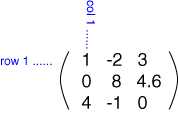
The top row is row 1. The leftmost column is column 1. This matrix is a 3x3 matrix because it has three rows and three columns. In describing matrices, the format is rows X columns
Each number that makes up a matrix is called an element of the matrix. The elements in a matrix have specific locations.
23.
\({\left[\begin{array}{ccc} x & -5 & -1 \end{array}\right]\left[\begin{array}{c} x+2 \\ 9 \\ 2 x+3 \end{array}\right]=0} \)
\(\Rightarrow \left[x^{2}+2 x-45-2 x-3\right]=[0] \Rightarrow x^{2}-48=0 \Rightarrow x=\pm 4 \sqrt{3} \)
24.
\(\mathrm{LHS}=(a I+b A)^{3}=\left\{\left[\begin{array}{ll} a & 0 \\ 0 & a \end{array}\right]+\left[\begin{array}{ll} 0 & b \\ 0 & 0 \end{array}\right]\right\}^{3} \)
\(=\left[\left.\begin{array}{ll} a & b \\ 0 & a \end{array}\right|^{3}=\left[\begin{array}{ll} a & b \\ 0 & a \end{array}\right]\left[\begin{array}{ll} a & b \\ 0 & a \end{array}\right]\left[\begin{array}{ll} a & b \\ 0 & a \end{array}\right]\right. \)
\(=\left[\begin{array}{cc} a^{2} & 2 a b \\ 0 & a^{2} \end{array}\right]\left[\begin{array}{ll} a & b \\ 0 & a \end{array}\right]=\left[\begin{array}{cc} a^{3}+0 & a^{2} b+2 a^{2} b \\ 0+0 & 0+a^{3} \end{array}\right]=\left[\begin{array}{cc} a^{3} & 3 a^{2} b \\ 0 & a^{3} \end{array}\right] \)
\(\mathrm{RHS}=a^{3} I+3 a^{2} b A=\left[\begin{array}{cc} a^{3} & 0 \\ 0 & a^{3} \end{array}\right]+\left[\begin{array}{cc} 0 & 3 a^{2} b \\ 0 & 0 \end{array}\right]=\left[\begin{array}{cc} a^{3} & 3 a^{2} b \\ 0 & a^{3} \end{array}\right] \)
\(\mathrm{LHS}=\mathrm{RHS} \)
\(\text {Hence, }(a I+b l)^{3}=a^{3} I+3 a^{2} b A \)
25.
(i) \(A=\frac { 1 }{ 2 } (A+A')+\frac { 1 }{ 2 } (A-A');\)
where \(A=\frac { 1 }{ 2 } (A+A')\) is symmetric
and \(\frac { 1 }{ 2 } (A-A')\) is skew symmetric Proceed.
\(\text { Let } A=\left[\begin{array}{rr} 3 & 5 \\ 1 & -1 \end{array}\right] \text { , then } A^{\prime}=\left[\begin{array}{ll} 3 & 1 \\ 5 & -1 \end{array}\right]\)
\(\text { Now, } A+A^{\prime}=\left[\begin{array}{rr} 3 & 5 \\ 1 & -1 \end{array}\right]+\left[\begin{array}{rr} 3 & 1 \\ 5 & -1 \end{array}\right]=\left[\begin{array}{rr} 6 & 6 \\ 6 & -2 \end{array}\right]\)
\(\text { Let } P=\frac{1}{2}\left(A+A^{\prime}\right)=\frac{1}{2}\left[\begin{array}{rr} 6 & 6 \\ 6 & -2 \end{array}\right]=\left[\begin{array}{rr} 3 & 3 \\ 3 & -1 \end{array}\right]\)
\(\text { Now, } P^{\prime}=\left[\begin{array}{rr} 3 & 3 \\ 3 & -1 \end{array}\right]=P\)
\(\text { Thus, }P=\frac{1}{2}\left(A+A^{\prime}\right) \text { is a symmetric matrix. }\)
\(\text { Now, } A-A^{\prime}=\left[\begin{array}{rr} 3 & 5 \\ 1 & -1 \end{array}\right]-\left[\begin{array}{cc} 3 & 1 \\ 5 & -1 \end{array}\right]=\left[\begin{array}{rr} 0 & 4 \\ -4 & 0 \end{array}\right]\)
\(\text { Let } Q=\frac{1}{2}\left(A-A^{\prime}\right)=\frac{1}{2}\left[\begin{array}{rr} 0 & 4 \\ -4 & 0 \end{array}\right]=\left[\begin{array}{rr} 0 & 2 \\ -2 & 0 \end{array}\right]\)
\(\text { Now, } Q^{\prime}=\left[\begin{array}{rr} 0 & 2 \\ -2 & 0 \end{array}\right]=-Q\)
Thus \(Q=\frac{1}{2}\left(A-A^{\prime}\right) \text { is a skew-symmetric matrix. }\)
\(\text { Representing } A \text { as the sum of } P \text { and } Q \text { : }\)
\(P+Q=\left[\begin{array}{rr} 3 & 3 \\ 3 & -1 \end{array}\right]+\left[\begin{array}{rr} 0 & 2 \\ -2 & 0 \end{array}\right]=\left[\begin{array}{rr} 3 & 5 \\ 1 & -1 \end{array}\right]=A\)
(ii) \(\text { Let } A=\left[\begin{array}{rrr} 6 & -2 & 2 \\ -2 & 3 & -1 \\ 2 & -1 & 3 \end{array}\right], \text { then } A^{\prime}=\left[\begin{array}{rrr} 6 & -2 & 2 \\ -2 & 3 & -1 \\ 2 & -1 & 3 \end{array}\right]\)
\(\text { Now, } A+A^{\prime}=\left[\begin{array}{rrr} 6 & -2 & 2 \\ -2 & 3 & -1 \\ 2 & -1 & 3 \end{array}\right]+\left[\begin{array}{rrr} 6 & -2 & 2 \\ -2 & 3 & -1 \\ 2 & -1 & 3 \end{array}\right]=\left[\begin{array}{rrr} 12 & -4 & 4 \\ -4 & 6 & -2 \\ 4 & -2 & 6 \end{array}\right]\)
\(\text { Now, } P^{\prime}=\left[\begin{array}{rrr} 6 & -2 & 2 \\ -2 & 3 & -1 \\ 2 & -1 & 3 \end{array}\right]=P\)
Thus,\(P=\frac{1}{2}\left(A+A^{\prime}\right) \text { is a symmetric matrix. }\)
\(\text { Now, } A-A^{\prime}=\left[\begin{array}{rrr} 6 & -2 & 2 \\ -2 & 3 & -1 \\ 2 & -1 & 3 \end{array}\right]+\left[\begin{array}{rrr} 6 & -2 & 2 \\ -2 & 3 & -1 \\ 2 & -1 & 3 \end{array}\right]=\left[\begin{array}{lll} 0 & 0 & 0 \\ 0 & 0 & 0 \\ 0 & 0 & 0 \end{array}\right]\)
\(\text { Let } Q=\frac{1}{2}\left(A-A^{\prime}\right)=\left[\begin{array}{lll} 0 & 0 & 0 \\ 0 & 0 & 0 \\ 0 & 0 & 0 \end{array}\right]\)
\(\text { Now, } Q^{\prime}=\left[\begin{array}{lll} 0 & 0 & 0 \\ 0 & 0 & 0 \\ 0 & 0 & 0 \end{array}\right]=-Q\)
Thus \(Q=\frac{1}{2}\left(A-A^{\prime}\right) \text { is a skew-symmetric matrix. }\)
\(\text { Representing } A \text { as the sum of } P \text { and } Q \text { : }\)
\(P+Q=\left[\begin{array}{rrr} 6 & -2 & 2 \\ -2 & 3 & -1 \\ 2 & -1 & 3 \end{array}\right]+\left[\begin{array}{lll} 0 & 0 & 0 \\ 0 & 0 & 0 \\ 0 & 0 & 0 \end{array}\right]=\left[\begin{array}{rrr} 6 & -2 & 2 \\ -2 & 3 & -1 \\ 2 & -1 & 3 \end{array}\right]=A\)
(iii) Let \(A=\left[\begin{array}{ccc}3 & 3 & -1 \\ -2 & -2 & 1 \\ -4 & -5 & 2\end{array}\right]\), then \(A^{\prime}=\left[\begin{array}{ccc}3 & -2 & -4 \\ 3 & -2 & -5 \\ -1 & 1 & 2\end{array}\right]\)
Now, \(A+A=\left[\begin{array}{ccc}3 & 3 & -1 \\ -2 & -2 & 1 \\ -4 & -5 & 2\end{array}\right]+\left[\begin{array}{ccc}3 & -2 & -4 \\ 3 & -2 & -5 \\ -1 & 1 & 2\end{array}\right]=\left[\begin{array}{ccc}6 & 1 & -5 \\ 1 & -4 & -4 \\ -5 & -4 & 4\end{array}\right]\)
\(P=\frac{1}{2}\left(A+A^{\prime}\right)=\frac{1}{2}\left[\begin{array}{ccc}6 & 1 & -5 \\ 1 & -4 & -4 \\ -5 & -4 & 4\end{array}\right]=\left[\begin{array}{ccc}3 & \frac{1}{2} & -\frac{-5}{2} \\ \frac{1}{2} & -2 & -2 \\ -\frac{5}{2} & -2 & 2\end{array}\right]\)
Now, \(P^{\prime}=\left[\begin{array}{ccc}3 & \frac{1}{2} & -\frac{5}{2} \\ \frac{1}{2} & -2 & -2 \\ -\frac{5}{2} & -2 & 2\end{array}\right]=\left[\begin{array}{ccc}3 & \frac{1}{2} & -\frac{5}{2} \\ \frac{1}{2} & -2 & -2 \\ -\frac{5}{2} & -2 & 2\end{array}\right]=P\)
Thus, \(P=\frac{1}{2}\left(A+A^{\prime}\right)\) is a symmetric matrix.
Now, \(A-A^{\prime}=\left[\begin{array}{ccc}3 & 3 & -1 \\ -2 & -2 & 1 \\ -4 & -5 & 2\end{array}\right]-\left[\begin{array}{ccc}3 & -2 & -4 \\ 3 & -2 & -5 \\ -1 & 1 & 2\end{array}\right]=\left[\begin{array}{ccc}0 & 5 & 3 \\ -5 & 0 & 6 \\ -3 & -6 & 0\end{array}\right]\)
Let \(Q=\frac{1}{2}\left(A-A^{\prime}\right)=\frac{1}{2}\left[\begin{array}{ccc}0 & 5 & 3 \\ -5 & 0 & 6 \\ -3 & -6 & 0\end{array}\right]=\left[\begin{array}{ccc}0 & \frac{5}{2} & \frac{3}{2} \\ -\frac{5}{2} & 0 & 3 \\ -\frac{3}{2} & -3 & 0\end{array}\right]\)
Now, \(Q=\left[\begin{array}{ccc}0 & \frac{5}{2} & \frac{3}{2} \\ -\frac{5}{2} & 0 & 3 \\ -\frac{3}{2} & -3 & 0\end{array}\right]=\left[\begin{array}{ccc}0 & -\frac{5}{2} & -\frac{3}{2} \\ \frac{5}{2} & 0 & -3 \\ \frac{3}{2} & 3 & 0\end{array}\right]=-Q\)
Thus, \(Q=\frac{1}{2}\left(A-A^{\prime}\right)\) is a skew -symmetric matrix.
Representing A as the sum of P and Q
\(P+Q=\left[\begin{array}{ccc}
3 & \frac{1}{2} & -\frac{5}{2} \\
\frac{1}{2} & -2 & -2 \\
-\frac{5}{2} & -22 & ]
\end{array}\right]+\left[\begin{array}{ccc}
0 & \frac{5}{2} & \frac{3}{2} \\
-\frac{5}{2} & 0 & 3 \\
-\frac{3}{2} & -3 & 0
\end{array}\right]=\left[\begin{array}{ccc}
3 & 3 & -1 \\
-2 & -2 & 1 \\
-4 & -5 & 2
\end{array}\right]=A\)
(iv)
\(\text { Let } A=\left[\begin{array}{rr} 1 & 5 \\ -1 & 2 \end{array}\right] \text { , then } A^{\prime}=\left[\begin{array}{lr} 1 & -1 \\ 5 & 2 \end{array}\right]\)
\(\text { Now } A+A^{\prime}=\left[\begin{array}{rr} 1 & 5 \\ -1 & 2 \end{array}\right]+\left[\begin{array}{rr} 1 & -1 \\ 5 & 2 \end{array}\right]=\left[\begin{array}{ll} 2 & 4 \\ 4 & 4 \end{array}\right]\)
\(\text { Let } P=\frac{1}{2}\left(A+A^{\prime}\right)=\left[\begin{array}{ll} 1 & 2 \\ 2 & 2 \end{array}\right]\)
\(P=\frac{1}{2}\left(A+A^{\prime}\right) \text { is a symmetric matrix. }\)
\(\text { Now, } A-A^{\prime}=\left[\begin{array}{rr} 1 & 5 \\ -1 & 2 \end{array}\right]-\left[\begin{array}{rr} 1 & -1 \\ 5 & 2 \end{array}\right]=\left[\begin{array}{rr} 0 & 6 \\ -6 & 0 \end{array}\right]\)
\(\text { Let } Q=\frac{1}{2}\left(A-A^{\prime}\right)=\left[\begin{array}{rr} 0 & 3 \\ -3 & 0 \end{array}\right]\)
\(\text { Now, } Q^{\prime}=\left[\begin{array}{rr} 0 & -3 \\ 3 & 0 \end{array}\right]=-Q\)
\(Q=\frac{1}{2}\left(A-A^{\prime}\right) \text { is a skew-symmetric matrix. }\)
\(\text { Representing } A \text { as the sum of } P \text { and } Q \text { : }\)
\(P+Q=\left[\begin{array}{ll} 1 & 2 \\ 2 & 2 \end{array}\right]+\left[\begin{array}{rr} 0 & 3 \\ -3 & 0 \end{array}\right]=\left[\begin{array}{rr} 1 & 5 \\ -1 & 2 \end{array}\right]=A\)

12th Standard CBSE Syllabus & Materials
12th Standard CBSE
CBSE 12th Computer Science Python Revision Tour I - New Previous year Question Papers Study Material - QB365 Set A
NEW12th Standard CBSE
CBSE 12th Business Studies Planning Important Questions And Answers Study Material - QB365 Set A
NEW12th Standard CBSE
CBSE 12th Business Studies Business Environment Important Questions And Answers Study Material - QB365 Set A
NEW12th Standard CBSE
CBSE 12th Business Studies Principles of Management Important Questions And Answers Study Material - QB365 Set A



CBSE 12th Standard CBSE Subjects
CBSE Standards










