
 100% FREE ACCESS
12th Standard CBSE Syllabus & Materials
12th Standard CBSE
CBSE 12th Economics Government Budget and the Economy Previous year Question Papers Study Material - QB365 Set A
NEW12th Standard CBSE
CBSE 12th Computer Science Interface Python with MySQL - New Previous year Question Papers Study Material - QB365 Set A
NEW12th Standard CBSE
CBSE 12th Computer Science Database Concept - New Previous year Question Papers Study Material - QB365 Set A
NEW12th Standard CBSE
CBSE 12th Computer Science Data Communication - New Previous year Question Papers Study Material - QB365 Set A
NEW12th Standard CBSE
CBSE 12th Computer Science Data Structures - New Previous year Question Papers Study Material - QB365 Set A
NEW12th Standard CBSE
CBSE 12th Computer Science Functions - New Previous year Question Papers Study Material - QB365 Set A

Published on: 01/08/2018
Molecular Basic of Inheritance - Important Question Paper
Download CBSE Class 12th Standard CBSE Biology question papers, sample papers, important questions, and previous year solved papers in PDF format. Get free study materials, NCERT solutions, and exam preparation resources for Class 12th Standard CBSE Biology
Questions + Answers key
Take MCQ Biology Test
1.
List the function of RNA.
2.
What forms the backbone of a polynucleotide strand of a nucleic acid?
3.
In some viruses DNA is synthesised using RNA template. What term is given to such a DNA?
4.
How does the flow of genetic information in HIV deviate from the 'central dogma' proposed by francis crick?
5.
Name a few enzymes involved in DNA replication other than DNA polymerase and ligase. Name the key function for each of them.
6.
Write the names of various nitrogenous based found in RNA
7.
Define genetic material
8.
Why is it that transcription and translation can be coupled in prokaryotic cells but not in eukaryotic cells?
9.
Compare the roles of the enzymes DNA-polymerase and DNA-ligase in the replication fork of DNA.
10.
Write down the possible levels of regulation of gene expression in eukaryotes.
11.
An mRNA strand has a series of codons out of which three are given below:
(i) AUG
(ii) UUU
(iii) UAG
(a) What will these RNA codons be translated into?
(b) What are the DNA codons that would have transcribed these RNA codons?
12.
There are certain complexities in eukaryotic transcription.Bring out the significance of such complexities.
13.
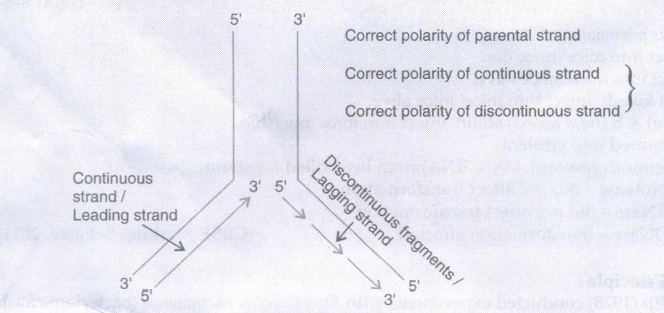
(i) Explain the process of DNA replication with the help of a schematic diagram.
(ii) In which phase of the cell cycle does replication occur in eukaryotes? What would happen if cell division is not followed after DNA replication?
14.
What is semiconservative replication of DNA? Explain how it was experimentally proved.
15.
What is genetic code?Name the scientists and their contribution in deciphering the genetic code
16.
Whose experiments cracked the DNA and discovered unequivocally that a genetic code is a 'triplet'?
Hershey and Chase
Nirenberg and Mathaei
Morgan and Sturtevant
Beadle and Tatum
17.
Intrinsic flow of information means
Transcription
Translation
Both of the above
None of the above
18.
The correctly matched pair is
Okazaki fragments-splicing
RNA polymerase-RNA primer
Central dogma_codon
Restriction endonuclease-genetic engineering
19.
In DNA replication, leading strand replicates in
5' ------>3' direction continuously
3'------>5' direction continuously
5'----->3' directiom discontinuosly
3,------->5' direction discontinuously
20.
Jumping genes given by Barbara Mclintock are also called
Transposons
Mutons
Cistrons
Vectors
1.
()
RNA act as genetic material in viruses and also functions as adapter, structural and in some cases as a catalytic molecule
2.
()
Pentose sugar and phosphate
3.
()
Complementary DNA (cDNA)
4.
()
HIV shows reverse transcription i.e.formation of DNA or RNA template.
5.
The enzymes involved in DNA replication other than DNA polymerase and ligase are listed below with their functions:
| Helicase | -opens the helix |
| Topoisomerases | -Removes the tension caused due to unwinding |
| DNA ligase | -Joins the cut DNA strands |
6.
Adenine,uracil,guanine,cytosine
7.
A substance which stores biological information,refers it to the next generation,and expresses it in the offspring
8.
1. In prokaryotes, the mRNA does not require any processing to become active.
2. Transcription and translation occur in the same compartment-cytosol, as there is no well-defined nucleus. So coupling of transcription and translation is possible.
3. The mRNA has to be processed before becoming active (splicing is necessary).
4. Since nucleus and cytoplasm are well separated, in eukaryotes the RNA has to be transported to the cytoplasm for translation.
5. So coupling of transcription and translation is not possible.
9.
1. The enzyme DNA polymerase polymerises the nucleotides in the 5' -> 3' direction in both continues and discontinuous synthesis.
2. The enzyme DNA-ligase joins the short stretches of DNA of discontinuous synthesis.
10.
The possible levels of regulation in eukaryotes could be at
(i) Transcriptional level i.e. formation of primary transcript.
(ii) Processing level i.e. regulation of splicing
(iii) During transport of mRNA from the nucleus to the cytoplasm
(iv) translation level
11.
(a) (i) Methionine.
(ii) Phenylalanine.
(iii) It is a termination codon that does not code for any amino acid.
(b) AUG - TAC,UUU - AAA and UAG- ATC.
12.
(i) The split-gene arrangement in eukaryotes represents probably an ancient feature of the genome
(ii) The presence of introns is reminiscent of antiquity.
(iii) The process of splicing represents the dominance of RNA-world.
13.
(ii) DNA replication occurs in S-phase of cell cycle in eukaryotes.If cell division is not followed after DNA replication then the replicated chromosomes (DNA) would not be distributed to daughter nuclei. A repeated replication of DNA without any cell division results in the accumulation of DNA inside the cell.thereby causing cell expansion.
14.
1. It was to show that DNA replication is semi conservative.
2. After completion of replication, each new/daughter molecule of DNA has one parental strand and one newly synthesised strand; this is called semiconservative replication of DNA.
3. Experiment
Mathew Meselson and Franklin Stahl performed the experiment.
4. They grew E.coli. in a medium containing \(^{ 15 }{ { NH }_{ 4 } }Cl,\) until \(^{ 15 }N\) was incorporated in the two strands of newly formed E.coli cells; this 'heavy' DNA can be separated from the normal \(^{ 14 }N-DNA\) by centrifugation in cesium chloride (CsCI) density gradient.
5. Then they transferred the cells into a medium with normal \(^{ 14 }{ { NH }_{ 4 } }Cl\) and took out samples at various time intervals.
6. They extracted the DNA and centrifuged it to measure the densities.
7. The DNA extracted from cells after one generation after transfer from the \(^{ 15 }{ { N } }\) medium to \(^{ 14 }{ { N } }\) medium (i.e. after about 20 minutes), had an intermediate/hybrid density.
8. The DNA extracted after two generations (i.e. after 40 minutes) consisted of equal amounts of 'light' DNA and 'hybrid' DNA.
This proves that after replication, each DNA molecule has one parental strand and one newly synthesised strand, i.e. replication is semiconservative.
15.
Genetic Code
Genetic code refers to the relationship between the sequence of nucleotides on mRNA and the amino acids in the polypeptide.
It was George Gamow, who suggested that the code must be made of three bases, in order to code for the twenty different amino acids, with only four bases; this would generate \(\left( { 4 }^{ 3 } \right) \) or (4 x 4 x 4) = 64 triplet codons.
Har Gobihd Khorana could synthesize RNA molecules with definite combinations of bases (homo polymers and copolymers).
Marshal Nirenberg made a cell-free system for protein synthesis, that helped in deciphering the code.
Ochoa discovered enzyme polynucleotide phosphorylase, that could polymerise RNA with definite sequence in template-independent manner.
16.
(b)
Nirenberg and Mathaei
17.
(c)
Both of the above
18.
(d)
Restriction endonuclease-genetic engineering
19.
(a)
5' ------>3' direction continuously
20.
(a)
Transposons

12th Standard CBSE Syllabus & Materials
12th Standard CBSE
CBSE 12th Computer Science Python Revision Tour I - New Previous year Question Papers Study Material - QB365 Set A
NEW12th Standard CBSE
CBSE 12th Business Studies Planning Important Questions And Answers Study Material - QB365 Set A
NEW12th Standard CBSE
CBSE 12th Business Studies Business Environment Important Questions And Answers Study Material - QB365 Set A
NEW12th Standard CBSE
CBSE 12th Business Studies Principles of Management Important Questions And Answers Study Material - QB365 Set A



CBSE 12th Standard CBSE Subjects
CBSE Standards










