
 100% FREE ACCESS
12th Standard CBSE Syllabus & Materials
12th Standard CBSE
CBSE 12th Economics Government Budget and the Economy Previous year Question Papers Study Material - QB365 Set A
NEW12th Standard CBSE
CBSE 12th Computer Science Interface Python with MySQL - New Previous year Question Papers Study Material - QB365 Set A
NEW12th Standard CBSE
CBSE 12th Computer Science Database Concept - New Previous year Question Papers Study Material - QB365 Set A
NEW12th Standard CBSE
CBSE 12th Computer Science Data Communication - New Previous year Question Papers Study Material - QB365 Set A
NEW12th Standard CBSE
CBSE 12th Computer Science Data Structures - New Previous year Question Papers Study Material - QB365 Set A
NEW12th Standard CBSE
CBSE 12th Computer Science Functions - New Previous year Question Papers Study Material - QB365 Set A

Published on: 31/07/2018
Based on the chapter The p-Block Elements, some of the important questions are covered in this question paper. The questions are prepared from the book back and the creative questions
Download CBSE Class 12th Standard CBSE Chemistry question papers, sample papers, important questions, and previous year solved papers in PDF format. Get free study materials, NCERT solutions, and exam preparation resources for Class 12th Standard CBSE Chemistry
Questions + Answers key
Take MCQ Chemistry Test
1.
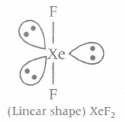
Draw the structure of XeF2 molecule.
2.
Write the conditions to maximise the yield of sulphuric acid by Contact process.
3.
Explain bleaching action of chlorine.
4.
H3PO3 is diprotic (or dibasic). Why?
5.
Explain why ozone is thermodynamically less stable than oxygen.
6.
Answer the following :
(i) Which neutral molecule would be isoelectronic with CIO-?
(ii) Of Bi(V) and Sb(V) which may be a stronger oxidising agent and why?
7.
(a) Draw the structures of the following:
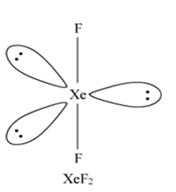
(i) XeF2 (ii) BrF3
(b) Write the structural difference between white phosphorus and red phosphorus.
8.
An almorphous solid "A" burns in air to form a gas "B" Which turns lime water milky. The gas is also produced as a by-product during roasting of sulphide ore. This gas decolourises acidified aqueous KMnO4 solution and reduces Fe3+ to Fe2+. Identify the soild "A" and the gas "B" and write the reactions involved.
9.
White phosphorus reacts with chlorine and the product hydrolyses in the presence of water. Calculate the mass of HCl obtained by the hydrolysis of the product formed by the reaction of 62g of white phosphorus with chlorine in the presence of water.
10.
Jusity the placement of O, S, Se, Te and Po in the same group of the periodic table in terms of electronic configuration, oxidation state and hydride formation.
11.
Draw the structures of the following molecules:
(i) NF3
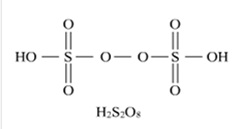
(ii) H2S2O8
(iii) H3PO3
12.
(a) Draw the structures of the following:
(i) PCl5(s)
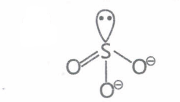
(ii) SO32-
(b) Explain the following observations:
(i) Ammonia has a higher boiling point than phosphine.
(ii) Helium does not form any chemical compound.
(iii) Bi(V) is a stronger oxidising agent than Sb(V).
13.
(a) Complete the following chemical equations:
(i) Cu + HNO3(dilute) \(\rightarrow\)
(ii) XeF4 + O2F2 \(\rightarrow\)
(b) Explain the following observations:
(i) Phosphorus has greater tendency for catenation than nitrogen.
(ii) Oxygen is a gas but sulphur a solid.
(iii) The halogens are coloured. Why?
14.
Roasting of sulphides gives the gas X as a byproduct. This is a colourless gas with choking smell of burnt sulphur and causes great damage to respiratory organs as a result of acid rain. Its aqueous solution is acidic, acts as a result of acid rain. Its aqueous solution is acidic, acts as reducing agent and its acid has never been isolated. The gas X is
CO2
SO3
H2S
SO2
15.
How many bridging atoms are present in P4O10 ?
6
4
2
5
16.
Which of the following properties is not shown by NO ?
Its bond order is 2.5
It is diamagnetic in the gaseous state.
It is a neutral oxide.
It combines with oxygen to form nitrogen dioxide.
17.
Which of the following statements are correct?
S-S bond is present in H2S2O6
In peroxosulphuric acid (H2SO5) sulphur is in +6 oxidation state.
Iron powder along with Al2O3 and K2O is used as a catalyst in the preparation of NH3 by Haber's process.
Changes in enthalpy is positive for the preparation of SO3 by catalytic oxidation of SO2
18.
A black compound of manganese reacts with a halogen acid to this gas reacts with NH3 an unstable trihalide is formed. In this process the oxidation state of nitrogen changes from.....
-3 to +3
-3 to 0
-3 to +5
0 to -3
19.
Which of the following elements does not show allotropy?
Nitrogen
Bismuth
Antimony
Arsenic
20.
On addition of conc.H2SO4 to a chloride salt, colourless fumes are evolved but in case of iodide salt, violet fumes comes out. This is because
H2SO4 reduces HI to I2
HI is of violet colour
HI gets oxidised to I2
HI changes to HIO3
21.
Which one of the following arrangements represents the correct order of electron gain enthalpy (with negative sign) of the given atomic species?
F<Cl<O<S
S<O<Cl>F
O<S<F<Cl
Cl<F<S<O
22.
Which o the following is not hydrolysed?
AsCl3
PF3
SbCl3
NF3
23.
Which of the following on heating does not give nitrogen gas?
NH4NO3
NH4NO2
Ba(N3)2
(NH4)2Cr2O7
1.
()
Structure of XeF2 molecule is given below:
2.
(i) High pressure (2 bar),
(ii) 720 K temperature,
(iii) V2O5 as catalyst.
3.
In presence of moisture, \({ Cl }_{ 2 }\) releases nascent oxygen which converts coloured material to colourless material. Thus, bleaching by \({ Cl }_{ 2 }\) is due to oxidation and hence permanent.
\({ Cl }_{ 2 }+{ H }_{ 2 }O\ \longrightarrow \ 2HCl+\left[ O \right] \)
\(Coloured\ material+\left[ O \right] \longrightarrow Colourless\ material\)
In contrast, in presence of moisture, \({ SO }_{ 2 }\) liberates nascent hydrogen which reduces coloured material to colourless material. Thus, bleaching with \({ SO }_{ 2 }\) is due to reduction. When colourless material is exposed to air, it gets oxidised and the colour returns. Thus, bleaching by \({ SO }_{ 2 }\) is temporary.
4.
Its structure is 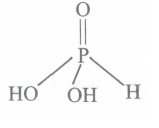 Since it contains only two ionizable H-atoms which are present as OH groups, it behaves as a dibasic acid.
5.
Formation of ozone has positive value of \(\triangle\)f Ho, that is why it is less thermodynamically stable than O2 .
6.
(i) OF2 and CIF are neutral molecules isoelectronic with CIO-.
(ii) Bi(V) is stronger oxidising agent due to inert pair effect as Bi(III) is more stable as compared to Sb(III).
7.
(a) (i)
(ii)
8.
\('A'\quad is\quad { S }_{ 8 }.\quad 'B'is{ SO }_{ 2 }(g).\)
\({ S }_{ 8 }+{ 8O }_{ 2 }\overset { heat }{ \rightarrow } { 8SO }_{ 2 }(g)\)
'B' decolorizes \(KMnS{ O }_{ 4 }\)
\(2KMn{ O }_{ 4 }+5S{ O }_{ 2 }+{ 2H }_{ 2 }O\longrightarrow { 2H }_{ 2 }{ SO }_{ 4 }+2Mn{ SO }_{ 4 }+{ K }_{ 2 }{ SO }_{ 4 }\)
'B' turns lime water milky due to formation of
\(Ca{ (OH) }_{ 2 }(aq)+{ SO }_{ 2 }(g)\longrightarrow CaSO_{ 3 }(s)+{ H }_{ 2 }O(l)\)
'B' is obtained by roasting of sulphideores
\(2ZnS(s)+{ 3O }_{ 2 }\longrightarrow 2ZnO(s)+{ 2SO }_{ 2 }(g)\)
'B' reduces in aqueous solution.
\(2{ Fe }^{ 3+ }+{ SO }_{ 2 }+{ 2H }_{ 2 }O\longrightarrow { Fe }^{ 2+ }+{ SO }_{ 4 }^{ 2- }+{ 4H }^{ + }\)
9.
\({ P }_{ 4 }={ 6CI }_{ 2 }\longrightarrow { 4PCI }_{ 3 }\)
\(\left[ { PCI }_{ 3 }+{ 6H }_{ 2 }O\longrightarrow { H }_{ 3 }{ PO }_{ 3 }+3HCI \right] \times 4\)
\({ P }_{ 4 }+{ 6CI }_{ 2 }+{ 12H }_{ 2 }O\longrightarrow { 4H }_{ 3 }{ PO }_{ 3 }+{ 12HCI }\)
1 mole of white phosphorus produces 12 moles of HCI.
\(\frac { 62 }{ 124 }\)mole of white phosphorus produces \(12\times \frac { 62 }{ 124 } =6\)moles of HCI.
Mass of 6 moles of HCI= 6 X 36.5
= 219.0 g of HCI.
10.
They have same general electronic configuration ns2np6.
They show +2, +4, +6, -2 oxidation states except oxygen which cannot show higher positive oxidation states.
All of them form hydrides having formula H2X where 'X' is group 16 element. Acidic character and reducing power of hydrides increases down the group due to decrease in bond dissociation energy.
11.
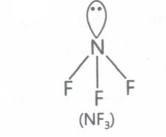
.png)
12.
(a) (i) \({ { [PCI }_{ 4 }] }^{ + }\quad { { [PCI }_{ 6 }] }^{ - }\)in solid state.
(ii)
(b) (i) It is because \({ NH }_{ 3 }\) molecules are associated with intermolecular H-bonding.
(ii) Helium is small in size and has very high ionization energy, least polarising power therefore no chemical compound of helium is known.
(iii) \({ Bi }^{ 3+ }\) more stable than \({ Bi }^{ 5+ }\) due to inert pair effect, therefore, \({ Bi }^{ 5+ }\)gains two electrons to form \({ Bi }^{ 3+ }\)
\({ Bi }^{ 5+ }+{ 2e }^{ - }\longrightarrow { Bi }^{ 3+ }\)
13.
(a) (i) \(3Cu+{ 8HNO }_{ 3 }(dil.)\longrightarrow { { 3 }Cu(NO_{ 3 }) }_{ 2 }+2NO+{ 4H }_{ 2 }O\)
(ii) \({ XeF }_{ 4 }+{ O }_{ 2 }{ F }_{ 2 }\overset { { -130°C } }{ \longrightarrow } { XeF }_{ 6 }+{ O }_{ 2 }\)
(b) (i) The property of catenation depends upon the strength of the element-element bond. Since P-P bond strength (213 kJ \({ mol }^{ -1 }\) ) is much more than N-N bond strength (159 kJ \({ mol }^{ -1 }\)), phosphorus has marked catenation properties than nitrogen.
(ii) Due to small size and high electronegativity, oxygen atom forms \(p\pi -p\pi \) double bond, 0= 0. The intermolecular forces in oxygen are weak van der Waal's forces and therefore, oxygen exists as a gas. On the other hand, sulphur does not form stable \(p\pi -p\pi \) bonds and do not exists as \({ S }_{2}\) It is linked by single bonds and form polyatomic complex molecules having eight atoms per molecule \({ S }_{ 8 }\) and have puckered ring structure. Therefore, S atoms are strongly held together and it exists as a solid.
(iii) All the halogens are coloured. This is due to absorption of radiations in the visible region which results in the excitation of outer electrons to higher energy levels. By absorbing different quanta of radiations, they display different colours. The fluorine atom is the smallest and the force of attraction between the nucleus and the outer electrons is very large. As a result, it requires large excitation energy and absorbs violet light (high energy) and therefore, appears pale yellow. On the other hand, iodine needs very less excitation energy and absorbs yellow light of low energy. Thus, it appears dark violet. Similarly, we can explain the greenish yellow colour of chlorine and reddish brown colour of iodine.
14.
(d)
SO2
15.
(a)
6
16.
(b)
It is diamagnetic in the gaseous state.
17.
(a)
S-S bond is present in H2S2O6
18.
(a)
-3 to +3
19.
(a)
Nitrogen
20.
(a)
H2SO4 reduces HI to I2
21.
(c)
O<S<F<Cl
22.
Neither N nor F have d-orbits to accept electrons donated by H2O for hydrolysis.
23.
(a)
NH4NO3

12th Standard CBSE Syllabus & Materials
12th Standard CBSE
CBSE 12th Computer Science Python Revision Tour I - New Previous year Question Papers Study Material - QB365 Set A
NEW12th Standard CBSE
CBSE 12th Business Studies Planning Important Questions And Answers Study Material - QB365 Set A
NEW12th Standard CBSE
CBSE 12th Business Studies Business Environment Important Questions And Answers Study Material - QB365 Set A
NEW12th Standard CBSE
CBSE 12th Business Studies Principles of Management Important Questions And Answers Study Material - QB365 Set A



CBSE 12th Standard CBSE Subjects
CBSE Standards










