
 100% FREE ACCESS
12th Standard CBSE Syllabus & Materials
12th Standard CBSE
CBSE 12th Economics Government Budget and the Economy Previous year Question Papers Study Material - QB365 Set A
NEW12th Standard CBSE
CBSE 12th Computer Science Interface Python with MySQL - New Previous year Question Papers Study Material - QB365 Set A
NEW12th Standard CBSE
CBSE 12th Computer Science Database Concept - New Previous year Question Papers Study Material - QB365 Set A
NEW12th Standard CBSE
CBSE 12th Computer Science Data Communication - New Previous year Question Papers Study Material - QB365 Set A
NEW12th Standard CBSE
CBSE 12th Computer Science Data Structures - New Previous year Question Papers Study Material - QB365 Set A
NEW12th Standard CBSE
CBSE 12th Computer Science Functions - New Previous year Question Papers Study Material - QB365 Set A

Published on: 30/07/2018
Principles of Inheritance and Variation - Important Question Paper
Download CBSE Class 12th Standard CBSE Biology question papers, sample papers, important questions, and previous year solved papers in PDF format. Get free study materials, NCERT solutions, and exam preparation resources for Class 12th Standard CBSE Biology
Questions + Answers key
Take MCQ Biology Test
1.
How many chromatids are involved in crossing over at one chiasma?
2.
What do letter P,F 1 and F2 represent in heredity studies?
3.
What will be the genetic makeup of an organism which suffers from sickle cell anemia?
4.
A change in the amino acid at the sixth position in the beta globin chain leads to sickle-cell anaemia. Name the amino acid that has changed and the new amino acid.
5.
In which type of cells are chromosomal aberrations commonly found?
6.
Define mutation.
7.
What scientific term is used for the ability of a gene to show/express multiple effects?
8.
What are alleles?
9.
A garden pea plant produced axial white flowers. Another of the same spcies produced terminal violet flowers. Identify the dominant traits
10.
Using a punnett square, workout the distribution of phenotypic features in the first filial generation after a cross between a homozygous female and a heterozygous male for a single locus.
11.
what are the causes of variations in clones? Are identical twins clones of each other?
12.
Justify the statement - A male honey - bee (drone) has no father, but has a grandfather.
13.
Inheritance is particulate in nature. Justify.
14.
How would you find the genotype of an organism exhibiting a dominant phenotype trait?
15.
A Corss between a red flower-bearing plant and a white flower-bearing plant of antirrhinum produced all plants having pin flowers. Work out a cross to explain how this is possible.
16.
How is aneuplody different from polyplodiy? Mention their causes.
17.
Differentiate between monosamy and trisomy. Give an example of each from human genetics.
18.
In cattle, hornless (H) is dominant over horned (h) and black (B) is dominant over red (b). Consider that these two pairs of genes assort independently.
(i) What proportion of the offspring from the cross, BbHh \(\times\) bbhh, would be black and hornless?
(ii) From the cross Bbbh \(\times\) Bbhh, how many will be
(a) black and horned and
(b) red and horned
19.
How was it conclused that genes are located on chromosome?
20.
What exactly is dominance? Why are some alleles dominant and some recessive?
21.
State and explain with the help of a cross the law of segregation as proposed by Mendel.
22.
Indicate, the inheritance of which of the following is controlled by multiple alleles
Colour blindness
Sickle cell anaemia
Blood group
Phenylketoneuria
23.
Lack of independent assortment of two genes A and B in fruit fly Drosophila is due to
Recombination
Linkage
crossing over
Repulsion
24.
How many different types of gametes can be formed by F1 progeny, resulting from the following cross AABBCC \(\times\) aa bb cc
3
8
7
64
25.
Two crosses between the same pair of genotype or phenotypes in which the sources of the gametes are reversed in one cross, is known as
Reverse cross
Dihybrid cross
Test cross
Reciprocal cross
26.
Heterozygous purple flower is crossed with recessive white flower. The progeny has the ratio :
75% purple and 25% white
50% purple and 50% white
All purple
All white
1.
()
Two
2.
()
F 1 - First Filial progency, F2 - Second Filial progeny
3.
()
Heterozygous \(\left( { Hb }^{ A }{ Hb }^{ s } \right) \)
4.
()
Glutamic acid is changed to valine.
5.
()
Cancerous cells usually exhibit chromosomal aberrations.
6.
()
Mutation is defined as the sudden heritable change in the basic sequences of DNA or structure of chromosomes or number of chromosomes.
7.
()
Pleiotropy.
8.
()
The various forms or slightly different forms of a gene, are called alleles.
9.
()
Axial flowers and violet flowers
10.
Honozygous female-Ww
Heterozygous male-Ww
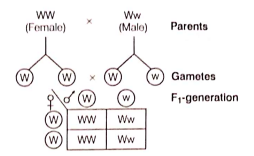
In this case, all individuals of Fi,-generation would possess dominant trait. 50% are homozygous dominant and 50% are heterozygous dominant.
11.
Causes of variations in clones.
Clones have the same genetic makeup but variations appear in clones due to following reasons:
(i) Effect of environment termed acquired variations are not inherited.
(ii) Mutations. These are sudden stable abrupt changes and they are discontinuous inheritable as produced due to changes in genetic makeup.
(iii) Identical twins arising from one fertilized egg are clones of each other though they are offspring of their parents and have the same genetic set up.
12.
1. A male honeybee develops parthenogenetically, i.e. from an ovum or female gamete, without fertillisation; hence has no father.
2. A female honeybee develops from the zygote formed by the function of a male and a female gamete; since the mother of a drone has a father, a dron has a grandfather.
13.
1. The characters are controlled by 'Factors' which are stably passed down without any change from the parents to the offspring, through the gametes.
2. The allels do not show any blending.
14.
In the test cross, an individual showing dominant phenotype would be crossed to an individual with recessive phenotype for the same trait.
(i) If the individual is homozygous dominant, all the individuals in the progeny would show the dominant phenotype.
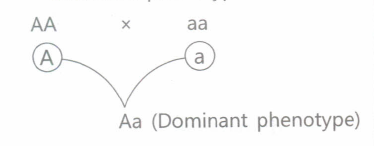
(it) If the individual is heterozygous, the progeny will show dominant phenotype and recessive phenotype in the ratio of 1 : 1.
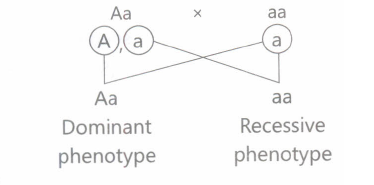
Thus, the genotype of the individual with dominant phenotype can be ascertained.
15.
Inheritance of flower colour in Antirrhinum majus:
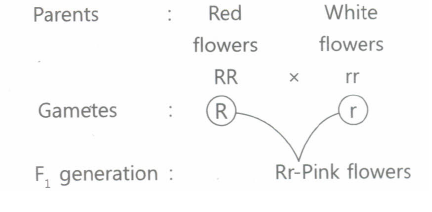
This character shows incomplete dominance , where neither of the two alleles of the gene is completely dominant and the Fl hybrid is intermediate between the two.
16.
| Aneploidy | Polyploidy |
| It is the phenomenon of loss or gain of one or more chromosomes from any pair(s) of chromosomes in a diploid cell/ organism, called aneuploid. | It is the presence of three or more sets of chromosomes in an organism, called polyploid. |
|
It arises due to failure of segergation of members of one/more pair (s) of homologous chromsomes. |
It arises due to failure of cytokineses following the telophase stage of cell division. It is found in many plants. |
17.
| Monosomy | Trisomy |
| It is the condition where a diploid individual lacks one member of any one pair of chromosomes. |
It is the condition where a diploid individual has an additional copy of a chromosome. |
|
The individual has (2n-1) number of chromosomes. |
The individual has (2n + 1) number of chromosome. |
18.
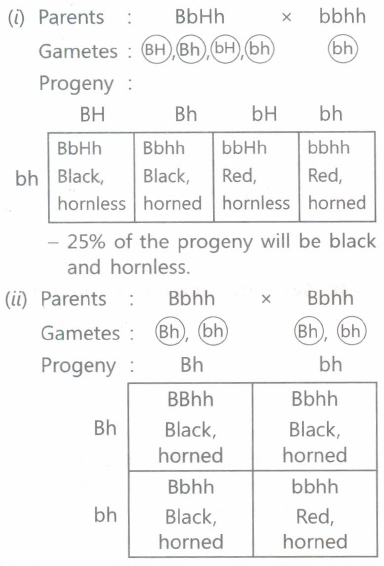
(a) 3/4 of the progeny will be black and horned.
(b) 1/4 of the progeny will be red and horned.
19.
Sutton and Boveri noted that the behaviour of chromosomes was parallel to that of genes.
(i) Both genes and chromosomes occur in pairs.
(ii) They segregate during gamete formation and only one member of a pair enters one gamete.
(iii) One pair of genes 'or chromosomes segregates independently of the other pairs.
(iv) Since the number of chromosomes is far less than the number of genes or traits an organism possesses, it is proposed that a number of genes are located on every chromosome.
20.
Dominance:
Every gene contains the information to express a particular trait.
In a diploid organism, there are two alternate forms of a gene, or a pair of alleles.
The two alleles may be similar (homo-zygous) or may be different (heterozygous).
One of them may be different due to some changes that it has undergone, which modify the information of that particular allele.
The phenotype will be dependent on the original unmodified allele.
21.
1. Law of segregation states that the members of the allelic pair that remained together in the parent/hybrid, segregate during gamete formation and enter different gametes.
2.As a result, gametes have only one allele for a trait and are pure for a character,
Parents : Tall plant X Dwarf plant
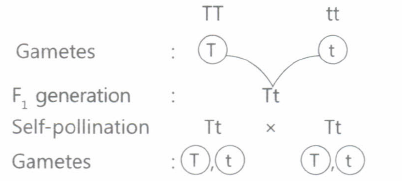
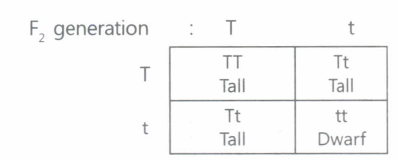
3. Tall plants: Dwarf plants
3 1
4. In this case, tallness is dominant and dwarfness is recessive.
5. The \(F_{ 1 }\) hybrid is tall (dominant character).
6. The recessive character, dwarfness, remains hidden in the \(F_{ 1 }\) but reappeared in the \(F_{ 2 }\) generation without any change.
7. This' is because the factors T and t remained together in the hybrid, but segregated during gamete formation and entered different gametes.
Diploid condition is restored during fertilisation.
22.
(c)
Blood group
23.
(b)
Linkage
24.
(b)
8
25.
(d)
Reciprocal cross
26.
(b)
50% purple and 50% white

12th Standard CBSE Syllabus & Materials
12th Standard CBSE
CBSE 12th Computer Science Python Revision Tour I - New Previous year Question Papers Study Material - QB365 Set A
NEW12th Standard CBSE
CBSE 12th Business Studies Planning Important Questions And Answers Study Material - QB365 Set A
NEW12th Standard CBSE
CBSE 12th Business Studies Business Environment Important Questions And Answers Study Material - QB365 Set A
NEW12th Standard CBSE
CBSE 12th Business Studies Principles of Management Important Questions And Answers Study Material - QB365 Set A



CBSE 12th Standard CBSE Subjects
CBSE Standards










