
 100% FREE ACCESS
12th Standard CBSE Syllabus & Materials
12th Standard CBSE
CBSE 12th Economics Government Budget and the Economy Previous year Question Papers Study Material - QB365 Set A
NEW12th Standard CBSE
CBSE 12th Computer Science Interface Python with MySQL - New Previous year Question Papers Study Material - QB365 Set A
NEW12th Standard CBSE
CBSE 12th Computer Science Database Concept - New Previous year Question Papers Study Material - QB365 Set A
NEW12th Standard CBSE
CBSE 12th Computer Science Data Communication - New Previous year Question Papers Study Material - QB365 Set A
NEW12th Standard CBSE
CBSE 12th Computer Science Data Structures - New Previous year Question Papers Study Material - QB365 Set A
NEW12th Standard CBSE
CBSE 12th Computer Science Functions - New Previous year Question Papers Study Material - QB365 Set A

Published on: 02/03/2019
Relations and Functions Important Questions
Download CBSE Class 12th Standard CBSE Maths question papers, sample papers, important questions, and previous year solved papers in PDF format. Get free study materials, NCERT solutions, and exam preparation resources for Class 12th Standard CBSE Maths
Questions + Answers key
Take MCQ Maths Test
1.
Let * be a binary operation. On the set of all non-zero real numbers, given by a*b = \(\frac { ab }{ 5 } \).
For all a, b \(\in R-[0].\)
Find the value of x, given that (i) 2*(x*5) =6, (ii) 3(x*3) = 9.
2.
If the binary operation * on the set of integers Z is defined by a*b = 3a + b2 then find the value of
(i) 4*3
(ii) 5*2
3.
Which of the following binary operations are commutative?
(i) * On Z defined by a*b = a2+ b2
(ii) * On Q defined by a*b = a2+2b
4.
If * is a binary operation on the set R of real numbers defined by a * b = a + b - 2 then find the identity element for the binary operation *.
5.
Let * : \(R\times R\rightarrow R\) given by (a, b) \(\rightarrow \) \(a+4b^{ 2 }\) is a binary operation Computer (-5) (2 * 0)
6.
Let A = (a, b, e) and B = (1, 2, 3). Find r of the following function f from A to B, if it exists.
(i) f = {(a, 3) (b,2)(e, 1)}
(ii) {(a, 2) (b, 1)(e, 1)}.
7.
How many equivalence relations on the set {1,2, 3} containing (1, 2) and (2, 1) are there in all? Justify your answer.
8.
Define symmetric Relation. Give one example
9.
Let R=[(a,\(a^{ 2 }\) ) : a is a prime number less than 5) be a relation Find the range of R
10.
* is a binary operation defined on the set of natural numbers N, defined by a*b = ab Find
(i) 2*3
(ii) 3*2
11.
Let f:\(R\rightarrow R\) is defined by f(x) = x2. Is f one-one?
12.
If f is an invertible function defined as f(x) = \({3X-4}\over5\), write f-1(x).
13.
Let * be a binary operation on N given by a*b=HCF(a,b), \(a,b\in N\). Write the value of 22*4.
14.
Let X be a non-empty set, Let * be a binary operation on the power set P(X) defined by A * B = A n B. What is the identify element for the operation * ? Given X is a set of people in a locality, A is a set of children and B is a set of citizens aged above 75 years in the same locality. Is * an invertible binary Feration for these sets as defined above?
What qualities would you suggest that elements of A should have towards elements of B?
15.
Let * be a binary operation defined on Q x Q by (a, b) * (c, d) = (ac, b + ad). where Q is the set of rational numbers. Determine, whether * is commutative and associative. Find the identity element for * and the invertible elements of Q x Q.
16.
Show that the binary operation * on A = R-{-1} defined as a*b = a + b for all a, b, c A is commutative and associative on A. Also find the identity element of * in A and prove that every element of A is invertible
17.
Let f : \(N\rightarrow N\) be a function defined as \(f(x)=x^{ 2 }+4x+7\) show that f : \(N\rightarrow S\) Where S is the range of f, and f is invertible Find the inverse of f .Has interest any relation with knowledge?
18.
Let f: \(W\rightarrow W\) be defined as \(f(n)=\begin{cases} n+1,if\quad n\quad is\quad even \\ n-1\quad if\quad n\quad is\quad odd \end{cases}\) show that f is invertible. Find the inverse of f, where W is the set of all whole numbers
19.
If f(x) = \({{4x+3}\over{6x-4}},x\ne{2\over3} \) show that f o f(x) = x for all \(x\ne{2\over3}\). What is the inverse of f?
20.
Let Z be the set of all integers and R be the relation on Z defined as R = {(a,b) : a,b \(\in\) Z, and (a-b) is divisible by 5}. Prove that R is an equivalence relation.
21.
Let R be a relation on the set A of ordered pairs of positive integers defined by (x, y) R(u, v) if and only if xv = yu. Show that R is an equivalence relation.
22.
(Manufacturing Problem) A manufacturing company makes two models A and B of a product. Each piece of Model A requires 9 labour hours for fabricating and 1 labour hour for finishing. Each piece of Model B requires 12 labour hours for fabricating and 3 labour hours for finishing. For fabricating and finishing, the maximum labour hours available are 180 and 30 respectively. The company makes a profit of Rs. 12,000 on each piece of Model B. How many pieces of Model A and Model B should be manufactured per week to realise a maximum profit? What is the maximum profit per week?
23.
Let the function f:\(R\rightarrow R\) to be defined by:
\(f(x)=cosx\) for all \(x\in R\).
Show that 'f' is neither one-one nor onto.
24.
If \(f:R\rightarrow R\) defined by:\(f(X)=X^{ 2 }-3X+2\), find f(f(X)).
25.
Show that the Modulus Function f : R → R, given by f(x) = | x |, is neither oneone nor onto, where | x | is x, if x is positive or 0 and | x | is – x, if x is negative.
26.
Show that \(*:R\times R\rightarrow R\) defined by \(a*b=a+2ab\) is not communicative.
27.
Find gof and fog, if \(f:R\rightarrow R\) and \(g:R\rightarrow R\) are given by: \(f(x)=\cos x\) and \(g(x)=3x^{ 2 }\). Show that gof \(\neq \) fog.
1.
a*b = \(\frac { ab }{ 5 } \). For all a, b \(\in R-[0].\)
(i) 2*(x*5) = 6
\( \Rightarrow 2 *\left(\frac{5 x}{5}\right)=6 \)
\( \Rightarrow 2 * x=6 \)
\( \Rightarrow \frac{2 x}{5}=6 \)
\( \Rightarrow 2x=30\)
\( \mathrm{x}=15
\)
(ii) 3*(x*3) = 9
\( \Rightarrow 3 *\left(\frac{3 x}{5}\right)=9\)
\( \Rightarrow \left(\frac{3\frac{3 x}{5}}{5}\right)=9\)
⇒ 9x = 25 ×× 9
∴ x = 25
2.
(i) Given a*b = 3a + b2
\(\Rightarrow 4*3=3(4)+(3)^{ 2 }\)
= 12 + 9
4*3 = 21
(ii) Given a*b = 3a + b2
\(\Rightarrow 5*2=3(5)+2^{ 2 }\)
\(\Rightarrow 5*2=15\)
\(\therefore 5*2=19\)
3.
(i) At a,b \(\in Q\)
a*b = a2+ 2b
and b*a = b2+ 2a
\(\Rightarrow b*a\neq b*a\)
* is not commutative on Q.
4.
e ∈ R is the identity element for *if a*e = e*a = a ∀ a ∈ R ⇒ e = 2
5.
Given a * b = \(a+4b^{ 2 }\) is a binary operation compute (-5)*(2*0)
(-5)*(2*0) = -5*[2 + 4(0)2]
= 5 * 2
= 5 + 4(2)2
= -5 +16
⇒(-5)* (2*0) = 11
6.
we have f = {(a, 3) (b, 2) (e, 1)}, f is a one-one function.
\(f^{ -1 },f^{ 0 }=[(3,a),(2,b)(1,c)]\)
(ii) f = {(a, 2), (b, 1)(e, 1)}. f is not one-one, f is not onto because 3 \(\epsilon\) B as it has no Pre-image.
7.
Equivalence relations could be the following:
{(1, 1), (2, 2), (3, 3), (1,2), (2, 1)} and
{(1, I), (2, 2), (3, 3), (1, 2), (1, 3), (2,1), (2, 3), (3, 1), (3,2)}
So, only two equivalence relations.
8.
Symmetric Relation : A relation R on a set A is called symmetric relation if aRb implies bRa, for every a,b \(\in a\) i.,e if (a,b) \(\in R\) \(\Rightarrow \) (b,a) \(\in R\)For every a,b \(\in A\)
Example
A = (1,2,3)
A x A =(1,2) (2,1) (1,1) (2,2) (3,3) (1,3) (2,3) (3,1) (3,2 ) \(\in R\)
since (a,b) \(\in R\) (b,a) \(\in R\) for every a, b \(\in A\)
Relation is said to be symmetric
9.
Given R=[(a,a2 ) : a is a prime number less than 5}
⇒ R =[(2,8),(3,27)]
Range=[8,27]
10.
(i) 2 * 3 = 23 = 8
(ii) 3 * 2 = 32 = 9.
11.
No, as \(f(-2)=(-2)^2=4\) and \(f(2)=(2)^2=4\)
i.e \(x_1 \neq x_2 \Rightarrow f\left(x_1\right)=f\left(x_2\right)\).
Not one-one
12.
Let \(y=\frac{3 x-4}{5} \Rightarrow 5 y=3 x-4\)
\(\Rightarrow x=f^{-1}(y)=\frac{5 y+4}{3} \Rightarrow f^{-1}(x)=\frac{5 x+4}{3}\)
13.
22 * 4 = HCF (22,4) = 2
14.
It is given that * P(X) x P(X) -7 P(X) is defined as
\(A*B=A\cap B\forall A,B\in \ P(X)\)
we know that
\(A\cap X=A=X\cap A\forall \in \quad P(X)\)
\(\Rightarrow A*X=A=X*A\forall A\in P(X)\)
Thus, X is the identity element for the given binary operation * .
Now, an element A P(X) is invertible if there exists B P(X) such that, A*B = X = B*A.
(AS X is the identity element)
\(A\cap B=A=B\cap A\)
Thus, X is the only invertible element in P(X) with
respect to the given operation * .
Hence, the given result is proved.
Values:
Respect for elders,
Concern for the aged,
Lending a helping hand.
15.
Let (a, b), (c, d) E Q x Q. Then b + ad may not be mequal to d + cd. We find that (1, 2) * (2, 3) = (2, 5), (2,3) * (1,2) = (2,7) '*(2, 5) Hence, * is not commutative.
Let, (a, b), (c, d), (e,f> E Q x Q, {(a, b) * (c, d) * (e,f)
= (ace, b + ad + acf)
= (a, b) * {(c, d) * (e, f)
Hence * is associative. 1
(x, y) Q x Q is the identity element for * if 2
(x, y) Q x Q is the inverse of (a, b) E Q x Q if (c, d) * (a, b) = (a, b) * (c, d) = (1,0),
i.e., (ac, b + ad) = (ca, d + cb) = (1,0)
\(\Rightarrow c=\frac { 1 }{ a } ,d=\frac { -b }{ a } \)
The inverse of (a,b) \(\in Q\) XQ \(a\neq 0\quad \left( \frac { 1 }{ a } ,\frac { -b }{ a } \right) \)
16.
Let a, b \(\in A\), a " b = a + b + ab
Commutatively : for all a, b \(\in A\)
.a * b = a + b + ab
= b + a + ba
= b * a
Associatively: Let a, b, c \(\in A\)
(a * b) " c = (a + b + ab) " c
= (a + b + ab) + c + (a + b + ab)c
(a * b) " c = a + b + c + ab + bc + ac + abc
a * (b * c) = a * (b + c + bc)
= a + b + c + ab + bc + ac + abc
Clearly
(a * b) * c = a * (b "c) \(\forall \) a, b, c \(\in A\)}
* is associative.
Identity: Let e \(\in A\)}such that
a * c = a
c + a + ea = a
c = 0
Identity element of A is e = O.
Inverse: Let b \(\in A\)such that
a*b = b*a = e
\(\Rightarrow \) a + b + ab = 0 and b + a + ba = 0
\(\Rightarrow \) a = -b-ab
\(\Rightarrow \) a = -b(l + a)
\(\Rightarrow \) b = \(\frac { -a }{ 1+a } \) \([\because \quad a\in A\therefore a\neq -1]\)
Invertible element of A is \(\frac { -a }{ 1+a } \) for all \(a\in A\)
17.
Assume, \(f(x)=x^{ 2 }+4x+7\)
= \((x+2)^{ 2 }+3\)
\(\Rightarrow y-3=(x+2)^{ 2 }\)
\(\Rightarrow x+2=\pm \sqrt { y-3 } \)
\(\Rightarrow x=\sqrt { y-3 } -2\quad y>3\)
\(g:s\rightarrow N\)
\(g(y)=\sqrt { y-3 } -2\)
\(gof(x)=g[f(x)]=g(x^{ 2 }+4x+7)\)
\(=g[(x+2)^{ 2 }+3]\)
\(=\sqrt { (x+3)^{ 2 }+3-3-2 } \)
\(=x+2-2=x\)
\(fog(y)=f[g(y)]\)
\( =f\sqrt { y-3 } -2\)
\(=(\sqrt { y-3 } -2+2)^{ 3 }=y\)
\( \Rightarrow gof=I_{ N }\)
\(gog=I_{ s }\)
\(\Rightarrow f^{ -1 }=g=\sqrt { x-3 } -2\)
Yes, interest & knowledge have bijective relation Value Interest leads to knowledge
18.
Let x,y \(\in W\)
If x and y both are even f(x) = f(y)
x + 1 = y + 1
x = y
If x and y both are odd, f(x) = f(y)
x - 1 = y - 1
x = y
If s is odd and y is even i.e., \(x\neq y\) (x-1) is even (y+1) is odd
\(\Rightarrow x\neq y\Rightarrow f(x)\neq f(y)\)
Similarly for X is even and y is odd f is one-one
Range of f = [f(0) ,f(1) ,f(2) .....}
= [1, 0, 3, 2....] = W = co-domain
f is onto
Hence f is invertible
\(f^{ 2 }:W\rightarrow W.f^{ -1 }(x)=\begin{cases} x-1,xis\quad odd \\ x+1,xis\quad even \end{cases}\)
19.
We have: \(f(x)=\frac { (4x+3) }{ 6x-4) } ,x\neq \frac { 2 }{ 3 } .\)
(a) \(fof(x)=f(f(x))=f\frac { (4x+3) }{ 6x-4) } \)
\(=\frac { 4\left( \frac { (4x+3) }{ 6x-4) } \right) +3 }{ 6\left( \frac { (4x+3) }{ 6x-4) } \right) -4 } \)
\(=\frac { 16x+12+x8x-12 }{ 24x+18-24x+16 } =\frac { 34x }{ 34 } =x.\)
(b) Let \(y=\frac { (4x+3) }{ 6x-4) } \)
\(\Rightarrow \) \(6xy-4y=4x+3\Rightarrow (6y-4)x=4y+3\)
\(\Rightarrow \) \(x=\frac { (4y+3) }{ 6y-4) } \)
\(\Rightarrow \) \(g(y)=f^{ -1 }(y)=\frac { (4y+3) }{ 6y-4) } \)
\(\therefore \) \(f^{ -1 }(x)=\frac { (4x+3) }{ 6x-4) } =f(x)\)
Hence, \(f^{ -1 }=f\) .
20.
For \(a\in Z,a-a=0,\) which is divisible by 5.
\(\therefore \) \((a,a)\in R\forall a\in Z\).
Thus R is reflexive.
Now let \((a,b)\in R\) \(\Rightarrow \) a-b is divisible by 5
\(\Rightarrow \) b-a is divisible by 5 \(\Rightarrow \) \((b,a)\in R\).
Thus R is symmetric.
Again let \((a,b)\in R,\ (b,c)\in R\)
\(\Rightarrow \) a-b and b-c are divisible by 5
\(\Rightarrow \) (a-b) + (b-c) = a-c is divisible by 5
\(\Rightarrow \) \((a,c)\in R\).
Thus R is transitive.
Hence, R is an equivalence relation.
21.
Clearly, (x, y) R (x, y), ∀ (x, y) ∈ A, since xy = yx.
This shows that R is reflexive.
Further, (x, y) R (u, v) ⇒ xv = yu ⇒ uy = vx and hence (u, v) R (x, y).
This shows that R is symmetric. Similarly, (x, y) R (u, v) and (u, v) R (a, b) ⇒ xv = yu and
\(u b=v a \Rightarrow x v \frac{a}{u}=y u \frac{a}{u} \Rightarrow x v \frac{b}{v}=y u \frac{a}{u} \Rightarrow x b=y a\) and hence (x, y) R (a, b).
Thus, R is transitive. Thus, R is an equivalence relation.
22.
Let 'x' and 'y' be the number of pieces of Model A and Model B respectively.
We have: \(x\ge 0\) ....(1)
\(y\ge 0\) .....(2)
\(9x+12y\le 180\quad i.e.3x+4y\le 60\) .....(3)
\(x+3y\le 30\)....(4)
The mathematical formulation of the problem is as be low:
Maximize Z = 8000x + 12000y subject to the constraints (1)-(4).
For solution set, we draw the lines:
x = 0, y = 0, 3x + 4y = 60 and 3y = 30.
The lines 3x + 4y = 60 and x + 3y = 30 meet at E (12, 6).
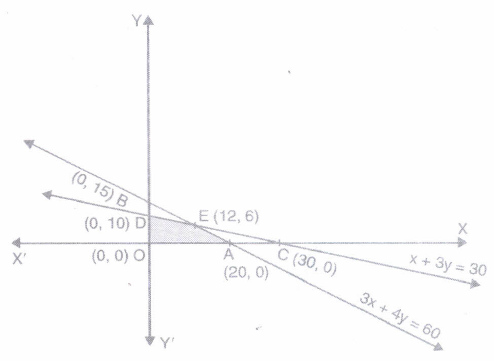
The shaded portion represents the feasible region, which is bounded.
Applying Corner Point Method, we have:
| Corner Point | Z = 8000x +12000y |
| O : (0,0) | 0 |
| A : (20,0) | 160000 |
| E : (12,6) | 168000 (Maximum) |
| D : (0,10) | 120000 |
Hence, the maximum profit is Rs. 1,68,000 when 12 pieces of Model A and 6 pieces of Model B are manufactured per week.
23.
Let \(x_{ 1 },x_{ 2 }\in R\).
Now \(f(x_{ 1 })=f(x_{ 2 })\Rightarrow cosx_{ 1 }=cosx_{ 2 }\)
\(\Rightarrow \) \(x_{ 1 }=(2n\pi +x_{ 2 })\)
\(\Rightarrow \) '\(f\)' is not one-one.
(ii) Since cos \(x\) lies in [-1,1],
\(\therefore \) R is not fully covered.
Hence, '\(f\)' is not onto.
24.
We have: \(f(x)=x^{ 2 }-3x+2\) ....(1)
\(\therefore \) \(f(f(x))=(f(x))^{ 2 }-3f(x)+2\) [Using (1)]
\(=(x^{ 2 }-3x+2)^{ 2 }-3(x^{ 2 }-3x+2)+2\)
\(=(x^{ 4 }+9x^{ 2 }+4-6x^{ 3 }-12x+4x^{ 2 })+(-3x^{ 2 }+9x-6)+2=x^{ 4 }-6x^{ 3 }+10x^{ 2 }-3x.\)
25.
f : R → R is given by,
\(f(x)=|x|=\left[\begin{array}{cl} x & \text { if } \quad x \geq 0 \\ -x & \text { if } \quad x<0 \end{array}\right]\)
It is seen that f(-1) = |-1| = 1, f(1) = |1| = 1
∴ f(−1) = f(1), but −1 ≠ 1.
∴ f is not one-one.
Now, consider −1 ∈ R.
It is known that f(x) = |x| is always non-negative. Thus, there does not exist any element x in domain Rsuch that f(x) = |x| = −1.
∴ f is not onto.
Hence, the modulus function is neither one-one nor onto.
26.
\(a*b=a+2ab\) and \(b*a=a+2a\)
\(\therefore a*b\neq b*a\) \(\left[ \because a+2b\neq b+2d \right] \)
Hence, '*' is not communicative
27.
We have gof (x) = g(f (x)) = g(cos x) = 3 (cos x)2 = 3 cos2 x. Similarly, fog(x) = f (g(x)) = f (3x2) = cos (3x2). Note that 3cos2 x \(\ne\) cos 3x2, for x = 0. Hence, gof \(\ne\) fog.

12th Standard CBSE Syllabus & Materials
12th Standard CBSE
CBSE 12th Computer Science Python Revision Tour I - New Previous year Question Papers Study Material - QB365 Set A
NEW12th Standard CBSE
CBSE 12th Business Studies Planning Important Questions And Answers Study Material - QB365 Set A
NEW12th Standard CBSE
CBSE 12th Business Studies Business Environment Important Questions And Answers Study Material - QB365 Set A
NEW12th Standard CBSE
CBSE 12th Business Studies Principles of Management Important Questions And Answers Study Material - QB365 Set A



CBSE 12th Standard CBSE Subjects
CBSE Standards










