
 100% FREE ACCESS
12th Standard CBSE Syllabus & Materials
12th Standard CBSE
CBSE 12th Economics Government Budget and the Economy Previous year Question Papers Study Material - QB365 Set A
NEW12th Standard CBSE
CBSE 12th Computer Science Interface Python with MySQL - New Previous year Question Papers Study Material - QB365 Set A
NEW12th Standard CBSE
CBSE 12th Computer Science Database Concept - New Previous year Question Papers Study Material - QB365 Set A
NEW12th Standard CBSE
CBSE 12th Computer Science Data Communication - New Previous year Question Papers Study Material - QB365 Set A
NEW12th Standard CBSE
CBSE 12th Computer Science Data Structures - New Previous year Question Papers Study Material - QB365 Set A
NEW12th Standard CBSE
CBSE 12th Computer Science Functions - New Previous year Question Papers Study Material - QB365 Set A

Published on: 30/07/2018
Reproductive Health - Important Question Paper
Download CBSE Class 12th Standard CBSE Biology question papers, sample papers, important questions, and previous year solved papers in PDF format. Get free study materials, NCERT solutions, and exam preparation resources for Class 12th Standard CBSE Biology
Questions + Answers key
Take MCQ Biology Test
1.
How do hormonal pills work as contraceptives?
2.
Name the organization that produced 'Saheli' pill
3.
Who is responsible for the sex of the child, father or mother?
4.
Which have age group highest infection rates of sexually transmitted infections (STIs) including HIV?
5.
Define fertility.
6.
How is annual average growth rate calculated?
7.
What are Assisted Reproductive Technologies?
8.
When is a society considered reproductively heathy?
9.
Explain GIFT and ICSI
10.
List some reasons of infertility
11.
How do injections and implants help in contraception?
12.
Amniocentesis for sex determination is banned in our country. Is this necessary? Comment.
13.
Describe the lactational Amenorrhoea method of birth control.
14.
How do oral pill act in a human female?Explain.
15.
How does CuT act as an effective contraceptive for human females?
16.
The hormonal methods of contraception are widely used and are known to cause changes either in the ovulation pattern or in the female reproductive tract. Explain the hormonal control of a female reproductive system (with the help of flow chart only) which helps in understanding the mechanism of action of these methods.
17.
Intensely lactating mothers do not generally conceive. Is it true? If yes, explain the reason.
18.
(a) At present, Reproductive and Child Health Care(RCH) Programmes are launched by the government of India. Name the two major aims and objectives of these programmes.
(b) Name the prominent Assisted Reproduction Technologies being used today to assist infertile couples to have children.
19.
If implementation of better techniques and new strategies are required to provide more efficient care and assistance to people, then why is there a statutory ban on amniocentesis? Write the use of this technique and give reason to justify the ban.
20.
Describe the different methods of embryo transfer.
21.
What is tubectomy?Represent it diagramatically
22.
What is census? What is Indian population as per census of 2001?
23.
Mention the different ways in which people are made aware of the significance of reproductive health and a reproductively healthy society.
24.
It is a disease which mainly affects mucous membrane of urinogenital tract. In males, burning feeling on passing urine, after a yellow discharge occurs, that is accompanied by fever, headache and feeling of illness.
Syphilis
Gonorrhoea
Genital warts
Trichomoniasis
25.
Oral contraceptive pills helps in birth control by
killing sperms
killing ova
preventing ovulation
forming barrier between sperms and ova
26.
Cu ions released from copper releasing Intra Uterine Devices(IUDs)
prevent ovulation
make uterus unsuitable for implantation
increase phagocytosis sperms
suppress sperm motility
27.
Choose the correct answer regarding the ZIFT procedure?
Ova collected from a female donor are transferred to the fallopian tube to facilitate zygote formation.
Zygote is collected from a female donor and transferred to the fallopian tube.
Zygote is collected from a female donor and transferred to the uterus
Ova collected from a female donor and transferred to the uterus
28.
Which of the following birth control measures can be considered as the safest?
the rhythm method
the use of physical barriers
termination of unwanted pregnancy
sterilization techniques
1.
()
An oral pill prevents pregnancy in the following ways
(i) It inhibits ovulation and implantation.
(ii) It alters the quality of cervical mucus and retards the entry of sperms into cervix.
2.
()
Central Drug Research Institute (CDRI), Lucknow
3.
()
Father
4.
()
Young people between 15-24 years.
5.
()
Fertility is the ability of reproductively active individual to produce offspring.
6.
()
\(\left( { P }_{ 2 }-{ P }_{ 1 } \right) \times 100/\left( { P }_{ 1 }\times N \right) .\)
7.
()
Assisted reproductive technologies are the special techniques to help the infertile couple produce children.
8.
()
A society with people having physically and functionally normal reproductive organs and normal emotional and behavioural interactions among them in all sex-related aspects is considered a reproductively heathy society.
9.
()
GIFT-Gamete Intra Fallopian Transfer
ICSI-Intra-Cytoplasmic Sperm Injection
10.
Physical, congenital, diseases, drugs, immunological and psychological reasons.
11.
Injections and Implants
1. Progestogens or progestogen-estrogen combination is also used as injections or implants under the skin.
2. Though their mode of action is similar to oral contraceptives, their effective periods are longer.
12.
Since it is misused to find out the sex of the foetus leading to female foeticides, it is necessary to ban amniocentesis. Amniocentesis is the prenatal diagostic technique that helps to find out chromosomal (genetic) disorders or metabolic disorders of the foetus; in extreme cases where the foetus is found to be suffering from an incurable disorder, MTP is advised. By banning this, the advantage of preventing an unwanted birth is lost.
13.
1. Lactational Amenorrhoea refers to the absence of menstriation during the period of intense lactation following parturition.
2. It is because ovulation and other events in menstrual cycle do not occur during this period.
3. Hence as long as the mother breast feeds her child chances of conception are almost nil.
14.
Saheli is an oral pill.
1. It inhabits ovulation and implantation.
2. It alters the quality of cervical muscus and retards the entry of sperms into cervix.
15.
Cut is an intra-uterine device (IUD) and functions as follows:
1. It suppresses sperm motility and the fertilising capacity of sperms.
2. It increases phagocytosis of sperms within the uterus.
16.
A flow chart showing negative feedback of estrogen and progesterone.
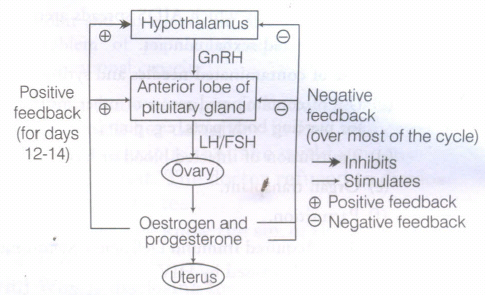
Hormonal control of female reproductive system.
17.
Yes, breast feeding is one of the natural contraceptive methods. It reduce fecundity by affecting the production of certain reproductive hormones. It is known to suppress the production of Gonadotropin Releasing Hormone (GnRh) and Follicle Stimulating Hormone (FSH).
The release of these hormones triggers ovulation. Breast feeding also leads to increased level of prolactin, a hormone that inhibits ovulation.
So, even when a woman ovulates, her likelihood of conceiving is low if she is breast feeding.
18.
(a) (i) creating awareness among the people about various reproduction related aspects, and
(ii) providing facilities and support for building up a reproductively healthy society
(b) Some Prominent Assisted Reproduction Technologies are:
(i) 'Test tube baby' programme.
(ii) Gamete intra fallopian transfer (GIFT).
(iii) Intra cytoplasmic sperm injection (ICSI).
(iv) Artificial insemination technique (AIT).
19.
1.Amniocentesis is a foetal determination test based upon the chromosomal pattern in the amniotic fluid surrounding the developing embryo.It should be legally banned throughout the country as such a ban shall check increasing female foeticide cases and maintain a normal sex ratio in the country.
2. Use This technique can be used to identify some abnormalities in the number of chromosomes and to detect certain biochemicals and enzymatic abnormality.
20.
Embryo or zygote is transferred into the uterus or fallopian tube in the foliowing ways:
(i) The zygote or embryo upto eight blastomeres is transferred into the fallopian tube; it is called Zygote Intra
Fallopian Transfer (ZIFT).
(ii) Embryo with more than eight blastomeres are transferred into the uterus; it is called Intra-Uterine Transfer (IUT).
21.
Tubectomy is the sterilisation procedure in females involving ligation of fallopian tube.
22.
Census is the counting of population, age, and sex of individuals, marital status, number of children per couple, number of dependents, number of earning hands, education, literacy, mother-tongue, religion, race, occupation, type of employment, mortality, etc. In India, census is undertaken every ten years, e.g., 1971, 1981, 1991. It takes over one year for the completion of census.Census of our country was carried out in February 2001.
23.
(i) Test tube baby programme - In this method, the ovum of the woman and the sperm of her husband or a donor, are made to fuse ,under laboratory conditions; it is called in vitro fertilisation (IVF). - The zygote or early embryo is implanted in the fallopian tube or uterus respectively for further development.
(ii) Intra Cytoplasmic Sperm Injection (ICSI) - In this method, the sperm is injected directly into the ovum to form the zygote and then embryo transfer is carried out.
(iii) Gamete Intra Fallopian Transfer (GIFn - This method involves the transfer of an ovum collected from a donor female into another female for fertilisation and further development of foetus.
(iv) Artificial insemination - In this method, the semen collected from the husband or a healthy XII donor, is artificially introduced into the vagina or into the uterus (intra uterine insemination). - It is carried out when infertility is due to the inability of the male partner to inseminate the female or due to very low sperm count in the semen.
24.
(b)
Gonorrhoea
25.
(c)
preventing ovulation
26.
(d)
suppress sperm motility
27.
(b)
Zygote is collected from a female donor and transferred to the fallopian tube.
28.
(d)
sterilization techniques

12th Standard CBSE Syllabus & Materials
12th Standard CBSE
CBSE 12th Computer Science Python Revision Tour I - New Previous year Question Papers Study Material - QB365 Set A
NEW12th Standard CBSE
CBSE 12th Business Studies Planning Important Questions And Answers Study Material - QB365 Set A
NEW12th Standard CBSE
CBSE 12th Business Studies Business Environment Important Questions And Answers Study Material - QB365 Set A
NEW12th Standard CBSE
CBSE 12th Business Studies Principles of Management Important Questions And Answers Study Material - QB365 Set A



CBSE 12th Standard CBSE Subjects
CBSE Standards










