
 100% FREE ACCESS
12th Standard CBSE Syllabus & Materials
12th Standard CBSE
CBSE 12th Economics Government Budget and the Economy Previous year Question Papers Study Material - QB365 Set A
NEW12th Standard CBSE
CBSE 12th Computer Science Interface Python with MySQL - New Previous year Question Papers Study Material - QB365 Set A
NEW12th Standard CBSE
CBSE 12th Computer Science Database Concept - New Previous year Question Papers Study Material - QB365 Set A
NEW12th Standard CBSE
CBSE 12th Computer Science Data Communication - New Previous year Question Papers Study Material - QB365 Set A
NEW12th Standard CBSE
CBSE 12th Computer Science Data Structures - New Previous year Question Papers Study Material - QB365 Set A
NEW12th Standard CBSE
CBSE 12th Computer Science Functions - New Previous year Question Papers Study Material - QB365 Set A

Published on: 05/03/2019
Sexual Reproduction in Flowering Plants Important Questions
Download CBSE Class 12th Standard CBSE Biology question papers, sample papers, important questions, and previous year solved papers in PDF format. Get free study materials, NCERT solutions, and exam preparation resources for Class 12th Standard CBSE Biology
Questions + Answers key
Take MCQ Biology Test
1.
Name the nuclei involved in triple fusion.
2.
What are the characters of flowers pollinated by insects?
3.
Differentiate between : coleoptile and coleorrhiza
4.
How long are the pollen grains viable in
(i) cereals and
(ii) members of Rosaceae, respectively?
5.
How many pollen grains and ovules are likely to be formed in the anther and the ovary of an angiosperm bearing 25 microspore mother cells and 25 megaspore mother cells, respectively.
6.
a) How does cleistogamy ensure autogamy?
(b) State one advantage and one disadvantage of cleistogamy to the plant.
7.
Name one example for each of the following :
A cultivated plant in which neither fruits nor seeds are formed.
8.
What are the main functions of Fruits?
9.
What is micropyle in a seed? Mention its significance.
10.
Name any four biotic agents of pollination.
11.
Mention the location and function of tapetum in the microsporangium of angiosperms. State the characteristic features of the cells forming this layer.
12.
Geitonogamous flowering plants are genetically autogamous, but functionally cross-pollinated. Justify.
13.
In angiosperms, the zygote is diploid, while the primary endosperm cell is triploid. Explain
14.
Plant breeding technique has helped sugar industry in North India. Explain how.
15.
Difference between male and female gametophyte are:
16.
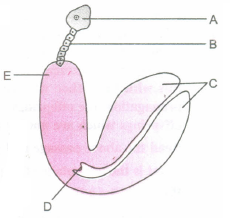
Observe the figure and answer the following question:
(a) What does A,B,C,D and E represent in the given figure?
(b) What type of embryo is shown in figure?
(c) What is the function of A and B?
17.
Observe the figure carefully and the answer of the following question:
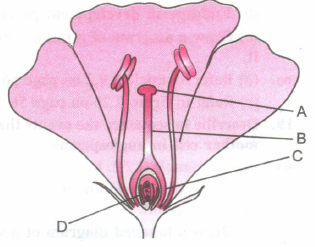
(a) Write whether ovary is superior or inferior?
(b) What is the type of flower - hypogynous, perigynous or epigynous?
(c) What type of ovule is shown the figure?
(d) What changes occur in C after fertilization?
(e) What does A, B, C, D represent in the figure.
18.
Name the three parts of pistil and mention one function of each of them.
19.
In an angiosperm, the embryo sac is haploid, zygote is diploid and endosperm is triploid. Justify giving reasons for each stage.
20.
Write the mode of pollination in Vallisneria and water lily. explain the mechanism of pollination in Vallisneria.
21.
(a) Why is fertilization in an angiosperm referred to as double fertilization? Mention the ploidy of the cells involved.
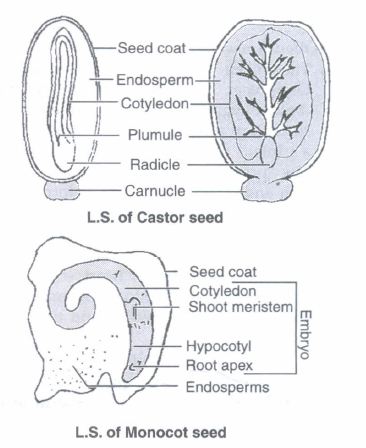
(b) Draw a neat labelled sketch of L.S. of an endospermous monocot seed.
22.
(a) Draw a labelled diagram of the sectional view of microsporangium of an angiosperm.
(b) Explain the development of male gametophyte in the microsporangium.
23.
While walking in the garden, Monu observed that large number of plants produce flowers and form seeds, whereas, Dadaji used to grow many vegetables by using vegetative propagules like underground rhizome etc.He thought that Dadaji can not afford seeds of these crops.He discussed propagation, the offspring so but the reason is different .In vegetative propagation, the offspring are identical to parent whereas propagation through seeds to offspring which are not identical.
Read the above passage and answer the following questions:
(i) What is the advantage of vegetative propagation in commercial production of crops?
(ii) What are the advantage of sexual reproduction?
(iii) What values are displayed by Monu's father?
24.
Draw the diagram of a microsporangium and label its wall layers. Write briefly about the wall layers.
25.
(a) Draw a diagrammatic sectional view of a mature anatropous ovule and label the following parts in it.
(i) that develops into seed coat.
(ii) that develops into embryo after fertilisation.
(iii) that develop into endosperm in an albuminous seed.
(iv) through which the pollen tube gains entry into the embryo sac.
(v) that attaches the ovule to placenta.
(b) Describe the characteristic features of wind-pollinated flowers.
26.
(a) Differentiate between: Autogamy, geitonogamy and xenogamy.
(b) Explain the events that occur during pollen-pistil interaction.
27.
What is the function of germ pore?
Emergence of radicle
Absorption of water for seed germination
Initiation of pollen tube
Release of male gametes
28.
At the time of shedding, the number of nuclei present in an angiosperm pollen grain is
one
one or two
two or three
only two
29.
The scutellum observed in a grain of wheat or maize is comparable to which part of the seed in other monocotyledons.
Plumule
Cotyledon
Endosperm
Aleurone Layer
30.
A dicotyledonous plant bears flowers but never produces fruit and seeds. The most probable cause for the above situation is
Plant is dioecious and bears only pistillate flowers
Plant is dioecious and bears both pistillate and staminate flowers
Plant is monoecious
The plant is dioecious and bears only staminate flowers.
31.
Which one of the following pairs of plant structures has a haploid number of chromosomes?
Nucellus and antipodal cells
Egg nucleus and secondary nucleus
Megaspore mother cell and antipodal cells
Egg cell and antipodal cells
32.
Plants of which one of the following groups of genera are pollinated by the same agency?
Triticum, Cocos, Mangifera
Ficus, Kigelia, Casuarina
Salvia, Morus, Euphorbia
Bombax, Butea, Bauhinia
33.
Which one of the following represents an ovule, where the embryo sac becomes horse-shoe shaped and the funiculus and micropyle are close to each other?
Amphitropous
Circinotropous
Atropous
Anatropous
34.
The pollen tube usually enters the embryo sac
Through one of the synergids
By directly penetrating the egg
Between one synergid and central cell
By knocking off the antipodal cells
35.
Anthesis is a phenomenon which refers to
Formation of pollen
Development of anther
the opening of a flower bud
Reception of pollen by stigma
36.
Pick the odd one out
Chalazogamy
Porogamy
Mesogamy
Allogamy
37.
In a flowering plant, archesporium gives rise to
only the wall of the sporangium
both wall and the sporogenous cells
wall and the tapetum
Only tapetum and sporogenous cells
38.
Intraspecific incompatibility can be overcome by
Wetting of anthers
Mixed pollination
Intraovarian fertilization
Intraspecific competition
39.
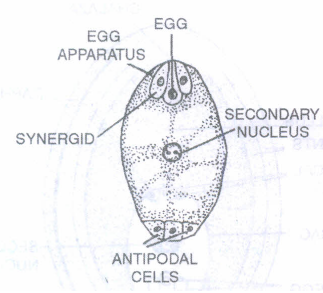
Egg apparatus consists of
egg
egg and polar nuclei
Egg and synergids
Egg and antipodal cells
1.
()
One male gamete and two polar nuclei (or secondary nucleus).
2.
()
Insect pollinated flowers (entomophilous flowers) are usually large, brightly coloured, scented and produce nectar to attract insects
3.
()
In monocot seeds, the radicle is covered by a protective sheath called coleorhiza whereas plumule is surrounded by a conical protective sheath called coleptile.
4.
()
(i) Cereals - 30 minutes
(ii) Rosaceae - A few months.
5.
()
100 pollen grains and 25 embryo sacs.
6.
(a) The cleistogamous flowers remain closed and never open. They are bisexual. Therefore, this condition of flowers i.e., cleistogamy ensures autogamy i.e., the transfer of pollen from the anther to the stigma of the same and single bisexual flower e.g., Commelina and Viola.
b) The main advantage of cleistogamy is that also guaranted or assured pollination and therefore, fertilization and seed setting.
The main disadvantage of cleistogamy is that variants cannot be produced due to autogamy. It results in poor crop yield and poor resistance to environmental stresses.
7.
Sugar Cane
8.
Functions of fruits
1.Protection of seeds in the early stages till they become fully mature.
2. Dispersal of seeds.
3. On their decay provide raw material for the benefit of new seedling.
4. Many fruits are consumed by human beings as food and is source of glucose and pectin.
9.
Micropyle is the opening left by the integuments at the trip of the ovule; this remains as an opening on the seed coat.
It facilitates the entry of oxygen water during seed germination.
10.
Biotic agents of pollination:
(i) Insects like butterflies, bees, wasps, etc.
(ii) Birds like humming bird.
(iii) Bats
(iv) Lemurs
(v) Arboreal rodents.
11.
Tapetum is the innermost wall layer of the microsporangium.
It nourishes the developing pollen grains.
Characteristics of tapetal cells:
(i) They possess dense cytoplasm.
(ii) They have more than one nucleus.
12.
1. Since geitonogamy involves two different flowers of the same plant, it is genetically similar to autogamy; both autogamy and geitonogamy do not result in genetic variation in the progeny.
2. Geitonogamy and cross-pollination involve different flowers and a pollinating agent.
13.
A zygote is the product of syngamy, it is formed by the fusion of a haploid male gamete and a haploid female gamete, i.e., egg cell.
\(\underset { (n) }{ Male\quad gamete } +\underset { (n) }{ Egg } \rightarrow \underset { (2n) }{ Zygote } \)
A primary endosperm cell is the product of the fusion of a secondary nucleus (2n) and a haploid male gamete (n).
\(\underset { (2n) }{ Secondary\\ nucleus } +\underset { (n) }{ Male\\ gamete } \rightarrow \underset { (3n) }{ Primary\quad endosperm\quad nucleus } \)
14.
Two species (Saccharum barberi and Saccharum officinarum) were crossed to get sugarcane varieties with high yield/thick stem/high sugar content) ability to grow in North India.
15.
| Male gramtophyte | Female gametophyte |
| It is derived from a microspore, which is produced inside the pollen chamber of anther. | It is derived from a megaspore, which is formed inside the nucellus of an ovule |
| The microspores are shed at maturity and transferred from anthers to stigma by the process called pollination. | The megaspores do not shed from the ovule. They develop to form embryo sac within the ovule. |
| The mature male gametophyte is 3-celled | The mature female gametophyte is 7-celled. |
16.
(a) A = Haustorium
B = Suspensor
C = Cotyledons
D = Plumule
E = Radicle
(b) Function of A is absorption of nourishment from embryosac and function of B is translocation of nutrients to the developing embryo.
17.
(a) Ovary is superior
(b) Flower is hypogynous because all the floral arise from thalamus below the level of ovary
(c) Ovule is anatropous because it is completely inverted. The micropyle is near the hilum and faces down towards the placenta.The embryo sac is straight.
(d) The ovary of the flower gets converted into fruit after fertilization.
(e) A = Stigma, B = Style, C = Ovary and D = Ovule
18.
The three parts of a pistil and their functions are:
(i) Stigma - it acts as the platform where the pollen grains are lodged during pollination.
(ii) Style - it exposes the stigma for easy pollination.
(iii) Ovary - it encloses the ovule(s) inside which is the female gametophyte.
19.
1. Embryo sac develops from a megaspore, which is formed after meiosis in a megaspore mother cell; so it is haploid.
2. Zygote is formed by the fusion of two haploid gametes (a male and a female); hence it is diploid.
3. Endosperm is formed by triple fusion, i.e. fusion of two haploid polar male gamete; hence it if triploid.
20.
Vallisneria is pollinated by water.
Water lily is pollinated by insects.
In Vallisneria, the male flowers (later pollen grains) are released on the surface of water and keep floating.
The female flowers reach the surface of water by uncoiling of the long stalk
When the passively carried male flowers/pollen grains meet the female flowers, pollination is effected.
The stalk of the female flower coils and the flower is drawn inside the water column.
21.
(a) In angiospermic embryo sac, two fusions, syngamy and triple fusion, occur. Therefore, this is known as double fertilization.
In this process, one of the male gametes moves towards the egg cell and fuses with it, this fusion is called syngamy and it results in the formation of a diploid cell, the zygote, that later develops into the embryo.
The second male gamete fuses with the secondary nucleus to form a triploid primary endosperm nucleus. This fusion is called triple fusion.
Ploidy of cells:
Endosperm cell - triploid
Fertilized egg cell - diploid
Synergids - haploid
Antipodals - haploid
(b)
22.
Each cell of sporogenous tissue, functions as microspore mother cells \(\rightarrow \) meiosis/ microsporogenesis, \(\rightarrow \) microspore tetrad \(\rightarrow \) 4-pollen grains (male gametophyte) 2-celled stage
See Quick Review \(\rightarrow \) Microsporogenesis
23.
(i) Keeping in view the market demands, same quality of product can be assured by vegetative propagation as there is no meiosis involved in this type of propagation.
(ii) As meiosis occurs in sexual reproduction, there is crossing over and new combinations are formed.These recombinations may have desirable traits from commercial point of view such as high yield, disease resistance, novel taste, shape etc.
(iii) Monu's father wanted to remove his son's misconcepts and , therefore, enhanced his knowledge by giving him scientific explanation.
24.
A typical microsporangium is surrounded by four wall layers, i.e. the epidermis, endothecium, middle layers and the tapetum. The outer three wall layers are protective in function and help in dehiscence of anther to release pollen grains.
The innermost layer (tapetum) nourishes the developing microspores or pollen grains. The cells of tapetum possess dense cytoplasm and generally have more than one nucleus.
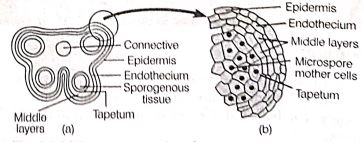
When the anther is young, a group of compactly arranged homogenous cells called the sporogenous tissue occupies the centre of each microsporangium.
25.
(i) part that develops into seed coat integuments
(ii) part that develops into an embryo after fertilization-egg
(iii) that develops into endosperm in a albuminous seed-polar nuclei
(iv) through which pollen tube enters into embryo sac-micropyle
(v) that attaches the ovule to the placenta funiculus.
26.
(a) Differences:
| Autogamy | Getonogamy | Xenogamy |
| It refers to the transfer of pollen grains from the anther of a flower to the stigma of the same flower | It refers to the transfer of pollen grains from the anther of a flower to the stigma of same plant. | It refers to the transfer of pollen grains from the anther of a flower to the stigma of another flower on a different plant of the same species. |
| It does not lead to genetic variation in the progency | It does not lead to genetic variation in the progeny. | It leads to genetic variation in the progeny |
| No pollinating agent is needed. | A pollinating agent is needed. | A pollinating agent is needed. |
(b) Pollen-Pistil Interaction.
The stigma/pistil has the ability to recognise the right type of pollen, i.e. the compatible pollen of the same species and rejects the wrong type of pollen grains.
It is the result of interaction between the chemical components of the pollen and those of stigma. - A compatible pollen grain starts its germination on the stigma.
The intine grows out through one of the germ pores as a protuberance.
The contents of the pollen move into this tube, i.e. the tube nucleus (nucleus of the vegetative cell) and the generative cell (or the two male gametes in those species where pollen is liberated in the three-celled stage).
The pollen tube grows through the tissues of stigma and style and enters the ovule through micropyle.
It enters the embryo sac through the filiform apparatus of one of the synergids to liberate the male gametes.
The events from the deposition of pollen on the stigma till the pollen tube enters the ovule, are collectively referred to as pollen-pistil interaction.
27.
(c)
Initiation of pollen tube
28.
(c)
two or three
29.
(b)
Cotyledon
30.
(d)
The plant is dioecious and bears only staminate flowers.
31.
(d)
Egg cell and antipodal cells
32.
(d)
Bombax, Butea, Bauhinia
33.
(a)
Amphitropous
34.
(a)
Through one of the synergids
35.
(c)
the opening of a flower bud
36.
(d)
Allogamy
37.
(b)
both wall and the sporogenous cells
38.
(b)
Mixed pollination
39.
(c)
Egg and synergids

12th Standard CBSE Syllabus & Materials
12th Standard CBSE
CBSE 12th Computer Science Python Revision Tour I - New Previous year Question Papers Study Material - QB365 Set A
NEW12th Standard CBSE
CBSE 12th Business Studies Planning Important Questions And Answers Study Material - QB365 Set A
NEW12th Standard CBSE
CBSE 12th Business Studies Business Environment Important Questions And Answers Study Material - QB365 Set A
NEW12th Standard CBSE
CBSE 12th Business Studies Principles of Management Important Questions And Answers Study Material - QB365 Set A



CBSE 12th Standard CBSE Subjects
CBSE Standards










