
 100% FREE ACCESS
12th Standard CBSE Syllabus & Materials
12th Standard CBSE
CBSE 12th Economics Government Budget and the Economy Previous year Question Papers Study Material - QB365 Set A
NEW12th Standard CBSE
CBSE 12th Computer Science Interface Python with MySQL - New Previous year Question Papers Study Material - QB365 Set A
NEW12th Standard CBSE
CBSE 12th Computer Science Database Concept - New Previous year Question Papers Study Material - QB365 Set A
NEW12th Standard CBSE
CBSE 12th Computer Science Data Communication - New Previous year Question Papers Study Material - QB365 Set A
NEW12th Standard CBSE
CBSE 12th Computer Science Data Structures - New Previous year Question Papers Study Material - QB365 Set A
NEW12th Standard CBSE
CBSE 12th Computer Science Functions - New Previous year Question Papers Study Material - QB365 Set A

Published on: 02/03/2019
Solution Important Questions
Download CBSE Class 12th Standard CBSE Chemistry question papers, sample papers, important questions, and previous year solved papers in PDF format. Get free study materials, NCERT solutions, and exam preparation resources for Class 12th Standard CBSE Chemistry
Questions + Answers key
Take MCQ Chemistry Test
1.
Define ideal solution
2.
State Henry's law about partial pressure of a gas in a mixture.
3.
State Raoult's law for the solution containing volatile components. Write two differences between an ideal solution and a non-ideal solution.
4.
Which substances is usually added into water in the car radiator to act as antifreeze?
5.
(a) Define Azeotropes and explain broefly minimum boiling azeotrope by taking suitable example.
(b) The vapour pressures of pure liquids A and B are 450 mm 700 mm of Hg respectively at 350 K. Calculate the composition of the liquid mixture if total vapour pressure is 600 mm of Hg. Also find the composition of the mixture in the vapour phase.
6.
When is the value of van't Hoff factor more than one ?
7.
Define reverse osmosis. Give one use of it.
8.
What is the effect of temperature on the solubility of sodium sulphate decahyrate ?
9.
How is it that alcohol (ethoxyethane) and water are miscible in all proportions ?
10.
An aqueous solution freezes at - 0.2°C. What is the molality of the solution ? Determine also (i) elevation in the boiling point (ii) lowering of vapour pressure at 298 K, given that Kf = 1.86° kg mol-1 , Kb = 0.512° kg mol-1 and vapour pressure of water at 298 K is 23.756 mm.
11.
An aqueous solution of glucose boils at 100.01°C . The molal elevation constant for water is 0.5 K kg mol-1 . What is the number of glucose molecules in the solution containing 100 g of water ?
12.
A 5% solution of cane-sugar (m.wt. = 342) is isotonic with 0.877% solution of urea. Find the molecular weight of urea.
13.
Ethylene dibromide (C2H4Br2) and 1, 2-dibromo propane form a series of ideal solutions over the whole range of composition.At 850C, the vapour pressure of these two liquids are 173 and 127 torr respectively. What would be the mole fraction of ethylene dibromide in a solution at 850 C equilibrated with 1:1 molar mixture in the vapour?
14.
Given below is the sketch of a plant carrying out a process.
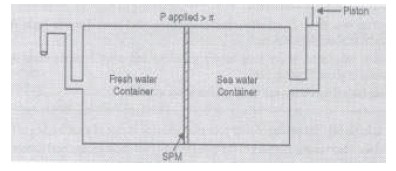
(i) Name the process occurring in the above plant.
(ii) To which container does the net flow of solvent take place ?
(iii) Name one SPM which can be used in this plant.
(iv) Give one practical use of the plant.
15.
When outer shell of two eggs are removed, one of the eggs is placed in pure water and other is placed in saturated solution of NaCl. What will be observed and why?
16.
What the molarity of acetic acid containing 6 g of acetic acid per litre of solution?
17.
Define Ebullioscopic constant or molal elevation constant.
18.
(i) What type of deviation is shown by a mixture of ethanol and acetone? Give reason.
(ii) A solution of glucose (molar mass = 180 g mol-1) in water is labelled as 10 % (by mass). What would be the molality and molarity of the solution?
(Density of solution = 1.2 g mL-1)
19.
A solution containing 30 g of non-volatile solute exactly in 90 g of water has a vapour pressure of 2.8 kPa at 298 K. Further, 18 g of water is then added to the solution, the new vapour pressure becomes 2.9 kPa at 298K. Calculate
(i) molar mass of the solute,
(ii) vapour pressure of water at 298K.
20.
Vapour pressure of pure acetene and chloroform at 328 K are 741.8 mm Hg and 632.8 mm Hg respectively. Assuming that they form ideal solution over the entire range of composition, plot ptotal, pchloroform , and pacetone as a function of xacetone. The experimental data observed for different compositions of mixtures is :
| \(100\times { x }_{ acetone }\) | 0 | 11.8 | 23.4 | 36.0 | 50.8 | 58.2 | 64.5 | 72.1 |
| pacetone/mm Hg | 0 | 54.9 | 110.1 | 202.4 | 322.7 | 405.9 | 454.1 | 521.1 |
| pchloroform/mm Hg | 632.8 | 548.1 | 469.4 | 359.7 | 257.7 | 193.6 | 161.2 | 120.7 |
Plot this data also on the same graph paper. Indicate whether it has positive deviation or negative deviation from the ideal solution.
21.
(a) Explain the following:
(i) Henry's law about dissolution of a gas in a liquid.
(ii) Boiling point elevation constant for a solvent.
(b) A solution of glycerol (C3H8O3) in water was prepared by dissolving some glycerol in 500 g of water. This solution as a boiling point of 100.42 oC. What mass of glycerol was dissolved to make this solution?
(K b for water = 0.512 K kg mol-1)
22.
Calculate the mole fraction of ethylene glycol (C2H6O2) in a solution containing 20% of C2H6O2 by mass.
23.
Calculate the boiling point of a 1M aqueous solution (density 1.04 g mL-1) of potassium chloride (Kb for water = 0.52 K kg mol-1, Atomic masses : K = 39 u, CI = 35.5 u). Assume, potassium chloride is completely dissociated in solution.
24.
45 g of ethylene glycol (C2H4O2) is mixed with 600 g of water. Calculate
(i) the freezing point depression and
(ii) the freezing point of the solution.
25.
Calculate the boiling point of solution when 4 g of MgSO4 (M = 120 g mol-1) was dissolved in 100 g of water, assuming MgSO4 undergoes complete ionization. (Kb for water = 0.52 K kg mol-1)
26.
Rekha observed that her mother placed shrinked or dried vegetables in water before cutting these for cooking. After sometime, these vegetables looked fresh.
Answer the following questions:
(i) Why did Rekha's mother place the shrinked or dried vegetables in water?
(ii) What is the name of the process used and define it.
(iii) Would the temperature increase accelerate the process or not?
27.
Calculate the mass of urea (NH2CONH2) required in making 2.5 kg of 0.25 molal aqueous solution.
28.
Calculate the mass of a non-volatile solute (molecular mass 40 g mol -1) which should be dissolved in 114 g octane to reduce its vapour pressure to 80%.
29.
At 25oC the saturated vapour pressure of water is 3.165 kPa (23.75 mm Hg). Find the saturated vapour pressure of a 5% aqueous solution of urea (carbamide) at the same temperature. (molar mass of urea = 60.05 g mol-1)
30.
Kf for water is 1.86 K kg mol-1 . If your automobile radiator holds 1.0 kg of water, how many grams of ethylene glycol (C2H6O2) must you add to get the freezing point of the solution lowered to - 2.8oC ?
27 g
72 g
93 g
39 g
31.
A a certain temperature, the value of the slope of the plot of osmotic pressure (\(\pi \) ) against concentration (C in mol L-1) of a certain polymer solution is 291 R. The temperature at which osmotic pressure is measured is ( R is gas constant)
271oC
18oC
564 K
18 K
32.
The relative lowering of vapour pressure of an aqueous solution containing non - volatile solute is 0.0125. The molality of the solution is
0.70
0.50
0.60
0.80
0.40
33.
The molarity of 900 g of water is
50 M
55.5 M
5 M
cannot be calculated
34.
On the basis of information given below mark the correct option.
Information :
(A) In bromoethane and chloroethane mixture, intermolecular interactions of A - A and B - B type are nearly same as A - B type interactions.
(B) In ethanol and acetone mixture, A - A or B - B type intermolecular interactions are stronger than A - B type interactions.
(C) In chloroform and acetone mixture, A - A or B - B type intermolecular interactions are weaker than A - B type interactions.
Solution (B) and (C) will follow Raoult's law
Solution (A) will follow Raoult's law
Solution (B) will show negative deviation from Raoult's law
Solution (C) will show positive deviation from Raoult's law
35.
The values of van't Hoff factors for KCI, NaCI and K2SO4, respectively, are ................. .
2,2 and 2
2,2 and 3
1,1, and 2
1,1 and 1
36.
In comparison to a 0.01 M solution of glucose, the depression in freezing point of a 0.01 M MgCI2 solution is _____________________.
the same
about twice
about three times
about six times
37.
Low concentration of oxygen in the blood and tissues of people living at high altitude is due to _____________.
low temperature
low atmospheric pressure
high atmospheric pressure
both low temperature and high atmospheric pressure
38.
The van't Hoff factor i for a compound which undergoes dissociation in one solvent and association in other solvent is respectively
Greater than one and greater than one
Less than one and greter than one
Less than one and less than one
Greater than one and less than one
39.
If an aqueous solution of glucose is allowed to freeze, then crystals of which will be separated out first ?
glucose
water
both of these
none of these
40.
What is the osmotic pressure of a 0.0020 mol dm-3 sucrose (C12H22O11) solution at 20oC ? (Molar gas constant, R = 8.314 JK-1mol-1)
4870 Pa
4.87 Pa
0.00487 Pa
0.33 Pa
41.
Formation of a solution from two components can be considered as
(i) pure solvent \(\longrightarrow \) seperated solvent molecules, \(\Delta { H }_{ 1 }\)
(ii) pure solute \(\longrightarrow \) seperated solute molecules,\(\Delta { H }_{ 2 }\)
(iii) separated solvent and solute molecules \(\longrightarrow \) solution,\(\Delta { H }_{ 3 }\)
Solution so formed will be ideal if.
\(\Delta { H }_{ soln }=\Delta { H }_{ 1 }+\Delta { H }_{ 2 }+\Delta { H }_{ 3 }\)
\(\Delta { H }_{ soln }=\Delta { H }_{ 1 }+\Delta { H }_{ 2 }-\Delta { H }_{ 3 }\)
\(\Delta { H }_{ soln }=\Delta { H }_{ 1 }-\Delta { H }_{ 2 }-\Delta { H }_{ 3 }\)
\(\Delta { H }_{ soln }=\Delta { H }_{ 3 }-\Delta { H }_{ 1 }-\Delta { H }_{ 2 }\)
42.
Which one of the following gases has the lowest value of the Henry's law constant ?
N2
He
H2
CO2
43.
Brass is
Solid solution
Liquid solution
Gas solution
All of these
44.
The molal depression constant of water is ............ while that of benzene is ................. .
45.
For a non-ideal solution showing positive deviations, \({ \Delta V }_{ mixing }\) is ....................... and \({ \Delta H }_{ mixing }\) is ............ .
1.
The solutions which obey Raoult's law over the entire range of concentration are known as ideal solutions. For ideal solutions, ∆H(mixing) = 0 and ∆V (mixing) = 0, e.g. solution of n-hexane and n-heptane, bromoethane and chloroethan etc. In these solutions (binary solutions), A-B type (i.e. solute-solvent) interactions are nearly equal to the A-A (solute-solute) and B-B type (solvent-solvent) interactions.
2.
Henry's law states that the mass of a gas dissolved in given volume of the liquid at constant temperature depends upon the pressure applied.
3.
Henry's law states that the mass of a gas dissolved per unit volume of the solvent is directly proportional to the pressure of the gas in equilibrium with the solution. If m is the mass of the gas dissolved in a unit volume of the solvent and P is the pressure of the gas in equilibrium with the solution, then
\(m\propto p\\ or\ m=K.p\)
(where K is the proportionality constant) The dissolution of a gas in a liquid is exothermic process. Therefore, in accordance with Le Chatelier's principle, with increase in temperature, the equilibrium shifts in the backward direction. As a result, solubility decreases with increase in temperature.
Differences between ideal and non-ideal solutions
|
Ideal solution |
Non-ideal solution |
| 1. It obeys Raoults law over the entire range of concentration of solution. | It does not obey Raoult's law. |
| 2. Solute - solvent interactions are nearly same as in pure solvent | Solute-solvent interactions are not same as solute-· solute or solvent--solvent interactions. |
4.
Ethylene glycol.
5.
(b) If xA is mol fraction of A in liquid phase, then xA (450)+(1 - xA)(700) = 600 or xA = 0.4, xB = 0.6.
Hence, \({ p }_{ A }=0.4\times 450=180\quad mm,{ p }_{ B }=0.6\times 700=420\quad mm,{ y }_{ A }=\frac { 180 }{ 600 } =0.3,{ y }_{ B }=\frac { 420 }{ 600 } =0.7\)
6.
i > 1 when the solute undergoes dissociation in the solution.
7.
In osmosis, net flow of solvent across the semipermeable membrane is from solvent to solution. The flow can be reversed by applying pressure greater than osmotic pressure on the solution. This is called reverse osmosis. It is used for desalination of sea water.
8.
The solubility first first increases upto 32.4oC (called transition temperature) and then decreases.
9.
(i) Both are polar and hence miscible.
(ii) They form hydrogen bonds with each other. This further increases their miscibility.
10.
Molality = 0.1075, (i) 0.055°C (ii) 0.046 mm
11.
1.204 x 10²¹ molecules
12.
60 u
13.
0.423
14.
(i) Desalination (i.e., removal of salts from sea water) by reverse osmosis.
(ii) From sea water container to fresh water container.
(iii) Cellulose acetate placed over a suitable suport.
(iv) To remove salts from sea water to obtain drinking water.
15.
The egg placed in pure water will swell, whereas the egg placed in saturated solution of NaCl will shrink.
16.
\(=\frac{W_E}{M_E} \times \frac{1000}{\text { Volume of solution in ml }}=\frac{6}{60} \times \frac{1000}{1000}=0.1 \mathrm{M} \text {. }\)
17.
Molal Elevation Constant (Ebullioscopic Constant:) It is equal to elevation in boiling point of 1 molal solution, i.e. 1 mole of solute is dissolved in 1 kg of solvent. It is also called ebullioscopic constant. The units of kb is K/m or oC/m or K kg mol-1, where 'm' is molality.
18.
(i) It shows positive deviation.
It is due to weaker interaction between acetone and ethanol than ethanol-ethanol interactions.
(ii) Given : WB = 10g, Ws = 100 g, WA = 90 g, MB = 180 g.mol and d = 1.2 g/mL
\(M=\frac { Wt%\times density\times 10 }{ Mol.wt } \)
\(M=\frac { 10\times 1.2\times 10 }{ 180 } \)
= 0.66 M or 0.66 mol/L
\(m=\frac { { W }_{ B }\times 1000 }{ { M }_{ B }\times { W }_{ A }(in\quad g) } \)
\(m=\frac { 10\times 1000 }{ 180\times 90 } \)
= 0.61 m or 0.61 mol/kg
(or any other suitable method)
19.
\((i){p_A^0-p_A\over p_A^0}=x_B\Rightarrow1-{p_A\over p_A}={{30\over M_B}\over{90\over 18}}\)
\(\Rightarrow\ \ 1-{2.8\over p_A^0}={6\over M_B}\Rightarrow{2.8\over p_A^0}=1-{6\over M_B}={M_B-6\over M_B}\)
\(\Rightarrow\ {2.8\over p_A^0}={M_B-6\over M_B}\)
Similarly, \(1-{2.9\over p_A^0}={{30\over M_B}\over{108\over 18}}\Rightarrow\ 1-{2.9\over p_A^0}={5\over M_B}\)
\(\Rightarrow\ {2.9\over p_A^0}={M_B-5\over M_B}\)
Dividing (0) by (b), we have
\({2.8\over 2.9}={M_B-6\over M_B-6}\)
=> 2.8 MB -14 = 2.9 MB - 17.4
0.1 MB = 3.4
Molecular weight of
solute = MB = 34 g mol-1.
(ii) From (a),
\({2.8\over p_A^0}={34-6\over 34}\Rightarrow\ p_A^0={34\times2.8\over 28}=3.4kpa\)
Vapour pressure of pure water = 3.4 kPa.
20.
| xacetone 0.00 | 0.118 | 0.234 | 0.360 | 0.508 | 0.582 | 0.645 | 0.721 | |
|---|---|---|---|---|---|---|---|---|
| pacetone/mm Hg | 0 | 54.9 | 110.2 | 202.4 | 322.7 | 405.9 | 454.1 | 521.1 |
| pchloroform/mm Hg | 632.8 | 548.1 | 469.4 | 359.7 | 257.7 | 193.6 | 161.2 | 120.7 |
| p(total) 632.8 | 603.0 | 579.5 | 562.1 | 580.4 | 599.5 | 615.3 | 641.8 |
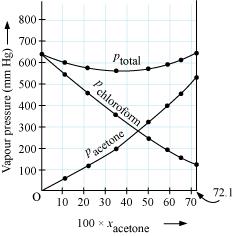
The plot of p(total) dips downwards and therefore, the solution shows negative deviation from ideal behaviour.
21.
(a) (i) Henry's Law: It states that the solubility of a gas in liquid is directly proportional to the pressure of the gas. P = KHx, where 'P' is pressure of gas, 'x' is mole fraction of of the gas and KH is Henry's law constant.
(ii) Boiling Point Elevation Constant (Molal Boiling Point Elevation Constant): It is equal to elevation in boiling point of 1molal solution, i.e. 1mole of solute is dissolved in 1 kg of solvent. The units of Kb is Kim or 0C/m or K kg mot".
(b) WB =? MB = 36 + 8 + 48 = 92 g mol-1, WA = 500 g, ~Tb = 100.420C - 1000C = 0.420C
\(\Delta T_b=K_b\times {W_B\over M_B}\times{1000\over W_A}\)
\(\Rightarrow\ 0.42=0.512\times{W_B\over 92}\times{1000\over 500}\)
\(\Rightarrow\ W_B={0.42\times92\over 2\times0.512}={38.64\over 1.024}=37.73g\)
22.
Assume that we have 100 g of solution (one can start with any amount of solution because the results obtained will be the same). Solution will contain 20 g of ethylene glycol and 80 g of water.
Molar mass of C2H6O2 = 12 x 2 + 1 × 6 + 16 × 2 = 62 g mol-1
\(\text {Moles of } \mathrm{C}_{2} \mathrm{H}_{6} \mathrm{O}_{2}=\frac{20 \mathrm{~g}}{62 \mathrm{~g} \mathrm{~mol}^{-1}}=0.322 \mathrm{~mol}\)
\(\text {Moles of water }=\frac{80 \mathrm{~g}}{18 \mathrm{~g} \mathrm{~mol}^{-1}}=4.444 \mathrm{~mol}\)
\(\mathrm{x}_{\text {glycol }}=\frac{\text { moles of } \mathrm{C}_{2} \mathrm{H}_{6} \mathrm{O}_{2}}{\text { moles of } \mathrm{C}_{2} \mathrm{H}_{6} \mathrm{O}_{2}+\text { moles of } \mathrm{H}_{2} \mathrm{O}}\)
\(=\frac{0.322 \mathrm{~mol}}{0.322 \mathrm{~mol}+4.444 \mathrm{~mol}}=0.068\)
\(\text {Similarly, } x_{\text {water }}=\frac{4.444 \mathrm{~mol}}{0.322 \mathrm{~mol}+4.444 \mathrm{~mol}}=0.932\)
Mole fraction of water can also be calculated as: 1- 0.068 = 0.932
23.
Molar mass of KCI = 39 + 35.5 = 74.35 g mol-1
A KCI dissociates completely, number of ions produced are 2.There, Van't Hoff factor, i = 2
Mass of KCI solution = 1000 \(\times\)1.04 = 1040 g
Mass of solvent = 1040 - 74.5 = 965.5 g = 0.9655 kg1/2
Molality of the solution :
\(\\ \frac { No.\quad of\quad moles\quad of\quad solute }{ Mass\quad of\quad solvent\quad in\quad kg } =\frac { 1\quad mol }{ 0.9655\quad kg } =1.0357\quad m\)
Tb = i \(\times\)Kb \(\times\)m
= 2 \(\times\) 0.52 \(\times\)1.0357 = 1.078 \(°\) C
Therefore, boiling point of solution
= 100 = 1.078 = 101.078\(°\)C
24.
Depression in freezing point is related to the molality, therefore, the molality of the solution with respect to ethylene glycol \(=\frac{\text { moles of ethylene glycol }}{\text { mass of water in kilogram }}\)
\(\text {Moles of ethylene glycol }=\frac{45 \mathrm{~g}}{62 \mathrm{~g} \mathrm{~mol}^{-1}}=0.73 \mathrm{~mol}\)
\(\text {Mass of water in } \mathrm{kg}=\frac{600 \mathrm{~g}}{1000 \mathrm{~g} \mathrm{~kg}^{-1}}=0.6 \mathrm{~kg}\)
\(\text {Hence molality of ethylene glycol }=\frac{0.73 \mathrm{~mol}}{0.60 \mathrm{~kg}}=1.2 \mathrm{~mol} \mathrm{~kg}^{-1}\)
Therefore freezing point depression,
ÄTf = 1.86 K kg mol–1 x 1.2 mol kg–1 = 2.2 K
Freezing point of the aqueous solution = 273.15 K – 2.2 K = 270.95 K
25.
\(\Delta\)Tb = iKbm
i = 2
\(\Delta\)Tb = i \(\times\)Kb \(\times\)\(\frac { { W }_{ 2 }\times 1000 }{ M\times { W }_{ 1 } } \)
\(=2\times 0.52 \ K \ kg \ { mol }^{ -1 }\times \frac { 4g\times 1000 \ g/kg }{ 120 \ g/mol\times 100g } \)
\(=\frac { 2\times 0.52 }{ 3 } =0.346\ K\)
Boiling point of solution=\(\frac { 373.15\quad K }{ 373\quad K } \)
Tb = \({ \Delta T }_{ b }^{ o }+\Delta { T }_{ b }\)
\(=\frac { 373.15+0.346\quad K }{ 373\quad K+\quad 0.346\quad K } \)
\(=\frac { 373.496\ K }{ 373.346\ K } \)
26.
(i) The cell walls of the vegetables have semi-permeable membrane. When the vegetables have dried, the concentration of water inside becomes low. When the dried or shrinked vegetables are placed in water, water enters into the cells due to osmosis. Hence, they swell and return to the original form.
(ii) The process is osmosis. It is defined as the flow of the solvent molecules from the solvent to the solution or from less concentrated solution to a more concentrated solution through a semi-permeable membrane.
(iii) The process will be accelerated with increase of temperature because osmosis becomes faster with increase of temperature.
27.
0.25 Molal aqueous solution to urea means that
moles of urea = 0.25 mole
mass of solvent (NH2CONH2) = 60 g mol-1
\(\therefore\) 0.25 mole of urea = 0.25 x 60 = 15g
Mass of solution = 1000+15 = 1015g = 1.015 kg
1.015 kg of urea solution contains 15g of urea
\(\therefore\)2.5 kg of solution contains urea = 15/1.015 x 2.5 = 37 g
28.
According to Raoult’s Law,
\(\frac{\mathrm{P}_{\mathrm{A}}^{\circ}-\mathrm{P}_{\mathrm{S}}}{\mathrm{P}_{\mathrm{S}}}=\frac{n_{\mathrm{B}}}{n_{\mathrm{A}}}=\frac{\mathrm{W}_{\mathrm{B}}}{\mathrm{M}_{\mathrm{B}}} \times \frac{\mathrm{M}_{\mathrm{A}}}{\mathrm{W}_{\mathrm{A}}}\)
\(\text { Let } \mathrm{P}_{\mathrm{A}}^{\circ}=1 \mathrm{~atm}, \mathrm{P}_{\mathrm{S}}=0 \cdot 8 \mathrm{~atm} ; \mathrm{P}_{\mathrm{A}}^{\circ}-\mathrm{P}_{\mathrm{S}}=0 \cdot 2 \mathrm{~atm} ; \mathrm{M}_{\mathrm{B}}=40 \mathrm{~g} \mathrm{~mol}^{-1} ; \mathrm{W}_{\mathrm{A}}=114 \mathrm{~g} \)
\(\mathrm{M}_{\mathrm{A}}\left(\mathrm{C}_{8} \mathrm{H}_{18}\right)=114 \mathrm{~g} \mathrm{~mol}^{-1} \)
\(\mathrm{W}_{\mathrm{B}}=\frac{\left(\mathrm{P}_{\mathrm{A}}^{\circ}-\mathrm{P}_{\mathrm{S}}\right)}{\mathrm{P}_{\mathrm{S}}} \times \frac{\mathrm{M}_{\mathrm{B}} \times \mathrm{W}_{\mathrm{A}}}{\mathrm{M}_{\mathrm{A}}}\)
\(=\frac{(0 \cdot 2 \mathrm{~atm})}{(0 \cdot 8 \mathrm{~atm})} \times \frac{\left(40 \mathrm{~g} \mathrm{~mol}^{-1}\right) \times(114 \mathrm{~g})}{\left(114 \mathrm{~g} \mathrm{~mol}^{-1}\right)}=10 \cdot 0 \mathrm{~g}\)
29.
\(\frac { { p }_{ A }^{ \circ }-{ p }_{ A } }{ { p }_{ A }^{ \circ } } ={ X }_{ B }=\frac { \frac { { W }_{ B } }{ { M }_{ B } } }{ \frac { { W }_{ A } }{ { M }_{ A } } +\frac { { W }_{ B } }{ { M }_{ B } } } \)
\(\\ \Rightarrow \frac { 3.165kPa-{ p }_{ A } }{ 3.165 \ kPa } =\frac { \frac { { W }_{ B } }{ { M }_{ B } } }{ \frac { { W }_{ A } }{ { M }_{ A } } } \)
\([\because \frac { { W }_{ B } }{ { M }_{ B } } <<<\frac { { W }_{ A } }{ { M }_{ A } } ]\)
\(\\ Molecular \ weight \ of \ urea=60.05 \ g \ { mol }^{ -1 }\)
\(\\ \Rightarrow 1-\frac { { p }_{ A } }{ 3.165 } =\frac { \frac { 5 }{ 60.05 } }{ \frac { 95 }{ 18 } } \)
\(\\ \Rightarrow 1-\frac { { p }_{ A } }{ 3.165 } =\frac { 5 }{ 60.05 } \times \frac { 18 }{ 95 } =\frac { 18 }{ 1140.95 } \)
\( \Rightarrow \frac { { p }_{ A } }{ 3.165 } =1-\frac { 18 }{ 1140.95 } \)
\(=\frac { 1140.95-18.00 }{ 1140.95 } =\frac { 1122.95 }{ 1140.95 } \)
\(\Rightarrow \ \ { p }_{ A }=\frac { 3.165\times1122.95 }{ 1140.95 }\)
\(=3.115 \ kPa=3.12 \ kPa\)
30.
(c)
93 g
31.
(b)
18oC
32.
(a)
0.70
33.
(b)
55.5 M
34.
(b)
Solution (A) will follow Raoult's law
35.
(b)
2,2 and 3
36.
0.01 M MgCI2 = 0.03 M particle concentration which is three times in comparison to 0.01 M glucose. Hence, depression will be about three times.
37.
Body temperature of the human body remains constant. Low concentration of oxygen in the blood at altitude is due to low atmospheric pressure.
38.
In case of dissociation, i>1 and in case of association, i>1.
39.
As solute is solid, the solvent, i.e., water will freeze out.
40.
\(\pi =CRT\\ C=0.002\quad mol\quad { dm }^{ -3 }=2\quad mol\quad { m }^{ -3 }\\ R={ 8.314JK }^{ -1 }{ mol }^{ -1 },T=293K\\ \pi =2\times 80314\times 293=4872\quad Pa\)
41.
(a)
\(\Delta { H }_{ soln }=\Delta { H }_{ 1 }+\Delta { H }_{ 2 }+\Delta { H }_{ 3 }\)
42.
Higher the solubility, lower is KH. As CO2 has maximum solubility, its KH is lowest.
43.
(a)
Solid solution
44.
()
1.86 K kg mol-1, 5.12 K kg mol-1
45.
()
positive, positive

12th Standard CBSE Syllabus & Materials
12th Standard CBSE
CBSE 12th Computer Science Python Revision Tour I - New Previous year Question Papers Study Material - QB365 Set A
NEW12th Standard CBSE
CBSE 12th Business Studies Planning Important Questions And Answers Study Material - QB365 Set A
NEW12th Standard CBSE
CBSE 12th Business Studies Business Environment Important Questions And Answers Study Material - QB365 Set A
NEW12th Standard CBSE
CBSE 12th Business Studies Principles of Management Important Questions And Answers Study Material - QB365 Set A



CBSE 12th Standard CBSE Subjects
CBSE Standards










