
 100% FREE ACCESS
12th Standard CBSE Syllabus & Materials
12th Standard CBSE
CBSE 12th Economics Government Budget and the Economy Previous year Question Papers Study Material - QB365 Set A
NEW12th Standard CBSE
CBSE 12th Computer Science Interface Python with MySQL - New Previous year Question Papers Study Material - QB365 Set A
NEW12th Standard CBSE
CBSE 12th Computer Science Database Concept - New Previous year Question Papers Study Material - QB365 Set A
NEW12th Standard CBSE
CBSE 12th Computer Science Data Communication - New Previous year Question Papers Study Material - QB365 Set A
NEW12th Standard CBSE
CBSE 12th Computer Science Data Structures - New Previous year Question Papers Study Material - QB365 Set A
NEW12th Standard CBSE
CBSE 12th Computer Science Functions - New Previous year Question Papers Study Material - QB365 Set A

Published on: 05/03/2019
Surface Chemistry Important Questions
Download CBSE Class 12th Standard CBSE Chemistry question papers, sample papers, important questions, and previous year solved papers in PDF format. Get free study materials, NCERT solutions, and exam preparation resources for Class 12th Standard CBSE Chemistry
Questions + Answers key
Take MCQ Chemistry Test
1.
To which colloidal system does milk belong?
2.
In reference to surface chemistry, define dialysis.
3.
Write a method by which lyophobic colloids can be coagulated
4.
If we add equimolar amount of \(Fe{ \left( OH \right) }_{ 3 }\) to \({ As }_{ 2 }{ S }_{ 3 }\) sol, what will happen?
5.
What causes Brownian movement in a colloidal solution?
6.
Write the differences between physisorption and chemisorption with respect to the following:
(i) Specificity
(ii) Temperature dependence
(iii) Reversibility
(iv) Enthalpy change
7.
Write adsorption isotherm for adsorption from solutions?
8.
List four applications of adsorption.
9.
Explain the terms with suitable examples:
(i) Alcosol
(ii) Aerosol and
(iii) Hydrosol
10.
Why are substance like platinium and palladium often used for carrying out electrolysis of aqueous solutions?
11.
What happens when a solution of NaCl is added to Fe(OH)3 sol, explain? Write whether Fe(OH)3 sol is a multimolecular colloid or macromolecular colloid.
12.
Write the reaction in which bismuthmolybdate is used as catalyst. Explain which characteristic of catalyst is shown by this reaction.
13.
Explain the following:
(a) Emulsification
(b) Emulsifying agent
(c) Demulsifier.
14.
Some zeolites are used to separate long straight chain hydrocarbons from branched chain hydrocarbons in petrochemical industry. Explain how this separation becomes possible.
15.
Describe a chemical method each for the preparation of the sols of sulphur and platinum in water.
16.
(i) Write the expression for the Freundlich's adsorption isotherm for the adsorption of gases on solids, in the form of an equation.
(ii) What are the dispersed phase and dispersion medium of butter?
(iii) A delta is formed at the meeting place of sea and river water. Why?
17.
Define the following terms:
(i) adsorption
(ii) peptisation
(iii) sol
18.
Define the following:
(i) Cationic detergents
(ii) Broad spectrum antibiotics
(iii) Tranquilisers
19.
How do the size of particles of adsorbent, pressure of gas and prevailing temperature influence the extent of adsorption of a gas on a solid?
20.
(a) How can we get the following colloidal solutions:
(i) Silver in water,
(ii) Sulphur in water,
(iii) Fe(OH)3 in water,
(iv) Gold in water.
(b) List two applications of adsorption.
21.
How are the two types of emulsions. different from one another ? Give suitable examples to justify the difference. State two applications of emulsions.
22.
What are role does adsorption play in heterogeneous catalysis?
23.
(a) In which of the following does adsorption take place and why?
(i) Silica gel placed in the atmosphere saturated with water.
(ii) Anhydrous CaCl2 placed in the atmosphere saturated with water.
(b) How does BF3 act as a catalyst in industrial process?
(c) Give an example of shape-selective catalysis.
24.
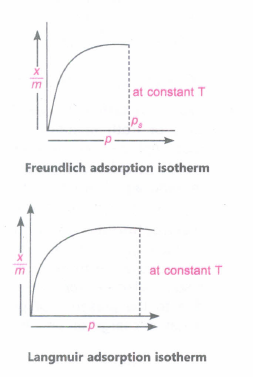
What is the adsorption isotherm? Distinguish between Freundlich adsorption isotherm and Langmuir adsorption isotherm with the help of appropriate graphs.
25.
How are the following colloidals different from each other in respect of their dispersion medium and dispersed phase? Give one example of each.
(i) Aerosol
(ii) Emulsion
(iii) Hydrosol
26.
In a reaction, catalyst changes...................... .
physically
qualitatively
chemically
quantitatively
27.
The value of colligative properties of colloidal solution are of smalll order in comparison to those shown by true solutions of same concentration because colloidal particles................
exhibit enormous surface area
remains suspended in the dispersion medium
form lyophilic colloids
are comparatively less in number
28.
Physical adsorption of a gaseous specis may change to chemical adsorption with.............................. .
decrease in temperature
increase in temperature
increase in surface area of adsorbent
decrease in surface area of adsorbent.
29.
Which of the following is correct ?
Adsorption is always exothermic
Adsorption is always endothermic
Physical adsorption is endothermic whereas chemisorption is exothermic
Chemical adsorption is exothermic whereas physical adsorption is endothermic.
30.
Choose the correct reason (s) for the stability of lyophobic colloidal particles.
Preferential adsorption of ions on their surface from the solution
Preferential adsorption of solvent on the surface from the solution
Attraction between different particles having opposite charges on their surface
Potential difference between the fixed layer and the diffused layer of opposite charges around the colloidal particles
31.
Which of the following statements are correct ?
Physical adsorption is multilayer, non - directional and non - specific.
Chemical adsorption increases with increase of temperature.
In some cases, solvent may be adsorption in preference to the solute on the surface of the adsorbent.
As a result of adsorption, there is increases of surface energy.
32.
Intensity of the scattered light depends upon the difference of which of the following property of the dispresed phase and the dispersion medium ?
densities
viscosities
surface tension
refractive indices
33.
Hydrolysis of protein in the stomach and intestine takes place due to presence of the enzymes
trypsin and pepsin respectively
pepsin and trypsin respectively
trypsin in both cases
pepsin in both cases
34.
In Freundlich adsorption isotherm, the value of 1/n is
between 0 and 1 in all cases
between 2 and 4 in all cases
1 in case of physical adsorption
1 in case of chemisorption
35.
Purple of cassius is a cooloidal sol of
silver
platinum
gold
iron
36.
The most adsorbed gas on activated charcoal is
N2
H2
CO2
CH4
37.
The process of separating the crystalloids from colloids using an animal membrane is called.......................... .
38.
Adsorption of N2 gas on iron at 83 K is........where as at 773 K, it is.....................(fill in the type of adsorption).
39.
Shyam living in Shimla, was washing clothes in cold water. He found that the clothes were not getting clean. Sneha, his grandmother, suggested that he wash the clothes in warm water, Washing of clothes with soaps or detergents is easier in luke warm water than cold water.
Answer the following questions:
(i) Why is it easier to wash the clothes in luke warm water?
(ii) What values are associated with these information?
40.
Hydrogenation of vegetable oil in presence of catalyst, is used to prepare vegetable ghee.
Vegetable oil ⟶ Vegetable ghee
It is the most important industrial process.
Answer the following questions:
(i) Which catalyst is commonly used in hydrogenation process and in which state?
(ii) Do you think we should use vegetable ghee instead of vegetable oils?
(iii) Is use of nickel useful or harmful for our body?
(iv) Why should we avoid taking deep fried snacks?
(v) Why should excessive use of antacids be avoided?
41.
Radha and Meera are fast friends. They both study in class XII.Radha is a student of science while Meera follows commerce stream. One day, when they were playing, Radha got hurt and started bleeding. Meera took her to house and applied some alum on the cut. The bleeding stopped immediately.
(i)Why bleeding stopped when some alum is applied on the cut?
(ii) What are the values associated with Meera's decision to take Radha to her house and apply alum on her cut?
42.
An emulsion is a colloidal dispersion in which both the dispersed phase and the dispersion medium are liquids. (The two liquids involved are otherwise immiscible).
43.
In an adsorption experiment, a graph between log (x/m) versus log P was found to be linear with a slope of 45o. The intercept on the log (x/m) axis was found to be 0.310. Calculate the amount of the gas adsorbed per gram of charcoal under a pressure of 0.5 atmosphere.
44.
A one - litre vessel contained a gas at 27oC. 6 g of charcoal was introduced into it. The pressure of the gas fell down from 700 mm to 400 mm. Calculate the volume of the gas (at S.T.P) adsorbed per gram of charcoal. Density of charcoal sample used was 1.5 g cm-3 .
45.
Paints
46.
Solvent molecules pass through semipermeable menbers towards solution side
1.
()
Emulsion.
2.
()
Dialysis is a process of removing a dissolved substance from a colloidal solution by means of diffusion through a suitable membrane.
3.
()
By electrophoresis lyophobic colloids can be coagulated.Other methods are by mixing two oppositely charged sols or by addition of electrolyte.
4.
()
Mutual coagulation will take place because \(Fe{ \left( OH \right) }_{ 3 }\) is positively charged colloid, whereas \({ As }_{ 2 }{ S }_{ 3 }\) is negatively charged colloid.
5.
()
It is due to unbalanced collision between colloidal particles and with the particles of dispersion medium.
6.
| Criteria | Physisorption | Chemisorption |
| Specificity | It is not specific in nature | It is highly specific in nature. |
| temperature dependence | It decreases with increase in temperature. Thus, low temperature is favourable for physisorption. |
It occurs at moderate temperature. It first increases and then decreases with increase in temperature. |
| Reversibility | Reversible in nature. | Irreversible in nature. |
| Enthalpy change | Low enthalpy of adsorption. (20-40 kJmol-1) | High enthalpy of adsorption. (80-240 kJmol-1) |
7.
Adsorption isotherm for solutions. The variation of extent of adsorption (x/m) and the equilibrium concentration (c) is expressed as
\(\frac { x }{ m } ={ kc }^{ 1/n }\) --------(i)
where k and n are constants which depend on the nature of adsorbent, adsorbate, and temperature. A graph between x/m and has been found to be similar to one shown for x/m and for gasses on solids. Taking logarithms, Eq. (i) becomes
\(log\frac { x }{ m } =k+\frac { 1 }{ n } log\quad c\)
when a graph is plotted between x/m and log c, a graph similar to has been obtained. From this 1/n graph, the value of 1/n and log k can be obtained as n slope and intercept respectively.
8.
(i) Chromatography is based on differential absorption.
(ii) The charge on the colloidal solution is due to selective adsorption of common ions on the surface.
(iii) Heterogeneous catalysis is based, on adsorption of gasses on solid.
(iv) Carbon particles from smoke get adsorbed on the surface of electrodes of Cottrell smoke precipitator
9.
(i) Alcosol: Is is a colloidal dispersion having alcohol as the dispersion medium, e.g., collodion (a colloidal sol of cellulose nitrate in ethyl alcohol).
(ii) Aerosol: It is a colloidal dispersion of a liquid in a gas, e.g., fog.
(iii) Hydrosol: It is a colloidal sol of a solid in water as the dispersion medium, e.g., starch sol or gold sol.
10.
Platinium and palladium form inert electrodes,i.e., they are not attacked by the ions of the electrolyte or the products of electrolysis. Hence, they are used as electrodes for carrying out the electrolysis.
11.
Coagulation of Fe(OH)3 sol takes place because excess of Cl- will react with Fe(OH)3. Fe(OH)3 is multimolecular colloid.
12.
\(\underset { Propene }{ { CH }_{ 2 }=CH-{ CH }_{ 3 }+{ O }_{ 2 } } \xrightarrow{BiMoO_4}\underset { Acrolein }{ { CH }_{ 2 }=CH-{ CH }O } +H_2O\)
This reaction explains selectivity of the catalyst
13.
(a) Emulsification: The process of making an emulsion from an oil is termed emulsification.
(b) Emulsifying agent: The substances which stabilise emulsions are called emulsifying agents or emulsifier, e.g. soaps and detergents.
(c) Demulsifier: It is a substance which changes the emulsion into two separate layers.
14.
Zeolites are being widely used as catalyst in petrochemical industries for cracking of hydrocarbons and isomerisation.An important catalyst used in the petroleum industry is ZSM-S.It converts alcohols directly into gasoline (petrol) by dehydrating them so that a mixture of hydrocarbon is obtained. Since zeolites have specific pore size therefore, only alcohols of specific size and shape are catalysed by them and converted into hydrocarbons.
15.
Sulfur sol can be prepared by oxidation of with the help\({ H }_{ 2 }S\) of Conc. \({ HNO }_{ 3 }\)
\({ H }_{ 2 }S\overset { [O] }{ \underset { { HNO }_{ 3 } }{ \rightarrow } } { H }_{ 2 }O+S\ \ { HNO }_{ 3 }\)
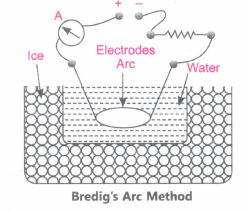
Bredig's Arc Method: Platinum (Pt) sol can be prepared by Bredig's arc method. Two Pt metal electrodes are taken through which high voltage is passed so that metal gets vaporized. When vapors are condensed, a colloidal solution of Pt in water is obtained.
16.
In butter, dispersed phase-liquid; dispersion medium- solid.
17.
Sol is solid dispersed in liquid, e.g. paints, cell fluids etc.
18.
Cationic detergents are quarternary ammonium salts of amines with acetates, chlorides or bromides as anions. The cationic part possesses a long hydrocarbon chain with a positive charge on nitrogen atom. e.g. cetyltrimethylammonium bromide used in hair conditioners.
\(\left[ { CH }_{ 3 }({ CH }_{ 2 })_{ 15 }-\overset { \begin{matrix} { CH }_{ 3 } \\ | \end{matrix} }{ \underset { \begin{matrix} | \\ { CH }_{ 3 } \end{matrix} }{ N } } \right] ^{ + }{ Br }^{ - }\)
(ii) Broad spectrum antibiotic Antibiotics which kill or inhibit a wide range of harmful or disease causing bacteria are called broad spectrum antibiotics. These are equally effective against gram-positive and gram-negative bacteria (both). e.g. ampicillin and amoxycillin.
(iii) Tranquiliser The chemical compounds which are used for the treatment of stress, mild and severe mental diseases are known as tranqulisers,
e.g. equanil. They form an essential component of sleeping pills
19.
(i) Smaller the size of the particles of adsorbent larger will be the surface area and greater will be the extent of adsorption.
(ii) At constant temperature, the extent of adsorption increases with increase of pressure, rapidly in the beginning, relatively slow at moderate pressure and ultimately becomes independent of pressure.
(iii) At constant pressure, the physical adsorption decreases with increase of temperature whereas, the chemisorption first increases and then decreases.
20.
(a) silver sol. in water is prepared by striking electric arc between two silver rods suspended in alkaline water. (Bredig's are method)
(ii) 2H2S+H2SO3 \(\rightarrow\) 3H2O+3S
(iii) Fecl3+3H2O \(\rightarrow\) Fe(OH)3+3HCL
(iv) 2AuCl3+3SnCl2 \(\rightarrow\) 2Au+3SnCl4
(b) (i) The gas masks function on principle of adsorption.
(ii) Chromatography is based on adsorption phenomenon.
21.
Two types of emulsions are as follows:
| Oil in Water | Water in Oil |
| In this type of emulsions, dispersed phase is oil and dispersion medium is water. e.g., Milk. |
In this type of emulsions, water acts as dispersed phase while the oil behaves as dispersion medium. e.g., Butter. |
Application of Emulsions:
(i) In medicine: The various pharmaceuticals and cosmetics are available in liquid form such as codliver oil etc., and some creams and ointment are emulsions of water in oil type.
(ii) Cleaning action of soap: This action is based on the formation of oil in water type emulsions
22.
In heterogeneous catalysis, generally, the reactants are gaseous whereas catalysts a solid. The reactant molecules are adsorbed on the surface of the solid catalyst by physical adsorption or chemisorption. As a result of the concentration of the reactant molecules on the surface increases and hence the rate of reaction increases. Alternatively, one of the reactant molecules undergoes fragmentation on the surface of the solid catalyst producing active species which react faster. The product molecules, in either case, have no affinity for the solid catalyst and are desorbed making the surface free for fresh adsorption. This theory is called adsorption theory.
23.
a) Silica gel is a good adsorbent and hence water vapour are adsorbed on its surface. Anhydrous CaCl2 undergoes absorption because it combines with water molecules to form hydrated calcium chloride, CaCI2. 2H2O.
b) BF3 acts as a strong Lewis acid and hence used as catalyst in industrial processes.
24.
When we plot a graph between the extent of adsorption (x/m) vs pressure (p) at a constant temperature, it is called adsorption isotherm.Freundlich adsorption isotherm fails at high pressure of gas, whereas Langmuir adsorption isotherm does not. Langmuir adsorption isotherm is based on kinetic. theory of gasses. It involves two processes, i.e. adsorption and desorption. It is applicable to chemical adsorption in which unimolecular layer is formed. Langmuir adsorption isotherm is based on assumption that every adsorption site is equivalent and that the ability of a particle to bind a particular at adsorption site or active site does not depend on whether or not nearby sites are occupied
25.
| Dispersed phase | Dispersion Medium | Name of the colloidal solution | Examples |
| Solid | Gas | Aerosol | Smoke, dust particles |
| Liquid | Liquid | Emulsion | Milk, hair cream, cod-liver oil |
(iii) When solid is dispersed in water, it is called hydrosol, e.g. starch dispersed in water.
26.
(b)
qualitatively
27.
Colloidal particles are big in size (macromolecular) and hence small in number in the same amount in grams/litre.
28.
(b)
increase in temperature
29.
(a)
Adsorption is always exothermic
30.
(a)
Preferential adsorption of ions on their surface from the solution
31.
(a)
Physical adsorption is multilayer, non - directional and non - specific.
32.
(d)
refractive indices
33.
(b)
pepsin and trypsin respectively
34.
(a)
between 0 and 1 in all cases
35.
(c)
gold
36.
(c)
CO2
37.
()
dialysis
38.
()
physisorption, chemisorption.
39.
(i) Soaps work due to the formation of micelles. But the formation of micelles takes place at a minimum temperature called 'Kraft temperature'. This temperature is reached in luke warm water.
(ii) Be humble to accept a scientific fact from a elder person.
40.
(i) Finely divided nickel is used as catalyst in hydrogenation.
(ii) No, we should use vegetable oil instead of vegetable ghee as it is partly saturated, may lead to formation of cholesterol.
(iii) Nickel gets mixed with vegetable ghee. It is harmful for our body as it is found to be carcinogenic (cancer causing).
(iv) It is because these led to the formation of excess of acid, which leads to hyperacidity, indigestion and stomach disorders.
(v) These are basic in nature and thus can induce more secretion of hydrochloric acid in gastric juice, that is why, these should be avoided as far as possible.
41.
(i) Blood is a colloidal solution of albuminoid substance. The styptic action (blood stopping action) of alum is due to coagulation of blood forming a clot which stops further bleeding.
(ii) Values associated with Meera's decision are:
(a) Friendship
(b) Keen observation
(c) Applying knowledge of chemistry to daily life
(d) Responsibility
(e) Love and care.
42.
Method of preparation. An emulsion is prepared by shaking strongly the mixture of the two liquids or by passing the mixture through a colloid mill, called the homogenizer. The emulsions thus prepared from the pure liquids are usually not stable and the two liquids separate out on standing. To get a stable emulsion, small quantities of certain other substances are added during preparation. The substances thus added (tJ stabilize the emulsions are called emulsifiers or emulsifying agents. The substances commonly used as emulsifying agents are soaps of various kinds, long chain sulphonic acids or lyophilic colloids (proteins, gum, agar etc.).
Role of emulsifier. The role of emulsifier can be explained taking the example of soap as an emulsifier. Soaps are sodium or potassium salts of higher fatty acids, e.g., sodium palmitate (C15H31COONa), sodium stearate (C17H35COONa), etc. A molecule of soap consists of two parts, the hydrocarbon part (C15H31 -, C17H35 - , etc.) which is soluble in oil and the polar group (COO-Na+) which is soluble in water
R COO-Na+
Hydrophobic part Hydrophilic part
(Soluble in oil) (Soluble in water)
Thus, if a drop of oil is surrounded by soap solution, the R - part of the soap remains in the oil and the COO-Na+ part remains in water as shown in Fig. 5.31. Thus, soap molecules are concentrated over the surface of the drop of oil. As a result, the interracial tension between oil and water decreases and hence they are intermixed into each other to form the emulsion.Thus, micelles are formed Some other commonly used stabilizing agents are proteins, gums and agar
Types of Emulsions. If the term "oil" is used for any liquid which is immicible with water and is capable of forming an emulsion with water, then the various types of emulsions may be classified into two types (fig. 5.32). These are:
(i) Emulsion of oil-in-water (o/w) in which oil is the dispersed phase and water is the dispersion medium.
For example, milk is an emulsion of liquid fat dispersed
in water. Another well known example is that of vanishing cream
(ii)Emulsion of water-in-oil (w/o) in which water is the dispersed phase and oil is the dispersion medium.For example, cod liver oil is an emusion of water in oil, i.e., water is the dispersed phase and oil is the dispersion medium. Two other common examples of this type are butter and cold cream.
Evidently, the type of emulsion depends upon the relative amounts of the two liquids. If water is in excess, it is oil-in-water emulsion.JIf oil is in excess, it is water-in-oil emulsion. The type of emulsion formed also depends upon the nature of the emulsifying agent. For example, the presence of soluble soaps as the emulsifying agents generally favours the formation of emulsions of oil-in-water whereas the presence of insoluble soaps (containing non-alkali metal atoms) favours the formation of emulsions of water-in-oil.Some very commonly used emulsifying agents for o/w emulsions are : proteins, gums, natural and synthetic soaps whereas for w/o emulsions are: heavy metal salts of fatty acids, long chain alcohols, lamp black, etc
To test the type of emulsion. The type to which the given emulsion belongs can be tested experimentally by anyone of the following methods:
(i) Microscopic method. To a small amount of the given emulsion, a few drops of water are added. The water will mix completely if the emulsion is oil-in-water type. Likewise, for the water-in-oil emulsion, the miscibility with a few drops of oil can be tested. The miscibility can be seen under a microscope.
(ii) Conductance method. This method is based upon adding a small amount of an electrolyte to the emulsion. If the conductance increases, the emulsion is oil-in-water type and if there is no significant change, it is water-in-oil type.
(iii) Dye method. A small amount of an oil-soluble dye is added to the emulsion. If it is water-in-oil type, it becomes deeply coloured, otherwise it remains colourless.
43.
At P = 0.5 atm, \(\frac { x }{ m } kP1/n\ =\ 2\times { (0.5) }^{ 1 }=1.0\)
44.
V2 = 59.6 cm3
45.
()
dispersion of solid in liquid
46.
()
Osmosis

12th Standard CBSE Syllabus & Materials
12th Standard CBSE
CBSE 12th Computer Science Python Revision Tour I - New Previous year Question Papers Study Material - QB365 Set A
NEW12th Standard CBSE
CBSE 12th Business Studies Planning Important Questions And Answers Study Material - QB365 Set A
NEW12th Standard CBSE
CBSE 12th Business Studies Business Environment Important Questions And Answers Study Material - QB365 Set A
NEW12th Standard CBSE
CBSE 12th Business Studies Principles of Management Important Questions And Answers Study Material - QB365 Set A



CBSE 12th Standard CBSE Subjects
CBSE Standards










