
 100% FREE ACCESS
12th Standard CBSE Syllabus & Materials
12th Standard CBSE
CBSE 12th Economics Government Budget and the Economy Previous year Question Papers Study Material - QB365 Set A
NEW12th Standard CBSE
CBSE 12th Computer Science Interface Python with MySQL - New Previous year Question Papers Study Material - QB365 Set A
NEW12th Standard CBSE
CBSE 12th Computer Science Database Concept - New Previous year Question Papers Study Material - QB365 Set A
NEW12th Standard CBSE
CBSE 12th Computer Science Data Communication - New Previous year Question Papers Study Material - QB365 Set A
NEW12th Standard CBSE
CBSE 12th Computer Science Data Structures - New Previous year Question Papers Study Material - QB365 Set A
NEW12th Standard CBSE
CBSE 12th Computer Science Functions - New Previous year Question Papers Study Material - QB365 Set A

Published on: 05/05/2022
Test
Download CBSE Class 12th Standard CBSE Maths question papers, sample papers, important questions, and previous year solved papers in PDF format. Get free study materials, NCERT solutions, and exam preparation resources for Class 12th Standard CBSE Maths
Questions + Answers key
Take MCQ Maths Test
1.
The total cost C(x) associated with provision of free mid-day meals to x students of a school in primary classes is given by C(x)=0.005x3-0.02x2+30x+50
If the marginal cost is given by rate of change \(dC\over dX\)of total cost,write the marginal cost of food for 300students.What value is shown here?
2.
For the curve \(y=4 x^{3}-2 x^{5}\) find all the points at which the tangent passes through the origin.
3.
Find ths approximate value of the following using derivative
\((26.57)^{1 / 3}\)
4.
A point on the hypotenuse of a triangle is at distances a and b from the sides of the triangle. Show that the minimum length of the hypotenuse is \(\left(a^{2 / 3}+b^{2 / 3}\right)^{3 / 2}\).
5.
Find the maximum area of an isosceles triangle inscribed in the ellipse \(\frac{x^{2}}{a^{2}}+\frac{y^{2}}{b^{2}}=1\) with its vertex at one end of the major axis
6.
Find two positive numbers whose sum is 16 and the sum of whose squares is minimum.
7.
Find the maximum and minimum values, if any of the following function
\(h(x)=x+1, x \in(-1,1)\)
8.
Find the maximum and minimum values, if any of the following function
\(f(x)=|\sin 4 x+3|\)
9.
Find the maximum and minimum values, if any of the following function.
\(h(x)=\sin (2 x)+5\)
10.
Find the maximum and minimum value, if any of the following functions
\(g(x)=-|x+1|+3\)
11.
Find the maximum and minimum values, if any of the following function.
\(f(x)=|x+2|-1\)
12.
It is given that at x = 1, the function \(x^{4}-62 x^{2}+a x+9\) attains maximum value on the interval [0, 2]. Find the value of a.
13.
Find the points at which the function f given by \(f(x)=(x-4)^{4}(x+1)^{3}\)
(i) local maxima.
(ii) local minima.
(iii) point of inflection.
14.
Using differential, find the approximate value of the following.
\((81.5)^{1 / 4}\)
15.
Using differential, find the approximate value of the following
\((0.999)^{1 / 10}\)
16.
Using differential, find the approximate value of the following \((255)^{1 / 4}\)
17.
Find the equations of the normal to the curve \(y=x^{3}+2 x+6\) ,which are parallel to line x+ 14y + 4 = 0.
18.
Find the intervals in which the following function is increasing or decreasing
\(f(x)=x^{3}+\frac{1}{x^{3}}, x \neq 0\)
19.
Find the intervals in which the function f given by
\(f(x)=\frac{4 \sin x-2 x-x \cos x}{2+\cos x}\)
is (i) increasing (ii) decreasing
20.
Using differentials, find the approximate value of (3.968)3/2.
21.
Find the equations of the tangent and normal to the curve \(\frac { { x }^{ 2 } }{ { a }^{ 2 } } -\frac { { y }^{ 2 } }{ { b }^{ 2 } } =1\) at the point \((\sqrt { 2 } a,b)\).
22.
Find the intervals in which \(f(x) =\frac{3}{10}x^4-\frac{4}{5}x^3+\frac{36}{5}x+11\)is (a) strictly increasing (b) strictly decreasing.
23.
Using differentials, find the approximate value of \(\sqrt {49\cdot5}\)
24.
Find the point on the curve \(y=x^3-11x+5\) at which the equation of tangent is \(y=x-11.\)
25.
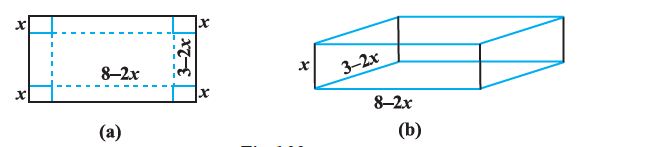
An open topped box is to be constructed by removing equal squares from each corner of a 3 metre by 8 metre rectangular sheet of aluminium and folding up the sides. Find the volume of the largest such box.
26.
Find the absolute maximum value and the absolute minimum value of the following functions in the given intervals:
\(f(x)=4 x-\frac{1}{2} x^2, x \in\left[-2, \frac{9}{2}\right]\)
27.
Find the absolute maximum value and the absolute minimum value of the following functions in the given intervals: \(f(x)=\sin x+\cos x, x \in[0, \pi]\)
28.
Find the shortest distance of the point (0, c) from the parabola y = x2, where \(\frac{1}{2}\) \(0\le c \le 5.\)
29.
Find two positive numbers whose sum is 15 and the sum of whose squares is minimum
30.
Show that the semi-vertical angle of the right circular cone of maximum volume and given slant height, is tan-1\(\sqrt{2}\)
31.
A window is in the form of a rectangle surmounted by a semicircular opening. The total perimeter of the window is 10 m. Find the dimensions of the window to admit maximum light through the whole opening.
32.
Manufacturer can sell x items at price of Rs. \((5-{x\over100})\) each. The cost price of x items is Rs. \(({x\over5}+500)\). Find the number of items he should sell to earn maximum profit.
33.
A tank with rectangular base and rectangular sides, open at the top is to be constructed so that its depth is 2 m and volume is 8 m3. If building of tank costs Rs. 70 per sq. metres for the base and Rs. 45 per square metre for sides. What is the cost of least expensive tank?
34.
Show that the height of the cylinder of maximum volume that can be inscribed in a sphere of radius R is \(2R\over \sqrt{3}\). Also find the maximum volume.
35.
Show that semi-vertical angle of right circular cone of given surface area and maximum volume is sin-1\(1\over3\).
36.
Prove that the volume of the largest cone that can be inscribed in a sphere of radius R is \(8\over27\)of the volume of the sphere.
37.
Show that the right circular cylinder of given volume open at the top has minimum total surface area,provided its height is equal to radius of its base.
38.
A wire of length 28 m is to be cut into two pieces. One of the pieces is to be made into a square and the other into a circle. What should be the length of the two pieces so that the combined area of the square and the circle is minimum?
39.
Show that the right circular cone of least curved surface and volume has an altitude equal to \(\sqrt{2}\) times the radius of the base.
40.
If the radius of a sphere is measured as 9cm with an error of 0.03cm, then find the approximate error in calculating its surface area
41.
Find the equation of all lines having slope -1 that are tangents to the curve \(y={1\over x-1},x\neq 1\).
42.
Show that the normal at any point \(\theta\) to the curve x = a cos \(\theta\)+ a\(\theta\) sin \(\theta\); y = a sin \(\theta\) - a \(\theta\) cos \(\theta\) is at a constant distance from origin.
43.
Find the equation of the tangent to the curve \(y=\frac { x-7 }{ \left( x-2 \right) \left( x-3 \right) } \)at the point where it cuts the x-axis.
44.
Show that \(y=log(1+x)-{2x\over2+x},x>-1\) is an increasing function of x, throughout its domain.
45.
Prove that \(y={4sin\theta\over2+cos\theta}-\theta\) is an increasing function of \(\theta\) in \([0,{\pi\over2}]\).
46.
Find the values of x for which f(x) = [x(x-2)]2 is an increasing function.
47.
A particle moves along the curve 6y = x3+2. Find the points on the curve at which the y-coordinate is changing 8 times as fast as x-coordinate .
48.
The volume of a cube is increasing at the rate of 8 cm3/sec. How fast is the surface area increasing when the length of an edge is 12 cm?
49.
The two equal sides of an isosceles triangle with fixed base b are decreasing at the rate of 3 cm per second. How fast is the area decreasing when the two equal sides are equal to the base?
50.
Sand is pouring from a pipe at the rate of 12 cm3/sec. The falling sand forms a cone on the ground in such a way that the height of the cone is always one-sixth of the radius of the base. How fast is the height of the sand-cone increasing, when the height is 4 cm?
51.
The length x of a rectangle is decreasing at the rate of 5 cm/minute and the width y is increasing at the rate of 4 cm/minute. When x = 8cm and y = 6cm, find the rates of change of
(a) the perimeter,
(b) the area of the rectangle.
52.
The points on the curve 9y2 = x3, where the normal to the curve makes equal intercepts with the axes are
\(\left( 4,\pm \frac { 8 }{ 3 } \right) \)
\(4,\frac { -8 }{ 3 } \)
\(\left( 4,\pm \frac { 3 }{ 8 } \right) \)
\(\left( 4,\pm \frac { 3 }{ 8 } \right) \)
53.
The normal to the curve x2 = 4y passing (1,2) is
x + y = 3
x – y = 3
x + y = 1
x – y = 1
54.
The normal at the point (1,1) on the curve 2y + x2 = 3 is
x + y = 0
x – y = 0
x + y +1 = 0
x – y = 1
55.
The line y = mx + 1 is a tangent to the curve y2 = 4x if the value of m is
1
2
3
\(\frac12\)
56.
The slope of the tangent to the curve x = t2 + 3t – 8, y = 2t2 – 2t – 5 at the point (2,– 1) is
\(\frac{22}{7}\)
\(\frac67\)
\(\frac76\)
\(\frac{-6}{7}\)
57.
A cylindrical tank of radius 10 m is being filled with wheat at the rate of 314 cubic metre per hour. Then the depth of the wheat is increasing at the rate of
1 m/h
0.1 m/h
1.1 m/h
0.5 m/h
58.
The maximum value of \({ [x(x-1)+1] }^{ \frac { 1 }{ 3 } }\), \(0\le x\le 1\) is
\({ \left( \frac { 1 }{ 3 } \right) }^{ \frac { 1 }{ 3 } }\)
\(\frac { 1 }{ 2 } \)
1
0
59.
For all real values of x, the minimum value of \(\frac { 1-x+{ x }^{ 2 } }{ 1+x+{ x }^{ 2 } } \) is
0
1
3
\(\frac { 1 }{ 3 } \)
60.
The point on the curve x2 = 2y which is nearest to the point (0, 5) is
(2 \(\sqrt2\),4)
(2 \(\sqrt2\),0)
(0, 0)
(2, 2)
61.
The approximate change in the volume of a cube of side x metres caused by increasing the side by 3% is
0.06 x3 m3
0.6 x3 m3
0.09 x3 m3
0.9 x3 m3
62.
If f(x) = 3x2 + 15x + 5, then the approximate value of f (3.02) is
47.66
57.66
67.66
77.66
63.
The line y = x + 1 is a tangent to the curve y2 = 4x at the point
(1, 2)
(2, 1)
(1, – 2)
(– 1, 2)
64.
The slope of the normal to the curve y = 2x2 + 3 sin x at x = 0 is
3
\(\frac13\)
-3
-\(\frac13\)
65.
The interval in which y = x2 e–x is increasing is
(– ∞, ∞)
(– 2, 0)
(2, ∞)
(0, 2)
66.
On which of the following intervals is the function f given by f (x) = x100 + sin x–1 decreasing?
(0, 1)
\(\frac{\pi}{2}\), ㅠ
0, \(\frac{\pi}{2}\)
None of these
67.
Which of the following functions are decreasing on 0, \(\frac{\pi}{2}\)?
cos x
cos 2x
cos 3x
tan x
68.
The total revenue in Rupees received from the sale of x units of a product is given by
R(x) = 3x2 + 36x + 5. The marginal revenue, when x = 15 is
116
96
90
126
69.
The rate of change of the area of a circle with respect to its radius r at r = 6 cm is
10π
12π
8π
11π
70.
Let R be the relation in the set {1, 2, 3, 4} given by R = {(1, 2), (2, 2), (1, 1), (4, 4), (1, 3), (3, 3), (3, 2)}. Choose the correct answer.
(A) R is reflexive and symmetric but not transitive.
(B) R is reflexive and transitive but not symmetric.
(C) R is symmetric and transitive but not reflexive.
(D) R is an equivalence relation.
1.
1368 Concern for children health and nutrient food for every child.
2.
The equation of the given curve is \( y=4 x^{3}-2 x^{5} \text { . }\)
\(\therefore \frac{d y}{d x}=12 x^{2}-10 x^{4}\)
Therefore, the slope of the tangent at a point (x,y) is \( 12 x^{2}-10 x^{4} \text { . }\)
The equation of the tangent at (x, y) is given by
\(Y-y=\left(12 x^{2}-10 x^{4}\right)(X-x)\)
When the tangent passes through the origin (0,0), then X = Y = 0
Therefore, equation (1) reduces to:
\(-y=\left(12 x^{2}-10 x^{4}\right)(-x) \)
\(y=12 x^{3}-10 x^{5} \)
\(y=4 x^{3}-2 x^{5}\)
\(\therefore 12 x^{3}-10 x^{5}=4 x^{3}-2 x^{5} \)
\(\Rightarrow 8 x^{5}-8 x^{3}=0\)
\(\Rightarrow x^{5}-x^{3}=0 \)
\(\Rightarrow x^{3}\left(x^{2}-1\right)=0 \)
\(\Rightarrow x=0, \pm 1 \)
\(\text {When } x=0, y=4(0)^{3}-2(0)^{5}=0\)
\(\text {When } x=1, y=4(1)^{3}-2(1)^{5}=2 \text { . }\)
\(\text {When } x=-1, y=4(-1)^{3}-2(-1)^{5}=-2\)
Hence, the required points are (0,0), (1,2), and (−1,−2) .
3.
\(\text { Consider } y=x^{\frac{1}{3}} \text { . Let } x=27 \text { and } \Delta x=-0.43 \text { . }\)
\(\text { Then, }\Delta y=(x+\Delta x)^{\frac{1}{3}}-x^{\frac{1}{3}}=(26.57)^{\frac{1}{3}}-(27)^{\frac{1}{3}}=(26.57)^{\frac{1}{3}}-3\)
\(\Rightarrow(26.57)^{\frac{1}{3}}=3+\Delta y\)
\(\text { Now, } d y \text { is approximately equal to } \Delta y \text { and is given by, }\)
\(d y=\left(\frac{d y}{d x}\right) \Delta x =\frac{1}{3(x)^{\frac{2}{3}}}(\Delta x) \quad\left[\text { as } y=x^{\frac{1}{3}}\right] \)
\(=\frac{1}{3(9)}(-0.43) \)
\(=\frac{-0.43}{27}=-0.015 \)
\(\text { Hence, the approximate value of }(26.57)^{\frac{1}{3}} \text { is } 3+(-0.015)=2.984 \text { . }\)
2.984
4.
Let P be a point on the hypotenuse AC of right angled
\(\Delta A B C \text { . Such that } P L \perp A B=a \text { and } P M \perp B C=b\)
Let \(\angle A P L=\angle A C B=\theta(\text { say })\)
Then,\(A P=a \sec \theta, P C=b \operatorname{cosec} \theta\)
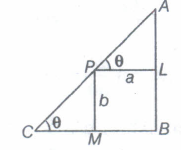
Let I be the length of the hypotenuse, then
\(l=A P+P C \)
\(\Rightarrow l=a \sec \theta+b \operatorname{cosec} \theta, 0<\theta<\frac{\pi}{2} \)
On differentiating both sides w.r.t. θ, we get
\(\frac{d l}{d \theta}=a \sec \theta \tan \theta-b \operatorname{cosec} \theta \cot \theta\)
For maxima or minima,put \(\frac{d l}{d \theta}=0\)
\(\Rightarrow a \sec \theta \tan \theta=b \operatorname{cosec} \theta \cot \theta \)
\(\Rightarrow\frac{a \sin \theta}{\cos ^{2} \theta}=\frac{b \cos \theta}{\sin ^{2} \theta} \Rightarrow \tan \theta=\left(\frac{b}{a}\right)^{1 /} \)
Again, differentiating both sides of Eq. (i) w.r.t. θ, we get
\( \frac{d^{2} l}{d \theta^{2}}=a\left(\sec \theta \times \sec ^{2} \theta+\tan \theta \times \sec \theta \tan \theta\right) -b\left[\operatorname{cosec} \theta\left(-\operatorname{cosec}^{2} \theta\right)+\cot \theta(-\operatorname{cosec} \theta \cot \theta)\right] \)
\(=a \sec \theta\left(\sec ^{2} \theta+\tan ^{2} \theta\right) +b \operatorname{cosec} \theta\left(\operatorname{cosec}^{2} \theta+\cot ^{2} \theta\right) \)
For \(0<\theta<\frac{\pi}{2}\) ,all trigonometric ratios are positive
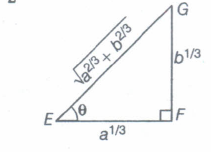
Also \(2 a>0 \text { and } b>0\)
\(\therefore \ \frac{d^{2} l}{d \theta^{2}} \text { is positive. }\)
and least value of
\(l=a \sec \theta+b \operatorname{cosec} \theta\)
\(=a \frac{\sqrt{a^{2 / 3}+b^{2 / 3}}}{a^{1 / 3}}+b \frac{\sqrt{a^{2 / 3}+b^{2 / 3}}}{b^{1 / 3}} \)
\(=\sqrt{a^{2 / 3}+b^{2 / 3}}\left(a^{2 / 3}+b^{2 / 3}\right)=\left(a^{2 / 3}+b^{2 / 3}\right)^{3 / 2} \)
\({\left[\because\right. \text { in } \Delta E F G, \tan \theta=\frac{b^{1 / 3}}{a^{1 / 3}}, \sec \theta=\frac{\sqrt{a^{2 / 3}+b^{2 /}}}{a^{1 / 3}}} \text { and } \left.\operatorname{cosec} \theta=\frac{\sqrt{a^{2 / 3}+b^{2 / 3}}}{b^{1 / 3}}\right] \)
Hence proved.
5.
Let the equation of an ellipse be \(\frac{x^{2}}{a^{2}}+\frac{y^{2}}{b^{2}}=1\) then any point on the ellipse is \(P(a \cos \theta, b \sin \theta)\)
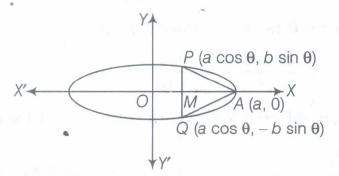
From P, draw PM \(\perp\) OX and produce it to meet the ellipse at Q, then APQ is an isosceles triangle, let S be its area then
\( S =2 \times \frac{1}{2} \times A M \times M P \)
\( =(O A-O M) \times M P \)
\(=(a-a \cos \theta) \cdot b \sin \theta \)
\(\Rightarrow S =a b(\sin \theta-\sin \theta \cos \theta)=a b\left(\sin \theta-\frac{1}{2} \sin 2 \theta\right) \)
On differentiating twice w.r.t. θ, we get
\( \frac{d S}{d \theta} =a b(\cos \theta-\cos 2 \theta) \)
\(\text { and } \frac{d^{2} S}{d \theta^{2}}=a b(-\sin \theta+2 \sin 2 \theta) \)
For maxima or minima, put \(d S / d \theta=0\)
\(\Rightarrow \cos \theta=\cos 2 \theta \Rightarrow 2 \theta=2 \pi-\theta\)
\(\Rightarrow 3 \theta=2 \pi \Rightarrow \theta=\frac{2 \pi}{3}\)
At \(\theta=\frac{2 \pi}{3}, \frac{d^{2} S}{d \theta^{2}}=a b\left[-\sin \frac{2 \pi}{3}+2 \sin \left(2 \times \frac{2 \pi}{3}\right)\right]\)
\( =a b\left[-\sin \left(\pi-\frac{\pi}{3}\right)+2 \sin \left(\pi+\frac{\pi}{3}\right)\right] \)
\(= a b\left(-\sin \frac{\pi}{3}-2 \sin \frac{\pi}{3}\right)\left[\begin{array}{c} \because \sin \left(\pi-\frac{\pi}{3}\right)=\sin \frac{\pi}{3} \\ \text { and } \sin \left(\pi+\frac{\pi}{3}\right)=\frac{-\sin \pi}{3} \end{array}\right] \)
\(=a b\left(-\frac{\sqrt{3}}{2}-\frac{2 \sqrt{3}}{2}\right)=a b\left(\frac{-3 \sqrt{3}}{2}\right)=\frac{-3 \sqrt{3} a b}{2}<0 \)
\(\therefore\) S is maximum, when \(\theta=\frac{2 \pi}{3}\) and maximum value of
\( S =a b\left(\sin \frac{2 \pi}{3}-\frac{1}{2} \cdot 2 \sin \frac{2 \pi}{3} \cos \frac{2 \pi}{3}\right) \)
\(=a b\left[\sin \left(\pi-\frac{\pi}{3}\right)-\sin \left(\pi-\frac{\pi}{3}\right) \cos \left(\pi-\frac{\pi}{3}\right)\right] \)
\(=a b\left[\sin \frac{\pi}{3}-\sin \frac{\pi}{3}\left(-\cos \frac{\pi}{3}\right)\right] \)
\(=a b\left[\sin \left(\pi-\frac{\pi}{3}\right)-\sin \left(\pi-\frac{\pi}{3}\right) \cos \left(\pi-\frac{\pi}{3}\right)\right. \)
\(=a b\left[\sin \frac{\pi}{3}-\sin \frac{\pi}{3}\left(-\cos \frac{\pi}{3}\right)\right] \)
\(=a b\left(\sin \frac{\pi}{3}+\sin \frac{\pi}{3} \cdot \cos \frac{\pi}{3}\right) \)
\(=a b\left(\frac{\sqrt{3}}{2}+\frac{\sqrt{3}}{2} \times \frac{1}{2}\right) \)
\(=a b\left(\frac{2 \sqrt{3}+\sqrt{3}}{4}\right) \)
\(=\frac{3 \sqrt{3}}{4} a b \text { sq units } \)
Hence, the maximum area of isosceles triangle is \(\frac{3 \sqrt{3}}{4} a b \text { sq units. }\)
6.
Let one number be x. Then, the other number is (16 − x).
Let the sum of the cubes of these numbers be denoted by S(x). Then, Now,
\(S(x)=x^{3}+(16-x)^{3} \)
\(\therefore S^{\prime}(x)=3 x^{2}-3(16-x)^{2}, S^{\prime \prime}(x)=6 x+6(16-x) \)
\(\text { Now, } S^{\prime}(x)=0 \Rightarrow 3 x^{2}-3(16-x)^{2}=0 \)
\(\Rightarrow x^{2}-(16-x)^{2}=0 \)
\(\Rightarrow x^{2}-256-x^{2}+32 x=0 \)
\(\Rightarrow x=\frac{256}{32}=8 \)
\(\text { Now, } S^{\prime \prime}(8)=6(8)+6(16-8)=48+48=96>0\)
∴ By second derivative test, x = 8 is the point of local minima of S.
Hence, the sum of the cubes of the numbers is the minimum when the numbers are 8 and 16 − 8 = 8.
7.
\(h(x)=x+1, x \in(-1,1)\)
\(\text { Here, if a point } x_{0} \text { is closest to }-1 \text { , then we find } \frac{x_{0}}{2}+1
\(\text {Also, if } x_{1} \text { is closest to } 1 \text { , then } x_{1}+1<\frac{x_{1}+1}{2}+1 \text { for all } x_{1} \in(-1,1) \text { . }\)
Hence, function h(x) has neither maximum nor minimum value in (-1,1)
8.
\(f(x)=|\sin 4 x+3|\)
\(\text { We know that }-1 \leq \sin 4 x \leq 1 \)
\(\Rightarrow 2 \leq \sin 4 x+3 \leq 4 \)
\(\Rightarrow 2 \leq|\sin 4 x+3| \leq 4 \)
Minimum value = 2, maximum value = 4
9.
\(h(x)=\sin (2 x)+5\)
\(\text { We know that }-1 \leq \sin 2 x \leq 1 .\)
\(\Rightarrow-1+5 \leq \sin 2 x+5 \leq 1+5 \)
\(\Rightarrow 4 \leq \sin 2 x+5 \leq 6\)
Minimum value = 4, maximum value = 6
10.
\(g(x)=-|x+1|+3\)
\(\text {We know that }-|x+1| \leq 0 \text { for every } x \in \mathbf{R} \text { . }\)
\(\text {Therefore, } g(x)=-|x+1|+3 \leq 3 \text { for every } x \in \mathbf{R} \text { . }\)
The maximum value of g is attained when \( |x+1|=0 \text { . }\)
\(|x+1|=0 \)
\(\Rightarrow x=-1 \)
\(\therefore \text { Maximum value of } g=g(-1)=-|-1+1|+3=3\)
Maximum value = 3, no minimum value
11.
\(f(x)=|x+2|-1\)
\(\text {We know that }|x+2| \geq 0 \text { for every } x \in \mathbf{R} \text { . }\)
\(\text {Therefore, } f(x)=|x+2|-1 \geq-1 \text { for every } x \in \mathbf{R} \text { . }\)
The minimum value of f is attained when \( |x+2|=0 \text { . }\)
\(|x+2|=0 \)
\(\Rightarrow x=-2 \)
\(\therefore \text { Minimum value of } f=f(-2)==|-2+2|-1=-1\)
Minimum value = -1, no maximum value
12.
Let f(x) = x4 − 62x2 + ax + 9
\(\therefore f^{\prime}(x)=4 x^{3}-124 x+a\)
It is given that function f attains its maximum value on the interval [0, 2] at x = 1.
\(\therefore f^{\prime}(1)=0 \)
\(\Rightarrow 4-124+a=0 \)
\(\Rightarrow a=120 \)
Hence, the value of a is 120
13.
The given function is \( f(x)=(x-2)^{4}(x+1)^{3} \text { . }\)
\(\therefore f^{\prime}(x) =4(x-2)^{3}(x+1)^{3}+3(x+1)^{2}(x-2)^{4} \)
\(=(x-2)^{3}(x+1)^{2}[4(x+1)+3(x-2)] \)
\(=(x-2)^{3}(x+1)^{2}(7 x-2) \)
\(\text { Now, } f^{\prime}(x)=0 \Rightarrow x=-1 \text { and } x=\frac{2}{7} \text { or } x=2\)
Now, for values of x close to \( \frac{2}{7} \)and to the left of \(\frac{2}{7}, f^{\prime}(x)>0\). Also, for values of x close to \(\frac{2}{7}\)and to
\(\text { the right of } \frac{2}{7}, f^{\prime}(x)<0\)
\(\text {Thus, } x=\frac{2}{7} \)is the point of local maxima
14.
\(\text { Consider } y=x^{\frac{1}{4}} \text { . Let } x=81 \text { and } \Delta x=0.5\)
\(\text { Then, }\Delta y=(x+\Delta x)^{\frac{1}{4}}-(x)^{\frac{1}{4}}=(81.5)^{\frac{1}{4}}-(81)^{\frac{1}{4}}=(81.5)^{1 /}-3\)
\(\Delta y=(x+\Delta x)^{\frac{1}{4}}-(x)^{\frac{1}{4}}=(81.5)^{\frac{1}{4}}-(81)^{\frac{1}{4}}=(81.5)^{4}-3 \)
\(\Rightarrow(81.5)^{\frac{1}{4}}=3+\Delta y \)
\(\text { Now, } d y \text { is approximately equal to } \Delta y \text { and is given by, }\)
\(d y=\left(\frac{d y}{d x}\right) \Delta x =\frac{1}{4(x)^{\frac{3}{4}}}(\Delta x) \quad\left[\text { as } y=x^{\frac{1}{4}}\right] \)
\(=\frac{1}{4(3)^{3}}(0.5)=\frac{0.5}{108}=0.0046 \)
\(\text { Hence, the approximate value of }(81.5)^{\frac{1}{4}} \text { is } 3+0.0046=3.0046\)
15.
\(\text { Consider } v=(x) \frac{1}{10} \text { . Let } x=1 \text { and } \Delta x=-0.001\)
\(\text { Then, }\Delta y=(x+\Delta x)^{\frac{1}{10}}-(x)^{\frac{1}{10}}=(0.999)^{\frac{1}{10}}-1\)
\(\Rightarrow(0.999)^{\frac{1}{10}}=1+\Delta y\)
\(\text { Now, } d y \text { is approximately equal to } \Delta y \text { and is given by, }\)
\(d y=\left(\frac{d y}{d x}\right) \Delta x =\frac{1}{10(x)^{\frac{9}{10}}}(\Delta x) \quad\left[\text { as } y=(x)^{\frac{1}{10}}\right] \)
\(=\frac{1}{10}(-0.001)=-0.0001\)
\(\text { Hence, the approximate value of }(0.999)^{\frac{1}{10}} \text { is } 1+(-0.0001)=0.9999 .\)
16.
We have,\((255)^{1 / 4}\)
It can be written as \((255)^{1 / 4}=(256-1)^{1 / 4}\)
Let \(x=256 \text { and } \Delta x=-1, \text { such that, } y=f(x)=(x)^{1 / 4}\)
\( \text { Now, } \Delta y=f(x+\Delta x)-f(x) \)
\(\therefore \Delta y=(x+\Delta x)^{1 / 4}-(x)^{1 / 4} \)
\(\Rightarrow \Delta y=(256-1)^{1 / 4}-(256)^{1 / 4} \)
\(\Rightarrow \Delta y=(255)^{1 / 4}-4 \)
\(\Rightarrow (255)^{1 / 4}=4+\Delta y \)
Now,
\( d y =\left(\frac{d y}{d x}\right) \Delta x=\frac{1}{4} x^{-3 / 4} \Delta x \)
\(=\frac{1}{4 x^{3 / 4}} \Delta x \quad\left[\because y=x^{1 / 4} \Rightarrow \frac{d y}{d x}=\frac{1}{4} x^{-3 / 4}\right] \)
\(=\frac{1}{4(256)^{3 / 4}} \times(-1)=\frac{-1}{4\left(4^{4}\right)^{3 / 4}} \)
\(=\frac{-1}{4(4)^{3}}=\frac{-1}{256}=-0.0039\)
Then, from Eq. (i), we get
\( (255)^{1 / 4} \approx 4+(-0.0039) \quad[\because d y \approx \Delta y] \)
\(=4-0.0039=3.9961 \)
Hence, the approximate value of \((255)^{1 / 4} \text { is } 3.9961\)
17.
Given the equation of curve is
\(y=x^{3}+2 x+6\) ..(i)
and equation of line is
x+14y+4 = 0
On differentiating both sides of (i) W.r.t. x, we get
\(\frac{d y}{d x}=3 x^{2}+2\)
\(\therefore \text { Slope of normal }=\frac{-1}{\left(\frac{d y}{d x}\right)}=\frac{-1}{3 x^{2}+2}\)
Also, slope of the line \(x+14 y+4=0 \text { is }-\frac{1}{14}\)
\(\left[\because \text { slope of the line } A x+B y+C=0 \text { is }\left(-\frac{A}{B}\right)\right]\)
Since, the normal to the curve is parallel to the line.
\(\therefore\) Slope of line = Slope of normal
\(\begin{array}{ll} \Rightarrow & \frac{-1}{14}=\frac{-1}{3 x^{2}+2} \Rightarrow 3 x^{2}+2=14 \\ \Rightarrow & 3 x^{2}=12 \Rightarrow x^{2}=4 \Rightarrow x=\pm 2 \end{array}\)
From Eq. (i), at x = 2, we get
y = (2)3 +2(2)+6 = 8+4+6 =18
and at x = - 2, we get
\(y=(-2)^{3}+2(-2)+6=-8-4+6=-6\)
\(\therefore\) Normal passes through the points (2, 18)and
Also, slope of normal \(\frac{-1}{14}\)
Hence, equation of normal at point (2, 18) is
\( y-y_{1}=\text { Slope of normal } \times\left(x-x_{1}\right) \)
\(\Rightarrow y-18=\frac{-1}{14}(x-2) \)
\(\Rightarrow 14 y-252 =-x+2 \Rightarrow x+14 y=254 \)
and equation of normal at point (- 2, - 6) is
\( y+6 =-\frac{1}{14}(x+2) \)
\(\Rightarrow14 y+84 =-x-2 \)
\( \Rightarrow x+14 y =-86 \)
Hence, the two equations of normal are x + 14y = 254 and x+14y = -86
18.
\(f(x)=x^{3}+\frac{1}{x^{3}} \)
\(\therefore f^{\prime}(x)=3 x^{2}-\frac{3}{x^{4}}=\frac{3 x^{6}-3}{x^{4}} \)
\(\text {Then, } f^{\prime}(x)=0 \Rightarrow 3 x^{6}-3=0 \Rightarrow x^{6}=1 \Rightarrow x=\pm 1 \)
\(\text {Now, the points } x=1 \text { and } x=-1 \)divide the real line into three disjoint intervals i.e.
\((-\infty,-1),(-1,1), \text { and }(1, \infty)\)
\(\text {In intervals }(-\infty,-1) \text { and }(1, \infty) \text { i.e., when } x<-1 \text { and } x>1, f^{\prime}(x)>0 \text { . }\)
\(\text {Thus, when } x<-1 \text { and } x>1, f \text { is increasing. }\)
19.
Given \(f(x)=\frac{4 \sin x-2 x-x \cos x}{2+\cos x}\)
\( =\frac{4 \sin x-x(2+\cos x)}{2+\cos x} \)
\(=\frac{4 \sin x}{2+\cos x}-\frac{x(2+\cos x)}{2+\cos x} \)
\(=\frac{4 \sin x}{2+\cos x}-x \)
On differentiating both sides w.r.t. x, we get
\( f^{\prime}(x) =4\left\{\frac{(2+\cos x) \cos x-\sin x(0-\sin x)}{(2+\cos x)^{2}}\right\}-1 \)
\(=4\left\{\frac{2 \cos x+\cos ^{2} x+\sin ^{2} x}{(2+\cos x)^{2}}\right\}-1 \)
\(\left[\because \cos ^{2} x+\sin ^{2} x=1\right] \)
\(=\frac{8 \cos x+4}{(2+\cos x)^{2}}-1 \)
\(=\frac{8 \cos x+4-(2+\cos x)^{2}}{(2+\cos x)^{2}} \)
\(=\frac{8 \cos x+4-4-\cos ^{2} x-4 \cos x}{(2+\cos x)^{2}} \)
\(=\frac{4 \cos x-\cos ^{2} x}{(2+\cos x)^{2}} \)
\( =\frac{\cos x(4-\cos x)}{(2+\cos x)^{2}} \)
We know that \(-1 \leq \cos x \leq 1\)
\(\Rightarrow 4-\cos x>0 \text { and }(2+\cos x)^{2}>0\)
(a) For f(x) to be increasing,
\(f^{\prime}(x) \geq 0, \text { when } \cos x \geq 0\)
[\(\because\)cos x is positive in I and IV quadrants]
Thus, f(x) is increasing in the interval
\(\left(0, \frac{\pi}{2}\right] \cup\left[\frac{3 \pi}{2}, 2 \pi\right)\)
(b) For f(x) to be decreasing
\(f^{\prime}(x) \leq 0, \text { when } \cos x \leq 0\)
\([\because \cos x \text { is negative in II and III quadrants] }\)
Hence, f(x) is decreasing in the interval \(\left[\frac{\pi}{2}, \frac{3 \pi}{2}\right]\).
20.
Let y = f(x) = x3/2, x = 4,
x + \(\Delta \)x = 3.968
\(\therefore \ \Delta x=-0.032\)
\(\Delta y={ \left[ \frac { dy }{ dx } \right] }_{ x=4 }\Delta x\)
\(\Rightarrow \Delta y={ \left[ \frac { 3 }{ 2 } { x }^{ 1/2 } \right] }_{ x=4 }\Delta x\)
\(\Rightarrow \Delta y=\frac { 3 }{ 2 } \times 2(-0.032)=-0.096\)
(3.968)3/2 = f(x+\(\Delta \)x)
= f(x) + \(\Delta \)y = 8-0.096
= 7.904
21.
\(\frac { { x }^{ 2 } }{ { a }^{ 2 } } -\frac { { y }^{ 2 } }{ { b }^{ 2 } } =1\)
\(\Rightarrow \quad \frac { 2x }{ { a }^{ 2 } } -\frac { 2y }{ { b }^{ 2 } } \frac { dy }{ dx } =0\)
\(\Rightarrow \quad \frac { dy }{ dx } =\frac { { b }^{ 2 }x }{ { a }^{ 2 }y } \)
Slope of tangent at \(\left( \sqrt { 2 } a,\quad b \right) =\frac { \sqrt { 2 } b }{ a } \)
Slope of normal at \(\left( \sqrt { 2 } a,b \right) =-\frac { a }{ \sqrt { 2 } b } \)
Equation of tangent is
\(y-b=\frac { \sqrt { 2 } b }{ a } (x-\sqrt { 2 } a\)
i.e., \(\sqrt { 2 } bx-ay=ab\)
and equation of normal is
\(y-b=-\frac { a }{ \sqrt { 2 } b } (x-\sqrt { 2 } a)\)
i.e., \(\sqrt { 2 } bx-ay=ab\)
and equation of normal is
\(y-b=-\frac { a }{ \sqrt { 2 } b } (x-\sqrt { 2 } a)\)
\(i.e.,\quad ax+\sqrt { 2 } by=\sqrt { 2 } ({ a }^{ 2 }+{ b }^{ 2 })\)
22.
\(f(x) =\frac{3}{10}x^4-\frac{4}{5}x^3+\frac{36}{5}\)
\(=\frac{6}{5}(x-1)(x+2)(x-3)\)

\(f'(x)>0\Rightarrow x=1,-2,3\)
ஃ Intervals are (-∞,- 2), (- 2,1), (1,3) and (3,∞)
\(\because\ \ \ \ f'(x)>0\ for (-2,1)\cup(3,\infty)\)
f(x) is strictly increasing in (-2,1) and (3, ∞)
\(\because\ \ \ \ f'(x)<0\ for (-\infty,-2)\ and\ (1,3)\)
f(x) is strictly decreasing in (- ∞,- 2) and (1, 3)
23.
Let \(y=\sqrt x \)
\(\frac{dy}{dx}=\frac{1}{2\sqrt x}\)
\(\therefore y+ \Delta y=\sqrt{x+\Delta x}\)
\(\Rightarrow y+\frac{dy}{dx}\cdot \Delta x=\sqrt{x+\Delta x}\)
\(\Rightarrow \sqrt x+\frac{1}{2\sqrt x}\cdot \Delta x=\sqrt{x+\Delta x}\)
\(\sqrt{49}+\frac{1}{2\sqrt{49}\cdot(0.5)}=\sqrt{49.5}\)
\(\Rightarrow\sqrt{49.5}=7+\frac{1}{28}=7.0357\)
24.
Slope of the tangent \(y=x-11\) is 1.
\(y=x^3-11x+5\)
\(\Rightarrow \frac{dy}{dx}=3x^2-11\)
If the points is (\(x_1,y_1\)), then
\(3x_1^2-11=1\)
\(\Rightarrow x_1=\pm2\)
When \(x_1=2,y_1=8-22+5=-9\)
when \(x_1=-2,y_1=-8+22+5=19\)
Since (-2, 19) does not lie on the tangent y = x-11
∴ Required points is (2, -9)
25.
Let x metre be the length of a side of the removed squares. Then, the height of the box is x, length is 8 – 2x and breadth is 3 – 2x. If V(x) is the volume of the box, then
V(x) = x(3 – 2x) (8 – 2x)
= 4x3 – 22x2 + 24x
\(\therefore \left\{\begin{array}{l} \mathrm{V}^{\prime}(x)=12 x^{2}-44 x+24=4(x-3)(3 x-2) \\ \mathrm{V}^{\prime \prime}(x)=24 x-44 \end{array}\right.\)
\(\text {Now } \ \mathrm{V}^{\prime}(x)=0 \text {gives } x=3, \frac{2}{3} . \text { But } x \neq 3 \text { (Why?) }\)
\(\text {Thus, we have } x=\frac{2}{3}. \text {Now } \mathrm{V}^{\prime \prime}\left(\frac{2}{3}\right)=24\left(\frac{2}{3}\right)-44=-28<0 \text { . }\)
Therefore, \(x=\frac{2}{3}\)is the point of maxima, i.e., if we remove a square of side \(\frac{2}{3}\) metre from each corner of the sheet and make a box from the remaining sheet, then the volume of the box such obtained will be the largest and it is given by \(\frac{2}{3}\)
\(V\left(\frac{2}{3}\right) =4\left(\frac{2}{3}\right)^{3}-22\left(\frac{2}{3}\right)^{2}+24\left(\frac{2}{3}\right) \)
\(=\frac{200}{27} \mathrm{~m}^{3} \)
26.
The given function is \(f(x)=4 x-\frac{1}{2} x^{2}\)
\(\therefore f^{\prime}(x)=4-\frac{1}{2}(2 x)=4-x\)
\(\text { Now, }f^{\prime}(x)=0 \Rightarrow x=4\)
Then, we evaluate the value of f at critical point x = 4 and at the end points of the interval \(\left[-2, \frac{9}{2}\right]\)
\(f(4)=16-\frac{1}{2}(16)=16-8=8 \)
\(f(-2)=-8-\frac{1}{2}(4)=-8-2=-10 \)
\(f\left(\frac{9}{2}\right)=4\left(\frac{9}{2}\right)-\frac{1}{2}\left(\frac{9}{2}\right)^{2}=18-\frac{81}{8}=18-10.125=7.875 \)
Hence, we can conclude that the absolute maximum value of f on \(\left[-2, \frac{9}{2}\right]\) is 8 occurring at x = 4 and the absolute minimum value of f on \(\left[-2, \frac{9}{2}\right]\) is −10 occurring at x = −2
27.
The given function is f(x) = sin x + cos x.
\(\therefore f^{\prime}(x)=\cos x-\sin x\)
\(\text { Now, }f^{\prime}(x)=0 \Rightarrow \sin x=\cos x \Rightarrow \tan x=1 \Rightarrow x=\frac{\pi}{4}\)
Then, we evaluate the value of f at critical point and at the end points\(x=\frac{\pi}{4}\) of the interval [0, π].
\(f\left(\frac{\pi}{4}\right)=\sin \frac{\pi}{4}+\cos \frac{\pi}{4}=\frac{1}{\sqrt{2}}+\frac{1}{\sqrt{2}}=\frac{2}{\sqrt{2}}=\sqrt{2} \)
\(f(0)=\sin 0+\cos 0=0+1=1 \)
\(f(\pi)=\sin \pi+\cos \pi=0-1=-1 \)
Hence, we can conclude that the absolute maximum value of f on [0, π] is \(\sqrt{2}\) occurring at \(x=\frac{\pi}{4}\)and the absolute minimum value of f on [0, π] is −1 occurring at x = π.
28.
Let (h, k) be any point on the parabola y = x2. Let D be the required distance between (h, k) and (0, c). Then
\(\mathrm{D}=\sqrt{(h-0)^{2}+(k-c)^{2}}=\sqrt{h^{2}+(k-c)^{2}}\)
Since (h, k) lies on the parabola y = x2, we have k = h2. So (1) gives
\(D \equiv D(k)=\sqrt{k+(k-c)^{2}} \)
\(D^{\prime}(k)=\frac{1+2(k-c)}{2 \sqrt{k+(k-c)^{2}}} \)
\(D^{\prime}(k)=0 \text { gives } k=\frac{2 c-1}{2} \)
Observe that when \(k<\frac{2 c-1}{2}, \text { then } 2(k-c)+1<0 \text { , i.e., } \mathrm{D}^{\prime}(k)<0 \text { . Also when }\)
\(k>\frac{2 c-1}{2}, \text { then } \mathrm{D}^{\prime}(k)>0 . \) So, by first derivative test, D(k) is minimum at \(k=\frac{2 c-1}{2}\)
Hence, the required shortest distance is given by
\(\mathrm{D}\left(\frac{2 c-1}{2}\right)=\sqrt{\frac{2 c-1}{2}+\left(\frac{2 c-1}{2}-c\right)^{2}}=\frac{\sqrt{4 c-1}}{2}\)
29.
Let one of the numbers be x. Then the other number is (15 – x). Let S(x) denote the sum of the squares of these numbers. Then
S(x) = x2 + (15 – x)2 = 2x2 – 30x + 225
\(\left\{\begin{array}{l} \mathrm{S}^{\prime}(x)=4 x-30 \\ \mathrm{~S}^{\prime \prime}(x)=4 \end{array}\right.\)
\(\text { Now } S^{\prime}(x)=0 \text { gives } x=\frac{15}{2} \text { . Also } S^{\prime}\left(\frac{15}{2}\right)=4>0\)
Therefore, by second derivative test \(x=\frac{15}{2}\) is the point of local minima of S. Hence the sum of squares of numbers is minimum when the numbers are \(\frac{15}{2} \text { and } 15-\frac{15}{2}=\frac{15}{2}\)
30.
The slant height is given by
\(1=\sqrt{h^2+r^2}\)
Now volume is
\( \mathrm{V}=\frac{\pi}{3}\left(\mathrm{r}^2\right) \mathrm{h}\\ =\frac{\pi}{3}\left(1^2-h^2\right) h\\ \frac{\mathrm{dV}}{\mathrm{dh}}=\frac{\pi}{3}\left[1^2-\mathrm{h}^2-\mathrm{h}(2 \mathrm{~h})\right] \)
Now for critical points
\( \frac{\mathrm{dV}}{\mathrm{dh}}=0 \)
\(Or 1^2-h^2-2 h^2=0 \)
\(1^2=3 h^2 1=\sqrt{3} h\\ \frac{\mathrm{h}}{1}=\frac{1}{\sqrt{3}}=\cos \theta \)
Hence
\( \tan \theta=\frac{\sqrt{1-\cos ^2 \theta}}{\cos \theta} \)
\(=\frac{\frac{\sqrt{2}}{\sqrt{3}}}{\frac{1}{\sqrt{3}}} \)
\(=\sqrt{2} \)
\(Therefore\ \tan \theta=\sqrt{2} \)
\(Or\ \theta=\tan ^{-1}(\sqrt{2}) \)
31.
Let length of rectangle = 2x m and breadth = y m
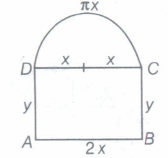
Given, perimeter of the window = 10 m
\(\because\) Perimeter of rectangle + Perimeter of semi-circle = 10m
\( \Rightarrow 2 y+2 x+\frac{1}{2}(2 \pi x)=10 \)
\(\Rightarrow 2 y=10-x(\pi+2)\)
Let A be area of the window, then
A = Area of semi-circle + Area of rectangle
\(=\frac{1}{2} \pi x^{2}+2 x y\)
\(\Rightarrow A=\frac{1}{2}\left(\pi x^{2}\right)+x[10-x(\pi+2)]\) [using Eq. (i)]
\(=\frac{1}{2}\left(\pi x^{2}\right)+10 x-x^{2} \pi-2 x^{2} \)
\(=10 x-\frac{\pi x^{2}}{2}-2 x^{2} \)
On differentiating twice w.r.t. r, we get
\(\frac{d A}{d x}=10-\pi x-4 x\) ...(ii)
and \(\frac{d^{2} A}{d x^{2}}=-\pi-4\) ...(iii)
For maximum or minima,put \(\frac{d A}{d x}=0\)
\( \Rightarrow 10-\pi x-4 x=0 \Rightarrow 10=(4+\pi) x \)
\( \Rightarrow x=\frac{10}{4+\pi} \)
on putting \(x=\frac{10}{4+\pi}\) in Eq.(iii) we get
\(\frac{d^{2} A}{d x^{2}}=\text { Negative }\)
Thus, A has local maxima, when \(x=\frac{10}{4+\pi}\)
\(\therefore\) Radius of semi-circle \(x=\frac{10}{4+\pi}\)
·and one side of rectangle \(2 x=\frac{2 \times 10}{4+\pi}=\frac{20}{4+\pi}\)
Now, from Eq. (i), we get
\(y=\frac{1}{2}[10-x(\pi+2)]\)
\(=\frac{1}{2}\left[10-\left(\frac{10}{\pi+4}\right)(\pi+2)\right] \quad[\text { from } \mathrm{Eq}(iv)]\)
\(=\frac{10 \pi+40-10 \pi-20}{2(\pi+4)} \)
\(=\frac{20}{2(\pi+4)}=\frac{10}{\pi+4} \)
So, other side of rectangle \(y=\frac{10}{\pi+4}\)
Light is maximum, when area is maximum.
Hence, dimensions of the window are length \(=\frac{20}{\pi+4} \mathrm{~m}\) and breadth \(=\frac{10}{\pi+4} \mathrm{~m}\)
32.
Let S(x) be the selling price of x items and let C(x) be the cost price of x items. Then, we have
\(\mathrm{S}(x)=\left(5-\frac{x}{100}\right) x=5 x-\frac{x^{2}}{100} \)
\(\mathrm{C}(x)=\frac{x}{5}+500 \)
Thus, the profit function P(x) is given by
\(\mathrm{P}(x)=\mathrm{S}(x)-\mathrm{C}(x)=5 x-\frac{x^{2}}{100}-\frac{x}{5}-500 \)
\(i.e., \mathrm{P}(x)=\frac{24}{5} x-\frac{x^{2}}{100}-500 \)
\(or \ \mathrm{P}^{\prime}(x)=\frac{24}{5}-\frac{x}{50} \)
\(\text { Now } \mathrm{P}^{\prime}(x)=0 \text { gives } x=240 \text { . Also } \mathrm{P}^{\prime \prime}(x)=\frac{-1}{50} \text { . So } \mathrm{P}^{\prime \prime}(240)=\frac{-1}{50}<0\)
Thus, x = 240 is a point of maxima. Hence, the manufacturer can earn maximum profit, if he sells 240 items.
33.
Let the length and breadth of the tank be x and y m, respectively
Then, volume = 75m3
\(\Rightarrow 3 x y=75 \quad[\because \text { depth of tank }=3 \mathrm{~m}]\)
\(\Rightarrow y=\frac{25}{x} \)
Let C be the cost of the tank.
Then, \(C^{\prime}=100 x y+50(3 \times 2 x+3 \times 2 y)\)
= 100xy + 300x + 300y
\( =100 x \times \frac{25}{x}+300 x+300 \times \frac{25}{x} \quad\left[\because y=\frac{25}{x}\right] \)
\(\Rightarrow C =2500+300 x+\frac{7500}{ } \)
On differentiating twice w.r.t. x, we get
\( \frac{d C}{d x}=300-\frac{7500}{x^{2}} \)
\(\text { and } \ \frac{d^{2} C}{d x^{2}}=\frac{15000}{x^{3}}>0 \)
For minimum value put \(\frac{d C}{d x}=0\)
\( \Rightarrow 300-\frac{7500}{x^{2}}=0 \Rightarrow x^{2}=25\)
\(\Rightarrow x=5 \quad[\because \text { length cannot be negative }]\)
\(\text { At } x=5, \frac{d^{2} C}{d x^{2}}=\frac{15000}{5^{3}}=120>0 \)
So, e is minimum.
When x = 5, then e = 2500 + 1500 + 1500 = 5500
Hence, the cost of least expensive tank is Rs. 5500.
34.
Let we have a sphere of radius R and a cylinder is inscribed in it. EB = r be the radius of the cylinder and BC = h be the height of cylinder.
In right angled \(\Delta A B C\) we have
\((A C)^{2}=(A B)^{2}+(B C)^{2}\) [using Pythagoras theorem]
\(\Rightarrow(2 R)^{2}=(2 r)^{2}+h^{2} \Rightarrow 4 R^{2}=4 r^{2}+h^{2} \)
\(\Rightarrow \cdot r^{2}=\frac{1}{4}\left(4 R^{2}-h^{2}\right) \)
volume of cylinder \(V=\pi r^{-2} h\)
\(\Rightarrow V=\pi\left[\frac{1}{4}\left(4 R^{2}-h^{2}\right)\right] h\)
\(\Rightarrow V=\frac{\pi}{4}\left(4 R^{2} h-h^{3}\right)\) ...(ii)
On differentiating V w.r.t. II, we get
\(\frac{d V}{d h}=\frac{\pi}{4}\left(4 R^{2}-3 h^{2}\right)\)
For maxima or minima put \(\frac{d V}{d h}=0\)
\(\Rightarrow \frac{\pi}{4}\left(4 R^{2}-3 h^{2}\right)=0 \Rightarrow 4 R^{2}=3 h^{2}\)
\(\Rightarrow h=\frac{2 R}{\sqrt{3}} \ [\because \text { height cannot be negative }] \)
On differentiating both sides of Eq. (iii) w.r.t. h, we get
\( \frac{d^{2} V}{d h^{2}} =-\frac{3}{2} \pi h \)
\(\text { At } h=\frac{2 R}{\sqrt{3}}, \frac{d^{2} V}{d h^{2}} =-\frac{3}{2} \pi \times \frac{2 R}{\sqrt{3}}=-\sqrt{3} \pi R<0[\because R>0] \)
\(\therefore\) Volume of cylinder is maximum at \(h=\frac{2 R}{\sqrt{3}}\)
From Eq. (i), we get \(r^{2}=\frac{1}{4}\left(4 R^{2}-\frac{4 R^{2}}{3}\right)=\frac{2 R^{2}}{3}\)
\(\therefore\) Volume of largest cylinder inscribed in a sphere,
\( V =\pi\left(\frac{2 R^{2}}{3}\right) \times \frac{2 R}{\sqrt{3}} \)
\(=\frac{1}{\sqrt{3}} \times\left(\frac{4}{3} \pi R^{3}\right) \)
\(=\frac{1}{\sqrt{3}} \times \text { Volume of sphere } \)
Hence, height of the cylinder of maximum volume is \(\frac{2 R}{\sqrt{3}}\)
and volume of largest cylinder inscribed in sphere is \(\frac{1}{\sqrt{3}}\) times volume of sphere.
35.
Let radius of cone = r, Height of cone = h ,
Slant height of cone = I, Semi-vertical angle = \(\alpha\)
Surface area = 5 and volume of cone
On squaring both sides, we get
\(V^{2}=\frac{1}{9} \pi^{2} r^{4} h^{2}=\frac{1}{9} \pi^{2} r^{4}\left(l^{2}-r^{2}\right)\) ...(ii)
\(\left[\because \text { in } \Delta A O B \text { , using Pythagoras theorem, } l^{2}=r^{2}+h^{2}\right]\)
Given, surface area of cone \(S=\pi r l+\pi r^{2}\)
\(\Rightarrow \pi r l=S-\pi r^{2} \)
\(\Rightarrow l=\frac{S-\pi r^{2}}{\pi r} \)
On putting the value of 1 in Eq. (ii), we get
\(V^{2}=\frac{1}{9} \pi^{2} r^{4}\left[\left(\frac{S-\pi r^{2}}{\pi r}\right)^{2}-r^{2}\right]\)
\(\Rightarrow V^{2}=\frac{1}{9} \pi^{2} r^{4}\left[\frac{S^{2}-2 \pi S r^{2}+\pi^{2} r^{4}}{\pi^{2} r^{2}}-r^{2}\right] \)
\(\Rightarrow V^{2}=\frac{1}{9} \pi^{2} r^{4}\left[\frac{S^{2}-2 \pi S r^{2} \neq \pi^{2} r^{4}-\pi^{2} r^{4}}{\pi^{2} r^{2}}\right. \)
\(\Rightarrow V^{2}=\frac{1}{9} r^{2}\left[S^{2}-2 \pi S r^{2}\right] \)
\(\Rightarrow V^{2}=\frac{1}{9}\left[S^{2} r^{2}-2 \pi S r^{4}\right]\)
Let \(V^{2}=f(r)\) then f(r) is maximum or minimum accordingly as volume (V) is maximum or minimum
Now, \(f(r)=\frac{1}{9}\left(S^{2} r^{2}-2 \pi S r^{4}\right)\)
For maximum or minimum value put \(f^{\prime}(r)=0\)
\(\Rightarrow \frac{1}{9}\left(2 S^{2} r-8 \pi S r^{3}\right)=0 \)
\(\Rightarrow 2 \operatorname{Sr}\left(S-4 \pi r^{2}\right)=0 \)
\(\Rightarrow 2 S r=0 \text { and } S-4 \pi r^{2}=0 \Rightarrow S \neq 0 \)
\(\Rightarrow r=0 \text { and } S-4 \pi r^{2}=0 \)
\(\Rightarrow r=0 \quad \text { and } S=4 \pi r^{2} \)
Since, r = 0 if; not possible
\(\therefore \ S=4 \pi r^{2} \Rightarrow r^{2}=\frac{S}{4 \pi} \Rightarrow r=\sqrt{\frac{S}{4 \pi}}\)
Again, differentiating both sides of Eq( v) w.r.t. r, we get
\(f^{\prime \prime}(r)=\frac{1}{9}\left(2 S^{2}-24 \pi S r^{2}\right) \)
\(\text { At } r=\sqrt{\frac{S}{4 \pi}},\left[f^{\prime \prime}(r)\right]_{r=\sqrt{\frac{s}{4 \pi}}}=\frac{1}{9}\left[2 S^{2}-24 \pi S \cdot \frac{S}{4 \pi}\right] \)
\(=\frac{1}{9}\left[2 S^{2}-6 S^{2}\right]=\frac{-4}{9} S^{2}<0 \)
\(\therefore\) Volume of cone is maximum, when \(n=\sqrt{\frac{S}{4 \pi}}\)
\(S=4 \pi r^{2}\)
On putting the value of S in Eq. (ill), we get
\(l=\frac{4 \pi r^{2}-\pi r^{2}}{\pi r}=\frac{3 \pi r^{2}}{\pi r}=3 r\)
In \(\Delta O B A, \sin \alpha=\frac{r}{I}\)
\(\Rightarrow \sin \alpha=\frac{r}{3 r}=\frac{1}{3} \Rightarrow \alpha=\sin ^{-1}\left(\frac{1}{3}\right)\)
Hence, the semi-vertical angle of cone is \(\sin ^{-1}\left(\frac{1}{3}\right)\)
36.
Let r and h be the radius and height of the cone respectively inscribed in a sphere of radius R.
Let V be the volume of the cone.
Then, \(V=\frac{1}{3} \pi r^{2} h\)
Height of the cone is given by
\(h=R+A B=R+\sqrt{R^{2}-r^{2}} \quad[\mathrm{ABC} \text { is a right triangle }] \)
\(\therefore V=\frac{1}{3} \pi r^{2}\left(R+\sqrt{R^{2}-r^{2}}\right) \)
\(=\frac{1}{3} \pi r^{2} R+\frac{1}{3} \pi r^{2} \sqrt{R^{2}-r^{2}} \)
\(\therefore \frac{d V}{d r}=\frac{2}{3} \pi r R+\frac{2}{3} \pi r \sqrt{R^{2}-r^{2}}+\frac{1}{3} \pi r^{2} \cdot \frac{(-2 r)}{2 \sqrt{R^{2}-r^{2}}} \)
\(=\frac{2}{3} \pi r R+\frac{2}{3} \pi r \sqrt{R^{2}-r^{2}}-\frac{1}{3} \pi \frac{r^{3}}{\sqrt{R^{2}-r^{2}}} \)
\(=\frac{2}{3} \pi r R+\frac{2 \pi r\left(R^{2}-r^{2}\right)-\pi r^{3}}{3 \sqrt{R^{2}-r^{2}}} \)
\(=\frac{2}{3} \pi r R+\frac{2 \pi r R^{2}-3 \pi r^{3}}{3 \sqrt{R^{2}-r^{2}}} \)
\(\frac{d^{2} V}{d r^{2}}=\frac{2 \pi R}{3}+\frac{3 \sqrt{R^{2}-r^{2}}\left(2 \pi R^{2}-9 \pi r^{2}\right)-\left(2 \pi r R^{2}-3 \pi r^{3}\right) \cdot \frac{(-2 r)}{6 \sqrt{R^{2}-r^{2}}}}{9\left(R^{2}-r^{2}\right)} \)
\(=\frac{2}{3} \pi R+\frac{9\left(R^{2}-r^{2}\right)\left(2 \pi R^{2}-9 \pi r^{2}\right)+2 \pi r^{2} R^{2}+3 \pi r^{4}}{27\left(R^{2}-r^{2}\right)^{\frac{3}{2}}} \)
\(\text { Now, } \frac{d V}{d r}=0 \Rightarrow \frac{2}{\pi} r R=\frac{3 \pi r^{3}-2 \pi r R^{2}}{3 \sqrt{R^{2}-r^{2}}} \)
\(\Rightarrow 2 R=\frac{3 r^{2}-2 R^{2}}{\sqrt{R^{2}-r^{2}}} \Rightarrow 2 R \sqrt{R^{2}-r^{2}}=3 r^{2}-2 R^{2} \)
\(\Rightarrow 4 R^{2}\left(R^{2}-r^{2}\right)=\left(3 r^{2}-2 R^{2}\right)^{2} \)
\(\Rightarrow 4 R^{4}-4 R^{2} r^{2}=9 r^{4}+4 R^{4}-12 r^{2} R^{2} \)
\(\Rightarrow 9 r^{4}=8 R^{2} r^{2} \)
\(\Rightarrow r^{2}=\frac{8}{9} R^{2} \)
\(\text { When } r^{2}=\frac{8}{9} R^{2}, \text { then } \frac{d^{2} V}{d r^{2}}<0 \)
∴ By second derivative test, the volume of the cone is the maximum when \(r^{2}=\frac{8}{9} R^{2}\)
\(\text { When } r^{2}=\frac{8}{9} R^{2}, h=R+\sqrt{R^{2}-\frac{8}{9} R^{2}}=R+\sqrt{\frac{1}{9} R^{2}}=R+\frac{R}{3}=\frac{4}{3} R \text { . }\)
\(\text { Therefore, }=\frac{1}{3} \pi\left(\frac{8}{9} R^{2}\right)\left(\frac{4}{3} R\right)\)
\(=\frac{8}{27}\left(\frac{4}{3} \pi R^{3}\right)\)
\(=\frac{8}{27} \times \)(Volume of the sphere)
Hence, the volume of the largest cone that can be inscribed in the sphere is \( \frac{8}{27} \)
37.
Let r and h be the radius and height of the cylinder respectively.
Then, the surface area (S) of the cylinder is given by
\(S= 2 \pi r^{2}+2 \pi r h \)
\(\Rightarrow h =\frac{S-2 \pi r^{2}}{2 \pi r} \)
\(=\frac{S}{2 \pi}\left(\frac{1}{r}\right)-r \)
Let V be the volume of the cylinder. Then,
\(V=\pi r^{2} h=\pi r^{2}\left[\frac{S}{2 \pi}\left(\frac{1}{r}\right)-r\right]=\frac{S r}{2}-\pi r^{3} \)
\(\text { Then, } \frac{d V}{d r}=\frac{S}{2}-3 \pi r^{2}, \frac{d^{2} V}{d r^{2}}=-6 \pi r \)
\(\text { Now, } \frac{d V}{d r}=0 \Rightarrow \frac{S}{2}=3 \pi r^{2} \Rightarrow r^{2}=\frac{S}{6 \pi} \)
\(\text { When } r^{2}=\frac{S}{6 \pi}, \text { then } \frac{d^{2} V}{d r^{2}}=-6 \pi\left(\sqrt{\frac{S}{6 \pi}}\right)<0 \)
∴ By second derivative test, the volume is the maximum when \(r^{2}=\frac{S}{6 \pi}\)
\(\text { Now, when } r^{2}=\frac{S}{6 \pi} \text { , then } h=\frac{6 \pi r^{2}}{2 \pi}\left(\frac{1}{r}\right)-r=3 r-r=2 r \text { . }\)
Hence, the volume is the maximum when the height is twice the radius i.e., when the height is equal to the diameter
38.
Let a piece of length l be cut from the given wire to make a square.
Then, the other piece of wire to be made into a circle is of length (28 − l) m.
Now, side of square =.\(\frac{l}{4}\)
Let r be the radius of the circle. Then, \(2 \pi r=28-l \Rightarrow r=\frac{1}{2 \pi}(28-l)\)
The combined areas of the square and the circle (A) is given by,
\(A=(\text { side of the square })^{2}+\pi r^{2} \)
\(=\frac{l^{2}}{16}+\pi\left[\frac{1}{2 \pi}(28-l)\right]^{2} \)
\(=\frac{l^{2}}{16}+\frac{1}{4 \pi}(28-l)^{2} \)
\(\therefore \frac{d A}{d l}=\frac{2 l}{16}+\frac{2}{4 \pi}(28-l)(-1)=\frac{l}{8}-\frac{1}{2 \pi}(28-l) \)
\(\frac{d^{2} A}{d l^{2}}=\frac{1}{8}+\frac{1}{2 \pi}>0 \)
\(\text { Now }, \frac{d A}{d l}=0 \Rightarrow \frac{l}{8}-\frac{1}{2 \pi}(28-l)=0 \)
\(\Rightarrow \frac{\pi l-4(28-l)}{8 \pi}=0 \)
\(\Rightarrow(\pi+4) l-112=0 \)
\(\Rightarrow l=\frac{112}{\pi+4} \)
Thus, when \(l=\frac{112}{\pi+4}, \frac{d^{2} \mathrm{~A}}{d l^{2}}>0 .\)
By second derivative test, the area (A) is the minimum when.\(l=\frac{112}{\pi+4}\)
Hence, the combined area is the minimum when the length of the wire in making the square is \(\frac{112}{\pi+4}\)m while the length of the wire in making the circle is
28 − 112π + 4 = 28π + 4m
39.
Let r and h be the radius and the height (altitude) of the cone respectively.
Then, the volume (V) of the cone is given as:
V = 13πr2h
⇒ h = 3Vπr2V
=13πr2h
⇒h = 3Vπr2
The surface area (S) of the cone is given by
S = πrl (where l is the slant height)
\(\therefore \frac{d S}{d r} =\frac{r \cdot \frac{6 \pi^{2} r^{5}}{2 \sqrt{\pi^{2} r^{6}+9 V^{2}}}-\sqrt{\pi^{2} r^{6}+9 V^{2}}}{r^{2}} \)
\(=\frac{3 \pi^{2} r^{6}-\pi^{2} r^{6}-9 V^{2}}{r^{2} \sqrt{\pi^{2} r^{6}+9 V^{2}}} \)
\(=\frac{2 \pi^{2} r^{6}-9 V^{2}}{r^{2} \sqrt{\pi^{2} r^{6}+9 V^{2}}} \)
\(=\frac{2 \pi^{2} r^{6}-9 V^{2}}{r^{2} \sqrt{\pi^{2} r^{6}+9 V^{2}}} \)
\(\text { Now }, \frac{d S}{d r}=0 \Rightarrow 2 \pi^{2} r^{6}=9 V^{2} \Rightarrow r^{6}=\frac{9 V^{2}}{2 \pi^{2}}\)
Thus, it can be easily verified that when \(r^{6}=\frac{9 V^{2}}{2 \pi^{2}}, \frac{d^{2} S}{d r^{2}}>0\)
∴ By second derivative test, the surface area of the cone is the least when \(r^{6}=\frac{9 V^{2}}{2 \pi^{2}}\)
\(\text { When } r^{6}=\frac{9 V^{2}}{2 \pi^{2}}, h=\frac{3 V}{\pi r^{2}}=\frac{3}{\pi r^{2}}\left(\frac{2 \pi^{2} r^{6}}{9}\right)^{\frac{1}{2}}=\frac{3}{\pi r^{2}} \cdot \frac{\sqrt{2} \pi r^{3}}{3}=\sqrt{2} r \text { . }\)
Hence, for a given volume, the right circular cone of the least curved surface has an altitude equal to \(\sqrt{2}\) times the radius of the base.
40.
Let r be the radius of the sphere and Δr be the error in measuring the radius.
Then, r = 9 m and Δr = 0.03 m
Now, the surface area of the sphere (S) is given by,
\(S=4 \pi r^{2} \)
\(\therefore \frac{d S}{d r}=8 \pi r \)
\(\therefore d S=\left(\frac{d S}{d r}\right) \Delta r \)
\(=(8 \pi r) \Delta r \)
\(=8 \pi(9)(0.03) \mathrm{m}^{2} \)
\(=2.16 \pi \mathrm{m}^{2} \)
Hence, the approximate error in calculating the surface area is \( 2.16 \pi \mathrm{m}^{2} \text { . }\)
41.
The equation of the given curve is \( y=\frac{1}{x-1}, x \neq 1 \text { . }\)
The slope of the tangents to the given curve at anv point (x, b is given by )
\(\frac{d y}{d x}=\frac{-1}{(x-1)^{2}}\)
If the slope of the tangent is −1, then we have
\(\frac{-1}{(x-1)^{2}}=-1 \)
\(\Rightarrow(x-1)^{2}=1 \)
\(\Rightarrow x-1=\pm 1 \)
\(\Rightarrow x=2,0 \)
When x = 0, y = −1 and when x = 2, y = 1 .
Thus, there are two tangents to the given curve having slope -1. These are passing through the points (0, -1) and (2, 1)
The equation of the tangent through (0,-1) is given by,
\(y-(-1)=-1(x-0) \)
\(\Rightarrow y+1=-x \)
\(\Rightarrow y+x+1=0 \)
∴ The equation of the tangent through (2,1) is given by,
\(y-1=-1(x-2) \)
\(\Rightarrow y-1=-x+2 \)
\(\Rightarrow y+x-3=0 \)
Hence, the equations of the required lines are y+x+1=0 and y+x−3=0 .
42.
\(\text {We have } x=a \cos \theta+a \theta \sin \theta \)
\(\therefore \frac{d x}{d \theta}=-a \sin \theta+a \sin \theta+a \theta \cos \theta=a \theta \cos \theta \)
\(y=a \sin \theta-a \theta \cos \theta \)
\(\therefore \frac{d y}{d \theta}=a \cos \theta-a \cos \theta+a \theta \sin \theta=a \theta \sin \theta \)
\(\therefore \frac{d y}{d x}=\frac{d y}{d \theta} \cdot \frac{d \theta}{d x}=\frac{a \theta \sin \theta}{a \theta \cos \theta}=\tan \theta \)
Slope of the normal at any point \( \theta \text { is }-\frac{1}{\tan \theta} \text { . }\)
The equation of the normal at a given point (x, y) is given by,
\(y-a \sin \theta+a \theta \cos \theta=\frac{-1}{\tan \theta}(x-a \cos \theta-a \theta \sin \theta) \)
\(\Rightarrow y \sin \theta-a \sin ^{2} \theta+a \theta \sin \theta \cos \theta=-x \cos \theta+a \cos ^{2} \theta+a \theta \sin \theta \cos \theta \)
\(\Rightarrow x \cos \theta+y \sin \theta-a\left(\sin ^{2} \theta+\cos ^{2} \theta\right)=0 \)
\(\Rightarrow x \cos \theta+y \sin \theta-a=0 \)
Now, the perpendicular distance of the normal from the origin is
\(\frac{|-a|}{\sqrt{\cos ^{2} \theta+\sin ^{2} \theta}}=\frac{|-a|}{\sqrt{1}}=|-a|, \text { which is independent of } \theta\)
Hence, the perpendicular distance of the normal from the origin is constant.
43.
Note that on x-axis, y = 0. So the equation of the curve, when y = 0, gives x = 7. Thus, the curve cuts the x-axis at (7, 0). Now differentiating the equation of the curve with respect to x, we obtain
\(\frac{d y}{d x} =\frac{1-y(2 x-5)}{(x-2)(x-3)} \)
\(\left.\frac{d y}{d x}\right]_{(7,0)} =\frac{1-0}{(5)(4)}=\frac{1}{20}\)
Therefore, the slope of the tangent at (7, 0) is \(\frac{1}{20}\) Hence, the equation of the tangent at (7, 0) is
\(y-0=\frac{1}{20}(x-7) \quad \text { or } \quad 20 y-x+7=0\)
44.
We have,
\( \frac{d y}{d x}=\frac{1}{1+x} \frac{d}{d x}(1+x)-\left[\frac{(2+x) \frac{d}{d x}(2 x)-2 x \frac{d}{d x}(2+x)}{(2+x)^2}\right] \\ =\frac{1}{1+x}-\left[\frac{(2+x) 2-2 x}{(2+x)^2}\right] \\ =\frac{1}{1+x}-\frac{(4+2 x-2)}{(2+x)^2} \\ =\frac{1}{1+x}-\frac{4}{(2+x)^2} \)
this implies
\( \frac{d y}{d x}=\frac{(2+x)^2-4(1+x)}{(1+x)(2+x)^2} \\ =\frac{x^2}{(1+x)(2+x)^2} \)
Domain of the given function is given to be x > -1
x + 1 > 0
Also (2+x)2 > 0 and x2 \(\geq 0\)
From equation (1), \(\frac{d y}{d x} \geq 0\) for all x in domain x>-1 and f is an increasing function.
45.
We have
\(y=\frac{4 \sin \theta}{(2+\cos \theta)}-\theta \)
\(\therefore \frac{d y}{d x} =\frac{(2+\cos \theta)(4 \cos \theta)-4 \sin \theta(-\sin \theta)}{(2+\cos \theta)^{2}}-1 \)
\(=\frac{8 \cos \theta+4 \cos ^{2} \theta+4 \sin ^{2} \theta}{(2+\cos \theta)^{2}}-1 \)
\(=\frac{8 \cos \theta+4}{(2+\cos \theta)^{2}}-1 \)
\(\text { Now, } \frac{d y}{d x}=0 .\)
\(\Rightarrow \frac{8 \cos \theta+4}{(2+\cos \theta)^{2}}=1\)
\(\Rightarrow 8 \cos \theta+4=4+\cos ^{2} \theta+4 \cos \theta \)
\(\Rightarrow \cos ^{2} \theta-4 \cos \theta=0\)
\(\Rightarrow \cos \theta(\cos \theta-4)=0 \)
\(\Rightarrow \cos \theta=0 \text { or } \cos \theta=4\)
\(\text { Since } \cos \theta \neq 4, \cos \theta=0\)
\(\cos \theta=0 \Rightarrow \theta=\frac{\pi}{2}\)
\(\text { Now, }\frac{d y}{d x}=\frac{8 \cos \theta+4-\left(4+\cos ^{2} \theta+4 \cos \theta\right)}{(2+\cos \theta)^{2}}=\frac{4 \cos \theta-\cos ^{2} \theta}{(2+\cos \theta)^{2}}=\frac{\cos \theta(4-\cos \theta)}{(2+\cos \theta)^{2}}\)
\(\text { In interval }\left(0, \frac{\pi}{2}\right), \text { we have } \cos \theta>0 . \text { Also, } 4>\cos \theta \Rightarrow 4-\cos \theta>0 \text { . }\)
\(\therefore \cos \theta(4-\cos \theta)>0 \text { and also }(2+\cos \theta)^{2}>0 \)
\(\Rightarrow \frac{\cos \theta(4-\cos \theta)}{(2+\cos \theta)^{2}}>0 \)
\(\Rightarrow \frac{d y}{d x}>0 \)
Therefore, y is strictly increasing in interval \( \left(0, \frac{\pi}{2}\right) \text { . }\)
Also, the given function is continuous at \( x=0 \text { and } x=\frac{\pi}{2} \text { . }\)
Hence, y is increasing in interval \( \left[0, \frac{\pi}{2}\right] \text { . }\)
46.
We have
\(y=[x(x-2)]^{2}=\left[x^{2}-2 x\right]^{2} \)
\(\therefore \frac{d y}{d x}=y^{\prime}=2\left(x^{2}-2 x\right)(2 x-2)=4 x(x-2)(x-1) \)
\(\therefore \frac{d y}{d x}=0 \Rightarrow x=0, x=2, x=1 \)
\(\text {The points } x=0, x=1 \text { and } x=2 \) divide the real line into four disjoint intervals i.e.,
\((-\infty, 0),(0,1)(1,2), \text { and }(2, \infty) .\)
\(\text { In intervals }(-\infty, 0) \text { and }(1,2), \frac{d y}{d x}<0 \text { . }\)
However, in intervals \( (0,1) \text { and }(2, \infty), \frac{d y}{d x}>0 .\)
\(\therefore y \text { is strictly increasing in intervals }(0,1) \text { and }(2, \infty) .\)
\(\therefore y \text { is strictly increasing for } 0
Increasing:\(\left( 0,1 \right) \cup \left( 2,\infty \right) \) ;Decreasing:\(\left( -\infty ,0 \right) \cup \left( 1,2 \right) ;\)points are(0,0),(1,1),(2,0).
47.
\(6 y=x^{3}+2\)
\(6 \frac{d y}{d t}=3 x^{2} \frac{d x}{d t}+0 \Rightarrow 2 \frac{d y}{d t}=x^{2} \frac{d x}{d t}\)
\(x \text { -coordinate i.e., }\left(\frac{d y}{d t}=8 \frac{d x}{d t}\right), \text { we have: }\)
\(2\left(8 \frac{d x}{d t}\right)=x^{2} \frac{d x}{d t} \)
\(\Rightarrow 16 \frac{d x}{d t}=x^{2} \frac{d x}{d t} \)
\(\Rightarrow\left(x^{2}-16\right) \frac{d x}{d t}=0 \)
\(\Rightarrow x^{2}=16 \)
\(\Rightarrow x=\pm 4 \)
\(\text { When } x=4, y=\frac{4^{3}+2}{6}=\frac{66}{6}=11 \text { . }\)
\(\text { When } x=-4, y=\frac{(-4)^{3}+2}{6}=-\frac{62}{6}=-\frac{31}{3} \text { . }\)
48.
Let x be the length of a side, V be the volume, and s be the surface area of the cube.
Then, V = x3 and S = 6x2 where x is a function of time t.
\(\therefore 8=\frac{d V}{d t}=\frac{d}{d t}\left(x^{3}\right)=\frac{d}{d x}\left(x^{3}\right) \cdot \frac{d x}{d t}=3 x^{2} \cdot \frac{d x}{d t}\)
\(\Rightarrow \frac{d x}{d t}=\frac{8}{3 x^{2}} \ \text { (1) } \quad \text { [By chain rule] } \)
\(\text { Now, } \frac{d \mathrm{~S}}{d t}=\frac{d}{d t}\left(6 x^{2}\right)=\frac{d}{d x}\left(6 x^{2}\right) \cdot \frac{d x}{d t} \ 0 .\)
\(=12 x \cdot \frac{d x}{d t}=12 x .\left(\frac{8}{3 x^{2}}\right)=\frac{32}{x}\)
\(\text {Thus, when } x=12 \mathrm{~cm}, \frac{d S}{d t}=\frac{32}{12} \mathrm{~cm}^{2} / \mathrm{s}=\frac{8}{3} \mathrm{~cm}^{2} / \mathrm{s}\)
Hence, if the length of the edge of the cube is 12 cm, then the surface area is increasing at the rate of \(\frac{8}{3}\) cm2/s
49.
Let the length of the two equal sides of \( \triangle \mathrm{ABC} \text { be } a \text { . }\)
\(\text {Draw } \mathrm{AD} \perp \mathrm{BC}\)
\(\text {Now, in } \triangle A D C \) by applying the Pythagoras theorem, we have:
\(\mathrm{AD}=\sqrt{a^{2}-\frac{b^{2}}{4}}\)
\(\therefore \text { Area of triangle }(A)=\frac{1}{2} b \sqrt{a^{2}-\frac{b^{2}}{4}}\)
\(\frac{d A}{d t}=\frac{1}{2} b \cdot \frac{2 a}{2 \sqrt{a^{2}-\frac{b^{2}}{4}}} \frac{d a}{d t}=\frac{a b}{\sqrt{4 a^{2}-b^{2}}} \frac{d a}{d t}\)
\(\therefore \frac{d a}{d t}=-3 \mathrm{~cm} / \mathrm{s} \)
\(\therefore \frac{d A}{d t}=\frac{-3 a b}{\sqrt{4 a^{2}-b^{2}}} \)
\(\frac{d A}{d t}=\frac{-3 b^{2}}{\sqrt{4 b^{2}-b^{2}}}=\frac{-3 b^{2}}{\sqrt{3 b^{2}}}=-\sqrt{3} b\)
50.
Let r be the radius, h be the height and V be the volume of the sand cone
Also given that, \(\frac{d V}{d t}=12 \mathrm{~cm}^{3} / \mathrm{s}, h=\frac{1}{6} r\)
\(\Rightarrow r=6 h \text { and } h=4 \mathrm{~cm}\)
Volume of sand cone,
\(V=\frac{1}{3} \pi r^{2} h\)
\( \Rightarrow V=\frac{1}{3} \pi(6 h)^{2} h \)
\(\Rightarrow V=\frac{1}{3} \pi \times 36 h^{2} \times h=12 \pi h^{3} \)
On differentiating both sides w.r.t. t, we get
\( \frac{d V}{d t}=12 \pi \times 3 h^{2} \frac{d h}{d t}=36 \pi h^{2} \frac{d h}{d t} \)
\(\Rightarrow 12=36 \pi(4)^{2} \frac{d h}{d t} \)
\(\Rightarrow \frac{d h}{d t}=\frac{12}{36 \pi \times 16}=\frac{1}{48 \pi} \mathrm{cm} / \mathrm{s} \)
Hence, the height of the sand cone is increasing at the rate of \(\frac{1}{48 \pi} \mathrm{cm} / \mathrm{s}\). when the height is 4 cm,
51.
Let P be the perimeter and A be the area of the rectangle of length x and width y.
Given \(\frac{d x}{d t}=-5 \mathrm{~cm} / \mathrm{min}\)
[negative (-) sign for decreasing rate]
\(x=8 \mathrm{~cm}, \frac{d y}{d t}=4 \mathrm{~cm} / \mathrm{min} \text { and } y=6 \mathrm{~cm}\)
(ii) Perimeter of the rectangle.\(P=2(x+y)\)
On differentiating both sides w.r.t. t, we get
\( \frac{d P}{d t} =2\left(\frac{d x}{d t}+\frac{d y}{d t}\right) \)
\(=2(-5+4)=-2 \mathrm{~cm} / \mathrm{min}\)
So, perimeter decreases at the rate of 2 cm/min.
(ii) Area of the rectangle, A = xy
On differentiating both sides w.r.t. t, we get
\( \frac{d A}{d t} =x \frac{d y}{d t}+y \frac{d x}{d t} \)
\(=8 \times 4+6 \times(-5)=32-30=2 \mathrm{~cm}^{2} / \mathrm{min} \)
Hence, area increases at the rate of 2 cm 2 /min.
52.
(a)
\(\left( 4,\pm \frac { 8 }{ 3 } \right) \)
53.
(a)
x + y = 3
54.
(b)
x – y = 0
55.
(a)
1
56.
(b)
\(\frac67\)
57.
(a)
1 m/h
58.
(c)
1
59.
(d)
\(\frac { 1 }{ 3 } \)
60.
(a)
(2 \(\sqrt2\),4)
61.
(c)
0.09 x3 m3
62.
(d)
77.66
63.
(a)
(1, 2)
64.
(d)
-\(\frac13\)
65.
(d)
(0, 2)
66.
(d)
None of these
67.
(b)
cos 2x
68.
(d)
126
69.
(b)
12π
70.
R = {(1, 2), (2, 2), (1, 1), (4, 4), (1, 3), (3, 3), (3, 2)}
It is seen that (a, a) ∈ R, for every a ∈{1, 2, 3, 4}.
∴ R is reflexive.
It is seen that (1, 2) ∈ R, but (2, 1) ∉ R.
∴ R is not symmetric.
Also, it is observed that (a, b), (b, c) ∈ R ⇒ (a, c) ∈ R for all a, b, c ∈ {1, 2, 3, 4}.
∴ R is transitive.
Hence, R is reflexive and transitive but not symmetric.
The correct answer is B.

12th Standard CBSE Syllabus & Materials
12th Standard CBSE
CBSE 12th Computer Science Python Revision Tour I - New Previous year Question Papers Study Material - QB365 Set A
NEW12th Standard CBSE
CBSE 12th Business Studies Planning Important Questions And Answers Study Material - QB365 Set A
NEW12th Standard CBSE
CBSE 12th Business Studies Business Environment Important Questions And Answers Study Material - QB365 Set A
NEW12th Standard CBSE
CBSE 12th Business Studies Principles of Management Important Questions And Answers Study Material - QB365 Set A



CBSE 12th Standard CBSE Subjects
CBSE Standards










