
 100% FREE ACCESS
12th Standard CBSE Syllabus & Materials
12th Standard CBSE
CBSE 12th Economics Government Budget and the Economy Previous year Question Papers Study Material - QB365 Set A
NEW12th Standard CBSE
CBSE 12th Computer Science Interface Python with MySQL - New Previous year Question Papers Study Material - QB365 Set A
NEW12th Standard CBSE
CBSE 12th Computer Science Database Concept - New Previous year Question Papers Study Material - QB365 Set A
NEW12th Standard CBSE
CBSE 12th Computer Science Data Communication - New Previous year Question Papers Study Material - QB365 Set A
NEW12th Standard CBSE
CBSE 12th Computer Science Data Structures - New Previous year Question Papers Study Material - QB365 Set A
NEW12th Standard CBSE
CBSE 12th Computer Science Functions - New Previous year Question Papers Study Material - QB365 Set A

Published on: 20/02/2020
un 1 physics
Download CBSE Class 12th Standard CBSE Physics question papers, sample papers, important questions, and previous year solved papers in PDF format. Get free study materials, NCERT solutions, and exam preparation resources for Class 12th Standard CBSE Physics
Questions + Answers key
Take MCQ Physics Test
1.
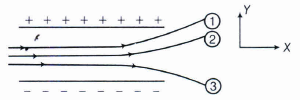
The given figure shows tracks of three charged particles in a uniform electrostatic field. Give the signs of the three charges. Which particle has the highest charge to mass ratio?
2.
An electrostatic field line is continuous curve, i.e. a field line cannot have sudden breaks. Why not?
3.
Two point charges of +2 \(\mu C\) and +6 \(\mu C\) repel each other with a force of 12N. If each is given an additional charge of -4\(\mu C\) , what will be the new force?
4.
Give four properties of electric charges.
5.
What do you mean by conservation of electric charge?
6.
The electric field at a point is
always continuous
continuous if there is no charge at that point
discontinuous only if there is a negative charge at that point
discontinuous if there is a charge at that point
7.
Charge on a body which carries 200 excess electrons is
\(-3.2\times 10^{-18}C\)
\(9\times10^{-9}Nm^2C^{-2}\)
\(3.2\times 10^{-17}C\)
\(3.2\times 10^{-17}C\)
8.
A closed surface in vacuum encloses charges -q and +3q. Another charge -2q lies outside the surface. Total electric flux over the surface is
Zero
\(2 q\over \epsilon_o\)
\(-{3q\over \epsilon_o}\)
\(4q\over\epsilon_o\)
9.
The correct relation between electric intensity E and electric potential V is
\(E=-{dV\over dr}\)
\(E={dV\over dr}\)
\(V=-{dE\over dr}\)
\(V={dE\over dr}\)
10.
When an electric dipole is held at an angle in a uniform electric field, the net force F and torque \(\tau\) on the dipole are
F = 0, \(\tau=0\)
\(F\ne 0,\tau\ne 0\)
F = 0, \(\tau\ne0\)
\(F\ne0,\tau=0\)
11.
Electric field intensity (E) due to an electric dipole varies with distance (r) of the point from the centre of dipole as:
\(E\alpha {1\over r}\)
\(E\alpha{1\over r^4}\)
\(E\alpha{1\over r^2}\)
\(E\alpha {1\over r^3}\)
12.
The SI unit of electric field intensity is
N
N/C
C/m2
N/m2
13.
Dipole moment is a ............... quantity and its units are .............
14.
Derive the expression for electric field at a point on the equatorial line of an electric
dipole. Depict the orientation of the dipole in
(a) stable,
(b) unstable equilibrium in a uniform electric field.
15.
Using Gauss's theorem, deduce an expression for the electric field intensity at any point due to a thin, infinitely long wire of charge/length '\(\lambda\)' C\m
16.
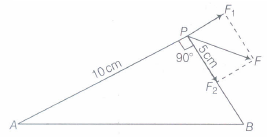
Find the magnitude of the resultant force on a charge of \(1\mu C\) held at P due to two charges of \(+2\times { 10 }^{ -8 }C\quad and\quad -{ 10 }^{ -8 }C\) at A and B respectively. Given, AP = 10 cm and BP = 5 cm. \(\angle APB={ 90 }^{ o }\)
17.
(a) Define electric flux. Write its S.I. unit.
(b) Using Gauss's law, prove that the electric field at a point due to a uniformly charged infinite plane sheet is independent of the distance from it.
(c) How is the field directed if
(i) the sheet is positively charged,
(ii) negatively charged?
1.
We know that a positively charged particle is attracted towards the negatively charged plate and a negatively charged plate and a negatively charged particle is attracted towards the positively charged plate.
Here particle 1 and 2 are attraced positive that mean 1 and 2 are negatively charged. 3 is attracted towards negatively charged plate so it is positively charged.
As the deflection in the path of a charged particle is directly proportional to the charge/mass ratio
\(y\propto \ \frac { q }{ m } \)
Here, the deflection in particle 3 is maximum. so, the charge to mass ratio of particle 3 is maximum.
2.
An electrostatic field line cannot be a discontinuous curve,i.e it cannot have breaks.If it has breaks,then it will indicate absence of electric field at the break points.But the electric field vanishes only at infinity.
3.
q1 = +\(\mu C\), q2 = +6\(\mu C\), F = 12N
\(q_{1}^{'}=+2-4=-2\mu C;\) \(q_2^{'}=+6-4=2\mu C\)
F' = ?
\({F'\over F}={(q_1^{'})(q_2^{'})\over q_1q_2}={(-2)(2)\over(2)(6)}=-{1\over 3}\)
\(F'={-F\over 3}={-12\over 3}=-4 N\)(attractive)
4.
(i) Like charges repel and unlike charges attract each other.
(ii) Charge is quantized
(iii) Charge is conserved
(iv) Charge on a body is not affected by its motion.
5.
Conservation of electric charge means that the total charge on an isolated system remains unchanged with time.
6.
(b)
continuous if there is no charge at that point
7.
(c)
\(3.2\times 10^{-17}C\)
8.
(b)
\(2 q\over \epsilon_o\)
9.
(a)
\(E=-{dV\over dr}\)
10.
(c)
F = 0, \(\tau\ne0\)
11.
(d)
\(E\alpha {1\over r^3}\)
12.
(b)
N/C
13.
()
vector ; C-m
14.
Electric field at a point on the equatorial line of an electric dipole.
Consider an electric dipole consisting of two point charges + q and - q separated by a small distance AB = 21 with centre at O and dipole moment, p = q(2l) as shown in the figure.
s.png)
Resultant electric field intensity at the"'point Q,
EQ = EA + EB
Here, EA = \({{1}\over{4\pi{\epsilon}_{0}}}.{{q}\over{({x}^{2}+{l}^{2})}}\)
and EB = \({{1}\over{4\pi{\epsilon}_{0}}}.{{q}\over{({x}^{2}+{l}^{2})}}\)
On resolving EA and EB into two rectangular components, the vectors EA sin \(\theta\) and EB sin \(\theta\) are equal in magnitude and opposite to each other and hence, cancel out.
The vectors EA cos\(\theta\) and EB cos\(\theta\) are acting along the same direction and hence, add up.
\(\therefore\) EQ = EA cos\(\theta\) + EB cos \(\theta\)= 2E A cos\(\theta\) \([\because{E}_{A}={E}_{B}]\)
= \({{2}\over{4\pi{\epsilon}_{0}}}.{{q}\over{({x}^{2}+{l}^{2})}}.{{q}\over{({x}^{2}+{l}^{2})^{1/2}}}\)
\(\left[ \because cos\ \theta={{l}\over{({x}^{2}+{l}^{2})^{1/2}}} \right]\)
= \({{1}\over{4\pi{\epsilon}_{0}}}.{{2ql}\over{({x}^{2}+{l}^{2})^{3/2}}}\)
But, the dipole moment |p| = q X 2l
\(\therefore\) EQ = \({{1}\over{4\pi{\epsilon}_{0}}}.{{|p|}\over{({x}^{2}+{l}^{2})^{3/2}}}\)
The direction of E is along QE II BA. i.e . opposite to AB. In vector form, we can rewrite as
EQ = \({{-p}\over{4\pi{\epsilon}_{0}({x}^{2}+{l}^{2})^{3/2}}}\)
The orientation of the dipole
In stable equilibrium, . p is parallel to E. i.e.
\(\theta=0°\)
s.png)
In unstable equilibrium, p is anti-parallel to E i.e. 0 = 180°
s.png)
15.
Electric field intensity due to a long wire : A line charge is in the form of a thin charged rod with uniform linear charge density A (charge per unit length),
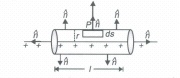
To determine the electric field intensity \(\overrightarrow{E}\) at any point P at a perpendicular distance r from the rod, let a right circular closed cylinder of radius r and length I with the infinitely long line of charge as its axis (as shown in figure). The magnitude of \(\overrightarrow{E}\) at every point on the curved surface of the cylinder is the same as all such points are at the same distance from the line charge. Also \(\overrightarrow{E}\) and unit vector \(\hat{n}\) it normal to curved surface are in the same direction so, \(\theta\)= 0°.
\(\therefore\) Contribution of curved surface of cylinder towards electric flux,
\(\oint_s \overrightarrow{E} \overrightarrow{ds} = \oint_s \overrightarrow{E} \hat{n}{ds}\)
= \(E \oint_s ds = E(2\pi r l)\)
where ( \(2\pi r l\) ) is area of the curved surface of the cylinder.
On the ends of cylinder, the angle between electric field \(\overrightarrow{E}\) and \(\hat{n}\) is 90°. So it will not contribute to electric flux on cylinder.
\(\Longrightarrow\) \(E \oint_s ds = E(2\pi r l)\)
Charge enclosed in the cylinder linear charge density length
q = \(\lambda \)I
According to Gauss's theorem \(\oint_s \overrightarrow{E} \overrightarrow{ds} = \frac{q}{\epsilon_0}\)
\(\Longrightarrow\) \((2\pi r l)\times E = \frac{\lambda l}{\epsilon_0}\)
\( E = \frac{\lambda l}{2\pi\epsilon_0rl}\)
\( E = \frac{l}{r}\)
(As \(\frac{\lambda}{2\pi\epsilon_0r} \) = constant)
16.
Here,
Charge at P, q = \(1\mu C={ 10 }^{ -6 }C\)
Charge at \({ A,q }_{ 1 }=2\times { 10 }^{ -8 }C\)
Charge at \({ B,q }_{ 2 }=-{ 10 }^{ -8 }C\)
\(Ap=10\quad cm=0.1m,BP=5cm=0.05m,\angle APB={ 90 }^{ o },F=?\)
Force at P due to q1 charge at \(A,{ F }_{ 1 }=\frac { 1 }{ 4\pi { \varepsilon }_{ o } } \frac { { q }_{ 1 }q }{ { AP }^{ 2 } } ,\) along AP produced
\(=\frac { 9\times { 10 }^{ 9 }\times 2\times { 10 }^{ -8 }\times { 10 }^{ -6 } }{ { \left( 0.1 \right) }^{ 2 } } =18\times { 10 }^{ -3 }N\)
Force at P due to q2 charge at \(B,{ F }_{ 2 }=\frac { 1 }{ 4\pi { \varepsilon }_{ o } } \frac { { q }_{ 2 }q }{ { BP }^{ 2 } } ,\) , along PB produced \(=\frac { 9\times { 10 }^{ 9 }\times -{ 10 }^{ -8 }\times { 10 }^{ -6 } }{ { \left( 0.05 \right) }^{ 2 } } =-36\times { 10 }^{ -3 }N\)
As, angle between F1and F2 is \({ 90 }^{ o }\)
\({ \therefore }\) Resultant Force,
\(F=\sqrt { { { F }_{ 1 } }^{ 2 }+{ { F }_{ 2 } }^{ 2 } } =\sqrt { { \left( 18\times { 10 }^{ -3 } \right) }^{ 2 }+{ \left( -36\times { 10 }^{ -3 } \right) }^{ 2 } } \)
\(\\ \sqrt { \left( 324+1296 \right) \times { 10 }^{ -6 } } =\sqrt { 1620\times { 10 }^{ -6 } }\)
\( \\ =40.2\times { 10 }^{ -3 }\)
\(\\ =4.0\times { 10 }^{ -2 }N\)
17.
(a) Electric flux is defined as the number of electric field lines passing through an area normal to the surface.
Alternatively
Surface integral of the electric field is defined as the electric flux through a closed surface
\(\phi= \oint \overrightarrow{E}. \overrightarrow{ds}\)
SI unit : \(\frac{N.m^2}{C}\) or volt. metre
(a)
.png)
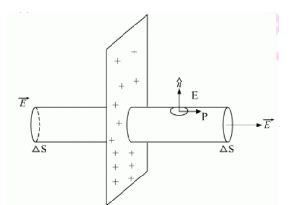
Outward flux through the Gaussian surface, is
\(2EA =\sigma A/\epsilon_0\)
\(\therefore\) \(E =\sigma A/2\epsilon_0\)
Vectorically \(\overrightarrow{E} = \frac{\sigma}{2\epsilon_0}\hat{n}\),
where \(\hat{n}\) is a unit vector normal to the plane, away from it.
Hence, electric field is independent of the distance from the sheet.
(c) For positively charged sheet \(\longrightarrow\) away from the sheet
For negatively charged sheet \(\longrightarrow\) towards the plane sheet

12th Standard CBSE Syllabus & Materials
12th Standard CBSE
CBSE 12th Computer Science Python Revision Tour I - New Previous year Question Papers Study Material - QB365 Set A
NEW12th Standard CBSE
CBSE 12th Business Studies Planning Important Questions And Answers Study Material - QB365 Set A
NEW12th Standard CBSE
CBSE 12th Business Studies Business Environment Important Questions And Answers Study Material - QB365 Set A
NEW12th Standard CBSE
CBSE 12th Business Studies Principles of Management Important Questions And Answers Study Material - QB365 Set A



CBSE 12th Standard CBSE Subjects
CBSE Standards










