
 100% FREE ACCESS
12th Standard CBSE Syllabus & Materials
12th Standard CBSE
CBSE 12th Economics Government Budget and the Economy Previous year Question Papers Study Material - QB365 Set A
NEW12th Standard CBSE
CBSE 12th Computer Science Interface Python with MySQL - New Previous year Question Papers Study Material - QB365 Set A
NEW12th Standard CBSE
CBSE 12th Computer Science Database Concept - New Previous year Question Papers Study Material - QB365 Set A
NEW12th Standard CBSE
CBSE 12th Computer Science Data Communication - New Previous year Question Papers Study Material - QB365 Set A
NEW12th Standard CBSE
CBSE 12th Computer Science Data Structures - New Previous year Question Papers Study Material - QB365 Set A
NEW12th Standard CBSE
CBSE 12th Computer Science Functions - New Previous year Question Papers Study Material - QB365 Set A

Published on: 30/07/2018
From the chapter Wave Optics, some of the important questions are covered in this question paper. It covers one mark, two, three and five marks questions from the book back and PTA question.
Download CBSE Class 12th Standard CBSE Physics question papers, sample papers, important questions, and previous year solved papers in PDF format. Get free study materials, NCERT solutions, and exam preparation resources for Class 12th Standard CBSE Physics
Questions + Answers key
Take MCQ Physics Test
1.
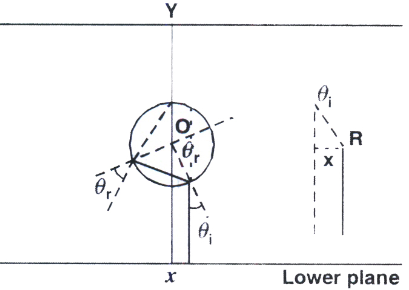
An infinitely long cylinder of radius R is made of an unusual exotic material with refractive index -1. The cylinder is placed between two planes whose normals are along the y direction. The centre of the cylinder O lies along the y-axis. A narrow laser beam is directed along the y direction from the lower plate. The laser source is at a horizontal distance x from the diameter in the y direction. find the range of x such that light emitted from the lower plane does not reach the upper plane
2.
Explain the terms interference of light and define constructive and destructive interference. Is law of conservation of energy obeyed?
3.
A biconvex lens is made of glass with \(\mu =1.52\). Each surface has a radius of curvature equal to 30 cm. An object of height 3 cm is placed 14 cm from the lens. Find the focal length of the lens and the position and size of image.
4.
In a Young's double slit experiment, red light of wavelength \(6000\mathring { A } \) is used and the nth bright fringe is obtained at a point P on the screen. Keeping the same setting, the source is replaced by green light of \(5000\mathring { A } \) and now (n+1)th bright fringe is obtained at the point P. Calculated the value of n.
5.
The light of wavelength \(4800\mathring { A } \) is incident on a double slit. If the overall separation of 8 fringes on a screen 150 cm away in 2 cm, find the distance between the two slits.
6.
Two monochromatic rays of light are incident normally on the face AB of an isosceles right-angled prism ABC. The refractive indices of the glass prism for the two rays 'I' and '2' are respectively 1.3 and 1.4 Trace the path of these rays after entering through the prism.
.jpg)
7.
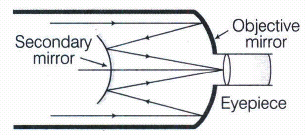
A Cassegrain telescope uses two mirrors as shown in the figure. Such a telescope is built with the mirrors 20mm apart. If the radius of curvature of large mirror is 220mm and the small mirror is 140 mm, where will the final image of an object at infinity be?
8.
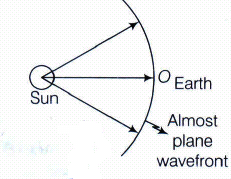
What is the shape of the wavefront on earth for sunlight?
9.
Name one phenomenon that is shown by light waves, but not by sound waves.
10.
What happens to the interference pattern if phase difference between two light sources varies continuously?
11.
How can you distinguish between a plane mirror, a concave mirror and convex mirror, just by looking at them?
12.
Can a virtual image be photographed?
13.
Which mirror is divergent, convex or concave?
14.
What is yellow spot?
15.
An astronomical telescope has a magnifying power of 10. In normal adjustment, distance between the objective and eye piece is 22 cm. The focal length of objective lens is
10 cm
22 cm
20 cm
2 cm
16.
A telescope uses an objective lens of focal length \(f_{ 0 }\) and an eye lens of focal length \(f_{ e }\). In normal adjustment, distance between the two lenses is
\(f_{ o }/f_{ e }\)
\(f_{ e }/f_{ o }\)
\((f_{ o }-f_{ e })\)
\((f_{ o }+f_{ e })\)
17.
The correct formula for magnifying power of a simple microscope is
\(m=\left( 1+\frac { f }{ d } \right) \)
\(m=\left( 1-\frac { d }{ f } \right) \)
\(m=\left( 1+\frac { d }{ f } \right) \)
\(m=\left( 1-\frac { f }{ d } \right) \)
18.
One dioptre is the power of a lens of focal length
1 cm
1 m
-1 cm
-1 m
19.
The angle between pass axis of polarizer and analyzer is \(45°\)The percentage of polarized light passing through analyzer is
100%
50%
25%
75%
20.
Light of wavelength \(6000 \ \overset { \circ }{ A } \) falls on a plane reflecting surface. The reflected wavelength is
\(6000 \ \overset { \circ }{ A } \)
\(<6000 \ \overset { \circ }{ A } \)
\(>6000 \ \overset { \circ }{ A } \)
cannot say
21.
Image of an object in a concave mirror is
always real
always virtual
always erect
real or virtual depending on position of object
22.
In a concave mirror, an object is placed at a distance \({ d }_{ 1 }\) from the focus and the real image is formed at a distance \({ d }_{ 2 }\) from the focus. then the focal length of the mirror is:
\(\sqrt { { d }_{ 1 }{ d }_{ 2 } } \)
\({ d }_{ 1 }{ d }_{ 2 }\)
\({ { (d }_{ 1 }{ /d }_{ 2 }) }^{ /2 }\)
\(\sqrt { { d }_{ 1 }{ /d }_{ 2 } } \)
1.
As the material is of refractive index-1. \({ \theta }_{ 2 }\) is negative and \({ \theta ' }_{ 2 }\) is positive
Now \(\left| { \theta }_{ i } \right| =\left| { \theta }_{ r } \right| =\left| { \theta ' }_{ r } \right| \)
The total deviation of the out coming ray from the incoming ray is \({ 4\theta }_{ i }\)
The ray shall not reach the receiving plate if
\(\frac { \pi }{ 2 } \le { 4\theta }_{ i }\le \frac { 3\pi }{ 2 } \)
(Angles measured clockwise from the y-axis)
\(or \ \frac { \pi }{ 8 } \le { \theta }_{ i }\le \frac { 3\pi }{ 8 } \)
From the figure
\( sin{ \theta }_{ i }=\frac { \pi }{ R } \)
\(\therefore \frac { \pi }{ 8 } \le { sin }^{ -1 }\frac { \pi }{ R } \le \frac { 3\pi }{ 8 } \)
\( orfrac { \pi }{ 8 } \le \frac { \pi }{ R } \le \frac { 3\pi }{ 8 } \)
Thus for \(\frac { R\pi }{ 8 } \le x\le \frac { 3R\pi }{ 8 } \) light emitted from the source shall not reach the receiving plate
2.
Interference of Light. The phenomenon of redistribution of energy in a medium due to superimposition of waves from two coherent source of light is called Interference of Light.
Constructive Interference. At points, where the crest of one wave falls the crest of the other or a through of one falls on the through of the other, the amplitude of the resulting wave becomes maximum. Hence the energy or the intensity of light at such points becomes maximum. This is called Constructive Interference.
Destructive Interference. At some other points where the through of one falls on the crest of the other or crest of one falls on the through of the other, the amplitude of the resulting waves becomes minimum. Hence the energy or intensity becomes minimum. This is called Destructive Interference.
Law of conservation of energy is obeyed. It should be clearly understood that in interference of light no light energy is destroyed. The loss of energy at the points of destructive interference appears as the increase of energy at the points of constructive interference.
3.
28.85 cm. -27.19 cm;enlarged, erect and virtual
4.
Diffraction of light is the phenomenon of bending of light around corners of an obstacle.
\(Now\frac { { n\lambda }_{ red }D }{ d } =\frac { (n+1){ \lambda }_{ green }D }{ d } \)
\( n6000=(n+1)5000\)
\(6n=5n+5\)
\( n=5.\)
5.
\(\lambda =4,800\mathring { A } =4,800\times{ 10 }^{ -8 }cm\)
\( =4.8\times{ 10 }^{ -5 }cm;\)
\( D=150cm;8\beta =2\)
\(so\quad \beta =\frac { 1 }{ 4 } =0.25cm\)
\( \beta =0.25cm;d=?\)
\( \beta =\frac { D }{ d } \lambda =\frac { D\lambda }{ \beta } \)
\( =\frac { 1504.8\times{ 10 }^{ -5 } }{ 0.25 } \)
\( or =0.0288cm.\)
6.
.jpg)
7.
Radius of curvature of objectrive mirror,
R1 = 220 mm
\({ f }_{ 1 }=\frac { { R }_{ 1 } }{ 2 } =\frac { 220 }{ 2 } =110 \ mm\)
Radius of curvature of secondary mirrors, R2 = 140 mm
\({ f }_{ 2 }=\frac { { R }_{ 2 } }{ 2 } =\frac { 140 }{ 2 } =70 \ mm\)
Distance between two mirrors, d = 20 mm from objective mirror.
Now, for secondary mirror, u = f1 - d = 110 - 20
= 90 mm
From mirror formula,
\(\frac { 1 }{ v } +\frac { 1 }{ u } =\frac { 1 }{ { f }_{ 2 } } \Longrightarrow \frac { 1 }{ v } =\frac { 1 }{ { f }_{ 2 } } -\frac { 1 }{ u } \)
\( =\frac { 1 }{ 70 } -\frac { 1 }{ 90 } \Longrightarrow v=\frac { 630 }{ 2 } =315\ mm\)
i.i., final image will be at 31.5 cm to the right of secondary mirror.
8.
We know the sun is at very distance from the earth. Assuming sun as spherical, it can be considered as point sourse situated, it can be considered as point sourse at infinity.
Due to the large distance the radius of wavefront can be considered as large(infinity) and hence, wavefront is almost plane.
9.
Polaroisation. Light waves can be polarised, but sound waves cannot be polarised.
10.
the positions of bright and dark fringes would change rapidly. The interference pattern shall not be sustained.
11.
In a plane mirror, image formed is virtual, erect and of same size as the object. In a convex mirror, image is erect and smaller in size.
In a concave mirror, the size and nature of the image change with change in position of the object in front of it.
12.
Yes, it can be photographed.
13.
Convex mirror is divergent.
14.
It is a spot at about the centre of the retina, which is most sensitive to light.
15.
(c)
20 cm
16.
(d)
\((f_{ o }+f_{ e })\)
17.
(c)
\(m=\left( 1+\frac { d }{ f } \right) \)
18.
(b)
1 m
19.
(b)
50%
20.
(a)
\(6000 \ \overset { \circ }{ A } \)
21.
(d)
real or virtual depending on position of object
22.
(a)
\(\sqrt { { d }_{ 1 }{ d }_{ 2 } } \)

12th Standard CBSE Syllabus & Materials
12th Standard CBSE
CBSE 12th Computer Science Python Revision Tour I - New Previous year Question Papers Study Material - QB365 Set A
NEW12th Standard CBSE
CBSE 12th Business Studies Planning Important Questions And Answers Study Material - QB365 Set A
NEW12th Standard CBSE
CBSE 12th Business Studies Business Environment Important Questions And Answers Study Material - QB365 Set A
NEW12th Standard CBSE
CBSE 12th Business Studies Principles of Management Important Questions And Answers Study Material - QB365 Set A



CBSE 12th Standard CBSE Subjects
CBSE Standards










