
 100% FREE ACCESS
11th Standard Syllabus & Materials
11th Standard
TN 11th Tamil இயற்கை வேளாண்மை,சுற்றுச்சூழல் -செய்யுள் - மனோன்மணீயம் Important Questions And Answers Study Material - QB365 Set A
NEW11th Standard
TN 11th Tamil என்னுயிர் என்பேன் -துணைப்பாடம் - இசைத்தமிழர் இருவர் Important Questions And Answers Study Material - QB365 Set A
NEW11th Standard
TN 11th Tamil மொழி கலை -செய்யுள் - ஒவ்வொரு புல்லையும் Important Questions And Answers Study Material - QB365 Set A
NEW11th Standard
TN 11th Tamil பீடு பெற நில் - இலக்கணம் - பகுபத உறுப்புகள் Important Questions And Answers Study Material - QB365 Set A
NEW11th Standard
TN 11th Tamil பீடு பெற நில் - துணைப்பாடம் - வாடிவாசல் Important Questions And Answers Study Material - QB365 Set A
NEW11th Standard
TN 11th Tamil பீடு பெற நில் - செய்யுள் - குறுந்தொகை Important Questions And Answers Study Material - QB365 Set A

Published on: 12/03/2019
+1 Public Exam March 2019 Important Creative Questions and Answers
Download Tamil Nadu 11th Standard Physics question papers, model tests, one-mark questions, important questions, and public exam papers in PDF format. Free study materials and answer keys for TN State Board students.
Questions + Answers key
Take MCQ Physics Test1.
What are longitudinal waves? Give one example.
2.
The wavelength of two sine waves are λ1 = 1m and λ2 = 6m. Calculate the corresponding wave numbers.
3.
What is meant by force constant of a spring?
4.
Calculate the temperature at which the rms velocity of a gas triples its value at S.T.P. (Standard temperature T1 = 273K).
5.
Define the term degrees of freedom.
6.
What is the microscopic origin of pressure?
7.
Define one calorie.
8.
What is meant by ‘thermal equilibrium’?
9.
Obtain an ideal gas law from Boyle’s and Charles’ law.
10.
Why two holes are made to empty an oil tin?
11.
Define angle of contact for a given pair of solid and liquid.
12.
State Pascal’s law in fluids.
13.
State Hooke’s law of elasticity.
14.
Within the elastic limit, the stretching strain produced in wires A, B, and C due to stress is shown in the figure. Assume the load applied are the same and discuss the elastic property of the material.
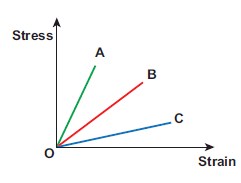
Write down the elastic modulus in ascending order
15.
Define weight.
16.
Will the angular momentum of a planet be conserved? Justify your answer.
17.
State Kepler’s three laws.
18.
A body of mass 100 kg is moving with an acceleration of 50 cm s-2. Calculate the force experienced by it.
19.
Compare the components of vector equation \(\vec F_1+\vec F_2+\vec F_3=\vec F_4\)
20.
A force \(\vec F=\vec i+2\vec j+3\vec k\) k acts on a particle and displaces it through a distance \(\vec S=4\vec i+6\vec j\). Calculate the work done if force and work done are in the same direction?
21.
State the number of significant figures in the following 2.65 \(\times\)1024m
22.
State the number of significant figures in the following 600800
23.
Why does a porter bend forward while carrying a sack of rice on his back?
24.
Is there any net work done by external forces on a car moving with a constant speed along a straight road?
25.
A bullet of mass 20 g strikes a pendulum of mass 5 kg. The centre of mass of pendulum rises a vertical distance of 10 cm. If the bullet gets embedded into the pendulum, calculate its initial speed?
26.
Calculate the work done by a force of 30 N in lifting a load of 2kg to a height of 10m (g = 10ms-2).
27.
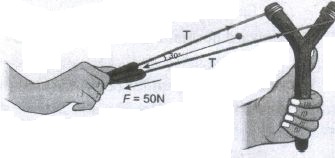
Apply Lami's theorem on sling shot and calculate the tension in each string?
28.
Explain the characteristics of elastic and inelastic collision.
29.
Can we predict the direction of motion of a body from the direction of force on it?
30.
Why does a parachute descend slowly?
31.
Why it is not possible to push a car from inside?
32.
Having all units in atomic standards is more useful. Explain.
33.
Show that a screw gauge of pitch 1mm and 100 divisions is more precise than a vernier caliper with 20 divisions on the sliding scale.
34.
The radius of the circle is 3.12 m. Calculate the area of the circle with regard to significant figures.
35.
Define a vector. Give examples.
36.
Write short notes on two springs connected in parallel.
37.
Can the given heat energy be completely converted to work in a cyclic process? If not, when can the heat can completely converted to work?
38.
Express the change in internal energy in terms of molar specific heat capacity.
39.
What is a thermal expansion?
40.
Distinguish between streamlined flow and turbulent flow.
41.
If the angular momentum of a planet is given by \(\vec{L}=5t^2\hat i-6t\hat j+3\hat k\) . What is the torque experienced by the planet? Will the torque be in the same direction as that of the angular momentum?
42.
Define gravitational potential energy.
43.
From a point on the ground, the top of a tree is seen to have an angle of elevation 60o . The distance between the tree and a point is 50m. calculate the height of the tree?
44.
Write the various types of potential energy. Explain the formulae.
45.
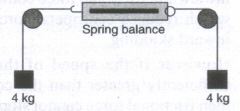
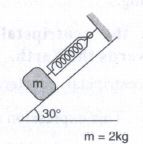
What is the reading shown in spring balance?
46.
The Moon is orbiting the Earth approximately once in 27 days, what is the angle traversed by the Moon per day?
47.
Compare the components for the following vector equations
(a) \(T\overrightarrow { j } -mg\hat { j } =ma\hat { j } \)
(b) \(\vec { T } +\vec { F } =\vec { A } +\vec { B } \)
(c) \(\overrightarrow { T } -\overrightarrow { F } =\overrightarrow { A } -\overrightarrow { B } \)
(d) \(T\overrightarrow { j } +mg\hat { j } =ma\hat { j } \)
48.
Calculate the average velocity of the particle whose position vector changes from \(\overrightarrow { { r }_{ 1 } } =5\hat { i } +6\hat { j } \) to \(\overrightarrow { { r }_{ 2 } } =2\hat { i } +3\hat { j } \) in a time 5 second.
49.
What are the steps involved in scientific method?
50.
Write a short note on vector product between two vectors.
1.
In longitudinal wave motion, the constituent of the medium oscillate or vibrate about their mean positions in a direction parallel to the direction of propagation (direction of energy transfer) of waves.
Example: Sound waves travelling in air.
2.
\({ K }_{ 1 }=\frac { 2\pi }{ 1 } =6.28 \ rad \ { m }^{ -1 }\)
\({ K }_{ 2 }=\frac { 2\pi }{ 6 } =1.05 \ rad \ { m }^{ -1 }\)
3.
Force constant of a spring is defined as the restoring force per unit length.
4.
RMS velocity \(\mathrm{C} =\sqrt{\frac{3 R T}{M}} \)
\(\mathrm{T}=\mathrm{T}_{1} =273 \mathrm{~K}
\)
\(\therefore C =\sqrt{\frac{3 R \times 273}{M}}\)
When the RMS velocity is tripled
\(3 \mathrm{C}=\sqrt{\frac{3 R T}{M}}\)
Dividing equation is (2) by (1) we get
\(\frac{3 C}{C} =\sqrt{\frac{3 R T / M}{3 R \times 273 / M}}
\)
\(3 =\sqrt{\frac{T}{273}}
\)
\(\therefore 9 =\frac{T}{273}
\)
\(\therefore T =273 \times 9=2457 \mathrm{~K}\)
\(\therefore\) Temperature \(\mathrm{T}_{2}=2457 \mathrm{~K}, \mathrm{~T}_{1}=273 \mathrm{~K}\)
5.
The minimum number of independent coordinates needed to specify the position and configuration of a thermodynamic system in space is called degree of freedom of the system.
6.
Pressure arises due to momentum transfer to the wall of the container.
7.
One calorie is defined as the amount of energy required to raise 1 gram of an object by 1oc.
8.
Two systems are said to be in thermal equilibrium with each other if they are at the same temperature, will not change with time.
9.
(i) Acceleration to Boyle's law P \(\alpha\)\(\frac { 1 }{ V } \)
(ii) Acceleration to Charles' law V \(\alpha\) T. By combining these two equations we have PV = CT. Here C is a positive constant.
(iii) So we can write the constant C as k times the number of particles N.
Here k is the Boltzmann constant (1.381\(\times\)10-23 JK-1) and it is found to be a universal constant. So the ideal gas law can be stated as follows PV = NKT
10.
When oil comes out through a tin with one hole, the pressure inside the tin becomes less than the atmospheric pressure, soon the oil stops flowing out. When two holes are made in the tin, air keeps on entering the tin, through the other hole and maintains pressure inside.
11.
Angle of contact is defined as the angle between the tangent to the liquid surface at the point of contact and the solid surface inside the liquid.
12.
Pascal's law states that, if the pressure in a liquid is changed at a particular point, the change is transmitted to the entire liquid without being diminished in magnitude.
13.
Hooke's law of elasticity states that within the elastic limit, the strain produced in a body is directly proportional to the stress applied.
strain ∝ stress
14.
Here, the elastic modulus is Young modulus and due to stretching, stress is tensile stress and strain is tensile strain.
Within the elastic limit, stress is proportional to strain (obey Hooke’s law). Therefore, it shows a straight line behaviour. So, Young modulus can be computed by taking slope of these straight lines. Hence, calculating the slope for the straight line, we get
Slope of A > Slope of B > Slope of C
Which implies,
Young modulus of C < Young modulus of B < Young modulus of A
Notice that larger the slope, lesser the strain (fractional change in length). So, the material is much stiffer. Hence, the elasticity of wire A is greater than wire B which is greater than C. From this example, we have understood that Young’s modulus measures the resistance of solid to a change in its length.
15.
The weight of an object is defined as the downward force whose magnitude W is equal to the upward force that must be applied to the object to hold it at rest or at constant velocity relative to the Earth.
16.
Yes, the angular momentum of a planet is conserved.
During the orbitary motion of the planets around the Sun, the line of action of gravitational force passes through the axis, the external torque is zero. Hence the angular momentum is conserved.
Torque, \( { \tau } =\frac { dL }{ dt }\)
If torque is zero then angular momentum (L) is constant i.e., it is conserved.
17.
1. Law of orbits
Each planet moves around the Sun in an elliptical orbit with the Sun at one of the foci.
2. Law of area
The radial vector (line joining the Sun to a planet) sweeps equal areas in equal intervals of time.
3. Law of period
The square of the time period of revolution of a planet around the Sun in its elliptical orbit is directly proportional to the cube of the semi major axis of the ellipse. It can be written as :
\(T^{2} \propto a^{3} \)
\(\frac{T^{2}}{a^{3}}=\text { constant. }\)
18.
Mass m = 100 kg
Acceleration a = 50 cm s-2 = 0.5 ms-2
Using Newton's second law,
F= ma
F=100 kg\(\times\)0.5 ms-2 = 50N
19.
We can resolve all the vectors in x, y and z components with respect to Cartesian coordinate system.
Once we resolve the components we can separately equate the x components on both sides, y components on both sides, and z components on both the sides of the equation, we then get
\(F_{1x}+F_{2x}+F_{3x}=F_{4x}\)
\(F_{1y}+F_{2y}+F_{3y}=F_{4y}\)
\(F_{1z}+F_{2z}+F_{3z}=F_{4z}\)
20.
Force \(\vec F=\vec i+2\vec j+3\vec k\)
Distance \(\vec S=4\vec i+6\vec j\)
Work done \(\vec F.\vec S=(\vec i2\vec j+3\vec k).(4\vec i+6\vec j)=4+12+0=16J\)
21.
three
22.
four
23.
Due to the added weight of rice sack, centre of gravity of the combined body weight and the carrying weight shifted to new position. Once he bends, the Centre of gravity realigns as with the body's axis making his body balanced.
24.
No.
If a car is moving at a constant speed, then net external force will be zero.
Because a = \(\frac{v-u}{t}\)
For constant speed v = u, then a = 0. (a-acceleration)
F = ma ∴ F = zero. i.e.. no external force.
W = FS = 0. So net work done is zero .
25.
\(\text {Mass of a bullet } m=20 g=20 \times 10^{-3} \mathrm{~kg} =0.02 \mathrm{~kg} \)
\(\text {Mass of a pendulum } M =5 \mathrm{~kg} \)
\(\text {Height } \mathrm{h} =10 \mathrm{~cm} \)
\(=10 \times 10^{-2} \)
\(=0.1 \mathrm{~m} \)
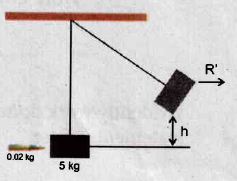
\(\text { K.E. of the block } =\text { P.E. of the block } \)
\(\frac{1}{2} M v^{2} =M g h \)
\(\therefore v^{2} =\sqrt{2 g h} \)
\(=\sqrt{2 \times 9.8 \times 0.1}=\sqrt{1.96}=1.4 \mathrm{~m} / \mathrm{s} \)
\(\therefore \text { Final speed } v =1.4 \mathrm{~m} / \mathrm{s} \)
\(\text {Final speed } v =\frac{m_{1} u_{1}+m_{2} u_{2}}{\left(m_{1}+m_{2}\right)} \)
\(v_{1} =\frac{0.02 u_{1}+5 \times 0}{(0.02+5)}=\frac{0.02}{5.02} u_{1} \)
\(\text { But } v =1.4 \)
\(\therefore 1.4 =\frac{0.02}{5.02} u_{1} \)
\(u_{1}=\frac{1.4 \times 5.02}{0.02}=\frac{7.028}{0.02}=351.4 \mathrm{~m} / \mathrm{s}\)
\(\therefore \text { Initial speed } =351.4 \mathrm{~m} / \mathrm{s}\)
26.
Given:
Force mg = 30 N; height = 10 m
Work done to lift a load W = ?
W = F.S (or) mgh
= 30 \(\times\) 10
W = 300J
27.
Force acting vertically to sling shot
Tension T in each string;
Now applying Lami's theorem, we get
\(\frac{2 T}{\sin \theta} =F
\)
\(\frac{2 T}{\sin (2 \times 30)} =50 N
\)
\(\frac{2 T}{\sin (60)} =50 N
\)
\(\frac{2 T}{\sqrt{3}} =50 N
\)
\(\frac{T}{2 T} =\frac{2}{\sqrt{3}} \times 50 N
\)
\(T=\frac{50 N}{\sqrt{3}}=28.268 N\)
28.
Characteristics of elastic collision are
1. Total momentum remains conserved
2. Total kinetic energy remains conserved.
3. In elastic collision conservative forces are involved. Hence total kinetic energy is conserved.
4. In elastic collision, mechanical energy is not dissipated.
Characteristics of inelastic collision are
1. Total momentum is conserved.
2. Total kinetic energy is not conserved.
3. Forces involved are non-conservative forces
4. Mechanical energy is dissipated into heat, light, sound etc.
29.
If an object is thrown vertically upward, the direction of motion is upward, but gravitational force is downward.
30.
The surface area of parachute is very large. And when it descends downwards, the air provides resistance to it and so it descends slowly.
31.
(i) According to Newton's third law when one body exerts a force on a second body, the second body simultaneously exerts a force equal in magnitude and opposite in direction on the first body.
(ii) When you push a car from inside, the reaction force of your pushing is balanced out by your body moving backward and eventually the seat behind you pushes against to bring things to static equilibrium.
32.
All units in atomic standards are more useful because they never change with time.
33.
Least count of screw gauge
\(={{Pitch}\over{No. of\ divisions}}\)
\(={{1}\over{100}}=0.01\ mm\) (or) 0.001 cm
Least count of vernier calipers
\(=1MSD-1-1VSD=(1-19/20)MSD\)
\(={{1}\over{20}}\) = 0.05 cm.
So screw gauge is more precise than vernier.
34.
Radius of the circle r = 3.12 m
Area of the circle A = \(\pi\) r2
= 3.14\(\times\)3.12\(\times\)3.12
= 30.566016 m2
According to the rule of significant
A = 30.6 m2
35.
(i) A quantity which is described by both its magnitude and direction is called a vector quantity.
(ii) Geometrically, a vector is a directed line segment
Examples: Force, velocity displacement, acceleration, position vector, linear momentum and angular momentum.
36.
When two or more springs are connected in parallel, we can replace (by removing) all these springs with an equivalent spring (effective spring) whose net effect is same as if all the springs are in parallel connection.
kp = k1 + k2
If n springs are connected in parallel then kp = nk.
37.
(i) According to first law of thermodynamics, in an isothermal process the given heat is completely converted into work (Q = W). Is it a violation of the second law of thermodynamics.
(ii) No. For non-cyclic process like an isothermal expansion, the heat can be completely converted into work. But Second law of thermodynamics implies that 'In a cyclic process only a portion of the heat absorbed is converted into work'.
38.
Quantity of heat \(\triangle\)Q = ms \(\triangle\)T
If internal energy is equivalent to heat transferred then internal energy.
U = \(\triangle\)Q = ms \(\triangle\)T
= C\(\triangle\)T
39.
Thermal expansion is the tendency of matter to change in shape, area, and volume due to a change in temperature.
40.
| S.No | Streamlined flow | Turbulent flow |
| 1. | In this flow, a liquid flows such that each particle of the liquid passing a point moves along the same path and has the same velocity as its predecessor. |
During this flow of fluid when the critical, velocity of the fluid exceeds the critical velocity |
| 2. | Its velocity is less than critical velocity. |
Its velocity is greater than critical velocity. |
| 3. | For this flow the value of Reynold's number lies between 0 and 1000. |
For this flow the value of Reynold's member is more than 2000. |
| 4. | Less energy is dissipated | More energy is dissipated. |
41.
Angular momentum \(\mathrm{L} =5 t^{2} \hat{i}-6 t \hat{j}+3 \hat{k} \)
\(\text {Torque } \propto \frac{d L}{d t}
\)
\(=\frac{d}{d t}\left[5 t^{2} \hat{i}-6 t \hat{j}+3 \hat{k}\right]=10 t \hat{i}-6 \hat{j}\)
42.
The gravitational potential energy U(r) of a system of two masses m1 and m2 separated by a distance r as the amount of work done to bring the mass m2 from infinity to a distance r assuming m1 to be fixed in its position and is written as
\(\mathrm{U}(\mathrm{r})=-\frac{G m_{1} m_{2}}{r}\)
43.
Angle \(\theta\) = 60 o
The distance between the tree and a point
x = 50m
Height of the tree (h)=?
For triangulation method tan\(\theta\) =\({h\over x}\)
h= x tan \(\theta\) = 50\(\times\)tan 600 = 50\(\times\)1.732
h = 86.6m
The height of the tree is 86.6m.
44.
Various types of potential energy are
(i) The energy possessed by the body due to gravitational force gives rise to gravitational potential energy.
The gravitational potential energy (U) at some height h is equal to the amount of work required to take the object from the ground to that height h.
U = mgh
(ii) The energy due to spring force and other similar forces give rise to elastic potential energy.
a) At the equilibrium position x = 0 potential energy is \(U=\frac{1}{2} k x^{2}\)
b) If the initial position is not zero and if the mass is changed from position xi to xf, if then elastic potential energy is \(U=\frac{1}{2} k\left(x_{f}^{2}-x_{i}^{2}\right)\)
(iii) The energy due to electrostatic force on charges gives rise to electrostatic potential energy.
Electrostatic potential energy is the work done to arrange two charges q1 and q2 at a separation \(r=\frac{1}{4 \pi \varepsilon_{0}} \frac{q_{1} q_{2}}{r^{2}}\)
45.
1. Equal mass balancing each side so reading shows Zero.
2. Mass of string acting downward direction in the inclined plane.
mg sin θ = T
T = 2kg x 9.8m/s2 x sin(30o)
T = 9.8N
46.
360o = 27 days
1 day = \(\frac{360^o}{27}=13^o.3'\)
47.
(a) T - mg = ma
(b) \(T_{x}+F_{x}=A_{x}+B_{x} ; T_{y}+F_{y}=A_{y}+B_{y} ; T_{z}+F_{z}=A_{z}+B_{z}\)
(c) T + mg = ma
(d) \(T_{x}-F_{x}=A_{x}-B_{x} ; T_{y}-F_{y}=A_{y}-B_{y} ; T_{z}-F_{z}=A_{z}-B_{z}\)
48.
\(\overrightarrow { { v }_{ 1 } } =5\hat { i } +6\hat { j } \)
\(\overrightarrow { { v }_{ 2 } } =2\hat { i } +3\hat { j } \)
\(\therefore \Delta \vec{r} =\vec{r}_{2}-\vec{r}_{1}=2 \hat{i}+3 \hat{j}-5 \hat{i}-6 \hat{j}
\)
\(=-3 \hat{i}-3 \hat{j}
\)
\(\Delta t =5 \mathrm{sec}
\)
\(\therefore \Delta v_{\text {avg }} s =\frac{\Delta \vec{r}}{\Delta t}
\)
\(=\frac{-3}{5}(\hat{i}+\hat{j})\)
49.
(i) Systematic observation
(ii) Controlled experimentation
(iii) Reasoning (qualitative and quantitative)
(iv) Modelling (Mathematical)
(v) Prediction and verification (theories)
50.
It is defined as another vector having a magnitude equal to the product of the magnitudes of two vectors and the sine of the angle between them.
If \(\overrightarrow { A } \) and \(\overrightarrow { B } \) are two vectors, then their vector product \(\vec{A} \times \vec{B}=\vec{C}=(A B \sin \theta) \hat{n}\).
The direction of the product vector \((\hat{n})\) is perpendicular to the plane containing the two vectors, in accordance with the right hand screw rule or right hand thumb rule.
1. It is not commutative, i.e., \(\vec{A} \times \vec{B} \neq \vec{B} \times \vec{A}. \ But \ \vec{A} \times \vec{B}=-[\vec{B} \times \vec{A}].\)
2. \((\vec{A} \times \vec{B})_{\max }=A B \hat{n}\), when \(\theta=90^{\circ}\) i.e., when \(\overrightarrow { A } \) and \(\overrightarrow { B } \) are orthogonal to each other.
3. \((\vec{A} \times \vec{B})_{\text {min }}=0\), when \(\theta=0^{\circ} \ or \ 180^{\circ}\) i.e., when the vectors are either parallel or antiparallel provided \(\overrightarrow { A } \) and \(\overrightarrow { B } \) are non-zero vectors.
4. The self - vector products of unit vectors are \(\hat{i} \times \hat{i}=\hat{j} \times \hat{j}=\hat{k} \times \hat{k}=0\)
5. In the case of orthogonal unit vectors, \(\hat{i} \times \hat{j}=\hat{k}, \hat{j} \times \hat{k}=i, \hat{k} \times \hat{i}=j\)
6. Torque \(\tau=\vec{r} \times \overrightarrow{\mathrm{F}}\), angular momentum \(\vec{L}=\vec{r} \times \vec{p}\ an \ \vec{V}=\vec{w} \times \vec{r}\) are examples of vector product.

11th Standard Syllabus & Materials
11th Standard
TN 11th Tamil பீடு பெற நில் - செய்யுள் - காவடிச்சிந்து Important Questions And Answers Study Material - QB365 Set A
NEW11th Standard
TN 11th Tamil பீடு பெற நில் - உரைநடை - மலை இடப்பெயர்கள் : ஓர் ஆய்வு Important Questions And Answers Study Material - QB365 Set A
NEW11th Standard
TN 11th Tamil மாமழை போற்றுதும் - துணைப்பாடம் - யானை டாக்டர் Important Questions And Answers Study Material - QB365 Set A
NEW11th Standard
TN 11th Tamil மாமழை போற்றுதும் - செய்யுள் - ஐங்குறுநூறு Important Questions And Answers Study Material - QB365 Set A



Tamilnadu Stateboard 11th Standard Subjects

Maths

Commerce

Economics

Biology

Business Maths and Statistics

Accountancy

Computer Science
Physics

Chemistry
Maths
Biology
Economics
Physics
Chemistry

History
Business Maths and Statistics

Computer Science
Accountancy

Computer Applications
History
Computer Technology
Commerce
Computer Applications
Computer Technology

Tamil

English

French
Tamilnadu Stateboard Standards

