
 100% FREE ACCESS
9th Standard Syllabus & Materials
9th Standard
TN 9th Tamil உள்ளத்தின் சீர் -கற்கண்டு (இலக்கணம்) - தொடர் இலக்கணம், ஆகுபெயர் Important Questions And Answers Study Material - QB365 Set A
NEW9th Standard
TN 9th Tamil உள்ளத்தின் சீர் -விரிவானம் (துணைப்பாடம்) - தாய்மைக்கு வறட்சி இல்லை! Important Questions And Answers Study Material - QB365 Set A
NEW9th Standard
TN 9th Tamil உள்ளத்தின் சீர் -கவிதை பேழை (செய்யுள்) - மார்கழி பெருவிழா Important Questions And Answers Study Material - QB365 Set A
NEW9th Standard
TN 9th Tamil உயிருக்கு வேர்-இலக்கணம் - பகுபத உறுப்பிலக்கணம் Important Questions And Answers Study Material - QB365 Set A
NEW9th Standard
TN 9th Tamil அமுதென்று பேர் - இலக்கணம்-எழுத்து -அளபெடை Important Questions And Answers Study Material - QB365 Set A
NEW9th Standard
TN 9th Tamil அமுதென்று பேர்-துணைப்பாடம் - ஆறாம்திணை Important Questions And Answers Study Material - QB365 Set A

Published on: 14/03/2020
9th Standard Mathematics English Medium All Chapter Book Back and Creative Five Marks Questions 2020
Download Tamil Nadu 9th Standard Maths question papers, model tests, one-mark questions, important questions, and public exam papers in PDF format. Free study materials and answer keys for TN State Board students.
Questions + Answers key
Take MCQ Maths Test1.
Find the value of \(\theta\) if
(i) sin \(\theta\) = 0.9858
(ii) cos\(\theta\) = 07656
2.
A farmer has a field in the shape of a rhombus. The perimeter of the field is 400 m and one of its diagonal is 120 m. He wants to divide the field into two equal parts to grow two different types of vegetables. Find the area of the field.
3.
Find the area of a quadrilateral ABCD whose sides are AB = 8cm, BC = 15 cm, CD = 12 cm, AD = 25 cm and  = 90°.
4.
Find the values of the following:
(i) (cos 00 + sin 450 + sin 300)(sin 900 - cos 450 + cos 600)
(ii) tan2600 - 2tan2450 - cot2300 +2sin2300 + \(\frac { 3 }{ 4 } \) cosec2 450
5.
The mid-points of the sides of a triangle are (5, 1), (3, −5) and (−5, −1). Find the coordinates of the vertices of the triangle.
6.
Draw the graph for the following
(i) y = 3x - 1
(ii) \(y=\left( \frac { 2 }{ 3 } \right) x+3\)
7.
In an examination 50% of the students passed in Mathematics and 70% of students passed in Science while 10% students failed in both subjects. 300 students passed in atleast one subject. Find the total number of students who appeared in the examination, if they took examination in only two subjects.
8.
Verify \(n\left( A\cup B\cup C \right) \) = n(A) + n(B) +n(C) - \(n\left( A\cap B \right) -n\left( B\cap C \right) -n\left( A\cap C \right) -n\left( A\cap C \right) +\left( A\cap B\cap C \right) \) for the following A = {1,3,5,6,8} C = {1,2,3,6}
9.
Draw Venn diagram for \(A\cap B\cap C\)
10.
Factorise 2x3- x2 - 12x - 9 into linear factors
11.
Find the quotient and remainder when 5x3 - 9x2 + 10x + 2 is divided by x + 2 using synthetic division
12.
In the class, weight of students is measured for the class records. Calculate mean weight of the students using direct method.
| Weight in kg | 15-25 | 25-35 | 35-45 | 45-55 | 55-65 | 56-75 |
| No.of students | 4 | 11 | 19 | 14 | 0 | 2 |
13.
Find the mode for the following data
| Marks | 1-5 | 6-10 | 11-15 | 16-20 | 21-25 |
|---|---|---|---|---|---|
| No. of students | 7 | 10 | 16 | 32 | 24 |
14.
Calculate the median for the following data:
| Height (cm) | 160 | 150 | 152 | 161 | 156 | 154 | 155 |
|---|---|---|---|---|---|---|---|
| No. of Students | 12 | 8 | 4 | 4 | 3 | 3 | 7 |
15.
If both (x - 2) and \(\left( x-\frac { 1 }{ 2 } \right) \) are the factors of ax2+ 5x + b, then show that a = b.
16.
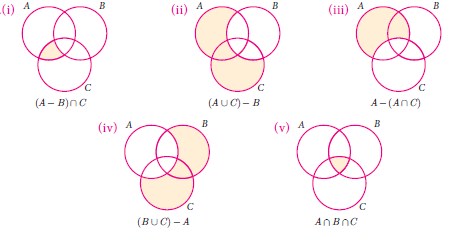
If A, B and C are overlapping sets, then draw Venn diagram for the following sets:
(i) (A-B)\(\cap \)C
(ii) (A\(\cup \)C)-B
(iii) A-(A\(\cap \)C)
(iv) (B\(\cup \)C)-A
(v) A\(\cap \)B\(\cap \)C
17.
Represent \(-\frac { 2 }{ 11 } ,-\frac { 5 }{ 11 } and-\frac { 9 }{ 11 } \)on the number line.
18.
Find any three rational numbers between \(\frac { 1 }{ 2 } \) and \(\frac { 1 }{ 5 } \)
19.
Consider the ten real numbers
\(\sqrt { 2 } ,\frac { 7 }{ 9 } \),-1.32,\(\frac { 6 }{ 9 } ,-\sqrt { 3 } \) , 2.151155 .....,\(\frac { 23 }{ 6 } ,\frac { 48 }{ 5 } \), -3.010010001... and 12.353553555.
(i) Arrange the ten real numbers in the given boxes in ascending order.

(ii) Arrange the same numbers in the boxes given below in descending order
20.
Show that the point A (3,7) B (6, 5) and C (15, -1) are collinear.
21.
Show that the given points (1, 1), (5, 4), (-2, 5) are the vertices of an isosceles right angled triangle.
22.
Find the value of ‘a’ such that PQ = QR where P, Q, and R are the points whose coordinates are (6, –1), (1, 3) and (a, 8) respectively
23.
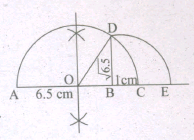
Represent the following irrational numbers on the number line \(\sqrt { 6.5 } \)
24.
Construct the centroid of \(\triangle\)PQR such that PQ = 9 cm, QR = 7 cm, RP = 8 cm.
25.
Construct \(\triangle\)ABC in which AB = BC = 8 cm and \(\angle \)B =70o. Locate its incentre and draw the incircle
26.
Draw ΔABC, where AB = 6 cm, ㄥB = 1100 and BC = 5 cm and construct its Orthocentre.
27.
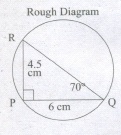
Construct the right triangle PQR whose perpendicular sides are 4.5 cm and 6 cm. Also locate its circumcentre and draw the circumcircle.
1.
(i) sin \(\theta\) = 0.9858 = 0.9857 + 0.0001
From the sine table 0.9857 = 80o 18'
Mean difference 1 = 2′
0.9858 = sin 80020'
sin\(\theta\) = 0.9858 = sin 80020'
\(\theta\) = 80020'
(ii) cos \(\theta\) = 0.7656 = 0.7660 - 0.0004
From the natural cosine table
0.7660 = 40°0′
Mean difference 4 = 2′
0.7656 = 40°0′
cos \(\theta\) = 0.7656 = cos 40°2'
\(\theta\) = 40°2'
2.
Let ABCD be the rhombus.
Its perimeter = 4 × side = 400 m
Therefore, each side of the rhombus = 100 m
Given the length of the diagonal AC = 120 m
In \(\triangle\)ABC, let a =100 m, b =100 m, c = 120 m
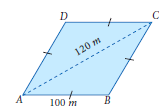
s = \(\frac{a+b+c}{2}=\frac{100+100+120}{2}\) = 160 m
Area of \(\triangle\)ABC =\(\sqrt{160(160-100)(160-100)(160-120)}\)
= \(\sqrt{160 \times 60\times 60 \times40}\)
= \(\sqrt{40 \times 2 \times \times2\times60\times60\times40}\)
= 40 × 2 × 60 = 4800 m2
Therefore, Area of the field ABCD = 2 × Area of \(\triangle\)ABC = 2 × 4800 = 9600 m2
3.
In the quadrilateral ABCD, join one of the diagonals, say AC.
Area of \(\triangle\)ABC = \(\frac{1}{2}\)\(\times\) base \(\times\) height
=\(\frac{1}{2}\)\(\times\)8\(\times\)15\(\times\) 60 cm2
By Pythagoras theorem, in right angled triangle ABC,
AC2 = AB2 + BC2
= 82 +152 = 64 + 225 = 289 cm
Therefore, AC =\(\sqrt{289}\) =17cm
Now, for\(\triangle\)ACD, let us consider a = 17 cm, b =12 cm, c =25 cm
then, s = \(\frac{a+b+c}{2}=\frac{17+12+25}{2}=\frac{54}{2}\) = 27cm
.PNG)
Area of \(\triangle\)ACD =\(\sqrt { s(s-a)(s-b)(s-c) } \)
=\(\sqrt{27(27-17)(27-12)(27-25)}\)
=\(\sqrt{27\times10\times15\times2}\)
=\(\sqrt{3\times3\times3\times2\times5\times5\times3\times2}\)
= 3 × 3 × 2 × 5 = 90cm2
Therefore, Area of quadrilateral ABCD
=Area of \(\triangle\)ABC + Area of \(\triangle\)ACD
= 60 + 90 = 150 cm2
4.
(i) (cos00 + sin 450 + sin 300) (sin 900 - cos 450 + cos 600)
= \(\left[ 1+\frac { 1 }{ \sqrt { 2 } } +\frac { 1 }{ 2 } \right] \left[ 1-\frac { 1 }{ \sqrt { 2 } } +\frac { 1 }{ 2 } \right] \)
= \(\left[ \frac { 2\sqrt { 2 } +2+\sqrt { 2 } }{ 2\sqrt { 2 } } \right] \left[ \frac { 2\sqrt { 2 } -2+\sqrt { 2 } }{ 2\sqrt { 2 } } \right] =\left[ \frac { 3\sqrt { 2 } +2 }{ 2\sqrt { 2 } } \right] \left[ \frac { 3\sqrt { 2 } -2 }{ 2\sqrt { 2 } } \right] \)
= \(\frac { 18-4 }{ 4\left( \sqrt { 2 } \right) ^{ 2 } } =\frac { 14 }{ 4\times 2 } =\frac { 7 }{ 4 } \)
(ii) tan2600 - 2tan2450 - cot2300 +2sin2300 + \(\frac { 3 }{ 4 } \) cosec2450
= \(\left( \sqrt { 3 } \right) ^{ 2 }-2(1)^{ 2 }-\left( \sqrt { 3 } \right) ^{ 2 }+2\left( \frac { 1 }{ 2 } \right) ^{ 2 }+\frac { 3 }{ 4 } \left( \sqrt { 2 } \right) ^{ 2 }\)
= \(3-2-3+\frac { 1 }{ 2 } +\frac { 3 }{ 2 } \)
= -2 + \(\frac { 4 }{ 2 } \) = -2 + 2 = 0
5.
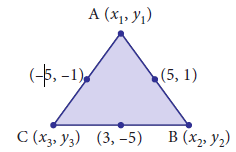
Let the vertices of the ABC be A(x1, y1), B(x2, y2 ) and C(x3, y3) and the given mid-points of the sides AB, BC and CA are (5, 1), (3, −5) and (−5, −1) respectively. Therefore
\(\frac { { x }_{ 1 }+{ x }_{ 2 } }{ 2 } =5 \Rightarrow\)x1 + x2 = 10 ...(1)
\(\frac { { x }_{ 2 }+{ x }_{ 3 } }{ 2 } =3 \Rightarrow\)x2 + x3 = 6 ...(2)
\(\frac { { x }_{ 3 }+{ x }_{ 1 } }{ 2 } =-5 \Rightarrow\)x3 + x1 = –10 ...(3)
Adding (1), (2) and (3)
2x1 + 2x2 + 2x3 = 6
x1 + x2 + x3 = 3 ...(4)
(4) − (2) \(\Rightarrow\) x1 = 3 − 6 = −3
(4) − (3) \(\Rightarrow\) x2 = 3 +10 = 13
(4) − (1) \(\Rightarrow\) x3 = 3 −10 = −7
\(\frac { { y }_{ 1 }+{ y }_{ 2 } }{ 2 } =1\)\(\Rightarrow\)y1 + y2 = 2 …(5)
\(\frac { { y }_{ 2 }+{ y }_{ 3 } }{ 2 } =-5\)\(\Rightarrow\)y2 + y3 = –10 …(6)
\(\frac { { y }_{ 3 }+{ y }_{ 1 } }{ 2 } =1\)\(\Rightarrow\)y3 + y1 = –2 …(7)
Adding (5), (6) and (7),
2y1 + 2y2 + 2y3 = −10
y1 + y2 + y3 = −5 ...(8)
(8) − (6) \(\Rightarrow\) y1 = −5 +10 = 5
(8) − (7) \(\Rightarrow\) y2 = −5 + 2 = −3
(8) − (5) \(\Rightarrow\) y3 = −5 − 2 = −7
Therefore the vertices of the triangle are A(−3, 5), B(13, −3) and C(−7, −7).
6.
(i) Let us prepare a table to find the ordered pairs of points for the line y = 3x −1.
We shall assume any value for x, for our convenience let us take −1, 0 and 1.
When x = −1, y = 3(–1)–1 = –4
When x = 0, y = 3(0)–1 = –1
When x = 1, y = 3(1)–1 = 2
| x | -1 | 0 | 1 |
| y | -4 | -1 | 2 |
The points (x,y) to be plotted :
(−1, −4), (0, −1) and (1, 2).
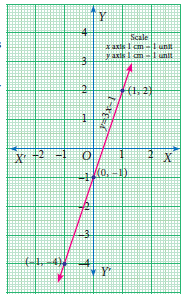
(ii) Let us prepare a table to find the ordered pairs of points for the line y =\(\left( \frac { 2 }{ 3 } \right) x+3\)
Let us assume −3, 0, 3 as x values.
(why?)
When x = -3, \(y=\frac { 2 }{ 3 } (-3)+3=1\)
When x = 0, \(y=\frac { 2 }{ 3 } (0)+3=3\)
When x =3, \(y=\frac { 2 }{ 3 } (3)+3=5\)
| x | -3 | 0 | 3 |
| y | 1 | 3 | 5 |
The points (x, y) to be plotted: (-3, 1), (0, 3) and (3, 5).
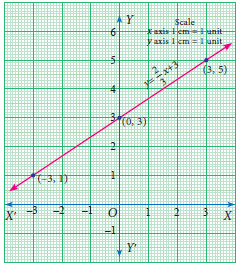
7.
Let M and S represent the student failed in Mathematics and Science.
Given: Number of students passed in Mathematics is 50%
∴ Number of students failed in Mathematics = 100 - 50% = 50%
n(M) = 50%
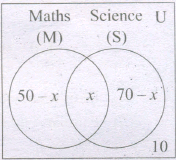
Number of students passed in Science is 70%
∴ Number of students failed in Science = 100 - 70% - 30%
n(S) = 30%
Number of students failed in both the subjects is 10%
n(M\(\cap\)S) = 10%
n(M\(\cup\)S) = n(M) + n(S) - n(M\(\cap\)S)
= 50 + 30 - 10
= 80 - 10 = 70
Given: 70% of the students failed in atleast anyone of the subject
∴ 30% of the students passed in atleast anyone of the subjects.
30 students passed mean, the total number of students is 100.
∴ 300 students passed means, the total number of students = \(\frac{100 \times 30}{30}\)= 1000
Total number of students appeared in the examination is = 1000
8.
\(\left( A\cup B\cup C \right) \) = {1,2,3,4,5,6,8}
\(\therefore \ n\left( A\cup B\cup C \right) \) =7
Also, n(A) = 5, n(B) = (C) = 4,
Further,\(A\cap B\) = {3,5,6} \(\Rightarrow \) \(n\left( A\cap B \right) \) = 3
\(B\cap C\) = {3,6} \(\Rightarrow \) \(n\left( B\cap C \right) \) = 2
\(A\cap C\) = {3,5,6} \(\Rightarrow \) \(n\left( A\cap C \right) \) = 3
Also, \(A\cap B\cap C\) = {3,6} \(\Rightarrow \)n\(\left( A\cap B\cap C \right) \) = 2
now, \(n\left( A\cup B\cup C \right) \)= n(A) + n(B) + n(C) -\(n\left( A\cap B \right) -n\left( B\cap C \right) -n\left( A\cap C \right) -n\left( A\cap C \right) +\left( A\cap B\cap C \right) \)
7 = 5 + 4 + 4 - 3 - 2 - 3 + 2
7 = 13 - 8 + 2
7 = 7
9.
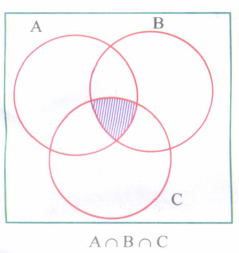
10.
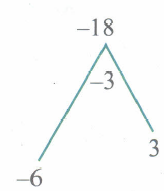
Let p (x) 2x3 - x2 - 12x - 9
Sum of the co-efficients = 2 - 1- 12- 9 = -20 \(\neq \) 0
Hence x-1 is not a factor
Sum of co-efficients of even powers with constant = -1 - 9 = -10
Sum of co-efficients of odd powers = 2 - 12= -10
Hence x + 1 is a factor of x.
Now we use synthetic division to find the other factors.
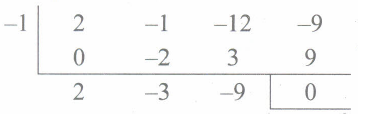
Then p (x) = (x + 1)(2x2 - 3x - 9)
Now 2x2 - 3x - 9 = 2x2 - 6x + 3x - 9 = 2x (x - 3) + 3 (x - 3)
= (x - 3)(2x + 3)
Hence 2x3 - x2 - 12x - 9 (x + 1) (x - 3) (2x + 3)
11.
p(x) 5x3 - 9x2 + 10x + 2
d (x) = x + 2
Standard form of p (x) 5x2 - 9x2 + 10x + 2 and
d (x) = x + 2
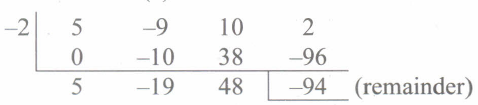
5x3 - 9x2 + 10x + 2 = (x + 2) (5x2 - 19x + 48) - 94
Hence the quotient is 5x2 - 19x + 48 and remainder is - 94
12.
| Weight in kgs(x) | Number of students(f) | Mid value of x | fx |
| 15-25 | 4 | 20 | 80 |
| 25-35 | 11 | 30 | 330 |
| 35-45 | 19 | 40 | 760 |
| 45-55 | 14 | 50 | 700 |
| 55-65 | 0 | 60 | 0 |
| 65-75 | 2 | 70 | 140 |
| \(\Sigma{f}=50\) | 2010 |

13.
| Marks | f |
|---|---|
| 0.5-5.5 | 7 |
| 5.5-10.5 | 10 |
| 10.5-15.5 | 16 |
| 15.5-20.5 | 32 |
| 20.5-25.5 | 24 |
Modal class is 16 -20 since it has the maximum frequency.
l = 15.5, f = 32, f1 = 16, f2 = 24, c = 20.5–15.5 = 5
Mode \(=l+{\left(f-f_1\over 2f-f_1-f_2\right)}\times c\)
\(=15.5+\left(32-16\over64-16-24\right)\times 5\)
\(=15.5+\left(16\over24\right)\times = 15.5 + 3.33 =18.83\)
14.
Let us arrange the marks in ascending order and prepare the following data:
| Height (cm) | Number of students (f) | Cumulative frequency (cf) |
|---|---|---|
| 150 | 8 | 8 |
| 152 | 4 | 12 |
| 154 | 3 | 15 |
| 155 | 7 | 22 |
| 156 | 3 | 25 |
| 160 | 12 | 37 |
| 160 | 12 | 37 |
Here N = 41
Median = size of \(\left(N+1\over 2\right)^{th}\) value = size of \(\left(41+1\over2\right)^{th}\) value = size of 21st value.
If the 41 students were arranged in order (of height), the 21st student would be the middle most one, since there are 20 students on either side of him/her. We therefore need to find the height against the 21st student. 15 students (see cumulative frequency) have height less than or equal to 154 cm. 22 students have height less than or equal to 155 cm. This means that the 21st student has a height 155 cm.
Therefore, Median = 155 cm
15.
Let P(x) = ax2+5x+b
(x-2) is a factor of P(x), if P(2) = 0
P(2) = a(2)2+5(2)+b = 0
4a +10+b = 0
4a+b = -10...(1)
\((x-\frac{1}{2})\) is a factor of P(x), if P\((\frac{1}{2})\) = 0
P\((\frac{1}{2})\) = a\((\frac{1}{2})^2\) + 5\((\frac{1}{2})\)+ b = 0
\(\frac{a}{4}+\frac{5}{2}+b=0\)
\(\frac{a}{4}+b=\frac{-5}{2}\)
\(\frac{a+4b}{4}=\frac{-5}{2}\)
2a + 8b = -20
a + 4b = -10...(2)
From (1) and (2)
4a + b = -10...(1)
a + 4b = -10...(2)
(1) and (2) ⇒ 4a + b = a + 4b
3a = 3b
a = b
Hence it is proved.
16.
17.

To represent \(-\frac { 2 }{ 11 } ,-\frac { 5 }{ 11 } and-\frac { 9 }{ 11 } \)on the number line we make 11 markings each being equal distance \(\frac { 1 }{ 11 } \) on the left of 0.
The point A represents \(\left( -\frac { 2 }{ 11 } \right) \) , the point B represents\(\left( -\frac { 2 }{ 11 } \right) \) and the point C represents \(\left( -\frac { 9 }{ 11 } \right) \)
18.
Rational between \(\frac { 1 }{ 2 } \) and \(\frac { 1 }{ 5 } \) = \(\frac { 1 }{ 2 } \left( \frac { 1 }{ 2 } +\frac { 1 }{ 5 } \right) \)
=\(\frac { 1 }{ 2 } \left( \frac { 1 }{ 2 } +\frac { 1 }{ 5 } \right) \)
= \(\frac { 1 }{ 2 } \left( \frac { 1 }{ 2 } +\frac { 1 }{ 5 } \right) \)
Rational numbers between\(\frac { 1 }{ 2 } \) and \(\frac { 7 }{ 20 } \)
=\(\frac { 1 }{ 2 } \left( \frac { 10+7 }{ 20 } \right) \)
=\(\frac { 17 }{ 40 } \)
Rational number between \(\frac { 1 }{ 2 } \) and \(\frac { 7 }{ 20 } \) =\(\frac { 1 }{ 2 } \left( \frac { 1 }{ 2 } \times \frac { 17 }{ 40 } \right) \)
=\(\frac { 1 }{ 2 } \left( \frac { 20+17 }{ 40 } \right) \)
=\(\frac { 37 }{ 80 } \)
Thus the rational numbers are \(\frac { 7 }{ 20 } ,\frac { 17 }{ 40 } and\frac { 37 }{ 80 } \)
19.
\(\sqrt { 2 } \) =1.414213...
\(\sqrt { 3} \) =1.73205....
\(\frac { 7 }{ 9 } \) = 0.7777
\(\frac { 6 }{ 7 } \) =0.857142
\(\frac { 23 }{ 6 } \) =3.8333...
\(\frac { 48 }{ 5 } \) =9.6
(i) Arrange the ten real numbers in the given boxes in ascending order.

(ii) Arrange the same numbers in the boxes given below in descending order.

20.
Distance = \(\sqrt{(x_2-x_2)^2+(y_2-y_1)^2}\)
AB =\(\sqrt{(6-3)^2+(5-7)^2}\)
\(\sqrt{3^2+(-2)^2}=\sqrt{9+4}=\sqrt{13}\)
BC=\(\sqrt{(15-6)^2+(-1-5)^2}=\sqrt{(9)^2+(-6)^2}\)
\(\sqrt{81+36}=\sqrt{117}\)
\(\sqrt{9\times 13}-3\sqrt{13}\)
AC =\(\sqrt{(15-3)^2+(-1-7)^2}\)
\(\sqrt{12^2+(-8)^2}=\sqrt{144+64}\)
\(=\sqrt{208}=\sqrt{16\times 13}=4\sqrt{13}\)

AB + BC =AC\(\Rightarrow \sqrt{13}+3\sqrt{13}=4\sqrt{13}\)
\(\therefore\)The points A,B,C are collinear.
21.
Let A(1, 1), B(5, 4) and C(-2, 5)
Distance =\(\sqrt{(x_2-x_1)^2+(y_2-y_1)^2}\)
AB =\(\sqrt{(5-1)^2+(4-1)^2}\)
\(=\sqrt{4^2+3^2}=\sqrt{16+9}=\sqrt{25}=5\)
BC =\(\sqrt{(-2-5)^2+(5-4)^2}\)
\(=\sqrt{(-7)^2+1^2}=\sqrt{49+1}=\sqrt{50}\)
AC =\(\sqrt{(-2-1)^2+(5-1)^2}\)
\(=\sqrt{(-3)^2+4^2}=\sqrt{9+16}=\sqrt{25}=5\)
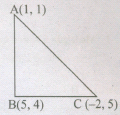
AB = 5, AC = 5,
\(\therefore\) ABC is an isosceles triangle .................(1)
BC2 = AB2 + AC2
50 = 25 + 25\(\Rightarrow\) 50 = 50
\(\therefore\) \(\angle\)A = 90° ...................(2)
From (1) and (2) we get ABC is an isosceles right angle triangle.
22.
Given P (6, –1), Q (1, 3) and R (a, 8)
\(PQ=\sqrt { \left( 1-6 \right) ^{ 2 }+\left( 3+1 \right) ^{ 2 } } =\sqrt { \left( -5 \right) ^{ 2 }+\left( 4 \right) ^{ 2 } } = \sqrt { 41 } \)
\(QR=\sqrt { \left( a-1 \right) ^{ 2 }+\left( 8-3 \right) ^{ 2 } } =\sqrt { \left( a-1 \right) ^{ 2 }+\left( 5 \right) ^{ 2 } } \)
Given PQ = QR
Therefore \(\sqrt { 41 } =\sqrt { \left( a-1 \right) ^{ 2 }+\left( 5 \right) ^{ 2 } } \)
41= (a –1)2 + 25 [Squaring both sides]
(a–1)2 + 25 = 41
(a–1)2 = 41 - 25
(a–1)2 = 16
(a–1) = \(\pm \) 4 [taking square root on both sides]
a = 1 \(\pm \)4
a = 1 + 4 or a = 1 – 4
a = 5, –3
23.
Represent \(\sqrt{6.5}\) on a number line.
Steps of construction:
1. Draw a line and mark a point A and B such that AB = 6.5 cm.
2. Mark a point C on this line such that BC = 1 cm.
3. Find the mid point of AC by drawing perpendicular bisector of AC and let it be "O".
4. With O as centre and OC = OA as radius draw a semicircle.
5. Draw a line BD, which is perpendicular to AB at B.
6. Now BD = \(\sqrt{6.5}\) which can be marked in the number line as the value of BE = BD = \(\sqrt{6.5}\).
24.
In \(\triangle\)PQR, PQ = 5 cm, PR = 6 cm, \(\angle\)QPR = 60°
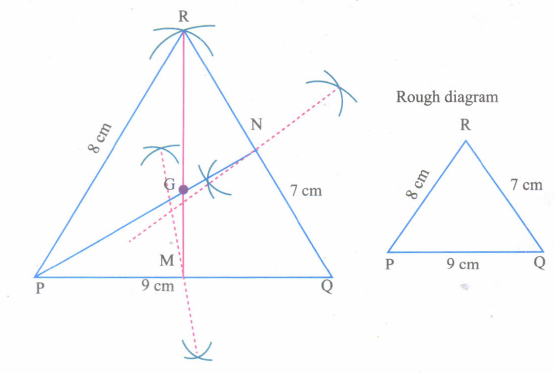
Construction:
Step 1: Draw \(\triangle\) PQR using the given measurements PQ = 9 cm, QR = 7 cm and RP = 8 cm and construct the perpendicular bisector of any two sides (PQ and QR) to find the mid-points M and N of PQ and QR respectively.
Step 2: Draw the medians PN and RM and let them meet at G. The point G is the centroid of the given \(\triangle\)PQR.
25.
In \(\triangle\)ABC, AB = BC = 8 cm, \(\angle\)B = 70°.
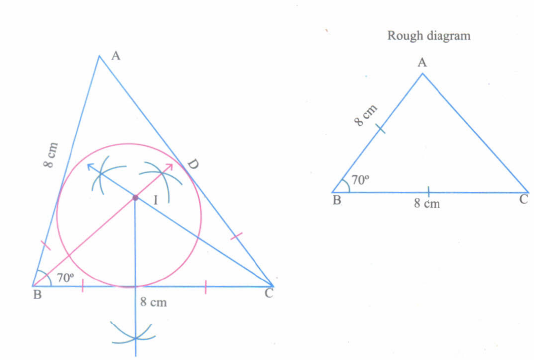
Construction :
Step 1: Draw \(\triangle\)ABC with BC = 8 cm, \(\angle\)B = 70°. AB = 8.
Step 2: Construct the angle bisectors of any two angles (B and C) and let them meet at I. Then I is the incentre of \(\triangle\)ABC. Draw perpendicular from I to anyone of the side (BC) to meet BC at D.
Step 3: With I as centre and ID as radius draw a circle. This circle touches all the sides of the triangle internally.
26.
Steps for construction:
Step 1: Draw the rough diagram and mark the measurements
Step 2: Draw the ΔABC with the given measurements.
Step 3: Construct altitudes from any two vertices Band C to their opposite sides AC and BC respectively.
Step 4: The point of intersection of the altitude H is the orthocentre of the given ΔABC.
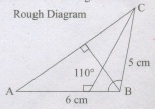
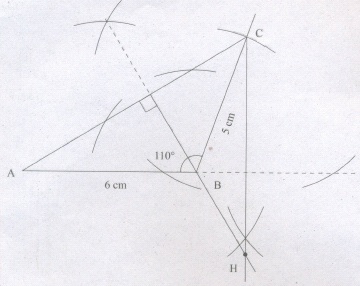
27.
Steps for construction:
Step 1: Draw the ΔPQR with the given measures.
Step 2: Construct the perpendicular bisector of (PQ and PR) any two sides and let them meet at S which is the circumcenter.
Step 3: With S as centre and SP = SQ = SR as radius draw the circumcircle to passes through P, Q and R.
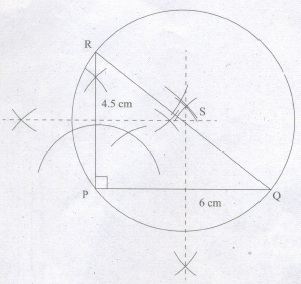
Circum radius = 4.3 cm.

9th Standard Syllabus & Materials
9th Standard
TN 9th Tamil உள்ளத்தின் சீர் - திருக்குறள் Important Questions And Answers Study Material - QB365 Set A
NEW9th Standard
TN 9th Tamil உள்ளத்தின் சீர் - மணிமேகலை Important Questions And Answers Study Material - QB365 Set A
NEW9th Standard
TN 9th Tamil உள்ளத்தின் சீர் - ஏறு தழுவுதல் Important Questions And Answers Study Material - QB365 Set A
NEW9th Standard
TN 9th Tamil உயிருக்கு வேர் - தண்ணீர் Important Questions And Answers Study Material - QB365 Set A



Tamilnadu Stateboard 9th Standard Subjects
Tamilnadu Stateboard Standards





