
 100% FREE ACCESS
9th Standard Syllabus & Materials
9th Standard
TN 9th Tamil உள்ளத்தின் சீர் -கற்கண்டு (இலக்கணம்) - தொடர் இலக்கணம், ஆகுபெயர் Important Questions And Answers Study Material - QB365 Set A
NEW9th Standard
TN 9th Tamil உள்ளத்தின் சீர் -விரிவானம் (துணைப்பாடம்) - தாய்மைக்கு வறட்சி இல்லை! Important Questions And Answers Study Material - QB365 Set A
NEW9th Standard
TN 9th Tamil உள்ளத்தின் சீர் -கவிதை பேழை (செய்யுள்) - மார்கழி பெருவிழா Important Questions And Answers Study Material - QB365 Set A
NEW9th Standard
TN 9th Tamil உயிருக்கு வேர்-இலக்கணம் - பகுபத உறுப்பிலக்கணம் Important Questions And Answers Study Material - QB365 Set A
NEW9th Standard
TN 9th Tamil அமுதென்று பேர் - இலக்கணம்-எழுத்து -அளபெடை Important Questions And Answers Study Material - QB365 Set A
NEW9th Standard
TN 9th Tamil அமுதென்று பேர்-துணைப்பாடம் - ஆறாம்திணை Important Questions And Answers Study Material - QB365 Set A

Published on: 14/03/2020
9th Standard Mathematics English Medium All Chapter Book Back and Creative Three Marks Questions 2020
Download Tamil Nadu 9th Standard Maths question papers, model tests, one-mark questions, important questions, and public exam papers in PDF format. Free study materials and answer keys for TN State Board students.
Questions + Answers key
Take MCQ Maths Test1.
The total surface area of a cube is 864 cm2. Find its volume
2.
In a recent year, of the 1184 centum scorers in various subjects in tenth standard public exams, 233 were in mathematics. 125 in social science and 106 in science. If one of the student is selected at random, find the probability of that selected student,
(i) is a centum scorer in Mathematics
(ii) is not a centum scorer in Science
3.
When a dice is rolled, find the probability to get the number greater than 4?
4.
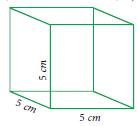
Find the Total Surface Area and Lateral Surface Area of the cube, whose side is 5 cm.
5.
(i) If cosec A = sec 340, then find A
(ii) If tan B = cot 470, then find B.
6.
Check whether (5, −1) is a solution of the simultaneous equations x – 2y = 7 and 2x + 3y = 7.
7.
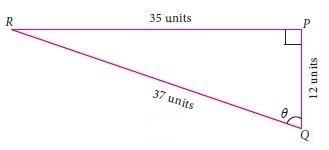
For the measures in the figure, compute sine, cosine and tangent ratios of the angle \(\theta \)
8.
If A = {2,5,6,7} and B = {3,5,7,8}, then verify the commutative property of intersection of sets
9.
If A = {2,5,6,7} and B = {3,5,7,8}, then verify the commutative property of union sets
10.
Find the GCD of ax, ax+y, ax+y+z
11.
Show that x+4 is a factor of x3 + 6x2 - 7x - 60
12.
Write in scientific notation : (0.00000004)3
13.
Compute and give the answer in the simplest form; \(3\sqrt { 162 } \times 7\sqrt { 50 } \times 6\sqrt { 98 } \)
14.
For the data 11,15,17, x+1,19, x-2, 3 if the mean is 14, find the value of x, Also find the mode of the data.
15.
If A = {-2,0,1,3,5}, B = {-1,0,2,5,6} and C = {-1,2,5,6,7} then show that A-(B∪C) = (A-B)∩(A-C).
16.
If the mean of the following data is 20.2, then find the value of p
| Marks | 10 | 15 | 20 | 25 | 30 |
| No.of students | 6 | 8 | p | 10 | 6 |
17.
Can you reduce the following numbers to surds of same order :
(i) \(\sqrt{3}\)
(ii) \(\sqrt [ 4 ]{ 3 } \)
(iii) \(\sqrt [ 3 ]{ 3 } \)
18.
Draw: Venn diagram for each of the following:
(i) \(A\cup (B\cap C)\)
(ii) \(A\cap (B\cup C)\)
(iii) \((A\cup B)\cap C\)
(iv) \((A\cap B)\cup C\)
19.
ABCD is a rectangle and P, Q, R and S are the mid-points of the sides AB, BC, CD and DA respectively. Show that the quadrilateral PQRS is a rhombus.
20.
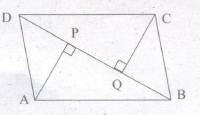
ABCD is a parallelogram and AP and CQ are perpendicular from vertex A and C on diagonal BD. Show that
(i) ΔAPB ≅ ΔCQD
(ii) AP = CQ
21.
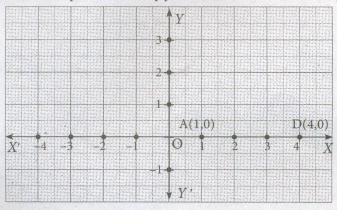
Plot the following points on a graph sheet by taking the scale as 1cm = 1 unit.
Find how far the points are from each other?
A (1,0) and D (4, 0). Find AD and also DA.
Is AD = DA?
You plot another set of points and verify your Result.
22.
Three vertices of a rectangle are (3, 2), (-4, 2) and (-4, 5). Plot the points and find the coordinates of the fourth vertex.
23.
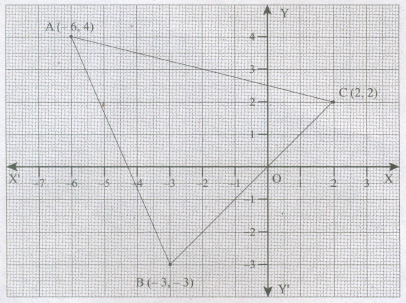
Read the coordinates of the vertices of the triangle ABC with the following figure.
24.
Show that the following points taken in order form the vertices of a parallelogram.
A (–7, –3), B(5, 10), C(15, 8) and D(3, –5)
25.
Express the following decimal expression into rational numbers. 0.86
26.
Add the following polynomials and find the degree of the resultant polynomial.
p(x) = 6x2-7x+2 q(x) = 6x3-7x+15
27.
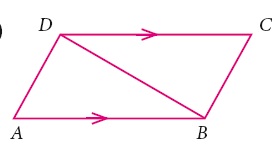
Consider the given pairs of triangles and say whether each pair is that of congruent triangles. If the triangles are congruent, say ‘how’; if they are not congruent say ‘why’ and also say if a small modification would make them congruent:
28.
Draw the \(\triangle \)ABC , where AB = 6 cm, B = 110° and AC = 9 cm and construct the centroid.
1.
Let ‘a’ be the side of the cube.
Given that, total surface area = 864 cm2
6a2= 864
a2 = \(\frac{864}{6}\)
a2 = 144
Therefore, side (a) = 12 cm
Now, volume of the cube = a3
= 123 = 12 ×12 ×12 = 1728 cm3
2.
Total number of centum scorers = 1184
Therefore n = 1184
(i) Let E1 be the event of getting a centum scorer in Mathematics.
Therefore n(E1) = 233, That is, r1 = 233
\(P({ E })_{ 1 }=\frac { { r }_{ 2 } }{ n } =\frac { 233 }{ 1184 } \)
(ii) Let E2 be the event of getting a centum scorer in Science.
Therefore n(E2 ) = 106, That is, r2 = 106
\(P({ E })_{ 2 }=\frac { { r }_{ 2 } }{ n } =\frac {106 }{ 1184 } \)
P(E'2) = 1− P(E2)
\(=1-\frac { 106 }{ 1184 } \)
\(=\frac { 1078 }{ 1184 } \)
3.
Sample space S = {1, 2, 3, 4, 5, 6}
Let E be the event of getting a number greater than 4
E = {5, 6}
\(P(E)=\frac { Number\ of\ favourable\ outcomes }{ Total\ number\ of\ outcomes } \)
\(P(E)=\frac { n(E) }{ n(S) } =\frac { 2 }{ 6 } =0.333...\)
4.
The side of the cube (a) = 5 cm
Total Surface Area = 6a2 = 6(52) = 150 sq. cm
Lateral Surface Area = 4a2 = 4(52) = 100 sq. cm
5.
(i) We know that cosec A = sec(900 A)
sec(900 - A) sec(340)
900 - A =340
We get A = 90° − 34°
A = 560
(ii) We know that tan B = cot(900 - B)
cot(900 - B) = cot 470
900 - B = 470
We get B = 90° − 47°
B = 430
6.
Given x – 2y = 7 …(1)
2x + 3y = 7 …(2)
When x = 5, y = −1 we get
From (1) x – 2y = 5 – 2(−1) = 5 + 2 = 7 which is RHS of (1)
From (2) 2x + 3y = 2(5) + 3(−1) = 10−3 = 7 which is RHS of (2)
Thus the values x = 5, y = −1 satisfy both (1) and (2) simultaneously. Therefore (5,−1) is a solution of the given equations.
7.
In the given right angled triangle, note that for the given angle \(\theta \), PR is the ‘opposite’ side and PQ is the ‘adjacent’ side.
\(sin\theta =\frac { opposite\ side }{ hypotenuse } =\frac { PR }{ QR } =\frac { 35 }{ 37 } \)
\(cos\theta =\frac { adjacent\ side }{ hypotenuse } =\frac { PQ }{ QR } =\frac { 12 }{ 37 } \)
\(tan\theta =\frac { opposite\ side }{ adjacent\ side } =\frac { PR }{ PQ } =\frac { 35 }{ 12 } \)
It is enough to leave the ratios as fractions. In case, if you want to simplify each ratio neatly in a terminating decimal form, you may opt for it, but that is not obligatory.
8.
\(A\cap B\) = {5,7}
\(B\cap A\)= {5,7}
From (3) and (4) we get, \(A\cap B=B\cap C\)
It is verified that intersection of sets is commutative.
9.
Given, A = {2,5,6,7} and B = {3,5,7,8}
\(A\cup B\) = {2,3,5,6,7,8} ...........(1)
\(B\cup A\) = {2,3,5,6,7,8} ..............(2)
10.
ax = \(\underline { { a }^{ x } } \)
ax+y = \(\underline { { a }^{ x } } \). ay
\(\therefore\) ax+y+z = \(\underline { { a }^{ x } } \). ay. az
11.
Let p (x) = x3 + 6x2 - 7x - 60
By factor theorem (x+4) is a factor of p(-4) = 0
p(-4) = (-4)3 + 6(-4)2 -7(-4) -60 = -64 + 96 + 28 - 60 = 0
Therefore,(x+4) is a factor of x3 + 6x2 + (-7x) -60
12.
(0.00000004)3=\(\left( 4.0\times 10^{ -8 } \right) ^{ 3 }=\left( 4.0 \right) ^{ 3 }\times \left( { 10 }^{ -8 } \right) ^{ 3 }\)
= \(64 \times 10^{-24}=6.4 \times 10 \times 10^{-24}=6.4 \times 10^{-23}\)
13.
\(3\sqrt { 162 } \times 7\sqrt { 50 } \times 6\sqrt { 98 } \) = \(\left( 3\times 9\sqrt { 2 } \times 7\times 5\sqrt { 2 } \times 6\times 7\sqrt { 2 } \right) \)
= \(3 \times 7 \times 6 \times 9 \times 5 \times 7 \times \sqrt{2} \times \sqrt{2} \times \sqrt{2}\) = 79380\(\sqrt { 2 } \)
14.
The data given is 11,15,17, x+1, 19, x-2, 3
\(\bar{x}=4\)
\(\bar{x}=\cfrac{\Sigma x}{n}=\cfrac{11+15+17+x+1+19+x-2+3}{7}\)
=\(\cfrac{66+2x-2}{7}=\cfrac{64+2x}{7}\)
\(\cfrac{64+2x}{7}=14\)
64 + 2x = 98
2x = 98 - 64 = 34
\(x=\cfrac{34}{2}=17\)
The data 11, 15, 17, x+1, 19, x-2, 3
= 11, 15,17, 18, 19, 15, 3
15.
A = {-2,0,1,3,5}, B = {-1,0,2,5,6}
C = {-1,2,5,6,7}
B∪C = {-1,0,2,5,6,7}
A-(B∪C) = {-2,1,3}.............(1)
(A-B) = {-2,1,3}
(A-C) = {-2,0,1,3}
(A-B)∩(A-C) = {-2,1,3}............(2)
From (1) and (2), it is verified that
A-(B∪C) = (A-B)⋂(A-C)
16.
\(\bar { x } =20.2\)
\( \bar{x}=\cfrac{\Sigma fx}{\Sigma f}\)
\(=\cfrac { 10\times 6+15\times 8+20p+25\times 10+30\times 6 }{ 6+8+p+10+6 } \)
\(20.2=\cfrac { 60+120+20p+250+180 }{ 30+p } \)
(30+p)20.2 = 610+20 p
606+20.2p = 610+20 p
20.2 p-20 p = 610-606 = 4
0.2 p = 4
\(\Rightarrow \) \(p=\cfrac { 4\times 10 }{ 0.2\times 10 } =\cfrac { 40 }{ 2 } =20\)
17.
(i) \( \sqrt{3} =3^{\frac{1}{2}} =3^{\frac{6}{12}} =\sqrt[12]{3^{6}} =\sqrt[12]{729} \)
(ii) \( \sqrt[4]{3} =3^{\frac{1}{4}} =3^{\frac{3}{12}} =\sqrt[12]{3^{3}} =\sqrt[12]{27} \)
(iii) \( \sqrt[3]{3} =3^{\frac{1}{3}} =3^{\frac{4}{12}} =\sqrt[12]{3^{4}} =\sqrt[12]{81} \)
The last row has surds of same order.
18.
(i) 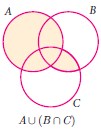
(ii) 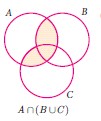
(iii) 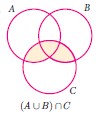
(iv) 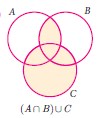
19.
In rectangle ABCD, P is the mid-point of AB.
Q is the mid-point of BC. R is the mid-point of CD
S is the mid-point of DA. AC is the diagonal
Now in ΔABC,
PQ = \(\frac { 1 }{ 2 } \)AC and PQ || AC .......(1)
Similarly in ΔACD,
SR = \(\frac { 1 }{ 2 } \) AC and SR || AC .......(2)
From (1) and (2) we get,
PQ = SR and PQ || SR
Similarly by joining BD, we have
PS = QR and PS || QR
i.e. Both pairs of opposite sides of quadrilateral PQRS are equal and parallel.
∴ PQRS is a parallelogram.
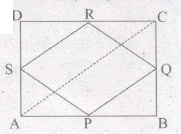
20.
(i) In ΔAPB and ΔCQD we have
∠APB = ΔCQD (90o each)
AB = CD (opposite sides of parallelogram ABCD)
∠ABP = ∠CDQ (AB II CD and AD is a transversal)
Using ASA congruency we have,
∠APB ≅ ΔCQD
(ii) Since ΔAPB ≅ ΔCQD
∴ Their corresponding parts are equal.
∴ AP = CQ.
21.
AD = 3 units
DA = 3 units (From graph)
Yes, Distance AD = Distance DA
The students are asked to do the activity with different points and verify the result.
22.
(3, 5)
23.
A (- 6, 4), B (- 3, -3) and C (2, 2)
24.
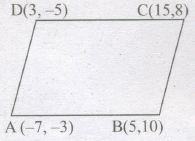
AB = \(\sqrt { (5+7)^{ 2 }+(10+3)^{ 2 } } \)
= \(\sqrt { (12)^{ 2 }+(13)^{ 2 } } =\sqrt { 144+169 } =\sqrt { 313 } \)
BC = \(\sqrt { (15-5)^{ 2 }+(8-10)^{ 2 } } \)
= \(\sqrt { 10^{ 2 }+(-2)^{ 2 } } =\sqrt { 100+4 } =\sqrt { 104 } \)
CD = \(\sqrt { (3-15)^{ 2 }+(-5-8)^{ 2 } } \)
= \(\sqrt { (-12)^{ 2 }+(-13)^{ 2 } } =\sqrt { 144+169 } =\sqrt { 313 } \)
AD =\(\sqrt { (3+7)^{ 2 }+(-5+3)^{ 2 } } \)
= \(\sqrt { (10)^{ 2 }+(-2)^{ 2 } } =\sqrt { 100+4 } =\sqrt { 104 } \)
AB = CD = \(\sqrt { 313 } \) and BC = AB = \(\sqrt { 104 } \) (Opposite sides are equal)
∴ ABCD is a parallelogram.
25.
0.86 = \({8\over 10}+{6\over 100}={80+6\over 100}\)
= \(86\over 100\) (or) \(43\over 50\)
26.
p(x) = 6x2 - 7x + 2 ; q(x) = 6x3 - 7x + 15
p(x) + q(x) = 6x2 - 7x + 2 +6x3 - 7x + 15
= 6x3 + 6x2-7x + 2+ 15
= 6x3+6x2–14x+17
The degree of the polynomial is 3
27.
In the given diagram
AB = CD (Given)
BD is common.
\(\angle ABD=\angle BDC\) (alternate angles)
(Since AC and CD are parallel and BD is the transversal)
By SAS congruency
\(\therefore\triangle ABD\cong\triangle CDB\)
28.
In \(\triangle \)ABC, AB = 6 cm, ∠B= 110°, AC = 9 cm
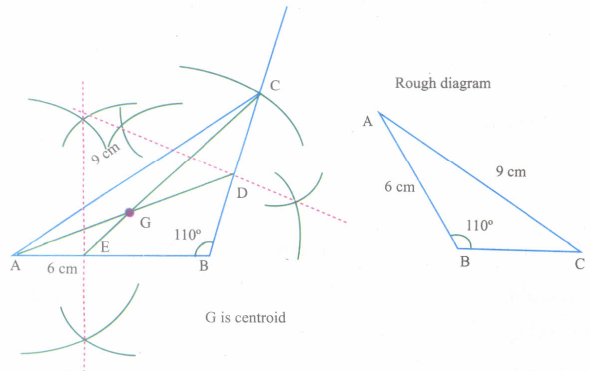
Construction :
Step 1: Draw \(\triangle \)ABC with AB = 6 cm, ∠B =110°, AC = 9 cm
Step 2: Draw perpendicular bisectors of any two sides (BC and AB) to find the midpoints of BC and AB.
Step 3: Construct medians AD and CE. Let them meet at G.
Step 4: G is the centroid of the given \(\triangle \)ABC.

9th Standard Syllabus & Materials
9th Standard
TN 9th Tamil உள்ளத்தின் சீர் - திருக்குறள் Important Questions And Answers Study Material - QB365 Set A
NEW9th Standard
TN 9th Tamil உள்ளத்தின் சீர் - மணிமேகலை Important Questions And Answers Study Material - QB365 Set A
NEW9th Standard
TN 9th Tamil உள்ளத்தின் சீர் - ஏறு தழுவுதல் Important Questions And Answers Study Material - QB365 Set A
NEW9th Standard
TN 9th Tamil உயிருக்கு வேர் - தண்ணீர் Important Questions And Answers Study Material - QB365 Set A



Tamilnadu Stateboard 9th Standard Subjects
Tamilnadu Stateboard Standards





