
 100% FREE ACCESS
11th Standard Syllabus & Materials
11th Standard
TN 11th Tamil இயற்கை வேளாண்மை,சுற்றுச்சூழல் -செய்யுள் - மனோன்மணீயம் Important Questions And Answers Study Material - QB365 Set A
NEW11th Standard
TN 11th Tamil என்னுயிர் என்பேன் -துணைப்பாடம் - இசைத்தமிழர் இருவர் Important Questions And Answers Study Material - QB365 Set A
NEW11th Standard
TN 11th Tamil மொழி கலை -செய்யுள் - ஒவ்வொரு புல்லையும் Important Questions And Answers Study Material - QB365 Set A
NEW11th Standard
TN 11th Tamil பீடு பெற நில் - இலக்கணம் - பகுபத உறுப்புகள் Important Questions And Answers Study Material - QB365 Set A
NEW11th Standard
TN 11th Tamil பீடு பெற நில் - துணைப்பாடம் - வாடிவாசல் Important Questions And Answers Study Material - QB365 Set A
NEW11th Standard
TN 11th Tamil பீடு பெற நில் - செய்யுள் - குறுந்தொகை Important Questions And Answers Study Material - QB365 Set A

Published on: 21/01/2020
Download Tamil Nadu 11th Standard Accountancy question papers, model tests, one-mark questions, important questions, and public exam papers in PDF format. Free study materials and answer keys for TN State Board students.
Questions + Answers key
Take MCQ Accountancy Test
1.
What is double entry system? State its advantages.
2.
Discuss briefly the branches of accounting.
3.
Mention any three advantages of CAS.
4.
What are the classifications of expenditures?
5.
What are the advantages of Double Entry System?
6.
Opening stock Rs. 30,000, Purchases Rs. 54,600, Expenses Rs. 6,000, Sales Rs.90,000, Expenses on sales Rs. 3,000, Closing stock Rs. 36,000. Calculate Cost of goods sold and Gross profit.
7.
What are the Factors determining the amount of depreciation?
8.
Pass necessary Adjusting entries for the following adjustments:
a) Interest on loan outstanding Rs.5,000
b) Depreciation @ 5% on furniture Rs.50,000
c) Write off bad and doubtful debts Rs.3,000
d) Provide provision for bad and doubtful debts @ 5% on sundry debtors Rs.4,00,000
f) Provide provision for discount on creditors @ 2% on sundry creditors Rs.3,50,000
9.
Explain the concept of Matching Principle.
10.
Following are some accounting errors. Rectify the same through Suspense Alc.
(i) Goods Purchased from Manohar of Rs. 2,500 has been posted to the debit of his account.
(ii) Cash of Rs. 4,500 paid to Munish was credited to Manish.
(iii) Discount Rs. 100 allowed to Anthony was not debited to discount account.
11.
Show the accounting equation on the basis of the following:
(a) Started business with cash Rs 60,000
(b) Goods bought on credit from Ramesh Rs 20,000
(c) Purchased furniture for cash Rs 15,000
(d) Paid creditors by cash Rs 500
12.
Explain any three advantages of subsidiary books.
13.
Find out from the following data, minimum collection of Rs.500 on any one day achieved by the sales counters.
| Counter | Day 1 sales | Day 2 sales |
| Ground floor | 600 | 600 |
| First floor | 850 | 300 |
| Second floor | 350 | 400 |
14.
Write the transactions from the Journal Entries
Cash A/c Dr.
To Bank A/c
15.
List the five items having the effects of lower balance in the Pass book
16.
The following balances are extracted from the books of Mr. Saran, as on 31.03.2017. Prepare trial balance transfer the different if any to suspense account.
| Rs | Rs | ||
| Discount allowed | 350 | Loan borrowed | 12,000 |
| Cash in hand | 4,100 | Commission paid | 3,000 |
| Capital | 45,000 | Purchases | 29,050 |
| Salaries | 10,000 | Sales | 35,000 |
| Furniture | 9,500 |
17.
Write the advantages of maintaining petty cash book?
18.
State the principles of double entry system of bookkeeping.
19.
What do you mean by IFRS?
20.
Explain the objectives of Accounting?
1.
(i) Double entry system of bookkeeping is a scientific and complete system of recording the financial transactions of an organisation.
(ii) According to this system, every transaction has a two fold effect.
(iii) That is, there are two aspects involved, namely, receiving aspect and giving aspect.
(iv) It is denoted by debit (Dr.) and credit (Cr.).
Following are the advantages of double entry system:
(1) Accuracy: In this system, the two aspects of each transaction are recorded in the books of accounts. This helps in checking the accuracy in accounting
(2) Ascertainment of business results: Details regarding expenses, losses, incomes, gains, assets, liabilities, debtors, creditors, etc: are readily available. This helps to ascertain the net profit earned or loss incurred during an accounting period and also to know the financial position as on a particular date.
(3) Comparative study: The business results of the current year can be compared with those of the previous years and also with other business firms. It facilitates business planning for future.
(4) Common acceptance: The business records maintained under this system are accepted by financial institutions, government and others, because it is a systematic and scientific system.
2.
The various branches of accounting are
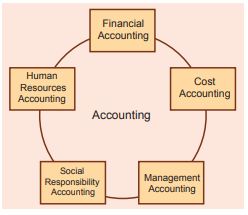
(i) Financial Accounting :
1. It involves recording of financial transactions and events.
2. It provides financial information to the users for taking decisions.
3. It ends up with the preparation of trading and profit and loss account and balance sheet,
(ii) Cost Accounting :
It involves the collection, recording, classification and appropriate allocation of expenditure for the determination of the costs of products or services and for the presentation of data for the purposes of cost control and managerial decision making.
(iii) Management Accounting :
It is concerned with the presentation of accounting information in such a way as to assist management in decision making and in the day-to-day operations of an enterprise.
(iv) Social Responsibility Accounting :
It is concerned with presentation of accounting information from the viewpoint of the society by showing the social costs and social benefits.
(v) Human Resource Accounting :
It is concerned with identification, quantification, and reporting of investments made in human resources of an enterprise.
3.
1. Faster processing,
2. Accurate information and
3. Reliability
4.
1. Capital expenditure
2. Revenue expenditure
3. Deferred revenue expenditure
5.
The advantages of double entry system are:
(i) Scientific system: Double entry system is systematic and scientific method of recording transactions. It helps to attain the objectives of accounting.
(ii) Complete record of transactions: This system records all the business transactions completely.
(iii) A check on the accuracy of accounts: Under this system, the accuracy can be established by the preparation of trial balance.
(iv) Ascertainment of profit or loss: The profit earned or loss occurred during a-period can be ascertained by the preparation of profit and loss account.
(v) Knowledge of the financial position: The' financial position of the business concern can be easily ascertained at the end of accounting period by preparing the balance sheet.
(vi) Full details for control: This system permits accounts to be kept in very detailed form and thereby sufficient informations are available for the purpose of control.
(vii) Comparative study: The results of one year can be compared with those of previous year. If there is any change, the reasons may be ascertained.
(viii) Helps in decision making: The management gets sufficient informations for making decisions. Weakness can be detected and remedial measures may be applied.
(ix) Detection of frauds The systematic and scientific recording of transactions under this system minimises the chances of frauds.
6.
Cost of Goods sold Opening stock + Purchases + Expenses on purchases - Closing stock
= Rs.30,000 + Rs. 54,600 + Rs. 6,000 -Rs. 36,600
= Rs. 54,000
Gross profit Net Sales - Cost of Goods sold
= Rs. 90,000 - Rs. 54,000
= Rs. 36,000
7.
There are different factors that determine the amount of depreciation to be provided on a fixed asset. They are as follows:
(i) Original cost of the asset :
(a) It means the amount incurred in acquiring the asset. It includes all those expenses incurred on the asset till it is put into use.
(b) Purchase price of the asset, freight, loading charges, unloading charges, erection cost, setting up cost and expenses of trial run are part of the original cost.
(ii) Estimated useful life of the asset:
(a) The time period for which an asset can be used in the enterprise is known as estimated useful life of an asset.
(b) In the case of leased assets, the period of lease is taken as its useful life. In the case of intellectual properties like patents and copyrights, their legal life is taken as their estimated useful life.
(iii) Scrap value of an asset:
(a) The amount which is expected to be realised at the end of the estimated useful life life of an asset is known as scrap value of the asset.
(b) In determining the scrap value, costs to be incurred for removal and sale of the asset should be deducted from the estimated gross realisable value.
(iv) Other factors:
Besides above mentioned factors, estimated running hours, production capacity, and other factors also determine the amount of depreciation.
8.
| Date | Particulars | L.F. | Debit Rs. | Credit Rs. | |
|---|---|---|---|---|---|
| (a) | Interest on loan A/c | Dr. | 5,000 | ||
| To Interest on loan outstanding A/c (Interest on loan outstanding) |
5,000 | ||||
| (b) | Depreciation A/c | Dr. | 2,500 | ||
| To Furniture A/c (Depreciation on furniture 50,000 x 5/100) |
2,500 | ||||
| (c) | Bad debts A/c | Dr. | 3,000 | ||
| To Sundry debtors A/c (Being write off Bad debts) |
3,000 | ||||
| (d) | Profit and Loss A/c | Dr. | 20,000 | ||
| To Provision for bad and doubtful debts A/c (Provision for Bad and doubtful debts 49,000 x 5/100) |
20,000 | ||||
| (e) | Provision for discount on creditor A/c | Dr. | 7,000 | ||
| To Profit 'and loss A/c (Provision for discount on creditors 3,50,000 x 2/100) |
7,000 |
9.
(i) Matching Principle demands that expenses incurred to earn the revenue should be properly matched.
(ii) The expenses and incomes for the current accounting period whether they have been paid or not received or not must be included.
(iii) Similarly, expenses and incomes which do not pertain to current accounting period must be excluded.
10.
| S.No | Particulars | L.F. | Debit Rs | Credit Rs | |
|---|---|---|---|---|---|
| (i) | Suspense A/c | Dr. | 5,000 | ||
| To Manohar A/c | 5,000 | ||||
| (Goods Purchased from Manohar debited to his account is now corrected) | |||||
| (ii) | Manish A/c | Dr. | 4,500 | ||
| Munish A/c | Dr. | 4,500 | |||
| To Suspense A/c | 9,000 | ||||
| (Cash paid to Munish was wrongly credited to Manish, now rectified) | |||||
| (iii) | Discount A/c | Dr. | 100 | ||
| To Suspense A/c | 100 | ||||
| (Discount allowed is not debited to discount A/c) |
11.
| Transaction | Assets | Capital Rs | ||
|---|---|---|---|---|
| Cash Rs | Stock Rs | |||
| (a) Started business with cash | +60,000 | = | +60,000 | |
| Equation | +60,000 | +60,000 | ||
| (b) Cash purchases | -20,000 | +20,000 | ||
| Equation | +40,000 | +20,000 | = | +60,000 |
| (c) Sold goods for cash | +15,000 | -10,000 | +5,000 | |
| Equation | +55,000 | +10,000 | = | +65,000 |
| (d) Paid rent by cash | -500 | -500 | ||
| Equation | +54,000 | +10,000 | = | +64,000 |
12.
(i) Division of work: As journal is sub-divided, the work will be subdivided and different persons can work on different books at the same time and the work can be speedily completed.
(ii) Efficiency: The sub-division of work gives same work is done by a person repeatedly, the person becomes efficient in handling it. Thus, specialization leads to efficiency in accounting work.
(iii) Prevents errors and frauds: Internal check becomes more effective as the work can be divided in such a manner that the work of one person is automatically checked by another person. With the use of internal check, the possibility of occurrence of errors or fraud may be avoided or minimised.
(iv) Saving in time: As there are many subsidiary books, work of entering can be done simultaneously by many person. Thus it saves time and accounting work can be completed quickly.
(v) Detailed informations available: As all transactions relating to a particular item are entered in a subsidiary book, it gives detailed information. It is easy to arrive at monthly or quarterly totals.
13.
Procedure
1. Open new excel sheet.
2. Input the table as given in the question.
3. Enter the data “Achieved” in Cell D1.
4. Type the following in Cell D2:
= OR (B2 > = 500,C2 > = 500)
5. Copy the formula from D2 into D3 and D4
Output
| Counter | Day 1 sales | Day 2 sales | Achieved |
| Ground floor | 600 | 600 | TRUE |
| First floor | 850 | 300 | TRUE |
| Second floor | 350 | 400 | FALSE |
14.
Amount drawn from bank for office use.
15.
The items having the effect of lower balance in the Pass book.
(i) Cheques deposited but not credited by the bank.
(ii) Dishonoured cheques appeared in the pass book but not entered in the cash book.
(iii) Bank charges as per pass book.
(iv) Wrong debit by banker.
(v) Payments as per standing instructions of customers
16.
| S.No | Name of account | L.F | Debit balance Rs |
Credit balance Rs |
| 1 | Discount allowed | 350 | ||
| 2 | Cash in hand | 4,100 | ||
| 3 | Capital | 45,000 | ||
| 4 | Salaries | 10,000 | ||
| 5 | Furniture | 9,500 | ||
| 6 | Loan borrowed | 12,000 | ||
| 7 | Commission paid | 3,000 | ||
| 8 | Purchases | 29,050 | ||
| 9 | Sales | 35,000 | ||
| 10 | Suspense Account | 36,000 | ||
| Total | 92,000 | 92,000 |
17.
Following are the advantages of maintaining petty cash book:
(i) There can be better control over petty payments.
(ii) There is saving of time of the main cashier.
(iii) Cash book is not loaded with many petty payments.
(iv) Posting of entries from main cash book and petty cash book is comparatively easy.
18.
Following are the principles of double entry system:
(i) In every business transaction, there are two aspects
(ii) The two aspects involved are the benefit or value receiving aspect and benefit or value giving aspect.
(iii) These two aspects involve minimum two accounts; at least one debit and at least one credit.
(iv) For every debit, there is a corresponding and equivalent credit. If one account is debited the other account must be credited.
19.
(i) International Financial Reporting Standards are issued by the International Accounting Standards Board (IASB).
(ii) IFRS is a set of International accounting standards stating how particular types of transactions and other events should be reported in financial statements.
(iii) IASB initially adopted the accounting standards issued by IASC to be replaced by IFRS upon their issuance.
(iv) The objective behind setting up the IASC and later IASB was to develop accounting standards that would be acceptable worldwide and to improve financial reporting internationally
20.
Following are the objectives of accounting:
(i) To keep a systematic record of financial transactions and events
(ii) To ascertain the profit or loss of the business enterprise
(iii) To ascertain the financial position or status of the enterprise
(iv) To provide information to various stakeholders for their requirements
(v) To protect the properties of an enterprise and
(vi) To ascertain the solvency and liquidity position of an enterprise

11th Standard Syllabus & Materials
11th Standard
TN 11th Tamil பீடு பெற நில் - செய்யுள் - காவடிச்சிந்து Important Questions And Answers Study Material - QB365 Set A
NEW11th Standard
TN 11th Tamil பீடு பெற நில் - உரைநடை - மலை இடப்பெயர்கள் : ஓர் ஆய்வு Important Questions And Answers Study Material - QB365 Set A
NEW11th Standard
TN 11th Tamil மாமழை போற்றுதும் - துணைப்பாடம் - யானை டாக்டர் Important Questions And Answers Study Material - QB365 Set A
NEW11th Standard
TN 11th Tamil மாமழை போற்றுதும் - செய்யுள் - ஐங்குறுநூறு Important Questions And Answers Study Material - QB365 Set A



Tamilnadu Stateboard 11th Standard Subjects

Maths

Commerce

Economics

Biology

Business Maths and Statistics
Accountancy

Computer Science

Physics

Chemistry
Maths
Biology
Economics
Physics
Chemistry

History
Business Maths and Statistics

Computer Science
Accountancy

Computer Applications
History
Computer Technology
Commerce
Computer Applications
Computer Technology

Tamil

English

French
Tamilnadu Stateboard Standards
