
 100% FREE ACCESS
11th Standard Syllabus & Materials
11th Standard
TN 11th Tamil இயற்கை வேளாண்மை,சுற்றுச்சூழல் -செய்யுள் - மனோன்மணீயம் Important Questions And Answers Study Material - QB365 Set A
NEW11th Standard
TN 11th Tamil என்னுயிர் என்பேன் -துணைப்பாடம் - இசைத்தமிழர் இருவர் Important Questions And Answers Study Material - QB365 Set A
NEW11th Standard
TN 11th Tamil மொழி கலை -செய்யுள் - ஒவ்வொரு புல்லையும் Important Questions And Answers Study Material - QB365 Set A
NEW11th Standard
TN 11th Tamil பீடு பெற நில் - இலக்கணம் - பகுபத உறுப்புகள் Important Questions And Answers Study Material - QB365 Set A
NEW11th Standard
TN 11th Tamil பீடு பெற நில் - துணைப்பாடம் - வாடிவாசல் Important Questions And Answers Study Material - QB365 Set A
NEW11th Standard
TN 11th Tamil பீடு பெற நில் - செய்யுள் - குறுந்தொகை Important Questions And Answers Study Material - QB365 Set A

Published on: 01/08/2018
Some of the important questions from the chapter Conceptual Framework of Accounting covered in this question paper. The questions are prepared from the book back and PTA question.
For parents, Please subscribe and get the plenty of question with answer for your children practice. For Subscription please, click here.
Download Tamil Nadu 11th Standard Accountancy question papers, model tests, one-mark questions, important questions, and public exam papers in PDF format. Free study materials and answer keys for TN State Board students.
Questions + Answers key
Take MCQ Accountancy Test
1.
According to _____________ concept only business transactions are recorded.
Dual aspect
Cost
Business entity
Money measurement
2.
__________ concept helps in keeping business affairs free from the influence of personal affairs of the owner.
Business entity
Money measurement
Cost
Dual aspect
3.
____________ is a branch of knowledge.
Accountancy
Accounting
book keeping
double entry
4.
_____________ is the process of managing the income and expenses of a business firm.
Economic
Statistics
Accountancy
None of these
5.
__________________ is basically generating financial information.
Accounting
Accountancy
Economic
Book keeping
6.
Which of the following does not follow dual aspect concept?
Increase in one asset and decrease in other asset
Increase in both asset liability
Decrease in one asset and decrease in other asset
Increase in one asset and increase in capital
7.
In India, Accounting Standards are issued by
Reserve Bank of India
The Cost and Management Accountants of India
Supreme Court of India
The Institute of Chartered Accountants of India
8.
The rule of stock valuation 'cost price or realisable value' whichever is lower is based on the accounting principle of :
Materiality
Money measurement
Conservatism
Accrual
9.
The profounder of double entry system of book-keeping is ___________
J. R. Batlibai
Luca Pacioli
Old Kesal
Menhar
10.
The business is liable to the proprietor of the business in respect of capital introduced by the person according to
Money measurement concept
Cost concept
Business entity concept
Dual aspect concept
11.
What is dual aspect concept?
12.
What do you mean by business entity concept?
13.
What are the conventions of accounting?
14.
Write a brief note on 'Consistency' assumption.
15.
What is "Full Disclosure Principle" of accounting?
16.
Do you think that the principle of conservatism results in creating of secret reserve?
17.
What is the need for accounting standards?
18.
Explain the Process of Accounting cycle.
19.
What are the basic concepts of accounting?
20.
What do you mean by IFRS?
21.
Explain briefly accounting conventions
22.
Explain the advantages of Book-keeping.
23.
Explain the meaning of Book-keeping and its features
1.
(c)
Business entity
2.
(a)
Business entity
3.
(a)
Accountancy
4.
(c)
Accountancy
5.
(a)
Accounting
6.
(c)
Decrease in one asset and decrease in other asset
7.
(d)
The Institute of Chartered Accountants of India
8.
(c)
Conservatism
9.
(b)
Luca Pacioli
10.
(c)
Business entity concept
11.
According to this concept, every transaction or event has two aspects i.e dual effect. This concept recognises that for every debit, there is a corresponding and equal credit. This is the basis of the entire system of double entry book-keeping.
12.
This concept implies that a business unit is separate and distinct from the owner or owners, that is the person who supply capital to it. Based on this concept, accounts are prepared from the point of view of, the business and not from the owner's point of view.
13.
i) Convention of consistency
ii) Convention of full disclosure
iii) Convention of materiality
iv) Convention of conservatism or providence.
14.
(i) The Consistency convention implies that the Accounting practice should remain the same from one year to another.
(ii) The results of different years will be comparable only when same accounting methods are followed from year to year.
(iii) The firm should be modify the method of charging the depreciation from one to another.
(iv) If any change has to be incorporated, valid reasons for such a change should be emphasised.
15.
(i) The accounts must disclose all material information.
(ii) The Accounting reports should disclose full and fair information to the related parties.
(iii) The financial position and performance should be disclosed very honestly to all the users.
16.
Yes, principle of conservatism has two effects.
(I) Profit and loss account discloses lower profit in comparison to the actual profits.
(ii) Balance sheet will disclose understatement of assets and overstatement of liabilities.
17.
The need for accounting standards is as follows:
1. To Promote better understanding of financial statements.
2. To help accountants to follow uniform policies and practices.
3. To facilitate meaningful comparison of financial statements of two or more entities.
4. To enhance reliability of financial statements.
5. To meet the legal requirements effectively.
18.
Process of Accounting cycle
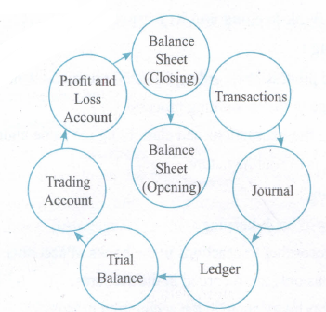
(i) When a businessman starts his business activities, he records the day-to-day transactions in the journal.
(ii) From the journal the transactions move further to the ledger where accounts are written up.
(iii) Preparation of trading and profit and loss account is the next step.
(iv) The balancing of profit and loss account gives the net result of the business transactions.
(v) Thus this cyclic movement of the transactions through the books of accounts (accounting cycle) is a continuous process.
19.
The following are the basic concepts of accounting :
(i) Business entity concept
(ii) Money measurement concept
(iii) Going concern concept
(iv) Cost concept
(v) Dual aspect concept
(vi) Accounting period concept
(vii) Matching concept
(viii) Realisation concept
(ix) verifiable and objective evidence concept
(x) Accrual concept.
20.
(i) International Financial Reporting Standards are issued by the International Accounting Standard Board (IASB).
(ii) IFRS is a set of International Accounting Standards stating how particular types of transactions and other events should be reported in financial statements.
(iii) IASB initially adopted the Accounting standards issued by IASC to be replaced by IFRS upon their issuance.
(iv) The objective behind setting up the IASC and later IASB was to develop Accounting Standards that would be acceptable worldwide and to improve financial reporting internationally
21.
(i) Accounting Conventions:
1. The word convention refers to traditions or customs. The accounting convention describes the customs or traditions followed as a guide to the preparation of accounting statements.
2. Modern business world has accepted the utility of these Accounting conventions in making financial statements more realistic, reliable, and useful to all concerned parties. The following four conventions are generally adopted over a period of time.
(ii) Convention of consistency:
1. The consistency convention implies that the Accounting practice should remain the same from one year to another. The results of different years will be comparable only when same accounting methods are followed from year to year.
2. For Example: If a firm follows the original or fixed installment method of charging depreciation since its purchase/construction, the method should be followed without any change.
(iii) Convention of full disclosure:
1. The accounts must disclose all material information. The Accounting reports should disclose full and fair information to the related parties. The financial position and performance should be disclosed very honestly to all the users.
2. All the information should be relevant, reliable, comparable and understood by all the concerned authorities.
(iv) Convention of conservatism or prudence:
It is a policy of caution or playing safe. While recording the business transactions one has to anticipate no income but provide for all possible losses.
22.
Book-keeping has the following advantages:
(i) Transactions are recorded systematically in chronological order in the book of accounts. Thus, book-keeping provides a permanent and reliable record for all business transactions.
(ii) Book-keeping is useful to get the financial information.
(iii) It helps to have control over various business activities.
(iv) Records provided by business serve as a legal evidence in case of any dispute.
(v) Comparison of financial information over the years is possible. Also comparison of financial information of different business units is facilitated.
(vi) Book-keeping is useful to find out the tax liability.
23.
Meaning of Book-keeping:
(i) Book-keeping is the process of recording financial transactions in the books of accounts.
(ii) It is the primary stage in the accounting process.
(iii) It includes recording the transactions and classifying the same under proper heads.
(iv) Book-keeping work is of routine nature.
Features of Book-Keeping :
Following are the features of book-keeping :
(i) It is the process of recording transactions in the books of accounts.
(ii) Monetary transactions only are recorded in the accounts.
(iii) Book-keeping is the primary stage in the accounting process.
(iv) Book-keeping includes journalising and ledger processing.

11th Standard Syllabus & Materials
11th Standard
TN 11th Tamil பீடு பெற நில் - செய்யுள் - காவடிச்சிந்து Important Questions And Answers Study Material - QB365 Set A
NEW11th Standard
TN 11th Tamil பீடு பெற நில் - உரைநடை - மலை இடப்பெயர்கள் : ஓர் ஆய்வு Important Questions And Answers Study Material - QB365 Set A
NEW11th Standard
TN 11th Tamil மாமழை போற்றுதும் - துணைப்பாடம் - யானை டாக்டர் Important Questions And Answers Study Material - QB365 Set A
NEW11th Standard
TN 11th Tamil மாமழை போற்றுதும் - செய்யுள் - ஐங்குறுநூறு Important Questions And Answers Study Material - QB365 Set A



Tamilnadu Stateboard 11th Standard Subjects

Maths

Commerce

Economics

Biology

Business Maths and Statistics
Accountancy

Computer Science

Physics

Chemistry
Maths
Biology
Economics
Physics
Chemistry

History
Business Maths and Statistics

Computer Science
Accountancy

Computer Applications
History
Computer Technology
Commerce
Computer Applications
Computer Technology

Tamil

English

French
Tamilnadu Stateboard Standards
