
 100% FREE ACCESS
11th Standard Syllabus & Materials
11th Standard
TN 11th Tamil இயற்கை வேளாண்மை,சுற்றுச்சூழல் -செய்யுள் - மனோன்மணீயம் Important Questions And Answers Study Material - QB365 Set A
NEW11th Standard
TN 11th Tamil என்னுயிர் என்பேன் -துணைப்பாடம் - இசைத்தமிழர் இருவர் Important Questions And Answers Study Material - QB365 Set A
NEW11th Standard
TN 11th Tamil மொழி கலை -செய்யுள் - ஒவ்வொரு புல்லையும் Important Questions And Answers Study Material - QB365 Set A
NEW11th Standard
TN 11th Tamil பீடு பெற நில் - இலக்கணம் - பகுபத உறுப்புகள் Important Questions And Answers Study Material - QB365 Set A
NEW11th Standard
TN 11th Tamil பீடு பெற நில் - துணைப்பாடம் - வாடிவாசல் Important Questions And Answers Study Material - QB365 Set A
NEW11th Standard
TN 11th Tamil பீடு பெற நில் - செய்யுள் - குறுந்தொகை Important Questions And Answers Study Material - QB365 Set A

Published on: 04/10/2019
Introduction to Accounting
Download Tamil Nadu 11th Standard Accountancy question papers, model tests, one-mark questions, important questions, and public exam papers in PDF format. Free study materials and answer keys for TN State Board students.
Questions + Answers key
Take MCQ Accountancy Test
1.
Evolution of accounting results in modern accounting approach - explain.
2.
Explain the importance of Human resource accounting and social responsibility accounting in business.
3.
Describe the various steps involved in accounting process?
4.
'Accounting information should be comparable'. Do you agree with this statement? Give two reasons.
5.
"The role of accounting has changed over the period of time". Do you agree?
6.
Why are the following parties interested in accounting information?
(i) Investors
(ii) Government
7.
Explain the meaning of accounting.
8.
Discuss the role of an accountant in the modern business world.
9.
10.
Discuss briefly the branches of accounting.
1.
In India, 23 centuries ago, Chandragupta Maurya's. Minister Kautilya wrote a book named 'Arthashastra', wherein some references can be traced regarding the way of maintaining accounting records.
In the earliest days of civilisation, accounting was done by Stewards who managed the properties of wealthy people. They rendered accounts periodically to the owners of property.
In 1494, Luca Pacioli an Italian developed double-entry book-keeping system which paved way to modem accounting approach later. Finally during 18th and 19th centuries, large scale operations by joint stock companies which paved way for development of comprehensive financial accounting information system.
2.
The importance of Human resource accounting and social responsibility accounting in business are:
(I) Human Resource Accounting: It is concerned with identification, quantification and reporting of investments made in human resources of an enterprise. It helps in recruitment and selection of personnel in any organisation.
(ii) Social Responsibility Accounting: It is concerned in presentation of accounting information by business entities and other organisations from the point of view of the society by showing the social costs incurred such as environmental pollution by the enterprise and social benefits such as infrastructure development and employment opportunities created by them.
3.
The various steps involved in accounting process are:
(i) Identifying the transactions and journaiising: The first step in the accounting process is identifying the financial transactions of a business. All the monetary transactions are recorded in the books of original entry called journals. Recording the transactions in the journal is called journalising. Entries are made journals.
(ii) Posting and balancing: Transferring the entries from the journal to the ledger is called posting. In ledger, entries are made in each account after classifying them under common heads. Finding out the difference between the total of the debit column and credit column of all the ledger accounts is called balancing.
(iii) Preparation of trial balance: The list of ledger balances namely trial balance is prepared as the next step. On the basis of ledger balances the financial statements are prepared.
(iv) Preparation of trading account: Next step is preparation of trading account for a particular accounting period. All the direct revenues and direct expenses are transferred to trading account. The balance in the trading account is the gross profit or gross loss.
(v) Preparation of profit and loss account: Profit and loss account is prepared next for a particular accounting period. All the indirect revenues. and indirect expenses along with gross profit or gross loss are transferred to profit and loss account. The balance in the profit and loss account is the net profit or net loss.
(vi) Preparation of balance sheet: A statement showing the balances of assets and liabilities namely balance sheet is prepared as the final step in the accounting process. It is prepared on a particular date, normally, on the last day of the accounting period.
4.
Yes, Accounting information should be comparable because,
i) It helps to make inter-firm comparisons, i.e., to find out how a firm has performed as compared to the other firms.
ii) It helps to make inter-period comparisons, i.e., to find out how it has performed as compared to the previous years.
5.
Earlier the role of Accounting was limited to recording of transactions. Now, it has shifted to providing information to managers and interested parties, to help them take appropriate decision. It is now regarded as an information system.
6.
(i) Investors :
1. Persons who are interested in investing their surplus funds should know about the financial condition of a business unit while making their investment decisions.
2. They are more concerned about future earnings and risk bearing capacity of the organisation which will affect the return to the investors.
(ii) Government :
1. The scarce resources of the country are used by business enterprises.
2. Information about performance of business units in different industries helps the government in policy formulation for development of trade and industry, allocation of scarce resources, grant of subsidy, etc.
3. Government also administers prices of certain commodities.
7.
(i) Accounting is the systematic process of identifying, measuring, recording, classifying, summarising, interpreting and communicating financial information.
(ii) Accounting gives information on :
1. the resources available
2. how the available resources have been employed and
3. the results achieved by their use.
(iii) The profit earned or loss incurred during the accounting period, value and nature of assets, liabilities, and capital can be ascertained from the information recorded in accounts.
8.
An accountant designs the accounting procedures for an enterprise. He plays several roles in an organisation as follows:
(i) Record keeper :
1. The accountant maintains a systematic record of financial transactions.
2. He also prepares the financial statements and other financial reports.
(ii) Provider of information to the management :
The accountant assists the management by providing financial information required for decision making and for exercising control.
(iii) Protector of business assets :
The accountant maintains records of assets owned by the business which enables the management to protect and exercise control over these assets.
(iv) Financial advisor :
The accountant analyses financial information and advises the business managers regarding investment opportunities, strategies for cost savings, capital budgeting, provision for future growth and development, expansion of enterprise, etc.
(v) Tax Manager :
1. The accountant ensures that tax returns are prepared and filed correctly on time and payment of tax is made on time.
2. The accountant can advise the managers regarding tax management, reducing tax burden, availing tax exemptions, etc.
(vi) Public relations officer :
The accountant provides accounting information to various interested users for analysis as per their requirements.
9.
10.
The various branches of accounting are
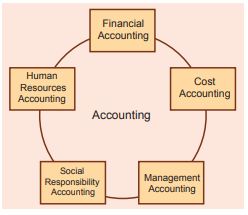
(i) Financial Accounting :
1. It involves recording of financial transactions and events.
2. It provides financial information to the users for taking decisions.
3. It ends up with the preparation of trading and profit and loss account and balance sheet,
(ii) Cost Accounting :
It involves the collection, recording, classification and appropriate allocation of expenditure for the determination of the costs of products or services and for the presentation of data for the purposes of cost control and managerial decision making.
(iii) Management Accounting :
It is concerned with the presentation of accounting information in such a way as to assist management in decision making and in the day-to-day operations of an enterprise.
(iv) Social Responsibility Accounting :
It is concerned with presentation of accounting information from the viewpoint of the society by showing the social costs and social benefits.
(v) Human Resource Accounting :
It is concerned with identification, quantification, and reporting of investments made in human resources of an enterprise.

11th Standard Syllabus & Materials
11th Standard
TN 11th Tamil பீடு பெற நில் - செய்யுள் - காவடிச்சிந்து Important Questions And Answers Study Material - QB365 Set A
NEW11th Standard
TN 11th Tamil பீடு பெற நில் - உரைநடை - மலை இடப்பெயர்கள் : ஓர் ஆய்வு Important Questions And Answers Study Material - QB365 Set A
NEW11th Standard
TN 11th Tamil மாமழை போற்றுதும் - துணைப்பாடம் - யானை டாக்டர் Important Questions And Answers Study Material - QB365 Set A
NEW11th Standard
TN 11th Tamil மாமழை போற்றுதும் - செய்யுள் - ஐங்குறுநூறு Important Questions And Answers Study Material - QB365 Set A



Tamilnadu Stateboard 11th Standard Subjects

Maths

Commerce

Economics

Biology

Business Maths and Statistics
Accountancy

Computer Science

Physics

Chemistry
Maths
Biology
Economics
Physics
Chemistry

History
Business Maths and Statistics

Computer Science
Accountancy

Computer Applications
History
Computer Technology
Commerce
Computer Applications
Computer Technology

Tamil

English

French
Tamilnadu Stateboard Standards
