
 100% FREE ACCESS
11th Standard Syllabus & Materials
11th Standard
TN 11th Tamil இயற்கை வேளாண்மை,சுற்றுச்சூழல் -செய்யுள் - மனோன்மணீயம் Important Questions And Answers Study Material - QB365 Set A
NEW11th Standard
TN 11th Tamil என்னுயிர் என்பேன் -துணைப்பாடம் - இசைத்தமிழர் இருவர் Important Questions And Answers Study Material - QB365 Set A
NEW11th Standard
TN 11th Tamil மொழி கலை -செய்யுள் - ஒவ்வொரு புல்லையும் Important Questions And Answers Study Material - QB365 Set A
NEW11th Standard
TN 11th Tamil பீடு பெற நில் - இலக்கணம் - பகுபத உறுப்புகள் Important Questions And Answers Study Material - QB365 Set A
NEW11th Standard
TN 11th Tamil பீடு பெற நில் - துணைப்பாடம் - வாடிவாசல் Important Questions And Answers Study Material - QB365 Set A
NEW11th Standard
TN 11th Tamil பீடு பெற நில் - செய்யுள் - குறுந்தொகை Important Questions And Answers Study Material - QB365 Set A

Published on: 28/12/2018
+1 First Revision Test
Download Tamil Nadu 11th Standard Accountancy question papers, model tests, one-mark questions, important questions, and public exam papers in PDF format. Free study materials and answer keys for TN State Board students.
Questions + Answers key
Take MCQ Accountancy Test
1.
Debts which cannot be recovered or irrecoverable are called _________.
Bad debts
Depreciation
Closing stock
Capital
2.
A trader followed WDV method of depreciation; the book value of assets after 4 years is 24% of original cost. Find rate of depreciation__________.
24%
26%
32%
30%
3.
In cash book bank charges recorded in the___________.
Credit side
Debit side
Both a & b
None of these above
4.
The return of goods to a supplier should be credited to______
Supplier Account
Goods Account
Purchase Return Account
None of the above
5.
Nominal account is classified under__________.
Personal A/c
Impersonal A/c
Neither of the two
6.
Buying of goods with an intention of resale is ________
purchases
sales
income
7.
Amount of Rs.5,000 spent as lawyer's fee to defend a suit claiming that the firm's factory site belonged to the plaintif's land is ____________
Capital expenditure
Revenue expenditure
Prepaid revenue expenditure
Revenue receipt
8.
TALLY is an example of _______.
Tailor-made accounting software
Ready-made accounting software
In-built accounting software
Customised accounting software
9.
10.
The total of purchases book was overcast. Which of the following accounts should be debited in the rectifying journal entry?
Purchases account
Suspense account
Creditor account
None of the above
11.
Drawings appearing in the trial balance is _______.
Added to the purchases
Subtracted from the purchases
Added to the capital
Subtracted from the capital
12.
A bank reconciliation statement is prepared with the help of ______.
Bank statement
Cash book
Bank statement and bank column of the cash book
Petty cash book
13.
'Cash withdrawn by the proprietor from the business for his personal use' causes
Decrease in assets and decrease in owner's capital
Increase in one asset and decrease in another asset
Increase in one asset and increase in liabilities
Increase in asset and decrease in capital
14.
15.
Sales return book is used to record_________
Returns of goods by the customer for which cash is paid immediately
Returns of goods by the customer for which cash is not paid immediately
Returns of assets by the customer for which cash is not paid immediately
Returns of assets by the customer for which cash is paid immediately
16.
A list which contains balances of accounts to know whether the debit and credit balances are matched is _______
Journal
Day book
Trial balance
Balance sheet
17.
Transferring entries from Journal to Ledger Accounts is called _____________
Casting
Posting
Journalising
Balancing
18.
If the total of the debit side of an account exceeds the total of its credit side, it means
Credit Balance
Debit Balance
Nil Balance
Debit and Credit Balance
19.
20.
21.
Enter the following transactions in a petty cash book of Mr. Jack with analytical columns. The petty cashier begins with an imprest amount of Rs.1,000.
| 2012, June | Rs. |
|---|---|
| 4 Postage Stamps | 40 |
| 5 Travelling expenses | 75 |
| 6 Lunch expenses | 150 |
| 8 Labour charges for bringing office tables | 50 |
| 10 Repair charges to fax machine | 250 |
| 12 Postage stamps | 20 |
| 15 Cleaning the office | 50 |
| 17 Stationery purchased | 175 |
| 27 Paid to Ravi | 150 |
22.
Classify the following receipts under capital and revenue.
i) Rs.3,00,000 worth of debentures are issued for raising loan.
ii) Rs.5,000 received as dividend from the investment on shares.
iii) Gokul started business with Rs.4,00,000.
iv) A machinery costing Rs.50,000 was sold for Rs.50,000.
v) Creditors allowed discount Rs.30,000.
23.
Enter the following transactions in the purchases returns book of Hari who is dealing in automobiles and post them into the ledger.
| 2017 | |
| Jan 5 | Returned to Anand 5 clutch plates @ Rs. 200 each, not in accordance with order. |
| Jan 14 | Returned to Chandran 4 brake shoes @ Rs. 200 each and 10rear view mirrors @ Rs. 350 each, due to inferior quality. |
24.
The bank statement of Sudha and Company showed an overdraft of Rs.10,000 on 31st December 2017, prepare a bank reconciliation statement.
(a) A cheque deposited on 30th December 2017 for Rs.15,000 was not credited by the bank.
(b) Interest on term loan Rs.500 was debited by bank on 31st December 2017 but not accounted in the books of Sudha and Company.
(c) A cheque issued for Rs.550 on 24th December 2017, paid by the bank was recorded as 505 in the bank column of the cash book.
(d) One outgoing cheque on 27th December 2017 of Rs.200·was recorded twice in the cash book.
(e) Bank recorded a cash deposit of Rs.2,598 as Rs.2,589.
(f) A sum of Rs.2,000 deposited in cash deposit machine by a customer of the business on 31st December 2017 was not recorded in the books of Sudha and Company.
(g) Interest on overdraft of Rs.600 was not recorded in the books of Sudha and Company,
(h) Two cheques issued on 29th December 2017 for Rs.500 and Rs 700, but only the first cheque was presented for payment before 31st December 2017.
25.
Veena is a dealer in textiles. On January 1, 2018, her business showed the following balances: Cash in hand: Rs. 20,000; Bank balance: Rs. 70,000; Stock: Rs. 15,000 following are the transactions made during January 2018. Show the effect of the transactions on accounting equation.
a) Purchased goods (readymade shirts) on credit from Subbu Rs. 20,000
(b) Goods returned to Subbu and no cash is received Rs. 5,000
(c) Goods (shirts) costing Rs. 1,600 was sold to Janani on credit Rs. 2,000
(d) Janani returned 1 shirt of sales value Rs. 500
(e) Janani deposited the money due in cash deposit machine in a bank Rs. 1,500
(f) Insurance on building paid through net banking Rs. 1,000
(g) Insurance on building paid through net banking Rs. 100
26.
Pass journal entries for the following transactions and post them in the ledger accounts.
| 2017 June 1 |
Basu started business with cash Rs. 50,000 |
| 4 | Purchased furniture by paying cash for Rs. 6,000 |
| 7 | Purchased machinery on credit from Harish Rs. 10,000 |
| 10 | Bought goods for cash Rs 4,000 |
| 18 | Paid insurance premium Rs 100 |
27.
On preparing final accounts of Suresh, bad debt account has a balance of Rs. 800 and sundry debtors account has a balance of Rs. 16,000 of which Rs. 1,200 is to be written off as further bad debts. Pass adjusting entry for bad debts. And also show how it would appear in profit and loss account and balance sheet.
28.
On 1st January 2015, a second hand machine was purchased for Rs. 58,000 and Rs. 2,000 was spent on its repairs. On 1st July 2017, it was sold for Rs. 28,600. Prepare the machinery account for the years 2011 to 2013 under written down value method by assuming the rate of depreciation as 10% p.a. and the accounts are closed on 31st December every year.
29.
From the following information, prepare profit and loss account for the year ending 31st December 2016.
| Particulars | Rs | Particulars | Rs |
|---|---|---|---|
| Gross loss | 60,000 | Printing and stationery (office) | 2,000 |
| Promotional expenses | 5,000 | Legal charges | 5,000 |
| Distribution expenses | 15,000 | Bad debts | 1,000 |
| Commission paid | 7,000 | Depreciation | 2,000 |
| Interest on loan paid | 5,000 | Rent received | 4,000 |
| Packing charges (on sales) | 4,000 | Loss by fire not covered by insurance | 3,000 |
| Dividend received | 3,000 |
30.
From the data given below
i) Fill the address in B3 using CONCATENATE Function.
ii) Change KAMARAJAR SALAI given in C2 as lower case in C3
iii) Change Chennai given in D2 as upper case in D3
| A | B | C | D | E | |
| 1 | NAME | HOUSE NO. | STREET | PLACE | PINCODE |
| 2 | ANAND | 123 | KAMARAJAR SALAI | Chennai | 600018 |
31.
Rectify the following errors which were located before preparing the trial balance.
(a) Wages paid Rs. 2,000 for the erection of machinery was debited to wages account.
(b) Sales returns book was short totalled by Rs.1,000.
(c) Goods purchased for Rs. 200 was posted as Rs. 2,000 to purchases account.
(d) The sales book was overcast by Rs.1,500.
(e) Cash paid to Mukil Rs. 2,800 which was debited to Akhil’s account as Rs. 2,000
32.
Record the following transactions in an analytical petty cash book and balance the same. On 1st November, 2017, the petty cashier started with imprest cash Rs.2,000.
| 2017 Nov | 1 | Postage stamps purchased | 155 |
| 2 | Paid to sweeper and scavenger | 170 | |
| 3 | Conveyance to Manager | 125 | |
| 6 | Lorry hire for goods rent | 260 | |
| 7 | Greeting card purchased | 110 | |
| 10 | Carriage paid | 70 | |
| 11 | Repairs to furniture | 100 | |
| 13 | Ink and gum purchased | 50 | |
| 17 | Computer servicing charges paid | 250 | |
| 20 | Cleaning charges paid | 120 | |
| 22 | Gave charity to beggars | 40 | |
| 23 | Paid to Rammohan | 80 | |
| 25 | Paid railway fare | 150 | |
| 30 | Subscription paid to the Times of India | 120 |
33.
Prepare the trial balance from the following balances of Rajesh as on 31st March, 2017.
| Particulars | Rs | Particulars | Rs |
|---|---|---|---|
| Bills receivable | 13,000 | Drawings | 7,000 |
| Bank charges | 750 | Sundry debtors | 17,100 |
| Conveyance charges | 350 | Bills payable | 12,000 |
| Discount received | 1,300 | Capital | 25,900 |
| Cash in hand | 1,000 |
34.
Briefly explain the functions of accounting
35.
Discuss briefly the branches of accounting.
36.
Enter the following transactions in a single column cash cash book of Pradeep for April, 2017
| April | Particulars | Rs |
|---|---|---|
| 1 | Commenced Bussiness with cash | 27,000 |
| 5 | Bought goods for cash | 6,000 |
| 10 | Goods sold for cash | 11,000 |
| 13 | Paid into bank | 5,000 |
| 14 | Goods sold to Sangeetha for cash | 9,000 |
| 17 | Goods purchased from Preethi on credit | 13,000 |
| 21 | Purchased stationery by cash | 200 |
| 25 | Paid Murugan by cash | 14,000 |
| 26 | Commission paid by cash | 700 |
| 29 | Drew from bank for office use | 4,000 |
| 30 | Rent paid by cheque | 3,000 |
37.
Give the adjusting entries for interest on capital and interest on drawings.
38.
Rectify the following errors assuming that the trial balance is already prepared and the difference was placed to suspense account:
(a) Sales book was undercast by Rs.250
(b) Purchases book was undercast by Rs.120
(c) Sales book was overcast by Rs.130
(d) Bills receivable book was undercast by Rs.75
(e) Purchases book was overcast by Rs.35.
39.
Consider the following information:
Loan amount Rs.3,00,000
Number of payment periods 48 months
Annual rate of interest 10%
Calculate periodic payment using PMT function.
40.
“Balance sheet is not an account”- Explain.
41.
Write the following transactions in proper subsidiary books of Mr. Rajasekaran.
| 2014 May 10 | Purchased goods from Raman Rs. 15,000. |
| May 14 | Returned goods to Raman Rs. 500. |
| May 18 | Purchased goods from Sekaran Rs. 10,000. |
| May 20 | Pradeep sold goods to us Rs. 20,000. |
| May 24 | Sent a Debit note to Sekaran for goods damaged in transit Rs. 1,000. |
42.
Indicate the nature of normal balance in the following accounts.
(a) Cash (b) Creditors (c) Sales (d) Furniture (e) Commission received (f) Debtors (g) purchases (h) Capital (i) Salaries and (j) Computer
43.
State the principles of double entry system of bookkeeping.
44.
Explain the process of Accounting cycle.
45.
When can a bank reconciliation be prepared?
46.
If depreciation reduces profits, reduces value of assets and also reduces capital of the proprietor, then why do enterprises provide for depreciation?
47.
'Accounting is useful only to the owner of the business' - Do you agree?
48.
Give any two examples of readymade software.
49.
A furniture costing Rs 5,000 was purchased on 1.1.2016, the installation charges being Rs 1,000. The furniture is to be depreciated @10% p.a. on the diminishing balance method. Pass journal entries for the first two years.
50.
Rectify the following errors discovered after the preparation of the trial balance:
(a) Rent paid was carried forward to the next page Rs.500 short.
(b) Wages paid was carried forward Rs.250 excess.
51.
State with reasons whether the following are capital or revenue expenditure:
i. Expenses incurred in connection with obtaining a licence for starting the factory for Rs.25,000.
ii. A factory shed was constructed at a cost of Rs.2,00,000. A sum of Rs.10,000 had been incurred in the construction of temporary huts for storing building material.
iii. Overhaul expenses of second-hand machinery purchased amounted to Rs.5,000.
52.
Mr. Ganesh an accountant of XYZ co. in order to match the trial balance passed a dummy entry without any proof of the transaction and did not even inform the senior about it. Identify the value being violated by the accountant.
53.
What is accounting equation?
54.
What is journal proper?
1.
(a)
Bad debts
2.
(d)
30%
3.
(a)
Credit side
4.
(c)
Purchase Return Account
5.
(b)
Impersonal A/c
6.
(a)
purchases
7.
(b)
Revenue expenditure
8.
(b)
Ready-made accounting software
9.
(b)
10.
(b)
Suspense account
11.
(d)
Subtracted from the capital
12.
(c)
Bank statement and bank column of the cash book
13.
(a)
Decrease in assets and decrease in owner's capital
14.
(d)
15.
(b)
Returns of goods by the customer for which cash is not paid immediately
16.
(c)
Trial balance
17.
(b)
Posting
18.
(b)
Debit Balance
19.
(b)
20.
(c)
21.
| Receipts | C.B.F.N. | Date | Particulars | V.N. | Total Payments Rs. | Postage & Telegrams Rs. | Printing & Stationery Rs. | Office Expenses Rs. | Carriage& Travelling Rs. | Sundries Rs. | Personal A/c Rs. | Repairs & Services Rs. | L.F. |
|---|---|---|---|---|---|---|---|---|---|---|---|---|---|
| 1,000 | 1.6.12 | To Cash A/c | |||||||||||
| 4.6.12 | By Postage Stamps | 40 | 40 | ||||||||||
| 5.6.12 | To Travelling expenses A/c | 75 | 75 | ||||||||||
| 6.6.12 | By Lunch expenses | 150 | 150 | ||||||||||
| 8.6.12 | By Labour charges | 50 | 50 | ||||||||||
| 10.6.12 | By Repairs | 250 | 250 | ||||||||||
| 12.6.12 | By Postage Stamps | 20 | 20 | ||||||||||
| 15.6.12 | By Cleaning | 50 | 50 | ||||||||||
| 17.6.12 | By Stationery | 175 | 175 | ||||||||||
| 27.6.12 | By Ravi | 150 | 150 | ||||||||||
| 30.6.12 | Total Expenses | 960 | 60 | 175 | 125 | 200 | 150 | 250 | |||||
| 30.6.12 | By Balance c/d | 40 | |||||||||||
| 1,000 | 1,000 | ||||||||||||
| 40 | 1.7.12 | To Balance b/d | |||||||||||
| 960 | 1.7.12 | To Cash A/c |
22.
| S.No. | Transactions | Classification |
|---|---|---|
| i) | Rs.3,00,000 worth of debentures are issued for raising loan. | Capital receipt |
| ii) | Rs.5,000 received as dividend from the investment on shares. | Revenue receipt |
| iii) | Gokul started business with Rs.4,00,000. | Capital receipt |
| iv) | A machinery costing Rs.50,000 was sold for Rs.50,000. | Capital receipt |
| v) | Creditors allowed discount Rs.30,000. | Revenue receipt |
23.
| Date | Particulars | Debit Note No. | L.F. | Amount Rs. | Remarks | |
|---|---|---|---|---|---|---|
| Details | Total | |||||
| 2017 | ||||||
| Jan 5 | Anand | Not in accordance with order | ||||
| 5 clutch plates @ Rs. 200 | 1,000 | |||||
| Jan 14 | Chandran | |||||
| 4 brake shoes @ Rs. 200 each | 800 | Due to inferior quality | ||||
| 10 rear view mirrors @ Rs. 350 each | 3,500 | 4,300 | ||||
| Purchase A/c Cr. | 5,300 | |||||
| Date | Particulars | J.F. | Amount Rs. | Date | Particulars | J.F. | Amount Rs. |
|---|---|---|---|---|---|---|---|
| 2017 | |||||||
| Jan 31 | By Sundry Creditors A/c | 5,300 |
| Date | Particulars | J.F. | Amount Rs. | Date | Particulars | J.F. | Amount Rs. |
|---|---|---|---|---|---|---|---|
| 2017 | |||||||
| Jan 5 | To Purchases return A/c | 1,000 |
| Date | Particulars | J.F. | Amount Rs. | Date | Particulars | J.F. | Amount Rs. |
|---|---|---|---|---|---|---|---|
| 2017 | |||||||
| Jan 14 | To Purchases return A/c | 4,300 |
24.
| Particulars | Amount Rs | Amount Rs |
|---|---|---|
| Overdraft as per bank statement (debit balance) | 10,000 | |
| Add: Cheque issued recorded twice in cash book | 200 | |
| Direct cash deposit not entered in cash book | 2,000 | |
| Unpresented cheque | 700 | 2,900 |
| 12,900 | ||
| Less: Cheque deposited but not credited by bank | 15,000 | |
| Interest on term loan not entered in cash book | 500 | |
| Cheque issued amount entered lesser in cash book (550-505) | 45 | |
| Cash deposit recorded lesser in bank statement (2,598-2,589) | 9 | |
| Interest on overdraft not entered in cash book | 600 | |
| Favourable balance as per cash book* | -3,254 |
25.
| Transaction | Assests | Capital Rs | Creditors Rs | |||||
|---|---|---|---|---|---|---|---|---|
| Cash Rs | Bank Rs | Stock Rs | Debtors Rs | Prepaid insurance Rs | ||||
| To Balance b/d | +20,000 | +70,000 | +15,000 | +1,05,000 | ||||
| Equation | +20,000 | +70,000 | +15,000 | = | +1,05,000 | |||
| (a) Purchased goods on credit | 20,000 | +20,000 | ||||||
| Equation | +20,000 | +70,000 | +35,000 | = | +1,05,000 | +20,000 | ||
| (b) Goods returned and no cash received | -5,000 | -5,000 | ||||||
| Equation | +20,000 | +70,000 | +30,000 | = | +1,05,000 | +15,000 | ||
| (c) Goods sold on credit | -1,600 | 2,000 | +400 | |||||
| Equation | +20,000 | +70,000 | +28,400 | +2,000 | = | +1,05,400 | +15,000 | |
| (d) Sales return the cost of which is Rs 400 and no cash paid |
+400 | -500 | -100 | |||||
| Equation | +20,000 | +70,000 | +28,800 | +1,500 | = | +1,05,300 | +15,000 | |
| (e) Customer deposited the money in CDM |
+1,500 | -1,500 | ||||||
| Equation | +20,000 | +71,500 | +28,800 | = | +1,05,300 | +15,000 | ||
| (f) Insurance premium paid through net banking |
-1,000 | -1,000 | ||||||
| Equation | +20,000 | +70,500 | +28,800 | = | +1,04,00 | +15,000 | ||
| (g) Prepaid Insurance | +100 | +100 | ||||||
| Equation | +20,000 | +70,500 | +28,800 | +100 | = | +1,04,400 | +15,000 | |
26.
| Date | Particulars | L.F | Debit Rs | Cresit Rs | |
|---|---|---|---|---|---|
| 2017 June 1 |
Cash A/c To Basu's capital A/c (Started business with cash) |
Dr. | 50,000 | 50,000 |
|
| June 4 | Furniture s A/c To Cash A/c (Furniture bought for cash) |
Dr. | 6,000 | 6,000 |
|
| June 7 | Machinery A/c To Harish A/c (Machinery bought on credit from Harish) |
Dr. | 10,000 | 10,000 |
|
| June 10 | Purchase A/c To Cash A/c (Goods bought for cash) |
Dr. | 4,000 | 4,000 |
|
| June 18 | Insurance premium A/c To Cash A/c (Insurance premium paid) |
Dr. | 100 | 100 |
Ledger accounts
| Date | Particulars | J.F. | Rs | Date | Particulars | J.F. | Rs |
|---|---|---|---|---|---|---|---|
| 2017 June 1 |
To Basu's capital A/c |
50,000 |
2017 June 4 10 18 |
By Furniture A/c By Purchases A/c By Insurance premium A/c. |
6,000 4,000 100 |
| Date | Particulars | J.F. | Rs | Date | Particulars | J.F. | Rs |
|---|---|---|---|---|---|---|---|
| 2017 June 1 |
By Cash A/c |
50,000 |
| Date | Particulars | J.F. | Rs | Date | Particulars | J.F. | Rs |
|---|---|---|---|---|---|---|---|
| 2017 June 4 |
To Cash A/c |
6,000 |
| Date | Particulars | J.F. | Rs | Date | Particulars | J.F. | Rs |
|---|---|---|---|---|---|---|---|
| 2017 June 7 |
To Harish A/c |
10,000 |
| Date | Particulars | J.F. | Rs | Date | Particulars | J.F. | Rs |
|---|---|---|---|---|---|---|---|
| 2017 June 7 |
By Machinery A/c |
10,000 |
| Date | Particulars | J.F. | Rs | Date | Particulars | J.F. | Rs |
|---|---|---|---|---|---|---|---|
| 2017 June 10 |
To Cash A/c |
4,000 |
| Date | Particulars | J.F. | Rs | Date | Particulars | J.F. | Rs |
|---|---|---|---|---|---|---|---|
| 2017 June 18 |
To Cash A/c |
100 |
27.
| Date | Particulars | L.F | Debit Rs | Credit Rs | |
|---|---|---|---|---|---|
| Bad debts A/c | Dr | 1,200 | |||
| To Sundry debtors A/c | 1,200 | ||||
| (Bad debts written off) |
| Particulars | Amount Rs | Amount Rs | Particulars | Amount Rs | Amount Rs |
|---|---|---|---|---|---|
| To Bad debts | 800 | ||||
| Add : Additional Bad debts | 1,200 | ||||
| 2,000 |
| Liabilities | Amount Rs | Amount Rs | Assets | Amount Rs | Amount Rs |
|---|---|---|---|---|---|
| Sundry Debtors | 16,000 | ||||
| Less: Additional Bad debts | 1,200 | ||||
| 14,500 |
28.
| Date | Particulars | Amount Rs. |
|---|---|---|
| 2015 Jan 01 | Cost Price (58,000 + 2,000) | 60,000 |
| 2015 Dec 31 | Less: Depreciation\([60,000\times\frac{10}{100}]\) | 6,000 |
| 54,000 | ||
| 2016 Dec 31 | Less: .Depreciation\([54,000\times\frac{10}{100}]\) | 5,400 |
| 48,600 | ||
| 2017 July 01 | Less: Depreciation\([48,600\times\frac{10}{100}\times\frac{6}{12}]\) | 2,430 |
| Book Value of the Machinery | 46,170 | |
| Sales | 28,600 | |
| Loss on sale | 17,570 |
| Date | Particulars | Amount Rs. | Date | Particulars | Amount Rs. |
|---|---|---|---|---|---|
| 2015 Jan 01 | To Bank A/c | 60,000 | 2015 Dec 31 | By Depreciation A/c | 6,000 |
| 2015 Dec 31 | By Balance c/d | 54,000 | |||
| 60,000 | 60,000 | ||||
| 2016 Jan 01 | To Balance b/d | 54,000 | 2016 Dec 31 | By Depreciation A/c | 5,400 |
| 2016 Dec 31 | By Balance c/d | 48,600 | |||
| 54,000 | 54,000 | ||||
| 2016 Jan 01 | To Balance b/d | 48,600 | 2017 Dec 31 | By Depreciation A/c | 2,430 |
| 2017 Dec 31 | By Bank A/c | 28,600 | |||
| 2017 Dec 31 | By Profit & LossA/c | 17,570 | |||
| 48,600 | 48,600 |
29.
| Particulars | Rs. | Particulars | Rs. |
|---|---|---|---|
| To Gross loss | 60,000 | By Dividend received | 3,000 |
| To Promotional expenses | 5,000 | By Rent received | 4,000 |
| To Distribution expenses | 15,000 | By Net Loss | 1,02,000 |
| To Commission paid | 7,000 | (Transferred to capital account) | |
| To Interest on loan paid | 5,000 | ||
| To Packing charges | 4,000 | ||
| To Printing and Stationery | 2,000 | ||
| To Legal charges | 5,000 | ||
| To Bad debts | 1,000 | ||
| To Loss by fire | 3,000 | ||
| To Depreciation | 2,000 | ||
| 1,09,000 | 1,09,000 |
30.
Procedure
i) To fill the address
a. Open a new spreadsheet in MS-Excel
b. Enter all given values as given in the question
c. Enter the formula in the cell B3 as
=CONCATENATE(A2,” “,B2,” “,C2,” “,D2,” “,E2)
ANAND 123 KAMARAJAR SALAI Chennai 600018
ii) To change KAMARAJAR SALAI given in C2 as lower case in C3
Enter the formula in the cell C3 as
=LOWER(C2)
kamarajar salai
iii) To change Chennai given in D2 as upper case in D3
Enter the formula in the cell D3 as
=UPPER(D2)
CHENNAI
31.
| S.No. | Particulars | L.F. | Debit Rs | Credit Rs | |
|---|---|---|---|---|---|
| (a) | Machinery A/c | Dr. | 2,000 | ||
| To WagesA/c | 2,000 | ||||
| (Wages paid Rs. 2,000 for the erection of machinery was debited to wages account now rectified) | |||||
| (b) | Sales return A/c | Dr. | 1,000 | ||
| To Suspense A/c | 1,000 | ||||
| (Being the mistake in totalling of sales return accounts now rectified) | |||||
| (c) | Suspense A/c | Dr. | 1,800 | ||
| To Purchases A/c | 1,800 | ||||
| (Being the purchases book overcast; now rectified) | |||||
| (d) | Sales A/c | Dr. | 1,500 | ||
| To Suspense A/c | 1,500 | ||||
| (Being sales book overast by Rs. 1,500 now rectified) | |||||
| (e) | Mukil A/c | Dr. | 2,800 | ||
| To Akhil's A/c | 2,000 | ||||
| To Suspense A/c | 800 | ||||
| (Cash paid to Mukil 2,800 was debited to Akhil's account now rectified) |
32.
| Receipts | C. B. F. N. |
Date | Particulars | V. N. |
Total Payment |
Postage and telegrams |
Printing & Stationary |
Carriage | Conveyance | Repairs | Sundries | L. F. |
Personal Accounts |
|---|---|---|---|---|---|---|---|---|---|---|---|---|---|
| (Rs.) | (Rs.) | (Rs.) | (Rs.) | (Rs.) | (Rs.) | (Rs.) | (Rs.) | (Rs.) | |||||
| 2017 Nov | |||||||||||||
| 1 | To Cash A/c | ||||||||||||
| 1 | By Postage Stamps | 155 | 155 | ||||||||||
| 2 | By Sweeper | 170 | 170 | ||||||||||
| 3 | By Conveyance | 125 | 125 | ||||||||||
| 6 | By Lorry hire | 260 | 260 | ||||||||||
| 7 | By Greetings card | 110 | 110 | ||||||||||
| 10 | By Carriage & Cooly | 70 | 70 | ||||||||||
| 11 | By Repairs | 100 | 100 | ||||||||||
| 13 | By Ink & Gums | 50 | 50 | ||||||||||
| 17 | By Service Charges | 250 | 250 | ||||||||||
| 20 | By Cleaning Charges | 120 | 120 | ||||||||||
| 22 | By Charity | 40 | 40 | ||||||||||
| 23 | By Ram Mohan | 80 | 80 | ||||||||||
| 25 | By Railway Fare | 150 | 150 | ||||||||||
| 30 | By Subscriptions | 120 | 120 | ||||||||||
| 1,800 | 155 | 50 | 330 | 275 | 350 | 560 | 80 | ||||||
| 30 | By Balance c/d | 200 | |||||||||||
| 2,000 | 2,000 | ||||||||||||
| Dec | |||||||||||||
| 200 | 1 | To Balance b/d | |||||||||||
| 1,800 | 1 | To Cash |
33.
| S.No | Name of account | L.F. | Debit balance Rs |
Credit balance Rs |
|---|---|---|---|---|
| 1. | Bills receivable | 13,000 | ||
| 2. | Bank Charges | 750 | ||
| 3. | Conveyance Charges | 350 | ||
| 4. | Discount received | 1,300 | ||
| 5. | Cash in hand | 1,000 | ||
| 6. | Drawings | 7,000 | 1,675 | |
| 7. | Sundry Debtors | 17,100 | ||
| 8. | Bills payable | 12,000 | ||
| 9. | Capital | 25,900 | ||
| Total | 39,200 | 39,200 |
34.
The main functions of accounting are as follows:
(i) Measurement:
1. The main function of accounting is to keep systematic record of business transactions, post them to the ledger and ultimately to prepare the final accounts.
2. Accounting works as a tool for measuring past performance of the business enterprises.
(ii) Forecasting:
With the help of the various tools of accounting, future performance and financial position of the business enterprises can be forecasted.
(iii) Comparison:
1. Accounting helps to assess the actual performance with the targets.
2. It also discloses the accounting policies.
(iv) Decision making:
1. Accounting assists the management in planning, evaluation of performance, control and decision making by providing required information to various users of accounts.
2. This will help them to take various decisions on cost, price, sales, volume, etc.
(v) Control:
1. As accounting works as a tool of control, the strengths and weaknesses are identified to provide feedback on various measures adopted.
2. It serves as a tool for evaluating compliance of business policies and programmes.
(vi) Assistance to Government regulations:
Government needs full information on the financial aspects of the business, so that proper tax can be levied on the income earned by the enterprises.
35.
The various branches of accounting are
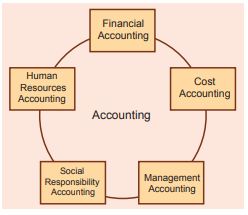
(i) Financial Accounting :
1. It involves recording of financial transactions and events.
2. It provides financial information to the users for taking decisions.
3. It ends up with the preparation of trading and profit and loss account and balance sheet,
(ii) Cost Accounting :
It involves the collection, recording, classification and appropriate allocation of expenditure for the determination of the costs of products or services and for the presentation of data for the purposes of cost control and managerial decision making.
(iii) Management Accounting :
It is concerned with the presentation of accounting information in such a way as to assist management in decision making and in the day-to-day operations of an enterprise.
(iv) Social Responsibility Accounting :
It is concerned with presentation of accounting information from the viewpoint of the society by showing the social costs and social benefits.
(v) Human Resource Accounting :
It is concerned with identification, quantification, and reporting of investments made in human resources of an enterprise.
36.
| Date | Receipts | L.F | Amount Rs. | Date | Payments | L.F | Amount Rs. |
| 2017 | 2017 | ||||||
| Apr.1 | To Pradeep's capital Alc | 27,000 | Apr.5 | By Purchases Alc | 6,000 | ||
| 10 | To Sales Alc | 11,000 | 13 | By BankA/c | 5,000 | ||
| 14 | To Sales Alc | 9,000 | 21 | By Stationery Alc | 200 | ||
| 29 | To Bank Alc | 4,000 | 25 | By Murugan Alc | 14,000 | ||
| 26 | By Commission A/c | 700 | |||||
| 30 | By Balance c/d | 25,100 | |||||
| 51,000 | 51,000 | ||||||
| May 1 | To Balance B/d | 25,100 |
37.
| Date | Particulars | L.F. | Debit Rs | Credit Rs | |
|---|---|---|---|---|---|
| Iriterest on capital A/c | Dr | xxxxxx | |||
| To Capital A/c | xxxxxx | ||||
| (Interest on capital due) |
| Date | Particulars | L.F. | Debit Rs | Credit Rs | |
|---|---|---|---|---|---|
| capital A/c | Dr | xxxxxx | |||
| To Interest on drawings A/c | xxxxxx | ||||
| (Interest on drawings) |
38.
| S.No. | Particulars | L.F. | Debit Rs | Credit Rs. | |
|---|---|---|---|---|---|
| (a) | Suspense A/c | Dr. | 250 | ||
| To Sales A/c | 250 | ||||
| (Being the uridercasting of sales book now rectified) | |||||
| (b) | Purchases A/c | Dr. | 120 | ||
| To Suspense A/c | 120 | ||||
| (Being the undercasting of Purchase book now rectified) | |||||
| (c) | Sales A/c | Dr. | 130 | ||
| To Suspense A/c | 130 | ||||
| (Being the overcasting the sales book now rectified) | |||||
| (d) | Bills receivable A/c | Dr. | 75 | ||
| To Suspense A/c | 75 | ||||
| (Being bills receivable book undercast, now rectified) | |||||
| (e) | Suspense A/c | Dr. | 35 | ||
| To Purchases A/c | 35 | ||||
| (Being Purchase book was overcast by Rs 35, now rectified) |
39.
Procedure
i) Open a new spreadsheet in MS-Excel
ii) Enter values in the cells as given below
| A | B | |
| 1 | Rate of interest (p.a.) | 10% |
| 2 | Number of instalments (nper) | 48 |
| 3 | Loan amount (pv) | -300000 |
| 4 | FV | 0 |
| 5 | Type | 0 |
iii) Compute PMT in the cell B6 by the formula
= PMT(B1/12,B2,B3,B4,B5)
= Rs.7,608.78
40.
(i) The balance sheet is a statement prepared for showing the financial position of the business summarising its assets and liabilities at a given date.
(ii) It is prepared at the end of the accounting period after the trading and profit and loss account have been prepared.
(iii) It is called a balance sheet because it is a statement of balances of ledger accounts which have not been closed even after the preparation of the trading and profit and loss account.
41.
| Date | Particulars | Inward Invoice No. | L.F. | Amount | |
| Details (Rs) | Total (Rs) | ||||
| 2017 May 10 | Raman | 15,000 | |||
| May 18 | Sekaran | 10,000 | |||
| May 20 | Pradeep | 20,000 | |||
| Purchases A/c Dr. | 45,000 | ||||
| Date | Particulars | Debit Note No. | L.F. | Amount | Remarks | |
| Details (Rs) | Total (Rs) | |||||
| 2014 May 14 | Raman | 500 | Damaged in transit | |||
| May 24 | Sekaran | 1,000 | ||||
| Purchases return A/c Cr. | 1,500 | |||||
42.
Debit balance : Cash, Furniture, Debtors, Purchases, Salaries paid, Computer
Credit balance : Creditors, Sales, Commission received, Capital
43.
Following are the principles of double entry system:
(i) In every business transaction, there are two aspects
(ii) The two aspects involved are the benefit or value receiving aspect and benefit or value giving aspect.
(iii) These two aspects involve minimum two accounts; at least one debit and at least one credit.
(iv) For every debit, there is a corresponding and equivalent credit. If one account is debited the other account must be credited.
44.
Process of Accounting cycle
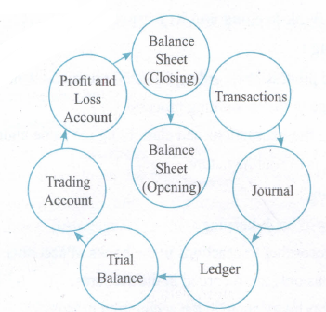
(i) When a businessman starts his business activities, he records the day-to-day transactions in the journal.
(ii) From the journal the transactions move further to the ledger where accounts are written up.
(iii) Preparation of trading and profit and loss account is the next step.
(iv) The balancing of profit and loss account gives the net result of the business transactions.
(v) Thus this cyclic movement of the transactions through the books of accounts (accounting cycle) is a continuous process.
45.
Normally entries in the cashbook should tally (agree) with those in the pass book and the balances shown by both the books should be the same. But in practice the balances may generally differ. In case of disagreement in the balance of the cash book and the pass book, on a particular date the need for preparing 'Bank Reconciliation Statement' arises. After tracing the various items of difference, the statement is prepared.
46.
Financial statements must show a true and fair view of the financial performance and position of the business. If depreciation is not provided, both fixed asset and profit, will be shown at inflated amounts .
47.
No, because there are several persons using of accounting systems:
1. Internal users \(\longrightarrow\) Owners, management
2. External users \(\longrightarrow\) Creditors, bankers
48.
Examples of Readymade software:
(i) TALLY
(ii) MS-EXCEL
49.
| Date | Particulars | L.F. | Debit Rs. |
Credit Rs. |
|
|---|---|---|---|---|---|
| 1.1.2016 | furniture A/c | Dr. | 6,000 | ||
| To Bank A/c | 6,000 | ||||
| (Furniture purchased) | |||||
| 31.12.2016 | Depreciation A/c | Dr. | 600 | ||
| To Furniture A/c | 600 | ||||
| (Annual depreciation) | |||||
| 31.12.2016 | Profit and loss A/c | Dr. | 600 | ||
| To Depreciation A/c | 600 | ||||
| (Depreciation transferred te profit and loss A/c) | |||||
| 31.12.2017 | Depreciation A/c | Dr. | 540 | ||
| To Furniture A/c | 540 | ||||
| (Annual depreciation) | |||||
| 31.12.2017 | Profit and loss A/c | Dr. | 540 | ||
| To Depreciation A/c | 540 | ||||
| (Depreciation transferred to profit and loss A/c) |
50.
(a) Rent was should be debited with Rs. 500.
(b) Wages paid should be credited with Rs. 250.
51.
i) It is a capital expenditure since it is incurred to acquire the right to carry on business.
ii) Cost of construction of building including cost of temporary huts is capital expenditure.
iii) It is a capital expenditure because overhaul expenses are incurred to put second-hand machinery in working condition to get long-term advantage.
52.
Value of trust is being violated by the accountant by passing a dummy entry and not even informing the seniors about it.
53.
(i) Accounting equation is a mathematical expression which shows that the total of assets is equal to the total of liabilities and capital.
(ii) This is based on the dual aspect concept of accounting.
(iii) This means that total claims of outsiders and the proprietor will always be equal to the total of assets of business enterprise.
Assets = Liabilities + Capital + Revenues - Expenses
54.
Journal Proper is a residuary book which contains record of transactions which do not find a place in the subsidiary books such as cash book, purchases book, sales book, purchases returns book, sales returns book, bills receivable book and bills payable book.

11th Standard Syllabus & Materials
11th Standard
TN 11th Tamil பீடு பெற நில் - செய்யுள் - காவடிச்சிந்து Important Questions And Answers Study Material - QB365 Set A
NEW11th Standard
TN 11th Tamil பீடு பெற நில் - உரைநடை - மலை இடப்பெயர்கள் : ஓர் ஆய்வு Important Questions And Answers Study Material - QB365 Set A
NEW11th Standard
TN 11th Tamil மாமழை போற்றுதும் - துணைப்பாடம் - யானை டாக்டர் Important Questions And Answers Study Material - QB365 Set A
NEW11th Standard
TN 11th Tamil மாமழை போற்றுதும் - செய்யுள் - ஐங்குறுநூறு Important Questions And Answers Study Material - QB365 Set A



Tamilnadu Stateboard 11th Standard Subjects

Maths

Commerce

Economics

Biology

Business Maths and Statistics
Accountancy

Computer Science

Physics

Chemistry
Maths
Biology
Economics
Physics
Chemistry

History
Business Maths and Statistics

Computer Science
Accountancy

Computer Applications
History
Computer Technology
Commerce
Computer Applications
Computer Technology

Tamil

English

French
Tamilnadu Stateboard Standards
