
 100% FREE ACCESS
11th Standard Syllabus & Materials
11th Standard
TN 11th Tamil இயற்கை வேளாண்மை,சுற்றுச்சூழல் -செய்யுள் - மனோன்மணீயம் Important Questions And Answers Study Material - QB365 Set A
NEW11th Standard
TN 11th Tamil என்னுயிர் என்பேன் -துணைப்பாடம் - இசைத்தமிழர் இருவர் Important Questions And Answers Study Material - QB365 Set A
NEW11th Standard
TN 11th Tamil மொழி கலை -செய்யுள் - ஒவ்வொரு புல்லையும் Important Questions And Answers Study Material - QB365 Set A
NEW11th Standard
TN 11th Tamil பீடு பெற நில் - இலக்கணம் - பகுபத உறுப்புகள் Important Questions And Answers Study Material - QB365 Set A
NEW11th Standard
TN 11th Tamil பீடு பெற நில் - துணைப்பாடம் - வாடிவாசல் Important Questions And Answers Study Material - QB365 Set A
NEW11th Standard
TN 11th Tamil பீடு பெற நில் - செய்யுள் - குறுந்தொகை Important Questions And Answers Study Material - QB365 Set A

Published on: 26/09/2019
Bio - Zoology - Excretion
Download Tamil Nadu 11th Standard Biology question papers, model tests, one-mark questions, important questions, and public exam papers in PDF format. Free study materials and answer keys for TN State Board students.
Questions + Answers key
Take MCQ Biology Test1.
What is kidney transplantation?
2.
Name the processes involved in urine formation.
3.
What is vasa recta?
4.
Name any four nitrogenous waste products produced by animals.
5.
Explain the heart’s role in secreting a hormone that regulates renal function? What hormone is this?
6.
Name the three main hormones that are involved in the regulation of the renal function?
7.
What is tubular secretion? Name the substances secreted through the renal tubules.
8.
Which vessels drain filtered blood from the kidneys?
9.
Differentiate cortical from medullary nephrons
10.
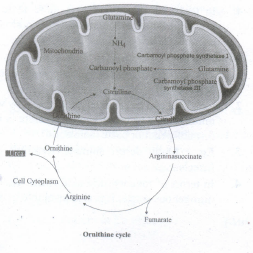
How is urea formed in the human body?
11.
Differentiate protonephridia from metanephridia
12.
13.
Which part of the autonomic nervous system is involved in micturition process?
14.
In which segment of the nephron most of the re-absorption of substances takes place?
15.
Name the three filtration barriers that solutes must come across as they move from plasma to the lumen of Bowman's capsule. What components of the blood are usually excluded by these layers?
16.
Identify the following structures and explain their significance in renal physiology?
(a) Juxtaglomerular apparatus
(b) Podocytes
(c) Sphincters in the bladder
17.
Differentiate acute and chronic Renal failure.
18.
Explain the structure of nephron.
19.
The glomerular hydrostatic pressure is estimated to be______________
60 mm/ Hg
55 mm / Hg
110 mm / Hg
75 mm / Hg
20.
Malpighian tubules remove excretory products from _____.
mouth
oesophagus
haemolymph
alimentary canal
21.
Kidney stones are produced due to deposition of uric acid and ______.
Silicates
Minerals
Calcium carbonate
Calcium oxalate
22.
Podocytes are the cells present on the ______.
Outer wall of Bowman's capsule
Inner wall of Bowman's capsule
Neck of nephron
Wall of glomerular capillaries
23.
The end product of Ornithine cycle is _____.
carbon dioxide
uric acid
urea
ammonia
24.
Concentration of urine depends upon which part of the nephron ______.
Bowman's capsule
Length of Henle's loop
P.C.T.
Network of capillaries arising from glomerulus
1.
It is the ultimate method for correction of a acute renal failures. This involves transfer of healthy kidney from one person (donor) to another person with kidney failure.
2.
Urine formation involves three main processes namely, glomerular filtration, tubular reabsorption and tubular secretion.
3.
The efferent arteriole serving the medullary nephron forms bundles of long straight vessel called vasa recta and runs parallel to the loop of Henle. Vasa recta is absent or reduced in cortical nephrons
4.
(a) Urea
(b) Uric acid
(c) Ammonia
(d) Creatinine
5.
Excessive stretch of cardiac atrial cells cause an increase in blood flow to the auricles of the heart and release ANF (Atrial natriuretic peptide or factor) which stimulates the increase Na+ excretion. Chemoreceptors like carotid bodies formed in the heart.
6.
Renin, aldosterone and ADH.
7.
Occurs in distal convoluted tubule of nephron potassium is excreted and sodium is absorbed.
8.
Venules, veins of renal vein comes out of hilum of kidneys.
9.
| Cortical nephrons | Medullary nephrons |
| Bowman's capsule malpighian capsule is present. | Tubular part of nephrons is present. |
| Glomerular filtration occurs. | Absorption, re-absorption and secretion occurs. |
10.
The nitrogenous waste formed as a result of breakdown of amino acids is converted to urea in the liver by the Ornithine cycle or urea cycle
11.
| S.N | Protonephridia | Metanephridia |
| 1. | Primitive | Advanced |
| 2. | Commonly found in primitive chordates (aquatic). | Commonly found in advanced terrestrial animals. |
| 3. | NH3 is the excretory product. | NH3 or urea may be the excretory product. |
| 4. | Originated /derived from invertebrates. |
Originated/ derived from primitive chordates. |
12.
13.
Sensory neurons of the parasympathetic autonomic nervous system.
14.
Henle's loop
15.
1. Podocytes end in foot processes found in the openings between the foot processes (Filtration slits).
2. Malpighian body/renal corpuscle.
3. Blood cells like RBCs, WBCs and platelets.
16.
(a) Some nephrons, have very long loop of Henle that run deep into the medulla are called juxtamedullary nephrons which aid in filtration from glomerulus.
(b) Podocytes are the filtration slits.
(c) Sphincters of urinary bladder are internal paired (involuntary) and external paired (Voluntary) control micturition.
17.
1. Renal failure are of two types, Acute, and Chronic renal failure
2. In acute renal failure the kidney stops its function abruptly, but there are chances for recovery of kidney functions.
3. In chronic renal failure there is, a progressive loss of function of the nephrons which gradually decreases the function of kidneys
18.
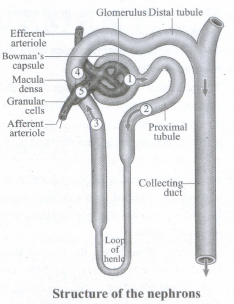
Nephrons
(i) Functional units of kidneys.
(ii) Consists of head as filtering malpighian body/capsule and a renal tubule.
(iii) Renal tube opens into a longer tubule called collecting duct.
(iv) Malpighian capsule is double walled.
(v) Capsule encloses a glomerulus formed of afferent and efferent arterioles.
(vi) Bowman's cup/capsule and glomerulus are together called as renal capsule.
(vii) The minute apertures called fenestrae are found in endothelium of glomerulus.
(viii) Peripheral layer of capsule is made up of squamous epithelium.
(ix) The visceral layer of capsule is made up of modified epithelial cells called podocytes.
(x) Podocytes end in foot process closer to basement membrane of the glomerulus.
(xi) Filtration slits lie between the foot processes.
(xii) The proximal convoluted tubule(PCT) starts from capsule.
(xiii) PCT is followed by 'U' shaped Henle's loop(HL) found with descending and ascending limbs.
(xiv) Ascending limb opens into distal convoluted tubule(DCT).
(xv) DCT of many nephrons open into a straight tube called collecting duct(CD).
(xvi) CD runs through the renal/medullary pyramids in the site of pelvis of ureter.
(xvii) CDs fuse to form papillary duct(PD).
(xviii) PD delivers urine into the calyces which finally open into pelvis.
(xix) PCT and DCT are found in an outer cortex of kidney.
(xx) HL is found in an inner medulla of kidney.
(xxi) Mostly nephrons of HL are very short and extend into cortical nephrons in peripheral area of medulla.
(xxii) Nephrons with a long loop of HL run deep into medulla and are called Juxta medullary nephrons(JMN).
(xxiii) The first capillary bed of the nephrons is the glomerulus and the other is the peritubular capillaries.
(xxiv) The glomerular capillary bed is supplied by the afferent drained by the efferent arterioles.
(xxv) A fine capillary network around the renal tubule forms peritubular capillaries.
(xxvi) The efferent arteriole serving the JMN forms the bundles of long straight vessel called vasa recta.
(xxvii) The vasa recta runs parallel to the HL.
(xxviii) Vasa recta is absent or reduced in cortical nephrons.
19.
(b)
55 mm / Hg
20.
(c)
haemolymph
21.
(d)
Calcium oxalate
22.
(b)
Inner wall of Bowman's capsule
23.
(c)
urea
24.
(b)
Length of Henle's loop

11th Standard Syllabus & Materials
11th Standard
TN 11th Tamil பீடு பெற நில் - செய்யுள் - காவடிச்சிந்து Important Questions And Answers Study Material - QB365 Set A
NEW11th Standard
TN 11th Tamil பீடு பெற நில் - உரைநடை - மலை இடப்பெயர்கள் : ஓர் ஆய்வு Important Questions And Answers Study Material - QB365 Set A
NEW11th Standard
TN 11th Tamil மாமழை போற்றுதும் - துணைப்பாடம் - யானை டாக்டர் Important Questions And Answers Study Material - QB365 Set A
NEW11th Standard
TN 11th Tamil மாமழை போற்றுதும் - செய்யுள் - ஐங்குறுநூறு Important Questions And Answers Study Material - QB365 Set A



Tamilnadu Stateboard 11th Standard Subjects

Maths

Commerce

Economics
Biology

Business Maths and Statistics

Accountancy

Computer Science

Physics

Chemistry
Maths
Biology
Economics
Physics
Chemistry

History
Business Maths and Statistics

Computer Science
Accountancy

Computer Applications
History
Computer Technology
Commerce
Computer Applications
Computer Technology

Tamil

English

French
Tamilnadu Stateboard Standards

