
 100% FREE ACCESS
11th Standard Syllabus & Materials
11th Standard
TN 11th Tamil இயற்கை வேளாண்மை,சுற்றுச்சூழல் -செய்யுள் - மனோன்மணீயம் Important Questions And Answers Study Material - QB365 Set A
NEW11th Standard
TN 11th Tamil என்னுயிர் என்பேன் -துணைப்பாடம் - இசைத்தமிழர் இருவர் Important Questions And Answers Study Material - QB365 Set A
NEW11th Standard
TN 11th Tamil மொழி கலை -செய்யுள் - ஒவ்வொரு புல்லையும் Important Questions And Answers Study Material - QB365 Set A
NEW11th Standard
TN 11th Tamil பீடு பெற நில் - இலக்கணம் - பகுபத உறுப்புகள் Important Questions And Answers Study Material - QB365 Set A
NEW11th Standard
TN 11th Tamil பீடு பெற நில் - துணைப்பாடம் - வாடிவாசல் Important Questions And Answers Study Material - QB365 Set A
NEW11th Standard
TN 11th Tamil பீடு பெற நில் - செய்யுள் - குறுந்தொகை Important Questions And Answers Study Material - QB365 Set A

Published on: 12/12/2019
Biomolecules
Download Tamil Nadu 11th Standard Biology question papers, model tests, one-mark questions, important questions, and public exam papers in PDF format. Free study materials and answer keys for TN State Board students.
Questions + Answers key
Take MCQ Biology Test1.
Compare DNA with RNA.
2.
How will you identify the presence of glucose in a given food sample.
3.
Enumerate the main differences between DNA and RNA.
4.
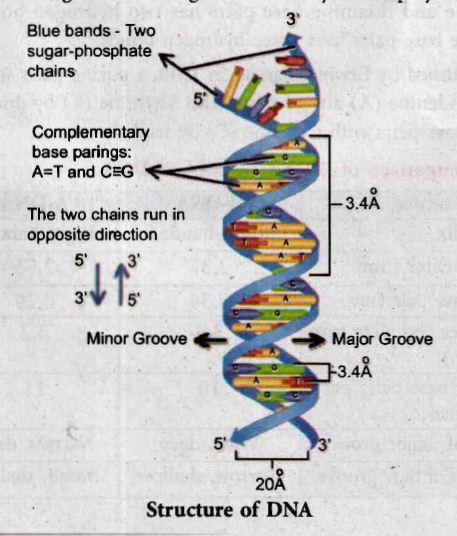
Write the characteristic features of DNA.
5.
Which are the structural units of DNA?
Nitrogen base
Pentose sugar
Nucleotide
Phosphoric acid
6.
Find out the mismatched pairs:
Protein - Important components of nucleus
Nucleic acid - Major components of chromosomes
Amino acid - An amphoteric compound
Enzymes - Colloidal catalysts
7.
The middle lamella is made up of ___________.
Muramic acid
Calcium pectate
Phosphoglycerol
Hemicellulose
8.
The activity of salivary amylase is increased in the presence _________ of ions.
Na
Cl
H2O
NH3
9.
Sanger first sequenced the protein called ____________.
Inulin
Glycine
Insulin
Peptidase
10.
How waxes are formed?
11.
What are the component percentage of the total cellular mass?
12.
Give a short note on tRNA.
13.
14.
15.
How will you identify the presence of protein in food samples?
16.
Why the sugar in DNA is a deoxyribose?
17.
Write a short note on Lock and Key Mechanism of Enzyme
18.
Mention the properties of water
19.
Differentiate between competitive and Allosteric
1.
| S.no | DNA | RNA |
| 1 | Deoxyribose sugar is present | Ribose sugar is present |
| 2 | Thymine is present | Uracil is present |
| 3 | More stable | Less stable |
| 4 | Double stranded | Single stranded |
| 5 | Types: A-DNA, B-DNA, Z-DNA | Type: mRNA, tRNA, rRNA |
| 6 | Genetic material for most of living organism except few viruses | Genetic material for few viruses only |
2.
Aldoses and ketoses are reducing sugars. This means that, when heated with an alkaline solution of copper (II) sulphate (a blue solution called benedict's solution), the aldehyde or ketone group reduces Cu2+ ions to Cu+ ions forming brick red precipitate of copper(I) oxide. In the process, the aldehyde or ketone group is oxidised to a carboxyl group (-COOH). This reaction is used as test for reducing sugar and is known as Benedict's test. The results of benedict's test depends on concentration ofthe sugar. If there is no reducing sugar it remains blue. Sucrose is not a reducing sugar The greater the concentration of reducing sugar, the more is the precipitate formed and greater is the colour change.
3.
| S.No | Deoxyribonucleic Acid (DNA) | Ribonucleic Acid (RNA) |
| 1 | Found in chromosomes of the nucleus. | Found in the cytoplasm, in nucleolus and Ribosomes |
| 2 | Double stranded structure. Two strands coiled spirally in opposite direction | Single-stranded polynucleotide chains. Strand in RNA coiled on itself and may be united by hydrogen bonds |
| 3 | The sugar is deoxyribose. | The sugar is ribose |
| 4 | Four nitrogenous bases in it are: 1) Adenine, 2) Guanine, 3) Cytosine, 4) Thymine. |
Four nitrogenous bases in it are: 1) Adenine, 2) Guanine, 3) Cytosine, 4) Uracil (i.e) In RNA, thymine is replaced by uracil. |
| 5 | Purines and pyrimidines occur in equal proportion. | Do not occur in equal proportion/ratio. |
| 6 | DNA is the hereditary material. | It takes part in protein synthesis |
| 7 | Base composition is A=T = G/C = 1. | Do not replicate like DNA. |
| 8 | Can replicate and makes its copy. | Cannot replicate, it is made from DNA. |
| 9 | Controls structure, metabolism, differentiation and inheritance | Helps in protein synthesis, functions as a messenger and translates message coded in DNA into protein. |
| 10 | Very long molecule, with very high molecular weight. | Relatively short molecule with low molecular weight |
| 11 | Genetic material in all prokaryotic and eukaryotic cells. | Genetic material only in some viruses |
| 12 | It is linear/circular. | It occurs in 3 different forms 1. mRNA, 2. tRNA, 3. rRNA. |
4.
Features of DNA:
1. If one strand runs in the 5'- 3' direction, the other runs in 3'- 5' direction and thus are antiparallel (they run in opposite direction). The 5' end has the phosphate group and 3' end has the OH group.
2. The angle at which the two sugars protrude from the base pairs is about 120°, for the narrow angle and 240° for the wide angle. The narrow-angle between the sugars generates a minor groove and the large angle on the other edge generates major groove.
3. Each base is 0.34 nm apart and a complete turn of the helix comprises 3.4 nm or 10 base pairs per turn in the predominant B form of DNA.
4. DNA helical structure has a diameter of 20 A° and a pitch of about 34 A°. X-ray crystal study of DNA takes a stack of about 10 bp to go completely around the helix (360°).
5. Thermodynamic stability of the helix and specificity of base pairing includes
(i) the hydrogen bonds between the complementary bases of the double helix
(ii) stacking interaction between bases tend to stack about each other perpendicular to the direction of helical axis. Electron cloud interactions ((Π – Π)) between the bases in the helical stacks contribute to the stability of the double helix.
6. The phosphodiester linkages give an inherent polarity to the DNA helix. They form strong covalent bonds, give the strength and stability to the polynucleotide chain.
7. Plectonemic coiling - The two strands of the DNA are wrapped around each other in a helix, making it impossible to simply move them apart without breaking the entire structure. Whereas in paranemic coiling the two strands simply lie alongside one another, making them easier to pull apart.
8. Based on the helix and the distance between each turn the DNA is of three forms - A DNA, B DNA and Z DNA.
5.
(c)
Nucleotide
6.
(d)
Enzymes - Colloidal catalysts
7.
(b)
Calcium pectate
8.
(b)
Cl
9.
(c)
Insulin
10.
Waxes are esters formed between a long chain alcohol and saturated fatty acids.
11.
| Component | % of the total cellular mass |
|---|---|
| Water | 70 |
| Proteins | 15 |
| Carbohydrates | 3 |
| Lipids | 2 |
| Nucleic acids | 6 |
| Ions | 4 |
12.
tRNA (transfer RNA): Translates the code from mRNA and transfers amino acids to the ribosome to build proteins. It is highly folded into an elaborate 3D structure and comprises about 15% of total RNA. It is also called as soluble RNA.
13.
14.
15.
The biuret test is used as an indicator of the presence of protein because it gives a purple colour in the presence of peptide bonds (-C- N-). To a protein solution an equal quantity of sodium hydroxide solution is added and mixed. Then a few drops of 0.5% copper (II) sulphate is added with gentle mixing. A distinct purple colour develops without heating.
16.
The sugar in DNA molecule is called 2' - deoxyribose because there is no hydroxyl group at 2' position.
17.
In a enzyme catalysed reaction, the starting substance is the substrate. It is converted to the product. The substrate binds to the specially formed pocket in the enzyme - the active site, this is called lock and key mechanism of enzyme action. As the enzyme and substrate form a ES complex, the substrate is raised in energy to a transition state and then breaks down into products plus unchanged enzyme
18.
1. Adhesion and cohesion property.
2. High latent heat of vaporisation.
3. High melting and boiling point.
4. Universal solvent
19.
| S.No | Competitive Inhibitor | Allosteric inhibitor |
|---|---|---|
| 1 | Binds with active site | Binds with some other site except active site |
| 2 | Inhibitor shows very close resemblance to the substrate in structural organisation. | Inhibitor shows no resemblance to the substrate. |
| 3 | An inhibitor is not a product of metabolic pathway. | An inhibitor is a product or intermediate of metabolic pathway |
| 4 | Eg: Malonate is competitive Inhibitor for succinic dehydrogenase. | Eg: Glucose hexokinase glucose\(\rightarrow \) 6, phosphate hexokinase enzyme is inhibited by glucose 6 phosphate. |

11th Standard Syllabus & Materials
11th Standard
TN 11th Tamil பீடு பெற நில் - செய்யுள் - காவடிச்சிந்து Important Questions And Answers Study Material - QB365 Set A
NEW11th Standard
TN 11th Tamil பீடு பெற நில் - உரைநடை - மலை இடப்பெயர்கள் : ஓர் ஆய்வு Important Questions And Answers Study Material - QB365 Set A
NEW11th Standard
TN 11th Tamil மாமழை போற்றுதும் - துணைப்பாடம் - யானை டாக்டர் Important Questions And Answers Study Material - QB365 Set A
NEW11th Standard
TN 11th Tamil மாமழை போற்றுதும் - செய்யுள் - ஐங்குறுநூறு Important Questions And Answers Study Material - QB365 Set A



Tamilnadu Stateboard 11th Standard Subjects

Maths

Commerce

Economics
Biology

Business Maths and Statistics

Accountancy

Computer Science

Physics

Chemistry
Maths
Biology
Economics
Physics
Chemistry

History
Business Maths and Statistics

Computer Science
Accountancy

Computer Applications
History
Computer Technology
Commerce
Computer Applications
Computer Technology

Tamil

English

French
Tamilnadu Stateboard Standards

