
 100% FREE ACCESS
11th Standard Syllabus & Materials
11th Standard
TN 11th Tamil இயற்கை வேளாண்மை,சுற்றுச்சூழல் -செய்யுள் - மனோன்மணீயம் Important Questions And Answers Study Material - QB365 Set A
NEW11th Standard
TN 11th Tamil என்னுயிர் என்பேன் -துணைப்பாடம் - இசைத்தமிழர் இருவர் Important Questions And Answers Study Material - QB365 Set A
NEW11th Standard
TN 11th Tamil மொழி கலை -செய்யுள் - ஒவ்வொரு புல்லையும் Important Questions And Answers Study Material - QB365 Set A
NEW11th Standard
TN 11th Tamil பீடு பெற நில் - இலக்கணம் - பகுபத உறுப்புகள் Important Questions And Answers Study Material - QB365 Set A
NEW11th Standard
TN 11th Tamil பீடு பெற நில் - துணைப்பாடம் - வாடிவாசல் Important Questions And Answers Study Material - QB365 Set A
NEW11th Standard
TN 11th Tamil பீடு பெற நில் - செய்யுள் - குறுந்தொகை Important Questions And Answers Study Material - QB365 Set A

Published on: 19/10/2019
Bio - Botany - Mineral Nutrition
Download Tamil Nadu 11th Standard Biology question papers, model tests, one-mark questions, important questions, and public exam papers in PDF format. Free study materials and answer keys for TN State Board students.
Questions + Answers key
Take MCQ Biology Test1.
Name two immobile elements found in plants.
2.
Explain 'Mineral toxicity'.
3.
What are siderophores?
4.
What are chelating agents?
5.
What are NPK fertilizers?
6.
The nitrogen is present in the atmosphere in huge amount but higher plants fail to utilize it. Why?
7.
8.
List the criteria for essential minerals.
9.
Write the role of nitrogenase enzyme in nitrogen fixation?
10.
Write a note on Nitrogen metabolism.
11.
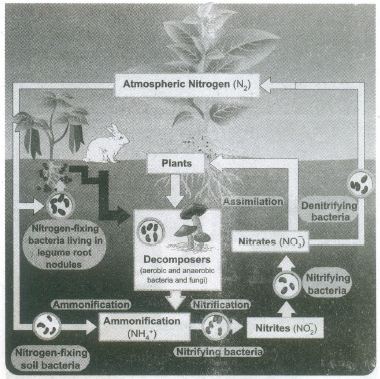
Explain the stages involved in nitrogen cycle.
12.
13.
A plant which is being researched as cleaning agent for polluted waters ________
Pongamia
Withania
Lemon
Moringa
14.
The macro nutrient which is an essential component of all organic compounds yet not obtained by plants from soil is _________
Nitrogen
Carbon
Phosphorous
Magnesium
15.
Minerals that play an important role for activation of enzymes involved in respiration.
Sulphur and Calcium
Calcium and Potassium
Nitrogen and Molybdenum
Magnesium and Manganese
16.
Plants deficient of element zinc, shows its effect on the biosynthesis of plant growth hormone _________
Auxin
Cytokinin
Ethylene
Abscisic acid
17.
Leghaemoglobin is ________
Oxygen scavenger in BGA
Oxygen, scavenger in Rhizobium
Oxygen scavenger in legume
scavenger in all nitrogen fixers
18.
Which chelating agent found in soil are produced by bacteria?
Siderophores
EDTA
Auxin
Leghaemoglobip
1.
Calcium and sulphur.
2.
Increase of mineral nutrients more than the normal concentration causes toxicity. A concentration, at which 10% of the dry weight of tissue is reduced, is considered as toxic.
3.
Biological chelating agents produced by bacteria are called siderophores. They are iron chelating agents which chelate Ferric iron from environment and host.
4.
Plants grown in alkaline soil when supplied with all nutrients will show Iron deficiency. This can be rectified by making Iron into a soluble complex I by adding a chelating agent like EDTA (Ethylene Diamine Tetra Acetic acid) to form Fe-EDTA.
5.
Fertilizers containing Nitrogen, Phosphate with Potassium in different proportions are called NPK fertilizers.
6.
(i) Yes. Nitrogen cannot be directly absorbed by plants but they are essential for normal growth and functioning of a plant. Hence they are fixed by bacteria and some fungi.
(ii) It can be utilised only in the form of nitrates (NO3-) and nitrites (NO2-).
7.
8.
Amon and Stout gave criteria required for essential minerals:
1. Elements necessary for growthand development.
2. They should have direct role in the metabolism of the plant.
3. It cannot be replaced by other elements.
9.
(i) Nitrogen fixation process requires Nitrogenase enzyme complex, Minerals (Mo, Fe and S), anaerobic condition, ATP, electron and glucose 6 phosphate as H+ donor.
(ii) Nitrogenase enzyme is active only in anaerobic condition.
(iii) To create this anaerobic condition a pigment known as leghaemoglobin is synthesized in the nodules which acts as oxygen scavenger and removes the oxygen.
10.
Ammonia Assimilation :
Ammonia is converted into amino acids by the following processes:
1. Reductive amination :
Glutamic acid or glutamate is formed by reaction of ammonia with a ketoglutaric acid.

2. Transamination: Transfer of amino group (NH3+) from glutamic acid to keto group of keto acid. Glutamic acid is the main amino acid from which other amino acids are synthesised by transamination. Transamination requires the enzyme transaminase and co enzyme pyridoxal phosphate (derivative of vitamin B6 -pyridoxine)
3. Catalytic Amination:(GS/GOGAT Pathway) Glutamate amino acid combines with ammonia to form the amide glutamine.

Glutamine reacts with \(\alpha\) ketoglutaric acid to form two molecules of glutamate.

(GOGAT - Glutamine - 2 Oxoglutarate aminotransferase)
11.
Nitrogen cycle and nitrogen metabolism
I. Nitrogen cycle : This cycle consists of following stages:
Nitrogen Fixation :
(i) Di-nitrogen molecule from the atmosphere progressively gets reduced by addition of a pair of hydrogen atoms to form Ammonia.
(ii) Nitrogen fixation process requires Nitrogenase enzyme complex, Minerals (Mo, Fe and S), Anaerobic condition, ATP, e- and H+ donor glucose 6 phosphate.
(iii) Nitrogenase enzyme is active only in anaerobic condition. To create this anaerobic condition a pigment known as leghaemoglobin is synthesized in the nodules which acts as oxygen scavenger and removes the oxygen.
(iv) Nitrogen fixing bacteria in root nodules appears pinkish due to the presence of this leghaemoglobin pigment.
Overall equation:
N2 + 8e-+ 8H + 16ATP \(\rightarrow\) 2NH3+H2+16ADP+16 Pi
2. Nitrification :
(NH3+) Ammonia is converted into Nitrite
(NO2-) by Nitrosomonas bacterium. Nitrite
(NO2-)is then converted into Nitrate (NO3-) by Nitrobacter bacterium
2 NH3+ + 3O2 \(\overset { Nitrosomonas }{ \longrightarrow } \) 2 NO2- + 2H+ + 2H2 O
2 NO2- + O2 \(\overset { Nitrobacter }{ \longrightarrow } \)2 NO3-
3. Nitrate Assimilation :
The process by which nitrate is reduced to ammonia is called nitrate assimilation and occurs during nitrogen cycle.
NO3- \(\overset { Nitrate\ reductase }{ \underset { Mo }{ \longrightarrow } } \)NO2-
NO2- \(\overset { Nitrate\ reductase }{ \underset { Mo }{ \longrightarrow } } \) NH3+
4. Ammonification :
Decomposition of organic nitrogen from dead plants and animals into ammonia is called ammonification. organisms involved in this process are Bacillus ramosus and Bacillus vulgaris.
5. Denitrification:
Nitrates in the soil are converted back into atmospheric nitrogen by a process called denitrification. Bacteria involved in this process are Pseudomonas; Thiobacillus and Bacillus subtilis.
Nitrate \(\overset { Pseudomonas }{ \longrightarrow } \) Molecular Nitrogen
(NO3-) (N2)
12.
13.
(b)
Withania
14.
(b)
Carbon
15.
(d)
Magnesium and Manganese
16.
(a)
Auxin
17.
(c)
Oxygen scavenger in legume
18.
(a)
Siderophores

11th Standard Syllabus & Materials
11th Standard
TN 11th Tamil பீடு பெற நில் - செய்யுள் - காவடிச்சிந்து Important Questions And Answers Study Material - QB365 Set A
NEW11th Standard
TN 11th Tamil பீடு பெற நில் - உரைநடை - மலை இடப்பெயர்கள் : ஓர் ஆய்வு Important Questions And Answers Study Material - QB365 Set A
NEW11th Standard
TN 11th Tamil மாமழை போற்றுதும் - துணைப்பாடம் - யானை டாக்டர் Important Questions And Answers Study Material - QB365 Set A
NEW11th Standard
TN 11th Tamil மாமழை போற்றுதும் - செய்யுள் - ஐங்குறுநூறு Important Questions And Answers Study Material - QB365 Set A



Tamilnadu Stateboard 11th Standard Subjects

Maths

Commerce

Economics
Biology

Business Maths and Statistics

Accountancy

Computer Science

Physics

Chemistry
Maths
Biology
Economics
Physics
Chemistry

History
Business Maths and Statistics

Computer Science
Accountancy

Computer Applications
History
Computer Technology
Commerce
Computer Applications
Computer Technology

Tamil

English

French
Tamilnadu Stateboard Standards

