
 100% FREE ACCESS
11th Standard Syllabus & Materials
11th Standard
TN 11th Tamil இயற்கை வேளாண்மை,சுற்றுச்சூழல் -செய்யுள் - மனோன்மணீயம் Important Questions And Answers Study Material - QB365 Set A
NEW11th Standard
TN 11th Tamil என்னுயிர் என்பேன் -துணைப்பாடம் - இசைத்தமிழர் இருவர் Important Questions And Answers Study Material - QB365 Set A
NEW11th Standard
TN 11th Tamil மொழி கலை -செய்யுள் - ஒவ்வொரு புல்லையும் Important Questions And Answers Study Material - QB365 Set A
NEW11th Standard
TN 11th Tamil பீடு பெற நில் - இலக்கணம் - பகுபத உறுப்புகள் Important Questions And Answers Study Material - QB365 Set A
NEW11th Standard
TN 11th Tamil பீடு பெற நில் - துணைப்பாடம் - வாடிவாசல் Important Questions And Answers Study Material - QB365 Set A
NEW11th Standard
TN 11th Tamil பீடு பெற நில் - செய்யுள் - குறுந்தொகை Important Questions And Answers Study Material - QB365 Set A

Published on: 12/12/2019
Cell Cycle
Download Tamil Nadu 11th Standard Biology question papers, model tests, one-mark questions, important questions, and public exam papers in PDF format. Free study materials and answer keys for TN State Board students.
Questions + Answers key
Take MCQ Biology Test1.
Mention the two types of nuclear division. Write a short note on them.
2.
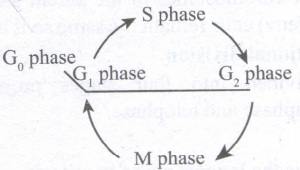
Which is the stage where mitosis takes place?
3.
What are the factors controlling cell division?
4.
Given an account of G0 phase.
5.
Differentiate between mitosis and meiosis.
6.
Significance of meiosis is associated with :
DNA duplication
Asexual reproduction
Sexual reproduction
Growth of the body
7.
The separation of two chromatids of each chromosome during early anaphase is initiated by:
The interaction of centromere with the chromosomal fibres
The elongation of spindle
Attachment of spindle fibres with Kinetochore
All the above
8.
What is synthesized during G2 - phase?
Protein
Microtubules
RNA
(a) and (b)
9.
The period between two successive cell divisions is called
Duplication
Growth phase
Cell cycle
Interphase
10.
Polytene Chromosomes are formed by ______
Mitosis
Endomitosis
Endoreduplication
Meiosis
11.
Distinguish between Anastral &Amphiastral.
12.
What is the role of MPF in Cell cycle?
13.
What is Cell Cycle?
14.
Who coined the word "Cell" and "protoplasm"?
15.
Imagine a situation if there was no meiosis. Then what would have happened to the next generation?
16.
List out the important features of Chromosomes.
17.
Explain the various phases in Cell Cycle.
18.
Significance of Mitosis
19.
Describe the process of Mitosis cell division.
1.
1. There are two types of nuclear division, as mitosis and meiosis.
2. In mitosis, the daughter cells formed will have the same number of chromosomes as the parent cell, typically diploid (2n) state. Mitosis is the nuclear division that occurs when cells grow or when cells need to be replaced and when organism reproduces asexually.
3. In meiosis, the daughter cells contain half the number of chromosomes of the parent cell and is known as haploid state (n).Whichever division takes place, it is normally followed by division of the cytoplasm to form separate cells, called as cytokinesis.
2.
M phase
3.
1. Cell size:
Cells capable of division growth attain a particular size and then undergo division.
2. Karyoplasmic ratio:
Rise in cell volume disturbs karyoplasmic ratio. It stimulates the cell to divide.
3. Mitogens:
Mitogens are agents, factors or substances that trigger cell division.
4.
(i) Some cells exit G1 and enter a quiescent stage called G0, where the cell remain metabolically active without proliferation.
(ii) Cells can exist for long periods in G0 phase. In G0 cells cease growth with reduced rate of RNA and protein synthesis.
(iii) The G0 phase is not permanent. Mature neuron and skeletal muscle cell remain permanently in G0.
(iv) Many cells in animals remain in G0 unless called on to proliferate by appropriate growth factors or other extracellular signals. G0 cells are not dormant.
5.
Difference between Mitosis and Meiosis:
| S.No | Mitosis | Meiosis |
| 1. | One division | Two divisions |
| 2. | Number of Chromosomes remains the same | Number of Chromosomes is halved |
| 3. | Homologous Chromosomes line up separately on the metaphase plate | Homologous Chromosomes line up in pairs at the metaphase plate |
| 4. | Homologous Chromosome do not pair up | Homologous Chromosome pair up to form bivalents |
| 5. | Chiasmata do not form and crossing over never occurs | Chiasmata form and crossing over occurs |
| 6. | Daughter cells are genetically identical | Daughter cells are genetically different from the parent cells |
| 7. | Two daughter cells are formed | Four daughter cells are formed |
6.
(c)
Sexual reproduction
7.
(c)
Attachment of spindle fibres with Kinetochore
8.
(d)
(a) and (b)
9.
(d)
Interphase
10.
(c)
Endoreduplication
11.
| S.No. | Anastral | Amphiastral |
| (a) | This is present only in plant cells. | This is found in animal cells. |
| (b) | No asters or centrioles are formed only spindle fibres are formed during cell division. | Aster and centrioles are formed at each pole of the spindle during cell division. |
12.
Maturation Promoting Factor (MPF) brings about condensation of interphase chromosomes into the mitotic form.
13.
A series of events leading to the formation of new cell is known as cell cycle. The phenomenonal changes leading to formation of new population take place in the cell cycle. It was discovered by Prevost and Duman.(1824)
14.
Robert Hooke, Jan Evangelista purkyne (J.E.Purkinje)
15.
1. In the absence of meiosis the next generation would have double the number of chromosomes after fusion of gametes.
2. This would have resulted in the birth of an altogether new species or produce abnormal offspring.
3. The maintenance of characters set would have been possible only through asexual reproduction.
16.
The four important features of the chromosome are:
The shape of the chromosome is specific: The long, thin, lengthy structured chromosome contains a short, constricted region called centromere. A centromere may occur any where along the chromosome, but it is always in the same position -on any given chromosome. The number of chromosomes perspecies is fixed: For example the mouse has 40 chromosomes, the onion has 16 and humans have 46.
Chromosomes occur in pairs: The chromosomes of a cell occur in pairs, called homologous pairs. One of each pair come originally from each parent. Example, human has 46 chromosomes, 23 coming originally from each parent in the process of sexual reproduction. Chromosomes are copied: Between nuclear divisions, whilst the chromosomes are uncoiled and cannot be seen, each chromosome is copied. The two identical structures formed are called chromatids.
17.
The different phases of cell cycle are as follows:
Interphase: Longest part of the cell cycle, but it is of extremely variable length. At first glance the nucleus appears to be resting but this is not the case at all. The chromosomes previously visible as thread like structure, have dispersed. Now they are actively involved in protein synthesis, at least for most of the interphase.
C-Value is the amount in picograms of DNA contained within a haploid nucleus.
G1 Phase: The first gap phase - 2C amount of DNA in cells of G0: The cells become metabolically active and grows by producing proteins, lipids, carbohydrates and cell organelles including mitochondria and endoplasmic reticulum. Many checkpoints control the cell cycle. The checkpoint called the restriction point at the end of Gp it determines a cells fate whether it will continue in the cell cycle and divide or enter a stage called G0 as a quiescent stage and probably as specified cell or die. Cells are arrested in G1 due to:
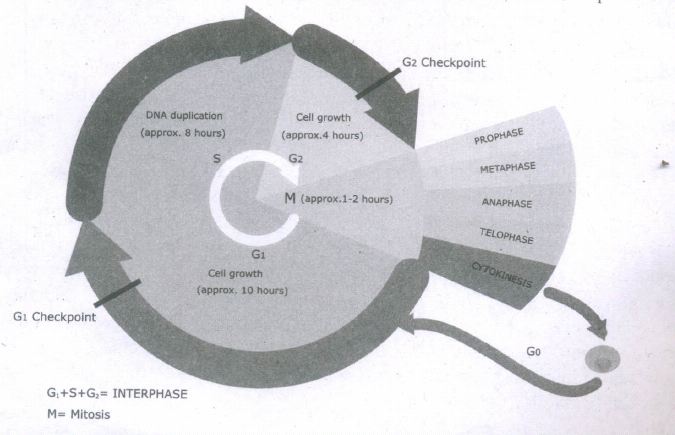
Nutrient deprivation: Lack of growth factors or density dependant inhibition. Undergo metabolic changes and enter into G0 state.
Biochemicals inside cells activates the cell division. The proteins called kinases and cyclins activate genes and their proteins to perform cell division.
Cyclins act as major checkpoint which operates in G1 to determine whether or not a cell divides.
G0 Phase: Some cells exit G1 and enters a quiescent stage called G0, where the cells remain metabolically active without proliferation. Cells can exist for long periods in G0 phase. In G0 cells cease growth with reduced rate of RNA and protein synthesis. The G0 phase is not permanent. Mature neuron and skeletal muscle cell remain permanently in G0.many cells in animals remains in G0 unless called on to. proliferate by appropriate growth factors or other extracellular signals. G0 cells are not dormant.
S phase - Synthesis phase - cells with intermediate amounts of DNA. Growth of the cell continues as replication of DNA occur, protein molecules called histones are synthesised and attach to the DNA. The centrioles duplicate in the cytoplasm. DNA content increases from 2C to 4C.
G2 - The second Gap phase - 4C amount of DNA in cells of G2 and mitosis. Cell growth continues by protein and cell organelle synthesis, mitochondria and chloroplasts divide. DNA content remains as 4C. Tubulin is synthesised and microtubules are formed. Microtubles organise to form spindle fibre. The spindle begins to form and nuclear division follows.
One of the proteins synthesized only In the G2 period is known as Maturation Promoting Factor (MPF). It brings about condensation of interphase chromosomes into the mitotic form. DNA damage checkpoints operates in GIS and G2 phases of the cell cycle.
18.
Exact copy of the parent cell is produced by mitosis (genetically identical).
1. Genetic stability - daughter cells are genetically identical to parent cells.
2. Growth - as multicellular organisms grow, the number of cells making up their tissue increases. The new cells must be identical to the existing ones.
3. Repair of tissues - damaged cells must be replaced by identical new cells by mitosis.
4. Asexual reproduction - asexual reproduction results in offspring that are identical to the parent. Example Yeast and Amoeba.
5. In flowering plants, structure such as bulbs, corms, tubers, rhizomes and runners are produced by mitotic division. When they separate from the parent, they form a new individual.
6. The production of large numbers of offsprings in a short period of time, is possible only by mitosis. In genetic engineering and biotechnology, tissues are grown by mitosis (i.e. in tissue culture).
7. Regeneration - Arms of star fish.
19.
Mitosis is divided into four stages prophase, metaphase, anaphase and telophase.
Prophase
Prophase is the longest phase in mitosis. Chromosomes. become visible as long thin thread like structure, condenses to form compact mitotic chromosomes. In plant: cells initiation of spindle fibres takes place, nucleolus disappears. Nuclear envelope breaks down. Golgi apparatus and endoplasmic reticulum are not seen.
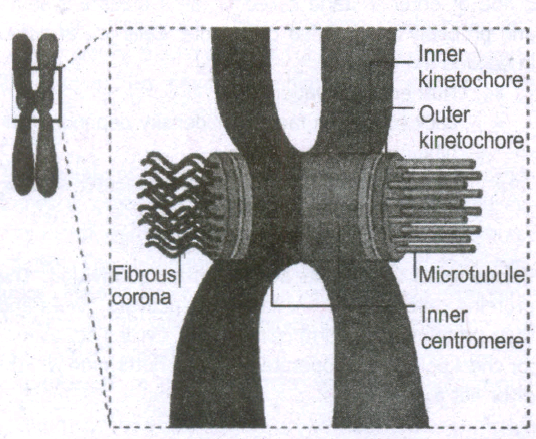
In animal cell the centrioles extend a radial array of rnicrotubules (Figure 7.4) towards the plasma membrane when they reach the poles of the cell. This arrangement of micrdtubules is called an aster. Plant cells do not form asters.
Metaphase
Chromosomes (two sister chromatids) are attached to the spindle ·fibres by- kinetochore of the centromere. The spindle fibres is made up of tubulin. The alignment of chromosome into compact group at the equator of the cell is known as metaphase plate. This is the stage where the chromosome morphology can be easily studied. Kinetochore is a DNA-Protein complex present in the centromere DNAwhere the microtubules are attached. It is a trilaminar disc like plate. The spindle assembly checkpoint which decides the cell to enter anaphase
Anaphase
Each chromosome split simultaneously and two daughter chromatids begins to migrate towards two opposite poles of a cell. Each centromere splits longitudinally into two, freeing the two sister chromatids from each other. Shortening of spindle fi bre and longitudinal splitting of centromere creates a pull which divides chromosome into two halves. Eachhalf receive two chromatids (that is sister chromatids are separated). When the sister chromatids separate the actual partitioning of the replicated genome is complete. A ubiquitine ligase is activated called as the napha e-promotlng complex cyclosome (APC/C) leads to degradation of the key regulatory proteins at the transition of metaphase to anaphase. APC is a cluster of proteins that induces the breaking down of cohesion proteins which leads to the separation of chromatids during mitosis (Figure 7.5).
.png)
Telophase
Two sets of daughter chromosomes reach opposite poles of the cell, mitotic spindle disappears. Division of genetic material is com leted after this karyokinesis cytokinesis (division of cytoplasm) is completed, nucleolus and nuclear membranes reforms. Nuclear membranes form around each set of sister chromatids now called chromosomes, each has its own centromere. Now the chromosomes decondense. In plants, phragmoplast are formed between the daughter cells. Cell plate is formed between the two daughter cells, reconstruction of'cell wall takes place. Finally the cells are separated by the distribution of organelles, macromolecules into two newly formed daughter cells.

11th Standard Syllabus & Materials
11th Standard
TN 11th Tamil பீடு பெற நில் - செய்யுள் - காவடிச்சிந்து Important Questions And Answers Study Material - QB365 Set A
NEW11th Standard
TN 11th Tamil பீடு பெற நில் - உரைநடை - மலை இடப்பெயர்கள் : ஓர் ஆய்வு Important Questions And Answers Study Material - QB365 Set A
NEW11th Standard
TN 11th Tamil மாமழை போற்றுதும் - துணைப்பாடம் - யானை டாக்டர் Important Questions And Answers Study Material - QB365 Set A
NEW11th Standard
TN 11th Tamil மாமழை போற்றுதும் - செய்யுள் - ஐங்குறுநூறு Important Questions And Answers Study Material - QB365 Set A



Tamilnadu Stateboard 11th Standard Subjects

Maths

Commerce

Economics
Biology

Business Maths and Statistics

Accountancy

Computer Science

Physics

Chemistry
Maths
Biology
Economics
Physics
Chemistry

History
Business Maths and Statistics

Computer Science
Accountancy

Computer Applications
History
Computer Technology
Commerce
Computer Applications
Computer Technology

Tamil

English

French
Tamilnadu Stateboard Standards

