
 100% FREE ACCESS
11th Standard Syllabus & Materials
11th Standard
TN 11th Tamil இயற்கை வேளாண்மை,சுற்றுச்சூழல் -செய்யுள் - மனோன்மணீயம் Important Questions And Answers Study Material - QB365 Set A
NEW11th Standard
TN 11th Tamil என்னுயிர் என்பேன் -துணைப்பாடம் - இசைத்தமிழர் இருவர் Important Questions And Answers Study Material - QB365 Set A
NEW11th Standard
TN 11th Tamil மொழி கலை -செய்யுள் - ஒவ்வொரு புல்லையும் Important Questions And Answers Study Material - QB365 Set A
NEW11th Standard
TN 11th Tamil பீடு பெற நில் - இலக்கணம் - பகுபத உறுப்புகள் Important Questions And Answers Study Material - QB365 Set A
NEW11th Standard
TN 11th Tamil பீடு பெற நில் - துணைப்பாடம் - வாடிவாசல் Important Questions And Answers Study Material - QB365 Set A
NEW11th Standard
TN 11th Tamil பீடு பெற நில் - செய்யுள் - குறுந்தொகை Important Questions And Answers Study Material - QB365 Set A

Published on: 12/12/2019
Cell The Unit of Life
Download Tamil Nadu 11th Standard Biology question papers, model tests, one-mark questions, important questions, and public exam papers in PDF format. Free study materials and answer keys for TN State Board students.
Questions + Answers key
Take MCQ Biology Test1.
What are the types of mounting involved in the preparation of slides?
2.
Describe the Special types of Chromosomes
3.
Draw the ultrastructure of plant cell.
4.
5.
It possess Flagella __________
Paramecium
Yeast
Amoeba
Euglena
6.
Who proposed the cell theory_________.
Singer and Nicolson
Schwann and Schleiden
Hook and Brown
Robertson
7.
Digestion of cell organelles by the cell is called _____
Phagocytosis
Pinocytosis
Autophagy
Autolysis
8.
Choose the group that belongs to Mesokaryotes.
Dinoflagellates and Protozoa
Fungi and Plants
Bacteria and Archaebacteria
Algae and Fungi
9.
The term protoplasm was coined by______.
A Purkinje
Mohl
Schultze
Felix
10.
How mitochondria helps in evolutionary studies?
11.
What is Chromomeres?
12.
Explain primary cell wall.
13.
What is Holocentric Chromosomes?
14.
What is a Telomere?
15.
Diffentiate between Endocytosis and Exocytosis.
16.
What are the Inclusions in prokaryotes
17.
Write a short note on Bright field Microscope
18.
Give a general account about the discoveries of the scientists.
19.
List out some Common stains used in Histochemistry.
1.
Preparation of Slides:
There are different types of mounting based on the portion of a specimen to be observed.
1. Whole mount: The whole organism or smaller structure is mounted over a slide and observed.
2. Squash: Is a preparation where the material to be observed is crushed/squashed onto a slide so as to reveal its contents. Eg: Pollen grains, mitosis and meiosis in root tips and flower buds to observe Chromosomes.
3. Smears: Here the specimens in fluid (blood, microbial cultures etc.,) are scraped, brushed or aspirated from the surface of an organ. Eg: Epithelial cells.
4. Sections: Free hand sections from a specimen and thin sections are selected, stained and mounted on a slide. Eg: Leaf and stem of plants.
2.
Special types of Chromosomes:
1. Special types of Chromosomes are found only in certain special tissues. These Chromosomes are larger in size and are called giant Chromosomes in certain plants and they are found in the suspensors of the embryo.
2. The Polytene Chromosome and Lampbrush Chromosome occur in animals and are also called as Giant Chromosomes.
Polytene Chromosomes:
1. It is observed in the salivary glands of Drosophila (fruit fly) by C.G. Balbiani in 1881. In larvae of many flies, and some insects the interphase Chromosomes duplicates and reduplicates without nuclear division.
2. A single Chromosome which is present in multiple copies forms a structure called Polytene Chromosome which can be seen in light microscope.
3. They are genetically active. There are distinct alternating dark bands and light inter-bands. About 95% of DNA is present in bands and 5% in inter-bands.
4. The polytene Chromosome has extremely large puff called Balbiani rings which is seen in Chironomus larvae. It is also known as chromosomal puff. Puffing of bands is the sites of intense RNA synthesis.
5. As this Chromosome occurs in the salivary gland it is known as salivary gland Chromosomes. Polyteny is achieved by repeated replication of chromosomal DNA several times (endomitosis).
6. Gene expression, transcription of genes and RNA synthesis occurs in the bands along the Polytene Chromosomes.
Lampbrush Chromosomes:
1. It occurs at the diplotene stage of first meiotic prophase in oocytes of an animal Salamander and in giant nucleus of the unicellular alga Acetabularia.
2. It was first observed by Flemming in 1882. The highly condensed Chromosome forms the chromosomal axis, from which lateral loops of DNA extend as a result of intense RNA synthesis.
3.
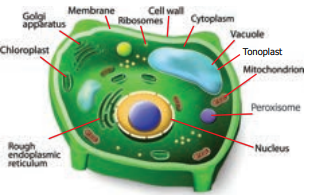
Ultrastructure of Plant Cell
4.
5.
(d)
Euglena
6.
(b)
Schwann and Schleiden
7.
(c)
Autophagy
8.
(c)
Bacteria and Archaebacteria
9.
(a)
A Purkinje
10.
Mitochondrial DNA is used to track and date recent evolutionary time because it mutates 5 to 10 time faster than DNA in the nucleus.
11.
Chromomeres are bead like accumulations of chromatin material which are visible along interphase chromosomes. They can be seen in polytene chromosomes. At metaphase they are not visible.
12.
It is the first layer inner to middle lamellae, primarily consisting of loose network of cellulose microfibrils in a gel matrix. It is thin, elastic and extensible.
13.
1. Holocentric Chromosomes have centromere activity distributed along the whole surface of the Chromosome during mitosis.
2. Holocentric condition can be seen in Caenorhabditis elegans (transparent nematode) and many insects.
14.
1. Telomere is the terminal part of Chromosome.
2. It offers stability to the Chromosome.
15.
Endocytosis:
During endocytosis the cell wraps the cell surface membrane around the material and brings it into cytoplasm inside a vesicle. There are two types of endocytosis:
1. Phagocytosis - Particle is engulfed by membrane, which folds around it and forms a vesicle. The enzymes digest the material and products are absorbed by cytoplasm.
2. Pinocytosis - Fluid droplets are engulfed by membrane, which forms vesicles around them. Exocytosis: Vesicles fuse with plasma membrane and eject contents. This passage of material out of the cell is known as exocytosis. This material may be a secretion in the case of digestive enzymes; hormones or mucus.
16.
In prokaryotes, reserve materials such as phosphate granules, cyanophycean granules, glycogen granules, polyhydroxybutyrate granules, sulphur granules, carboxysomes and gas vacuoles are present. Inorganic inclusions in bacteria are polyphosphate granules (volutin granules) and sulphur granules. These granules are also known as metachromatic granules.
17.
Bright field microscope is routinely used microscope in studying various aspects of cells. It allows light to pass directly through specimen and shows a well distinguished image from different portions of the specimen depending upon the contrast from absorption of visible light. The contrast can be increased by staining the specimen with reagent that reacts with cells and tissue components of the object. The light rays are focused by condenser on to the specimen on a microslide placed upon the adjustable platform called as stage. The light comes from the Compact Flourescent Lamp (CFL) or Light Emitting Diode (LED) light system. Then it passes through two lens systems namely objective lens (closer to the object) and the eye piece (closer to eye). There are four objective lenses (5X, lOX, 45X and 100X) which can be rotated and fixed at certain point to get required magnification. It works on the principle ,of numerical aperture value and its own resolving power. The first magnification of the microscope is done by the objective lens which is called primary. magnification and it is real, inverted image. The second' magnification of the microscope is obtained through eye piece lens called as secondary magnification and it is virtual and inverted image.
18.
Aristotle (384-322BC), was the one who first recoqnised that animals and plants consists of organised structural units but unable to explain what It was. In 1660's Robert Hooke observed something which looks like 'honeycomb with a great little boxes' which was later called as 'cell' from the cork tissue in 1665. He compiled his work as Micrographia. Later, Antonie von Leeuwenhoek observed unicellular - particles which he named as 'animacules'. Robert Brown (1831-39) described the spherical body in the plant cells as nucleus. H. J. Dutrochet (1824), a French scientist, was the first to give idea on cell theory. Later, Matthias Schleiden (German Botanist) and Theodor Schwann (German Zoologist) (1833) outlined the basic features of the cell theory. Rudolf Virchow (1858) explained the cell theory by adding a feature stating that all living cells arise from pre-existing living cells by 'cell division.
19.
| S.No | Stain | Colour of staining | Affinity |
| 1. | Eosin | Pink, Red | Cytoplasm, cellulose |
| 2. | Acetocarmine/Haematoxylin | Pink/ Red | Nucleus, Chromosomes |
| 3. | Methylene Blue | Blue | Nucleus |
| 4. | Safranine | Red | Cell wall (Lignin) |
| 5. | Cotton blue | Blue | Fungal Hyphae |

11th Standard Syllabus & Materials
11th Standard
TN 11th Tamil பீடு பெற நில் - செய்யுள் - காவடிச்சிந்து Important Questions And Answers Study Material - QB365 Set A
NEW11th Standard
TN 11th Tamil பீடு பெற நில் - உரைநடை - மலை இடப்பெயர்கள் : ஓர் ஆய்வு Important Questions And Answers Study Material - QB365 Set A
NEW11th Standard
TN 11th Tamil மாமழை போற்றுதும் - துணைப்பாடம் - யானை டாக்டர் Important Questions And Answers Study Material - QB365 Set A
NEW11th Standard
TN 11th Tamil மாமழை போற்றுதும் - செய்யுள் - ஐங்குறுநூறு Important Questions And Answers Study Material - QB365 Set A



Tamilnadu Stateboard 11th Standard Subjects

Maths

Commerce

Economics
Biology

Business Maths and Statistics

Accountancy

Computer Science

Physics

Chemistry
Maths
Biology
Economics
Physics
Chemistry

History
Business Maths and Statistics

Computer Science
Accountancy

Computer Applications
History
Computer Technology
Commerce
Computer Applications
Computer Technology

Tamil

English

French
Tamilnadu Stateboard Standards

