
 100% FREE ACCESS
11th Standard Syllabus & Materials
11th Standard
TN 11th Tamil இயற்கை வேளாண்மை,சுற்றுச்சூழல் -செய்யுள் - மனோன்மணீயம் Important Questions And Answers Study Material - QB365 Set A
NEW11th Standard
TN 11th Tamil என்னுயிர் என்பேன் -துணைப்பாடம் - இசைத்தமிழர் இருவர் Important Questions And Answers Study Material - QB365 Set A
NEW11th Standard
TN 11th Tamil மொழி கலை -செய்யுள் - ஒவ்வொரு புல்லையும் Important Questions And Answers Study Material - QB365 Set A
NEW11th Standard
TN 11th Tamil பீடு பெற நில் - இலக்கணம் - பகுபத உறுப்புகள் Important Questions And Answers Study Material - QB365 Set A
NEW11th Standard
TN 11th Tamil பீடு பெற நில் - துணைப்பாடம் - வாடிவாசல் Important Questions And Answers Study Material - QB365 Set A
NEW11th Standard
TN 11th Tamil பீடு பெற நில் - செய்யுள் - குறுந்தொகை Important Questions And Answers Study Material - QB365 Set A

Published on: 21/01/2020
Download Tamil Nadu 11th Standard Biology question papers, model tests, one-mark questions, important questions, and public exam papers in PDF format. Free study materials and answer keys for TN State Board students.
Questions + Answers key
Take MCQ Biology Test1.
What are the conditions which can be diagnosed by MRI?
2.
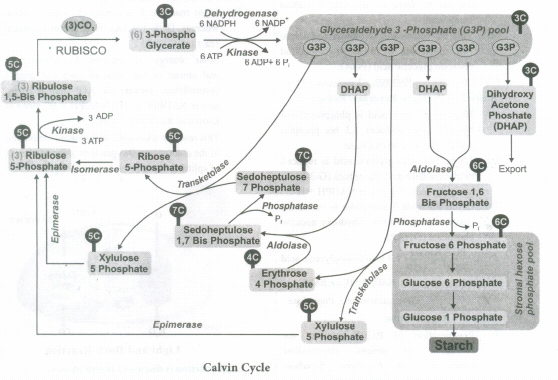
Draw the schematic representation of Calvin Cycle?
3.
Explain the physiological effects and agricultural role of Auxin.
4.
List the differences between Sap wood and Heart wood?
5.
Explain about cardiac output (CO).
6.
Write short note on Absorption and Assimalation.
7.
Endocrine glands control and coordinate the body functions through secreting certain chemical messengers called hormones. Due to certain physiological reasons, the blood glucose level of an otherwise normal person.
a. Give the possible cause for the increases in blood glucose level.
b. What is the chemical nature of this hormone? Discuss its role in the body.
c. How can this condition be reversed?
8.
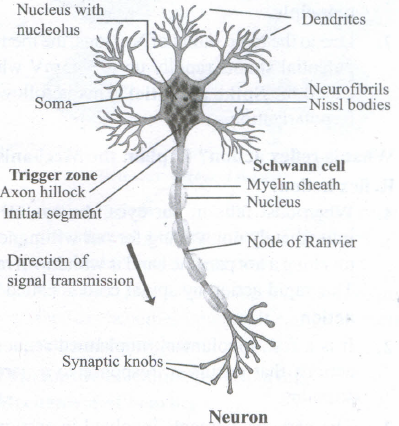
Draw a diagram of a neuron and label the parts.
9.
What are the advantages of aquaponic gardening?
10.
Explain Transport of carbon dioxide during respiration.
11.
Explain the tubular reabsorption process of urine formation.
12.
Explain coagulation of blood.
13.
Select the correct biological term.
Cardiac muscle, atria, tricuspid systole, auricles, arteries, diastole, ventricles, bicuspid valve, pulmonary artery, cardiac cycle, semilunar valve, veins, pulmonary vein, capillaries, vena cava, aorta.
(a) The main artery of the blood
(b) Valves between the left atrium and ventricle
(c) Technical name for relaxation of the heart.
(d) Another name for atria.
(e) The main vein.
(f) Vessels which carry blood away from the heart
(g) Two names for the upper chambers of the heart
(h) Thick walled chambers of the heart.
(i) Carries blood from the heart to the lungs
(j) Takes about 0.8 sec to complete.
(k) Valves situated at the point where blood flows out of the heart.
(l) Vessels which carry blood towards the heart
(m) Carries blood from the lungs to the heart.
(n) The two lower chambers of the heart.
(o) Prevent blood from re-entering the ventricles after entering the aorta.
(p) Technical name for one heartbeat.
(q) Valves between right atrium and ventricles.
(r) Technical name for contraction of the heart.
(s) Very narrow blood vessels.
14.
Give a general account on lichens.
15.
What are the components of blood in frog?
16.
What is the difference between a Zoo and Wild Life Sanctuary?
17.
Give the economic importance of Silkworm
18.
Explain the conditions which creates problems in oxygen transport.
19.
Identify the biological term
Excretion, glomerulus, urinary bladder, glomerular filtrate, ureters,urine, Bowman’s capsule, urinary system, reabsorption, micturition, osmosis, proteins.
a. A liquid which gathers in the bladder.
b. Produced when blood is filtered in a Bowman’s capsule.
c. Temporary storage of urine.
d. A ball of intertwined capillaries.
e. Removal of unwanted substances from the body.
f. Each contains a glomerulus.
g. Carry urine from the kidneys to the bladder.
h. Scientific term for urination.
i. Regulation of water and dissolved substances in blood and tissue fluid.
j. Consists of the kidneys, ureters and bladder.
k. Removal of useful substances from glomerular filtrate.
l. What solute the blood contains that are not present in the glomerular filtrate?
20.
Can we use recent molecular tools to identify and classify organisms?
1.
1. Tumours of the chest, abdomen or pelvis.
2. Diseases of the liver; inflammatory bowel disease, heart problems, such as congenital heart disease.
3. Malformation of the blood vessels and inflammation of the vessels (vasculitis).
4. A foetus in the womb of a pregnant woman.
5. Visualising injuries, tom ligaments especially' in areas like wrist ankle or knee.
2.
3.
Auxin is a phytohormone - Physiological effects
1. They promote cell elongation in stem and coleoptile.
2. At higher concentrations auxins inhibit the elongation of roots but induce more lateral roots. Promotes growth of root only at extremely low concentrations.
3. Suppression of growth in lateral bud by apical 'buddue to auxin produced by apical bud is termed as apical dominance,
4. Auxin prevents abscission.
5. It is responsible for initiation and promotion of cell division in cambium, which is responsible for the secondary growth and tumor. This property of induction cell division has been exploited for tissue culture techniques and for the formation of callus.
6. Auxin stimulates respiration.
7. Auxin induces vascular differentiation.
Agricultural role:
1) It is used to eradicate weeds. Example: 2,4-D and 2, 4, 5 - T.
2) Synthetic auxins are used in the formation of seedless fruits (Parthenocarpic fruit).
3) It is used to break the dormancy in seeds.
4) Induce flowering in Pineapple by NAA & 2, 4 - D.
5) Increase the number of female flowers and fruits in cucurbits.
4.
| SapWood (Alburnum) | Heart wood (Duramen) | |
| 1. | Living part of the wood. | Dead part of the wood. |
| 2. | It is situated on the outer side of wood | It is situated in the centre part of wood |
| 3. | It is less dark in colour | It is dark in colour |
| 4. | Very soft in nature | Hard in nature |
| 5. | Tyloses are absent | Tyloses are present |
| 6. | It is not durable and not resistant to microorganisms | It is more durable and resists microorganisms |
5.
(i) Definition: The amount of blood pumped out by each ventricle per minute is called cardiac output (CO).
(ii) Heart rate (HR) and stroke volume (SV) are the products of CO.
(iii) HR or pulse is the number of beats per minute.
(iv) So pulse pressure = Systolic pressure - Diastolic pressure.
(v) SV is the volume of blood pumped out by one ventricle with each beat.
(vi) SV depends on ventricular systole/contraction.
(vii) CO = HR x SV
(viii) SV represents the difference between EDV (amount of blood that collects in a ventricle during diastole).
(ix) SV = EDV - ESV.
(x) Frank-Starling law of the heart, the critical factor controlling SV is the degree to which the cardiac myocytes are stretched just before they contract.
(xi) The most important factor stretching cardiac muscle is the amount of blood returning to the heart and distending its ventricles venous return.
(xii) SV performs the doubling of circulation during venous return during physical exercise.
(xiii) A balance between cardiac output and venous return is maintained by the pumping action of heart.
(xiv) As the heart serves as a double pump, each side can fail independently of the other.
(xv) If the left side of the heart fails. It results in pulmonary congestion and similarly the right side of the heart fails it results in the peripheral congestion.
(xvi) Frank-Starling effect protects the heart from abnormal increase in blood volume.
6.
Absorption is a process by which the end product of digestion passes through the intestinal mucosa into the blood and lymph. The villi in the lumen of ileum are the absorbing units, consisting of a lacteal duct in the middle surrounded by fine network of blood capillaries. The process of absorption involves active, passive and facilitated transport. Small amounts of glucose, amino acids and electrolytes like chloride ions are generally absorbed by simple diffusion. The passage of these substances into the blood depends upon concentration gradients. However, some of the substances like fructose are absorbed with the help of the carrier ions like Na+. This mechanism is called facilitated transport.
Nutrients like amino acids, glucose and electrolytes like Na+ are absorbed into the blood against the concentration gradient by active transport. The insoluble substances like fatty acids, glycerol and fat-soluble vitamins are first incorporated into small, spherical water-soluble droplets called micelles and are absorbed into the intestinal mucosa where they are re-synthesized into protein coated fat globules called chylomicrons which are then transported into the lacteals within the intestinal villi and eventually empty into lymphatic duct. The lymphatic ducts ultimately release the absorbed substances into the bloodstream. While the fatty acids are absorbed by the lymph duct, other materials are absorbed either actively or passively by the capillaries of the villi. Water-soluble vitamins are absorbed by simple diffusion or active transport. Transport of water depends upon the osmotic gradient.
7.
a. Blood glucose levels increase when there is a reduced secretion of insulin in the body. This is called Hyperglycaemia or Diabetes mellitus.
b. Insulin:
1. Insulin is a peptide hormone and plays an important role in glucose homeostasis.
2. It's main effect is to lower blood glucose levels by increasing the uptake of glucose into the body cells, especially muscle and fat cells. Insulin also inhibits the breakdown of glycogen to glucose, the conversion of amino acids or fats to glucose, so insulin is rightly called a hypoglycemic hormone.
Glucagon:
1. Glucagon is a polypeptide hormone. It is a potent hyperglycaemic hormone that acts on the liver and promotes the breakdown of glycogen to glucose (Glygogenolysis), synthesis of glucose from lactic acid and from non-carbohydrate molecules (gluconeogenesis). It also releases glucose from the liver cells, increasing the blood glucose levels.
2. Since glucagon reduces the cellular uptake and utilisation of glucose it is called a hyperglycemic hormone. Prolonged hyperglycemia leads to the disorder called diabetes mellitus.
c. This condition can be treated by first analysing the cause. Diabetes mellitus is of two types .
1. Type I Diabetes - Insulin-dependent Diabetes:
It is caused by lack of Insulin secretion due to illness or viral infections.
2. Type II Diabetes-Non-Insulin dependent Diabetes:
It is caused due to reduced sensitivity to Insulin.
Treatment:
Type I Diabetes:
In this case, pancreas fails to produce enough Insulin. Treatment involves injecting the Insulin through the skin.
Type II Diabetes:
In this case, pancreas produces Insulin but the quantity of Insulin is not sufficient to meet the requirements of the body and cells become resistant to it.
Medications will help to treat and control Diabetes II.
In general people with diabetes must:
1. Check blood sugar levels regularly.
2. Plan diet accordingly.
3. Perform exercises regularly.
4. Follow proper medication.
8.
9.
(i) Water is conserved because no need of water discharge and recharge as the water is maintained by recycling process
(ii) Bottom soil may be loaded with fresh water
(iii) Microbes in water can convert the wastes into usable forms like ammonia into NO3- which are in turn used by plants for the synthesis of proteins
(iv) Soil fertility increases
(v) Utilization of pesticides can be avoided
(vi) Growth of weeds is arrested
(vii) Plants utilize more nutrients available
(viii) Plants wastes and decayed plant
(ix) Parts are being used as food for fishes
(x) Fertilizers can be minimum used
(xi) The cultivable fishes like tilapia, trout, koi, gold fish, bass etc are cultured in aquaponics
(xii) The common cultivable plants like tomato, pepper, lettuce, cucumber and rose are co-cultivated in this method.
10.
Transport of Carbon dioxide: Blood transports CO2 from the tissue cells to the lungs in three ways,
(i) Dissolved in plasma: About 7-10% of CO2 is transported in a dissolved form in the plasma.
(ii) Bound to haemoglobin: About 20-25% of dissolved CO2 is bound and carried in the RBCs as carbaminohaemoglobin (HbCO2)
CO2 + Hb \(\leftrightarrows \) Hb CO2
(iii) As bicarbonate ions in plasma: About 70% of CO2 is transported as bicarbonate ions.
1. This is influenced by pCO2 and the degree of haemoglobin oxygenation. RBCs contain a high concentration of the enzyme, carbonic anhydrase, Whereas small amounts of carbonic anhydrase is present in the plasma.
2. At the tissues the pCO2 is high due to catabolism and diffuses into the blood to form HCO3-and H+ ions. When CO2 diffuses into the RBCs, it combines with water forming carbonic acid (H2CO3) catalyzed by carbonic anhydrase. Carbonic acid is unstable and dissociates into hydrogen and bicarbonate ions.
3. Carbonic anhydrase facilitates the reaction in both directions.
CO2 + H2O  H2CO3
H2CO3
HCO3- + H+
4. The HCO3- moves quickly from the RBCs into the plasma, where it is carried to the lungs. At the alveolar site where pCO2 is low, the reaction is reversed leading to the formation of CO2 and water. Thus CO2 trapped as HCO3- at the tissue level it is transported to the alveoli and released out as CO2.
5. Every 100mL of deoxygenated blood delivers 4mL of CO2 to the alveoli for elimination.
11.
This is the second step in process of urine formation Tubular Reabsorption:
1. This involves movement of the filtrate back into the circulation.
2. The volume of filtrate formed per day is around 170-180 L and the urine released is around 1.5 L per day, i.e., nearly 99% of the glomerular filtrate that has to be reabsorbed by the renal tubules as it contains certain substances needed by the body. This process is called selective reabsorption.
3. Reabsorption takes place by the tubular epithelial cells in different segments of the nephron either by active transport or passive transport, diffusion and osmosis.
4. Proximal convoluted Tubule (PCT) Glucose, lactate, amino acids, Na+ and water in the filtrate is reabsorbed in the PCT. Sodium is reabsorbed by active transport through sodium- potassium (Na+ - K+) pump in the PCT. Small amounts of urea and uric acid are also reabsorbed.
5. Descending limb of Henle's loop is permeable to water due the presence of aquaporins, but not permeable to salts. Water is lost in the descending limb, hence Na+ and cr gets concentrated in the filtrate.
6. Ascending limb of Henle's loop is impermeable to water but permeable to solutes such as Na+, CI- andK+.
7. The distal convoluted tubule recovers water and secretes potassium into the tubule. Na+, Cland water remains in the filtrate of the DCT.
8. Most of the reabsorption from this point is dependent on the body's need and is regulated by hormones. Reabsorption of bicarbonate (HC03-) takes place to regulate the blood pH. Homeostasis of K+ and Na+ in the blood is also regulated in this region.
9. Collecting duct is permeable to water, secretes K+ (potassium ions are actively transported into the tubule) and reabsorbs Na+ to produce concentrated urine. The change in permeability to water is due to the presence of number of water-permeable channels called aquaporins.
12.
Coagulation of blood:
The mechanism by which excessive blood loss is prevented by the formation of clot is called blood coagulation or clotting of blood. Schematic representation of blood coagulation is shown below.
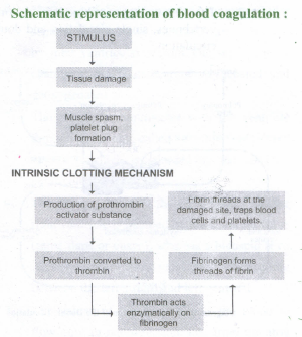
1. The clotting process begins when the endothelium of the blood vessel is damaged and the connective tissue in its wall is exposed to the blood.
2. Platelets adhere to collagen fibres in the connective tissue and release substances that form the platelet plug which provides emergency protection against blood loss.
3. Clotting factors released from the clumped platelets or damaged cells mix- with clotting factors in the plasma. The protein called prothrombin is converted to its active form called thrombin in the presence of calcium and vitamin K.
4. Thrombin helps in the conversion of fibrinogen to fibrin threads. The threads of fibrin become interlinked into a patch that traps blood cell and seals the injured vessel until the wound is healed.
5. After sometime fibrin fibrils contract, squeezing out a straw-coloured fluid through a meshwork called serum.
13.
(a) Aorta
(b) Bicuspid
(c) Diastole
(d) Auricle
(e) Vena cava
(f) Arteries
(g) Atria /Auricles
(h) Ventricles
(i) Pulmonary Artery
(j) Cardiac cycle
(k) Semilunar Valves
(I) Veins
(m) Pulmonary vein
(n) Ventricles
(o) Semilunar Valve
(p) Cardiac cycle
(q) Tricuspid Valve
(r) Systole
(s) Capillaries
14.
(i) The symbiotic association between algae and fungi is called lichens.
(ii) The algal partner is called Phycobiont or Photobiont and the fungal partner is called Mycobiont.
(iii) Algae provide nutrition for fungal partner in turn fungi provide protection and also help to fix the thallus to the substratum through rhizines.
(iv) Asexual reproduction takes place through fragmentation, soredia and Isidia. Phycobionts reproduce by akinetes, hormogonia, aplanospore, etc., Mycobionts undergo sexual reproduction and produce ascocarps.
Classification:
(i) Based on the habitat lichens are classified into following types: Corticolous (on Bark) Lignicolous (on Wood) Saxicolous (on rocks) Terricolous (on ground) Marine (on siliceous rocks of sea) Fresh water (on siliceous rock of fresh water).
(ii) On the basis of morphology of the thallus they are divided into Leprose (a distinct fungal layer is absent) Crustose-crust like; Foliose-leaf like; Fruticose-branched pendulous shrub like.
(iii) The distribution of algal cells distinguishes lichens into two forms namely Homoiomerous (Algal cells evenly distributed in the thallus) and Heteromerous (a distinct layer of algae and fungi present)
(iv) If the fungal partner of lichen belongs to ascomycetes, it is called Ascolichen and if it is basidiomycetes it is called Basidiolichen.
15.
(i) Blood consists of 60% of plasma and 40% of blood cells.
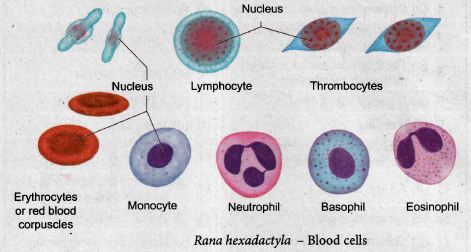
(ii) Red blood cells are nucleated containing haemoglobin (red pigment) and these are oval shaped.
(iii) Leucocytes are nucleated and circular in shape.
16.
| Zoo | Wild life sanctuary |
| Wild animals kept in protected environments under human care Eg: Zoological parks | Wild animals are maintained in the protected areas under various projects for various animals and maintained by the services of Government. |
17.
Economic importance of Silk:
1. Silk fibers are utilized in preparing silk clothes. Silk fibers are now combined with other natural or synthetic fibers to manufacture clothes like Teri-silk, Cot-silk etc.
2. Silk is dyed and printed to prepare ornamented fabrics. They are generally made from Eri-silk or spun silk.
2. Silk is used in industries and for military purposes.
3. It is used in the manufacture of fishing fibers, parachutes, cartridge bags, insulation coils for telephone, wireless receivers, tyres of racing cars, filter fibres, in medical dressings and as suture materials.
18.
Conditions which create the problems in O2 transport:
(i) Poor ventilation.
(ii) Less quantity of haemoglobin.
(iii) Anaemia
(iv) Histotoxic conditions of tissue fluid.
(v) Inability for the transport of O2 into cell due to cellular disorder.
19.
(a) Urine
(b) Glomerular filtrate
(c) Urinary bladder
(d) afferent and efferent arterioles and venules of renel artery and renel vein.
(e) Excretion
(f) Bowman's capsule
(g) Ureters
(h) Micturition
(i) Balance of electrolytes minerals and organics
(j) excretory system
(k) micturition
(l) glucose, amino acid and liquids
20.
(i) Yes we can use recent molecular tools to identify and classify organisms.
(ii) Eg: Automated species identification tools electron microscopy (for cellular organelles and molecular structures by neo taxonomical tools) behaviour of organisms by ethology of taxonomical tools and development of electronic digital images and description by INOTAXA or e- Taxonomic resources.

11th Standard Syllabus & Materials
11th Standard
TN 11th Tamil பீடு பெற நில் - செய்யுள் - காவடிச்சிந்து Important Questions And Answers Study Material - QB365 Set A
NEW11th Standard
TN 11th Tamil பீடு பெற நில் - உரைநடை - மலை இடப்பெயர்கள் : ஓர் ஆய்வு Important Questions And Answers Study Material - QB365 Set A
NEW11th Standard
TN 11th Tamil மாமழை போற்றுதும் - துணைப்பாடம் - யானை டாக்டர் Important Questions And Answers Study Material - QB365 Set A
NEW11th Standard
TN 11th Tamil மாமழை போற்றுதும் - செய்யுள் - ஐங்குறுநூறு Important Questions And Answers Study Material - QB365 Set A



Tamilnadu Stateboard 11th Standard Subjects

Maths

Commerce

Economics
Biology

Business Maths and Statistics

Accountancy

Computer Science

Physics

Chemistry
Maths
Biology
Economics
Physics
Chemistry

History
Business Maths and Statistics

Computer Science
Accountancy

Computer Applications
History
Computer Technology
Commerce
Computer Applications
Computer Technology

Tamil

English

French
Tamilnadu Stateboard Standards

