
 100% FREE ACCESS
11th Standard Syllabus & Materials
11th Standard
TN 11th Tamil இயற்கை வேளாண்மை,சுற்றுச்சூழல் -செய்யுள் - மனோன்மணீயம் Important Questions And Answers Study Material - QB365 Set A
NEW11th Standard
TN 11th Tamil என்னுயிர் என்பேன் -துணைப்பாடம் - இசைத்தமிழர் இருவர் Important Questions And Answers Study Material - QB365 Set A
NEW11th Standard
TN 11th Tamil மொழி கலை -செய்யுள் - ஒவ்வொரு புல்லையும் Important Questions And Answers Study Material - QB365 Set A
NEW11th Standard
TN 11th Tamil பீடு பெற நில் - இலக்கணம் - பகுபத உறுப்புகள் Important Questions And Answers Study Material - QB365 Set A
NEW11th Standard
TN 11th Tamil பீடு பெற நில் - துணைப்பாடம் - வாடிவாசல் Important Questions And Answers Study Material - QB365 Set A
NEW11th Standard
TN 11th Tamil பீடு பெற நில் - செய்யுள் - குறுந்தொகை Important Questions And Answers Study Material - QB365 Set A

Published on: 21/01/2020
Download Tamil Nadu 11th Standard Biology question papers, model tests, one-mark questions, important questions, and public exam papers in PDF format. Free study materials and answer keys for TN State Board students.
Questions + Answers key
Take MCQ Biology Test1.
2.
3.
Do you know any wearable healthcare devices?
4.
5.
Write the internal factors for condition of growth.
6.
What is the significance of C4 cycle?
7.
Explain the significance of potassium as a Macronutrient.
8.
What is the aim of Kuhne's experiment?
9.
What is the function of the digestive system?
10.
Write about the various types of symmetrical of body of animals with the suitable examples.
11.
What are the sense organs present in periplaneta americana and write its position and function of each.
12.
Human brain is formed of a large number of parts like cerebrum, thalamus, hypothalamus, pons, cerebellum and medulla oblongata. Each part performs some specialized function and all the parts are essential for the survival of a person. Discuss the following statement:
Thalami are called relay centres of the brain.
13.
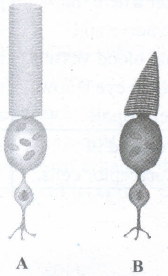
Identify A and B. Write the significance of each.
14.
Write two advantages of Aquaponic gardening.
15.
What is the incomplete double circulation?
16.
Distinguish between open and closed circulation.
17.
Distinguish between Neurons and Neuroglia
18.
Differentiate between aggregate fruit with multiple fruit.
19.
Which segment is the site of secretion and regulated reabsorption of ions and pH homeostasis?
20.
Head of cockroach is called hypognathous. Why?
1.
2.
3.
Wearable healthcare devices include smart watches,fitbit wristbands, fitness trackers, helmet-worn impact checkers, back pain posture checkers, necklaces clipons, smart clothing and filament implant.
4.
5.
lnternal Factors:
1. Genes are intracellular factors for growth.
2. Phytohormones are intracellular factors for growth. Example: auxin, gibberellin, cytokinin, etc.
3. C/N Ratio: The ratio of carbohydrates and nitrogenous compounds regulate the specific pattern of growth in plants
6.
1) Plants having C4 cycle are mainly of tropical and sub-tropical regions and are able to survive in environment with low CO2 concentration.
2) C4 plants are partially adapted to drought conditions.
3) Oxygen has no inhibitory effect on C4 cycle since PEP carboxylase is insensitive to O2.
7.
Potassium (K): Maintains turgidity and osmotic potential of the cell, opening and closure of stomata, phloem translocation, stimulate activity of enzymes, anion and cation balance by ion-exchange. It is absorbed as K+ ions.
Deficiency symptoms:Marginal chlorosis, necrosis, low cambial activity, loss of apical dominance, lodging in cereals and curled leaf margin.
8.
Kuhne's fermentation tube experiment demonstrates the process of alcoholic fermentation.
9.
The function of the digestive system is to bring the nutrients, water and electrolytes from the external environment into every cell in the body through the circulatory system.
10.
| a) Asymmetry | : | Sponges (poriferians)and adult molluscans |
| b) Radial | : | Coelenterates / Cnidarians Eg: Sea anemone |
| c) Bi radial | : | Cnidarians like comb jelly |
| d) Penta radial | : | Adult Echinoderms like star fish |
| e) Bilateral | : | Triploblastic adults like Platyhelminthes (flatworms) Nematodes (round worm) |
Annelidians, Arthopodians, Young Molluscans, Young Echinoderms and Chordates.
11.
In cockroach, the sense organs are antennae, compound eyes, labrum, maxillary palps, labial palps and anal cerci. The receptor for touch (thigmo receptors) is located in the antenna, maxillary palps and cerci. The receptor for smell (olfactory receptors) is found on the antennae. The receptor for taste (gustatory receptors) is found on the palps of maxilla and labium. Thermoreceptors are found on the first four tarsal segments on the legs. The receptor chordotonal is found on the anal cerci which respond to air or earth borne vibrations. The photoreceptors of the cockroach consists of a pair of compound eyes at the dorsal surface of the head. Each eye is formed of about 2000 simple eyes called the ommatidia (singular: ommatidium), through which the cockroach can receive several images of an object. This kind of vision is known as mosaic vision with more sensitivity but less resolution.
12.
Thalamus is composed of grey matter which. serves as a relay center for impulses between the spinal cord, brain stem and cerebrum. Within the thalamus, information is sorted and edited and plays a key role in learning and memory. It is a major coordinating center for sensory and motor signaling.
13.
A- Rod cell, B- Cone cell
A- Rods are photoreceptor cells responsible for vision in dim light in the human eye.
B- The cones are photoreceptor cells responsible for colour vision in the human eye
14.
Advantages of Aquaponic gardening:
1. Water conservation: No need of water discharge and recharge as the water is maintained by recycling process.
2. Pesticides: In this system use of pesticides is avoided and hence it is eco-friendly
15.
1. Amphibians have two auricles and one ventricle and no inter ventricular septum whereas reptiles except crocodiles have two auricles and one ventricle and an incomplete inter ventricular septum.
2. Thus mixing of oxygenated and deoxygenated blood takes place in the ventricles.
3. This type of circulation is called incomplete double circulation.
16.
| Open circulation | Closed circulation |
| 1. No blood vessels. | Blood vessels are present. |
| 2. Blood flows in sinuses. | Blood flows in vessels. |
| 3. No respiratory pigment. | Respiratory pigment present. |
| 4. Eg: insects. | Eg: Earthworms, Molluscans, Echinoderms and Chordates. |
17.
| Neuron | Neuroglia |
| 1. They have two types of process - axon and dendron | They have only one process |
| 2. They have synapse | Do not have synapse |
| 3. No power of division | Have power of division |
| 4. conduct nerve impulses. | They are nutritive and defensive in function and serve as packing cells. |
18.
| S.No. | Aggregate fruit | Multiple fruit |
| 1 | Aggregate fruits develop from a single flower having an apocarpous pistil. Each of the free carpel develops into a simple fruitlet. A collection of simple fruitlets makes an Aggregate fruit. An individual ovary develops into a drupe, achene, follicle or berry | A Multiple or composite fruit develops from the whole inflorescence along with its peduncle on which they are borne |
| 2 | Eg: Polyalthia | Eg: Pineapple |
19.
Distal convoluted tubule (DCT of nephron).
20.
(i) The head is small, triangular and lies at right angle to the longitudinal axis of the body.
(ii) The mouth parts are directed downwards so it is hypognathous.

11th Standard Syllabus & Materials
11th Standard
TN 11th Tamil பீடு பெற நில் - செய்யுள் - காவடிச்சிந்து Important Questions And Answers Study Material - QB365 Set A
NEW11th Standard
TN 11th Tamil பீடு பெற நில் - உரைநடை - மலை இடப்பெயர்கள் : ஓர் ஆய்வு Important Questions And Answers Study Material - QB365 Set A
NEW11th Standard
TN 11th Tamil மாமழை போற்றுதும் - துணைப்பாடம் - யானை டாக்டர் Important Questions And Answers Study Material - QB365 Set A
NEW11th Standard
TN 11th Tamil மாமழை போற்றுதும் - செய்யுள் - ஐங்குறுநூறு Important Questions And Answers Study Material - QB365 Set A



Tamilnadu Stateboard 11th Standard Subjects

Maths

Commerce

Economics
Biology

Business Maths and Statistics

Accountancy

Computer Science

Physics

Chemistry
Maths
Biology
Economics
Physics
Chemistry

History
Business Maths and Statistics

Computer Science
Accountancy

Computer Applications
History
Computer Technology
Commerce
Computer Applications
Computer Technology

Tamil

English

French
Tamilnadu Stateboard Standards

