
 100% FREE ACCESS
11th Standard Syllabus & Materials
11th Standard
TN 11th Tamil இயற்கை வேளாண்மை,சுற்றுச்சூழல் -செய்யுள் - மனோன்மணீயம் Important Questions And Answers Study Material - QB365 Set A
NEW11th Standard
TN 11th Tamil என்னுயிர் என்பேன் -துணைப்பாடம் - இசைத்தமிழர் இருவர் Important Questions And Answers Study Material - QB365 Set A
NEW11th Standard
TN 11th Tamil மொழி கலை -செய்யுள் - ஒவ்வொரு புல்லையும் Important Questions And Answers Study Material - QB365 Set A
NEW11th Standard
TN 11th Tamil பீடு பெற நில் - இலக்கணம் - பகுபத உறுப்புகள் Important Questions And Answers Study Material - QB365 Set A
NEW11th Standard
TN 11th Tamil பீடு பெற நில் - துணைப்பாடம் - வாடிவாசல் Important Questions And Answers Study Material - QB365 Set A
NEW11th Standard
TN 11th Tamil பீடு பெற நில் - செய்யுள் - குறுந்தொகை Important Questions And Answers Study Material - QB365 Set A

Published on: 27/12/2018
+1 First Revision Test Model
Download Tamil Nadu 11th Standard Biology question papers, model tests, one-mark questions, important questions, and public exam papers in PDF format. Free study materials and answer keys for TN State Board students.
Questions + Answers key
Take MCQ Biology Test1.
Explain Bast fibres?
2.
What is Scarification?
3.
Describe the shapes of Apopetalous zygomorphic in Corolla.
4.
Give some examples for bony fishes coming under Osteichthyes.
5.
Name the following.
i. The largest bee in the colony.
ii. The kind of flight which the new virgin queen takes along with the drones out of the hive.
6.
Give the economic importance of prawn fishery
7.
How is rigor mortis happen?
8.
Which vessels drain filtered blood from the kidneys?
9.
If the afferent arteriole of the nephron constricts, what happens to the GFR in that nephron? If the efferent arteriole constricts what happens to the GFR in that nephron? Assume that no auto regulation takes place.
10.
What is the significance of biconcave shape of RBC?
11.
12.
How does the male frog attract the female for mating?
13.
What is Tonoplast?
14.
15.
All carotenoid pigments have ___________carbon atoms.
30
40
50
20
16.
_________ observed correlation between respiration and anion absorption.
Lundegardh
Donnan
Bennet
Overton
17.
Johnston's organ is present in ___________
antenna of insect
head of cockroach
abdomen of housefly
abdomen of spider
18.
___________ sps is an endophyte in coralloid roots of Cycas.
Gloeocapsa
Scytonema
Nostoc
Azolla
19.
Match the following
| A)Samara | i)Strawberry |
| B)Utricle | ii)Acer |
| C)Cremocarp | iii)Abutilon |
| D)Carcerulus | iv)Helianthus |
| E)Achene | v)Chenopodium |
| F)Cypsela | vi)Carrot |
A - i), B- ii), C- Hi), D- iv), E- v), F- vi)
A-vi), B-v), C-iv), D-iii), E-ii), F-i)
A - iv), B- vi), C- iii), D- i), E- v), F-ii)
A - ii), B-v), C- vi), D- iii), E- i), F- iv)
20.
The carbohydrate molecules of cell membrane are ___________
Long chain polysaccharides
Short chain polysaccharides
Long chain glyco proteins
Short chain glycolipids
21.
If the diameter of the pulley is 12 inches, length of pointer is 10 inches and distance travelled by pointer is 5 inches. Calculate the actual growth in length of plant.
3 inches
6 inches
12 inches
30 inches
22.
Refer to the given figure and select the correct statement.
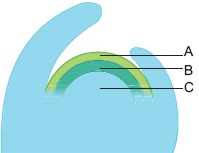
i. A, B, and C are histogen of shoot apex
ii. A Gives rise to medullary rays.
iii. B Gives rise to cortex
iv. C Gives rise to epidermis
i and ii only
ii and iii only
i and iii only
iii and iv only
23.
'Lazy gates' condition is seen in _____________
Repolarization
Hyperpolarization
Depolarization
Synapse
24.
The structure which connects the hypothalamus with anterior lobe of pituitary gland is the ______.
Dendrites of neurohypophysis
Axons of neurohypophysis
Bands of white fibers from cerebellar region
Hypophyseal portal system
25.
Assertion (A): The cocoons of silkworm are soaked in hot water.
Reason (R) : The gum that binds the silk threads is softened.
A and R are right
R explains A
A and R are wrong
R does not explain A
26.
During inspiration, the diaphragm _____.
expands
unchanged
relaxes to become domed-shaped
contracts and flattens
27.
Concentration of urine depends upon which part of the nephron ______.
Bowman's capsule
Length of Henle's loop
P.C.T.
Network of capillaries arising from glomerulus
28.
Presence of gills in the tadpole of frog indicates that _______.
fishes were amphibious in the past
fishes evolved from frog -like ancestors
frogs will have gills in future
frogs evolved from gilled ancestor
29.
Every unit of classification regardless of its rank is _____.
Taxon
Variety
Species
Strain
30.
Bryophyllum and Dioscorea are examples of ______.
Foliar bud, apical bud
Foliar bud, cauline bud
Cauline bud, apical bud
Cauline bud, foliar bud
31.
What is sigmoid curve? Mention their phases
32.
Mention two important products obtained from bark.
33.
Name the three components of gram negative cell wall.
34.
What is the function of the cardiac sphincter?
35.
Mention the Test for Proteins.
36.
Write the role of nitrogenase enzyme in nitrogen fixation?
37.
Define the two phases involved in transmission of nervous impulses
38.
Differentiate between aggregate fruit with multiple fruit.
39.
Explain the process of photo respiration / C2 cycle.
40.
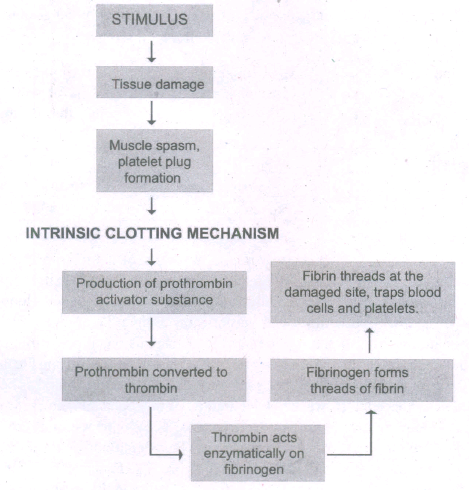
Explain the process of coagulation of blood.
41.
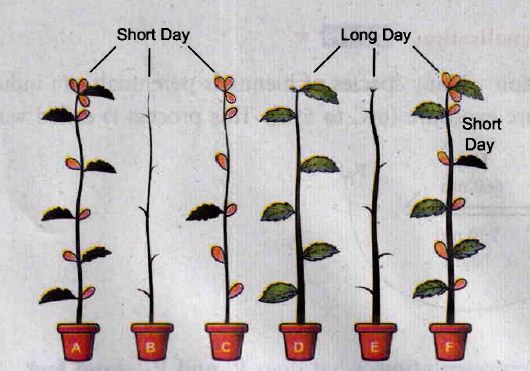
Describe the mechanism of photoperiodic induction of flowering.
42.
Write the causes for diabetes mellitus and diabetes insipidus.
43.
Identify the following structures and explain their significance in renal physiology?
(a) Juxtaglomerular apparatus
(b) Podocytes
(c) Sphincters in the bladder
44.
How respiration takes place in cockroach?
45.
Describe the Respiration life processes in Bacteria.
46.
Explain 'Geocarpic fruit' with an example.
1.
The fibres of sclerenchyma associated with phloem are called phloem fibres or Bast fibres. They are narrow, vertically elongated and have small lumen. It Is the only dead tissue in phloem. They give support.
2.
Scarification: Mechanical and chemical treatments like cutting or chipping of hard tough seed coat and use of organic solvents to remove waxy or fatty compounds are called as Scarification. It is a method of breaking dormancy of seeds.
3.
1. Papilionaceous is made up of five distinct petals organized in a butterfly shape. Corolla has three types of petals.
2. One usually large posterior petal called vexillum(standard)two lateral petals- wings (alae) and two anterior sympetalous petals called carina.
3. Example: Clitoria ternatea, Pea, Bean.
4.
Exocoetus, Labeo, Catla, Echeneis, Pterophyllum.
5.
1. Queen bee
2. Nuptial flight
6.
Economic importance of prawn:
(i) Prawn is a very tasty proteinaceous food.
(ii) Economic growth can be achieved by prawn at a low cost.
(iii) It is profitable to cultivate prawns in fresh water at a low cost.
(iv) By Exporting prawns can also bring a lot of foreign currency to the country.
7.
The muscle contracts when the myosin shifts. The lack of ATP after death prevents it from relaxing and the muscle remains contracted. Such process occurs in all muscles and the body becomes rigid.
8.
Venules, veins of renal vein comes out of hilum of kidneys.
9.
(i) Blood supply to kidney's is reduced.
(ii) Disposal of blood from the kidney's is reduced.
(iii) Auto regulation of micturition is disturbed.
10.
The biconcave shape increases the surface area to volume ratio. Hence oxygen diffuses quickly in and out of the cell.
11.
12.
Male frog attracts female frog by amplifying its croaking sound during breeding season.
13.
In plant cells vacuoles are large, bounded by a single unit membrane called Tonoplast.
14.
15.
(b)
40
16.
(a)
Lundegardh
17.
(a)
antenna of insect
18.
(c)
Nostoc
19.
(d)
A - ii), B-v), C- vi), D- iii), E- i), F- iv)
20.
(b)
Short chain polysaccharides
21.
(a)
3 inches
22.
(c)
i and iii only
23.
(b)
Hyperpolarization
24.
(d)
Hypophyseal portal system
25.
(b)
R explains A
26.
(d)
contracts and flattens
27.
(b)
Length of Henle's loop
28.
(b)
fishes evolved from frog -like ancestors
29.
(a)
Taxon
30.
(b)
Foliar bud, cauline bud
31.
Stages in Growth rate:
The total period from initial to the final stage of growth is called the grand period of growth. The total growth is plotted against time and 'S' shaped sigmoid curve (Grand period curve) is obtained. It consists of four phases. They are:
I) Lag phase
2) Log phase
3) Decelerating phase
4) Maturation phase
32.
(a) Cinnamon - Spice got from the bark of the tree. Eg: Cinnamomum.
(b) Rubber - Got from the latex vessels of the inner bark of Hevea brasiliensis.
33.
Lipoprotein, outermembrane and lipopolysaccharide
34.
A cardiac sphincter or gastro esophageal sphincter regulates the opening of oesophagus into the stomach
35.
The biuret test is used as an indicator of the presence of protein because it gives a purple colour in the presence of peptide bonds (-C- N-). To a protein solution an equal quantity of sodium hydroxide solution is added and mixed. Then a few drops of 0.5% Copper (II) sulphate is added with gentle mixing. A distinct purple colour develops without heating
36.
(i) Nitrogen fixation process requires Nitrogenase enzyme complex, Minerals (Mo, Fe and S), anaerobic condition, ATP, electron and glucose 6 phosphate as H+ donor.
(ii) Nitrogenase enzyme is active only in anaerobic condition.
(iii) To create this anaerobic condition a pigment known as leghaemoglobin is synthesized in the nodules which acts as oxygen scavenger and removes the oxygen.
37.
The transmission of impulse involves two main phases; Resting membrane potential and Action membrane potential.
Resting membrane Potential: The electrical potential difference across the plasma membrane of a resting neuron is called the resting potential during which the interior of the cell is negative due to greater efflux of K+ outside the cell than Na+ influx into the cell.
Action membrane potential: An action potential occurs when a neuron sends information down an axon, away from the cell body. It includes following phases, depolarization, repolarisation and hypo polarization.
38.
| S.No. | Aggregate fruit | Multiple fruit |
| 1 | Aggregate fruits develop from a single flower having an apocarpous pistil. Each of the free carpel develops into a simple fruitlet. A collection of simple fruitlets makes an Aggregate fruit. An individual ovary develops into a drupe, achene, follicle or berry | A Multiple or composite fruit develops from the whole inflorescence along with its peduncle on which they are borne |
| 2 | Eg: Polyalthia | Eg: Pineapple |
39.
1. Chloroplast: Photorcspiration is the excess respiration taking place in photosynthetic cells due to absence of CO2 and increase of 02. This condition changes the carboxylase role of RUISCO into oxygenase. C2 Cycle takes place in Chloroplast, Peroxisome and Mitochondna. RUBP is converted into PGA and a 2C- compound Phosphoglycolate by Rubisco enzyme in chloroplast. Since the first product is a 2C- compound, this cycle is known as C2 Cycle. Phosphoglycolate by loss of Phosphate becomes Glycolate.
2. Chloroplast: Glycolate formed in Chloroplast enters into Peroxisome to form Glyoxylate and Hydrogen peroxide. Glyoxylate is converted I into Glycine and transferred into Mitochondria.
3. Mitochondria: Two molecules of Glycine combine to form Serine. Serine enters into Peroxisome to form Hydroxy pyruvate. Hydroxy pyruvate with help of NADH + H+ becomes Glyceric acid. Glyceric acid is cycled back to Chloroplast utilising ATP and becomes Phosphoglyceric acid (PGA) and enters into the Calvin Cycle (PCR Cycle). Photorespiration does not yield any free energy in the form of ATP. Under certain conditions 50% of the Photosynthetic potential is lost because of Photorespiration.
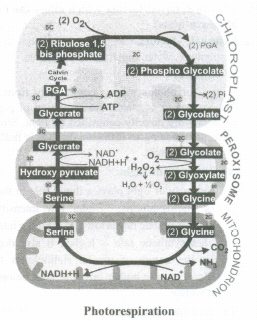
Significance of photorespiration:
1) Glycine and Serine synthesised during this process are precursors of many biomolecules like chlorophyll, proteins, nucleotides, etc.
2) It consumes excess NADH + H+ generated.
3) Glycolate protects cells from Photo oxidation.
40.
If you cut your finger or when you get yourself hurt, your wound bleeds for some time after which it stops to bleed. This is because the blood clots or coagulates in response to trauma. The mechanism by which excessive blood loss is prevented by the formation of clot is called blood coagulation or clotting of blood. The clotting process begins when the endothelium of the blood vessel is damaged and the connective tissue in its wall is exposed to the blood. Platelets adhere to collagen fibres in the connective tissue and release sub stances that form the platelet plug which provides emergency protection against blood loss. Clotting factors released from the clumped platelets or damaged cells mix with clotting factors in the plasma. The protein called prothrombin is converted to its active form called thrombin in thepresence of calcium and vitamin K. Thrombin helps in the conversion of fibrinogen to fibrin threads. The threads of fibrins become interlinked into a patch that traps blood cell and seals the injured vessel until the wound is healed. After sometime fibrin fibrils contract, squeezing out a straw-coloured fluid through a meshwork called serum (Plasma without fibrinogen is called serum). Heparin is an anticoagulant produced in small quantities by mast cells of connective tissue which prevents coagulation in small blood vessels.
41.
Photoperiodic induction
1) An appropriate photoperiod in 24 hours cycle constitutes one inductive cycle. Plants may require one or more inductive cycles for flowering.
2) The phenomenon of conversion of leaf primordia into flower primordia under the influence of suitable inductive cycles is called photoperiodic induction.
Example: Xanthium (SDP) - 1 inductive cycle and Plantago (LDP)- 25 inductive cycles.
Site of Photoinductive perception
1) Photoperiodic stimulus is perceived by the leaves.
2) Floral hormone is synthesised in leaves and translocated to the apical tip to promote flowering.
3) This can be explained by a simple experiment on Cocklebur (Xanthium pensylvanicum), a short day plant.
4) Usually Xanthium will flower under short day conditions. If the plant is defoliated and kept under short day conditions it will not flower.
5) Flowering will occur even when all the leaves are removed except one leaf.
6) If a cocklebur plant is defoliated and kept under long day conditions, it will not flower.
7) If one of its leaves is exposed to short day condition and rest are in long day condition, flowering will occur.
42.
Diabetes mellitus:
1. It is otherwise known as hyperglycaemia.
2. It is caused due to lower secretion of insulin. By this process blood glucose level is elevated. There are two types of diabetes mellitus. Types I and Type II.
3. Type I diabetes is known Insulin dependent diabetes, caused by the lack of insulin secretion due to illness or some viral infections.
4. Type II diabetes is also known as Non-Insulin dependent diabetes, caused due to lower secretion of insulin.
5. The half life period of insulin [in plasma] is only 6 minutes.
6. Symptoms of diabetes includes polyurea, polyphagia, polydipsia [excessive consumption of liquid due to thirst] ketosis [Breakdown of fat into glucose result in accumulation of ketone bodies in blood.]
Diabetes insipidus:
1. Diabetes insipidus is caused due to hypo secretion of vasopressin [ADH] from neuro hypophysis
2. The symptom includes frequent urination [Polyurea] and excessive consumption of liquid due to thirst [polydipsia]
43.
(a) Some nephrons, have very long loop of Henle that run deep into the medulla are called juxtamedullary nephrons which aid in filtration from glomerulus.
(b) Podocytes are the filtration slits.
(c) Sphincters of urinary bladder are internal paired (involuntary) and external paired (Voluntary) control micturition.
44.
1. The respiratory system of cockroach is well developed compared with other terrestrial insects.
2. Branched tubes known as trachea open through 10 pairs of small holes called spiracles or stigmata, present on the lateral side of the body.
3. Terminal branches of tracheal tubes are called tracheoles which carry oxygen to the entire body. The spiracles open and close by valves regulated by sphincter or spiracular muscles. Each tracheole is filled with a watery fluid through which exchange of gases takes place.
4. During high muscular activity, a part of the fluid is drawn into the tissues to enable more oxygen intake and rapid diffusion.
5. The passage of air in the tracheal system is:

45.
Respiration:
Two types of respiration is found in Bacteria. They are
1. Aerobic respiration
2. Anaerobic respiration
1. Aerobic respiration:
These bacteria require oxygen as terminal acceptor and will not grow under anaerobic conditions (i.e. in the absence of O2)
Eg: Streptococcus
Obligate aerobes :
Some Micrococcus species are obligate aerobes (i.e. they must have oxygen to survive).
2. Anaerobic respiration:
These bacteria do not use oxygen for growth and metabolism but obtain their energy from fermentation reactions. Eg : Clostridium
a) Facultative anaerobes:
(i) There are bacteria that can grow either using oxygen as a terminal electron acceptor or anaerobically using fermentation reaction to obtain energy.
(ii) Facultative anaerobes are often termed "aerobes".
(iii) When a facultative anaerobes such as E. coli is present at a site of infection like an abdominal abscess, it can rapidly consume all available O2 and change to anaerobic metabolism producing an anaerobic environment and thus allow the anaerobic bacteria that are present to grow and cause disease.
Eg: Escherichia coli and Salmonella.
b) Capnophilic Bacteria:
(i) Bacteria which require CO2 for their growth are called as capnophilic bacteria.
(ii) Eg : Campylobacter
46.
Geocarpic means production or ripening of the fruit beneath the surface of the ground like the peanut. Peanut is also named hypogaea, which means under the earth. After pollination, the flower stalk elongates, and then it bends until the ovary touches the ground. Stalk growth continues and then it pushes the ovary underground, where the mature fruit develops into a legume pod. Thus peanut is a classical example of geocarpic fruit. Geocarpy is generally seen in tropical or semi-desert areas. Some geocarpic species are found in the families Convolvulaceae, Moraceae, Cucurbitaceae, Araceae, Begoniaceae, Brassicaceae (Cruciferae), Fabaceae (Leguminosae), and Rubiaceae. The best-known example of Geocarpy is the peanut, that is, Arachis hypogaea.

11th Standard Syllabus & Materials
11th Standard
TN 11th Tamil பீடு பெற நில் - செய்யுள் - காவடிச்சிந்து Important Questions And Answers Study Material - QB365 Set A
NEW11th Standard
TN 11th Tamil பீடு பெற நில் - உரைநடை - மலை இடப்பெயர்கள் : ஓர் ஆய்வு Important Questions And Answers Study Material - QB365 Set A
NEW11th Standard
TN 11th Tamil மாமழை போற்றுதும் - துணைப்பாடம் - யானை டாக்டர் Important Questions And Answers Study Material - QB365 Set A
NEW11th Standard
TN 11th Tamil மாமழை போற்றுதும் - செய்யுள் - ஐங்குறுநூறு Important Questions And Answers Study Material - QB365 Set A



Tamilnadu Stateboard 11th Standard Subjects

Maths

Commerce

Economics
Biology

Business Maths and Statistics

Accountancy

Computer Science

Physics

Chemistry
Maths
Biology
Economics
Physics
Chemistry

History
Business Maths and Statistics

Computer Science
Accountancy

Computer Applications
History
Computer Technology
Commerce
Computer Applications
Computer Technology

Tamil

English

French
Tamilnadu Stateboard Standards

