
 100% FREE ACCESS
11th Standard Syllabus & Materials
11th Standard
TN 11th Tamil இயற்கை வேளாண்மை,சுற்றுச்சூழல் -செய்யுள் - மனோன்மணீயம் Important Questions And Answers Study Material - QB365 Set A
NEW11th Standard
TN 11th Tamil என்னுயிர் என்பேன் -துணைப்பாடம் - இசைத்தமிழர் இருவர் Important Questions And Answers Study Material - QB365 Set A
NEW11th Standard
TN 11th Tamil மொழி கலை -செய்யுள் - ஒவ்வொரு புல்லையும் Important Questions And Answers Study Material - QB365 Set A
NEW11th Standard
TN 11th Tamil பீடு பெற நில் - இலக்கணம் - பகுபத உறுப்புகள் Important Questions And Answers Study Material - QB365 Set A
NEW11th Standard
TN 11th Tamil பீடு பெற நில் - துணைப்பாடம் - வாடிவாசல் Important Questions And Answers Study Material - QB365 Set A
NEW11th Standard
TN 11th Tamil பீடு பெற நில் - செய்யுள் - குறுந்தொகை Important Questions And Answers Study Material - QB365 Set A

Published on: 12/12/2019
Kingdom Animalia
Download Tamil Nadu 11th Standard Biology question papers, model tests, one-mark questions, important questions, and public exam papers in PDF format. Free study materials and answer keys for TN State Board students.
Questions + Answers key
Take MCQ Biology Test1.
________ are the organs of balance in Arthropods.
Nematocysts
Statocysts
Choanocytes
Cochlea
2.
SACON is located in____________
Tirunelveli
Trichy
Madurai
Coimbatore
3.
Hibernation and aestivation are seen in______________
Amphibia
Aves
Reptiles
Mammals
4.
For the first time development of four-chambered heart is seen in______________
Tunicates
Urochordates
Reptilia
Man
5.
_____________show anadromous migration.
Bony fishes
Cyclostomes
Cartilaginous fishes
Blue whale
6.
Distinguish between Diploblastic animals and triploblastic animals.
7.
What is the special character seen in cyclostomes during spawning?
8.
What is tissue level of Organization?
9.
What is unique about the female reproductive system in Aves
10.
What is anadromous migration?
11.
Why are Ctenophores called comb jellies?
12.
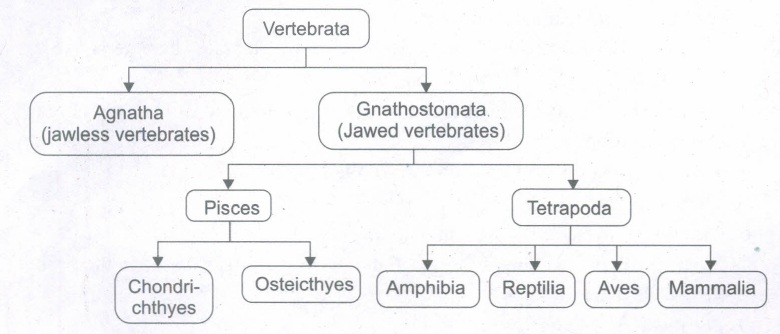
Classify the sub phylum Vertebrata.
13.
Write the functions of the following:
(i) Ctenidia
(ii) Ospharidiam.
14.
Animals such as sponges lack nervous tissue and muscle tissue, what does this tell you about sponges?
15.
What are comb Jellies or sea walnuts
16.
Explain the distinct features of Phylum Chordata.
17.
Write the general characters of the Class mammalia.
18.
What are the general features of Reptilians?
19.
Write the salient features of the phylum mollusca.
1.
(b)
Statocysts
2.
(d)
Coimbatore
3.
(a)
Amphibia
4.
(c)
Reptilia
5.
(b)
Cyclostomes
6.
| Diploblastic animals | Triploblastic animals | ||
| 1. | The animals in which the cells are arranged in two embryonic layers, the ectoderm and endoderm are called diploblastic animals. | 1. | The animals in which the cells are arranged in three embryonic layers, the ectoderm, mesoderm and endoderm are called triploblastic animals. |
| 2. | These are lower organisms. e.g. cnidaria, ctenophora |
2. | These are higher organisms. e.g. Platyhelminthes to Mammalia. |
7.
Cyclostomes are marine but migrate to fresh waters for spawning (anadromous migration). After spawning within a few days they die. The larvae (ammocoete) after metamorphosis returns to the ocean.
8.
In some animals, cells that perform similar functions are aggregated to form tissues. The cells of a tissue integrate in a highly coordinated fashion to perform a common function, due to the presence of nerve cells and sensory cells. This tissue level of organisation is exhibited in diploblastic animals like cnidarians. The formation of tissues is the first step towards evolution of body plan in animals (Hydra - Coelenterata).
9.
The left ovary is well developed while the right ovary is atrophied.
10.
1. Cyclostomes are marine but migrate to fresh waters for spawning. This is called anadromous migration.
2. After spawning they die within a few days. The larva after metamorphosis returns to the ocean.
11.
The Ctenophores have eight external rows of ciliated comb plates (comb jellies) in the mesoglea which help in locomotion. Hence they are commonly called as comb jellies or sea walnuts
12.
13.
(i) Ctenidia: MandIe cavity has a number of feather like gills (ctenidia) are present, which are respiratory in function.
(ii) Ospharidiam: The anterior head regim of molluscs has ospharidium to test the purity of water and present in bivalves and gasropods.
14.
1. Absence of nervous and muscular tissue indicates that sponges must have been one of the earliest forms in the course of evolution.
2. Absence of tissues indicate that the body organisation would have been at cellular level only without cells forming compact tissues.
3. Further this also indicates that sponges do not show locomotion since they have no means of gauging the surrounding because they lack muscular tissue.
4. They are sedentary since they lack muscular tissue
15.
The Ctenophores have eight external rows of ciliated comb plates (comb jellies) in the mesoglea which help in locomotion. Hence they are commonly called as comb jellies or sea walnuts.
16.
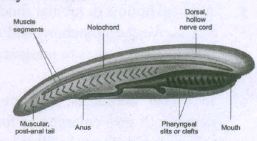
Chordata is the largest phylum with most familiar group of animals, such as fishes, amphibians, reptiles, birds and mammals and less known forms such as lancelets (Amphioxus) and tunicates (Ascidian). All chordates possess three fundamental distinct features at some stage of their life cyele.
1. Presence of elongated rod like notochord below the nerve cord and above the alimentary canal. It serves as a primitive internal skeleton.
2. It may persist throughout life in lancelets and lampreys. In adult vertebrates, it may be partially or completely replaced by backbone or vertebral column.
3. A dorsal hollow or tubular fluid filled nerve cord lies above the notochord and below the dorsal body wall. It serves to integrate and co-ordinate the body functions
17.
(i) Their body is covered by hair, a unique feature of mammals. Some of them are adapted to fly or live in water.
(ii) Presence of mammary glands-is the most unique feature of mammals.
(iii) They have two pairs of limbs adapted for walking, running, climbing, burrowing, swimming and flying.
(iv) Their skin is glandular in nature, consisting of sweat glands, scent glands and sebaceous glands.
(v) Exoskeleton includes horny epidermal horns, spines, scales, claws, nails, hooves and bony dermal plates.
(vi) Teeth are thecodont, heterodont and diphyodont.
(vii) External ears or pinnae are present.
(viii) The heart is four chambered and possess a left systematic arch. Mature RBCs are circular, biconcave and non nucleated.
(ix) Mammals have a large brain when compared to other animals.
(x) They show greatest intelligence among all animals. Their kidneys are metanephric and are ureotelic.
(xi) All are homeothermic, sexes are separate and fertilization is internal.
(xii) eg. Platypus, Kangaroo, Monkey, Elephant.
18.
(i) They are mostly terrestrial animals and their body is covered by dry, and cornified skin with epidermal scales or scutes.
(ii) Reptiles have three chambered heart but four chambered in crocodiles.
(iii) All are cold blooded amniotes.
(iv) Most reptiles lay cleidoic eggs with extraembryonic membranes like amnion, allantois, chorion and yolk sac.
(v) Excretion by metanephric kidneys and are uricotelic.
(vi) They are monoecious. Internal fertilization takes place and all are oviparous.
(vii) eg. Calotes (Garden Lizard), Draco (Flying Lizard), Crocodilus (Crocodile).
19.
(i) This is the second largest animal phylum.
(ii) Molluscs are terrestrial or aquatic (marine or fresh water) and exhibit organ system level of body organisation.
(iii) They are bilaterally symmetrical (except univalves), triploblastic and coelomate animals.
(iv) Body is covered by a calcareous shell and is unsegmented with a distinct head, muscular foot and a visceral hump or visceral mass.
(v) A soft layer of skin forms a mantle over the visceral hump. The space between the visceral mass and mantle (pallium) is called the mantle cavity.
(vi) A number of feather like gills (ctenidia) are present, which are respiratory in function.
(vii) The digestive system is complete and mouth contains a rasping organ called radula with transverse rows of chitinous teeth for feeding (radula is absent in bivalves).
(viii) The sense organs are tentacles, eyes and ospharidium (to test the purity of water and present in bivalves and gastropods).
(ix) Excretory organs are nephridia.
(x) Open type of circulatory system is seen except for cephalopods such as squids, cuttle fishes and octopuses. Blood contains haemocyanin, a copper containing respiratory pigment.
(xi) Development is indirect with a veliger larva.
(xii) eg. Pila (Apple snail).

11th Standard Syllabus & Materials
11th Standard
TN 11th Tamil பீடு பெற நில் - செய்யுள் - காவடிச்சிந்து Important Questions And Answers Study Material - QB365 Set A
NEW11th Standard
TN 11th Tamil பீடு பெற நில் - உரைநடை - மலை இடப்பெயர்கள் : ஓர் ஆய்வு Important Questions And Answers Study Material - QB365 Set A
NEW11th Standard
TN 11th Tamil மாமழை போற்றுதும் - துணைப்பாடம் - யானை டாக்டர் Important Questions And Answers Study Material - QB365 Set A
NEW11th Standard
TN 11th Tamil மாமழை போற்றுதும் - செய்யுள் - ஐங்குறுநூறு Important Questions And Answers Study Material - QB365 Set A



Tamilnadu Stateboard 11th Standard Subjects

Maths

Commerce

Economics
Biology

Business Maths and Statistics

Accountancy

Computer Science

Physics

Chemistry
Maths
Biology
Economics
Physics
Chemistry

History
Business Maths and Statistics

Computer Science
Accountancy

Computer Applications
History
Computer Technology
Commerce
Computer Applications
Computer Technology

Tamil

English

French
Tamilnadu Stateboard Standards

