
 100% FREE ACCESS
11th Standard Syllabus & Materials
11th Standard
TN 11th Tamil இயற்கை வேளாண்மை,சுற்றுச்சூழல் -செய்யுள் - மனோன்மணீயம் Important Questions And Answers Study Material - QB365 Set A
NEW11th Standard
TN 11th Tamil என்னுயிர் என்பேன் -துணைப்பாடம் - இசைத்தமிழர் இருவர் Important Questions And Answers Study Material - QB365 Set A
NEW11th Standard
TN 11th Tamil மொழி கலை -செய்யுள் - ஒவ்வொரு புல்லையும் Important Questions And Answers Study Material - QB365 Set A
NEW11th Standard
TN 11th Tamil பீடு பெற நில் - இலக்கணம் - பகுபத உறுப்புகள் Important Questions And Answers Study Material - QB365 Set A
NEW11th Standard
TN 11th Tamil பீடு பெற நில் - துணைப்பாடம் - வாடிவாசல் Important Questions And Answers Study Material - QB365 Set A
NEW11th Standard
TN 11th Tamil பீடு பெற நில் - செய்யுள் - குறுந்தொகை Important Questions And Answers Study Material - QB365 Set A

Published on: 05/12/2018
This is the most important model question paper for state board 11th Biology. Start revising all the portions for half yearly and get good marks in your examination. All the important questions from every chapter are covered in this question paper. It's nearing the examination. This is the right time to grab the model question papers and practice for the board exams. The questions are prepared based on the state board syllabus. It is a very useful question paper for Matriculation and state board students for their exam preparation.
By practicing repeatedly you will get the idea of answering the questions and this improves the speed of answering. This will save the time and you can complete all the questions without any last our tension.
Everyone has the same aim that is to reach the top rank list. We are paving the way for you to reach your goal. practice with important question papers and get set ready to crack your exams with confidence. Get more model question papers and practice for your examination.
Download Tamil Nadu 11th Standard Biology question papers, model tests, one-mark questions, important questions, and public exam papers in PDF format. Free study materials and answer keys for TN State Board students.
Questions + Answers key
Take MCQ Biology Test1.
Select the correctly matched one
| A) Human urine | i) Auxin –B |
| B) Corn gram oil | ii) GA3 |
| C) Fungus | iii) Abscisic acid II |
| D) Herring fish sperm | iv) Kinitin |
| E) Unripe maize grains | v) Auxin A |
| F) Young cotton bolls | vi) Zeatin |
| A | B | C | D | E | F |
| iii | iv | v | vi | i | ii |
| A | B | C | D | E | F |
| v | i | ii | iv | vi | iii |
| A | B | C | D | E | F |
| iii | v | vi | i | ii | iv |
| A | B | C | D | E | F |
| ii | iii | v | vi | iv | i |
2.
The compound which links glycolysis and Krebs cycle is _______.
Succinic acid
Pyruvic acid
Acetyl CoA
Citric acid
3.
Identify true statement regarding light reaction of photosynthesis.
Splitting of water molecule is associate with PS I.
PS I and PS II involved in the formation of NADPH + H+
The reaction center of PS I is Chlorophyll a with absorption peak at 680 nm.
The reaction center of PS II is Chlorophyll a with absorption peak at 700 nm.
4.
If a plant is provided with all mineral nutrients but, Mn concentration is increased, what will be the deficiency?
Mn prevent the uptake of Fe, Mg but not Ca
Mn increase the uptake of Fe, Mg and Ca
Only increase the uptake of Ca
Prevent the uptake Fe, Mg, and Ca
5.
In a fully turgid cell _____.
DPD = 10 atm; OP = 5 atm; TP = 10 atm
DPD = 0 atm; OP = 10 atm; TP = 10 atm
DPD = 0 atm; OP = 5 atm; TP = 10 atm
DPD = 20 atm; OP = 20 atm; TP = 10 atm
6.
7.
In Gymnosperms, the activity of sieve cells are controlled by _____.
Nearby sieve tube members
Phloem parenchyma cells
Nucleus of companion cells
Nucleus of albuminous cells
8.
All of the following are associated with the myelin sheath except.
Faster conduction of nerve impulses
Nodes of Ranvier forming gaps along the axon
Increased energy output for nerve impulse conduction
Saltatory conduction of action potential
9.
Examine the diagram of the two cell types A and B given below and select the correct option.
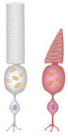
Cell-A is the rod cell found evenly all over retina
Cell-A is the cone cell more concentrated in the fovea centralis
Cell-B is concerned with colour vision in bright light
Cell-A is sensitive to bright light intensities
10.
Which of the given option shows all wrong statements for thyroid gland.
Statement
(i) It inhibits process of RBC formation
(ii) It helps in maintenance of water and electrolytes
(iii) Its more secretion can reduce blood pressure
(iv) It Stimulates osteoblast
(i) and (ii)
(iii) and (iv)
(i) and (iv)
(i) and (iii)
11.
12.
Inland fisheries are _____.
deep sea fishing
capturing fishes from sea coast
Raising and capturing fishes in fresh water
oil extraction from fish
13.
The protein present in the thick filament is _____.
myosin
actin
pectin
leucine
14.
15.
The end product of Ornithine cycle is _____.
carbon dioxide
uric acid
urea
ammonia
16.
Absorption of glycerol, fatty acids and monoglycerides takes place by ______.
Lymph vessels within villi
Walls of stomach
Colon
Capillaries within villi
17.
The sphincter of Oddi guards _____.
Hepatopancreatic duct
Common bile duct
Pancreatic duct
Cystic duct
18.
19.
Buccopharyngeal respiration in frog ______.
is increased when nostrils are closed
Stops when there is pulmonary respiration
is increased when it is catching fly
stops when mouth is opened.
20.
21.
Sea anemone belongs to phylum ________.
Protozoa
Porifera
Coelenterata
Echinodermata
22.
What taxonomic aid gives comprehensive information about a taxon?
Taxonomic Key
Herbarium
Flora
Monograph
23.
Curcuma amada, Curcuma domestica, Asparagus, Maranta are example of __________
Tuberous root
Beaded root
Moniliform root
Nodulose root
24.
In an inflorescence where flowers are borne laterally in an acropetal succession the position of the youngest floral bud shall be ______.
Proximal
Distal
Intercalary
Anywhere
25.
Identify the Archaebacterium.
Acetobacter
Erwinia
Treponema
Methanobacterium
26.
Proteins perform many physiological functions. For example some functions as enzymes. One of the following represents an additional function that some proteins discharge:
Antibiotics
Pigment conferring colour to skin
Pigments making colours of flowers
Hormones
27.
Keeping in view the fluid mosaic model for the structure of cell membrane which one of the following statements is correct with respect to the movement of lipids and proteins from one lipid monolayer to the other.
Neither lipid nor proteins can flip-flop
Both lipid and proteins can flip flop
While lipids can rarely flip-flop proteins cannot
While proteins can flip-flop lipids cannot
28.
The taxonomy which involves the similarities & dissimilarities among the immune system of different taxa is termed as ______.
Chemotaxonomy
Molecular systematics
Serotaxonomy
Numerical taxonomy
29.
In meiosis crossing over is initiated at ______.
Diplotene
Leptotene
Pachytene
Zygotene
30.
The haploid number of chromosome for an Angiosperm is 14, the number of chromosome in its endosperm would be
7
14
42
28
31.
What is Devernalization?
32.
33.
Why is that in certain plants deficiency symptoms appear first in younger parts of the plants while in others, they do so in mature organs?
34.
Comment on homeostasis.
35.
What is the effect of aldosterone on kidneys and where is it produced?
36.
Which segment is the site of secretion and regulated reabsorption of ions and pH homeostasis?
37.
Digestive secretions are secreted only when needed Discuss.
38.
Name the visual units of the compound eyes of cockroach.
39.
40.
State the protoplasm theory.
41.
Mention two characters shared by gymnosperms and angiosperms.
42.
Select the correct biological term
Lymphocytes, red cells, leucocytes, plasma, erythrocytes, white cells, haemoglobin, phagocyte, platelets, blood clot.
(a) Disc shaped cells which are concave on both sides.
(b) Most of these have a large, bilobed nucleus.
(c) Enable red cells to transport blood.
(d) The liquid part of the blood.
(e) Most of them move and change shape like an amoeba.
(f) Consists of water and important dissolved substances.
(g) Destroyed in the liver and spleen after circulating in the blood for four months.
(h) The substances which gives red cells their colour .
(i) Another name for red blood cells
(j) Blood that has been changed to a jelly
(k) A word that means cell eater.
(l) Cells without nucleus .
(m) White cells made in the lymphatic tissue.
(n) Blocks wound and prevent excessive bleeding.
(o) Fragment of cells which are made in the bone marrow.
(p) Another name for white blood cells.
(q) Slowly releases oxygen to blood cells.
(r) Their function is to help blood clot in wounds.
43.
Explain the different methods of asexual reproduction in fungi.
44.
Draw the ultrastructure of plant cell.
45.
What is plasticity?
46.
Write the role of nitrogenase enzyme in nitrogen fixation?
47.
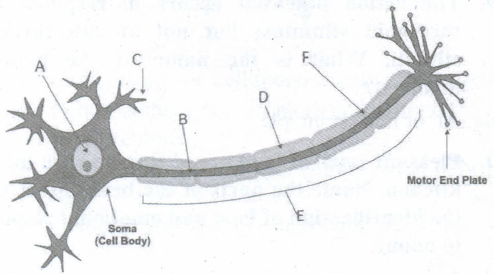
Label the parts of the neuron.
48.
Mention the advantages of MOET.
49.
How does an isometric contraction take place?
50.
Identify the biological term
Excretion, glomerulus, urinary bladder, glomerular filtrate, ureters,urine, Bowman’s capsule, urinary system, reabsorption, micturition, osmosis, proteins.
a. A liquid which gathers in the bladder.
b. Produced when blood is filtered in a Bowman’s capsule.
c. Temporary storage of urine.
d. A ball of intertwined capillaries.
e. Removal of unwanted substances from the body.
f. Each contains a glomerulus.
g. Carry urine from the kidneys to the bladder.
h. Scientific term for urination.
i. Regulation of water and dissolved substances in blood and tissue fluid.
j. Consists of the kidneys, ureters and bladder.
k. Removal of useful substances from glomerular filtrate.
l. What solute the blood contains that are not present in the glomerular filtrate?
51.
What are the heart sounds? When and how are these sounds produced?
52.
53.
List the unique features of bird's endoskeleton.
54.
Differentiate between aggregate fruit with multiple fruit.
1.
(b)
| A | B | C | D | E | F |
| v | i | ii | iv | vi | iii |
2.
(c)
Acetyl CoA
3.
(b)
PS I and PS II involved in the formation of NADPH + H+
4.
(a)
Mn prevent the uptake of Fe, Mg but not Ca
5.
(b)
DPD = 0 atm; OP = 10 atm; TP = 10 atm
6.
(b)
7.
(c)
Nucleus of companion cells
8.
(c)
Increased energy output for nerve impulse conduction
9.
(c)
Cell-B is concerned with colour vision in bright light
10.
(d)
(i) and (iii)
11.
(d)
12.
(c)
Raising and capturing fishes in fresh water
13.
(a)
myosin
14.
(c)
15.
(c)
urea
16.
(a)
Lymph vessels within villi
17.
(a)
Hepatopancreatic duct
18.
(c)
19.
(d)
stops when mouth is opened.
20.
(d)
21.
(c)
Coelenterata
22.
(a)
Taxonomic Key
23.
(d)
Nodulose root
24.
(a)
Proximal
25.
(d)
Methanobacterium
26.
(d)
Hormones
27.
(c)
While lipids can rarely flip-flop proteins cannot
28.
(c)
Serotaxonomy
29.
(c)
Pachytene
30.
(c)
42
31.
Reversal of the effect of vernalization is called devernalization
32.
33.
This is due to the immobile nature of minerals, Eg: Calcium.
34.
(i) Hormones coordinate different physical, physiological, mental activities and maintain homeostasis.
(ii) Maintenance of constant internal environment of the body by the different coordinating system.
35.
Aldosterone maintains renal blood flow to the kidneys. It is produced as medullary adrenal hormone in the adrenal gland of kidney.
36.
Distal convoluted tubule (DCT of nephron).
37.
(i) Ingested food is to be completely digested.
(ii) Digestive medium should become normal conditions.
(iii) Maximum utilization of digestive secretions is to be performed for the digestion of food.
(iv) The stimulation of digestive hormonal secretions is to be regulated.
38.
(i) Ommatidia are the visual units of compound eyes of cockroach.
(ii) Each ommatidium is functional as an eye unit.
(iii) Photoreceptors are dorsally found.
(iv) Each compound eye consists of 2000 simple eyes called ommatidia.
(v) All the visual images captured by ommatidia are made into a single coherent picture by supra oesophageal ganglion (brain).
39.
40.
(i) Corti first observed protoplasm Felix Dujardin (1835) observed a living juice in animal cell and called it "Sarcode". Purkinje (1839) coined the term protoplasm for sap inside a plant cell. Hugo Van Mohl (1846) indicated importance of protoplasm.
(ii) Max Schultze (1861) established similarity between Protoplasm and Sarcode and O. Hertwig (1892) proposed a theory which later called the 'protoplasm theory' Huxley (1868) proposed protoplasm as a "physical basis of life".
41.
(i) Presence of well organised plant body which is differentiated into roots, stem and leaves.
(ii) Presence of eustele.
42.
(a) Erythrocytes.
(b) Leucocytes (Not specific option)
(c) Question framed wrongly
(d) Plasma
(e) Phagocyte
(t) Plasma
(g) Erythrocyte
(h) Haemoglobin
(i) Erythrocyte
(j) Blood clot
(k) Phagocyte
(I) Erythrocytes / Platelets
(m) Leucocytes
(n) Blood clot
(o) Red Cells
(p) Leucocytes
(q) Haemoglobin
(r) Platelets
43.
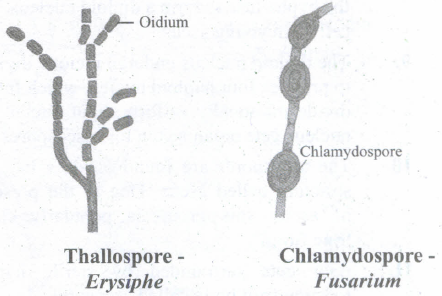
Asexual reproduction in Fungi:
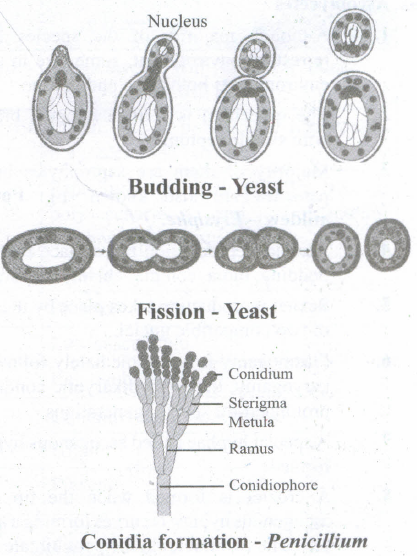
1. Zoospores : They are flagellate structures produced in zoosporangia. Eg : Chytrids.
2. Conidia : The spores produced on conidiophores. Eg: Aspergillus.
3. Oidia/Thallospores : The hypha divides and develop into spores called oidia. Eg : Erysiphe.
4. Fission : The vegetative cell divides into 2 daughter cells. Eg: Schizosaccharomyces- Yeast.
5. Budding: A small outgrowth is developed on parent cell, which gets detached and becomes independent. Eg: Saccharomyces - Yeast.
6. Chlamydospore: Thick walled resting spores are called chlamydospores Eg: Fusarium.
44.
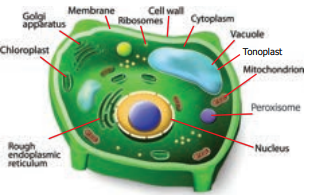
Ultrastructure of Plant Cell
45.
1) Plants follow different pathways in response to environment or phases of life to form different kinds of structures. This ability is called plasticity.
2) Example: Heterophylly in cotton and coriander. In such plants, the leaves of the juvenile plant are different in shape from those in mature plants.
3) On the other hand, the difference in shapes of leaves produced in air and those produced in water in buttercup also represent the heterophyllous development due to the environment. This phenomenon ofheterophylly is an example of plasticity.
46.
(i) Nitrogen fixation process requires Nitrogenase enzyme complex, Minerals (Mo, Fe and S), anaerobic condition, ATP, electron and glucose 6 phosphate as H+ donor.
(ii) Nitrogenase enzyme is active only in anaerobic condition.
(iii) To create this anaerobic condition a pigment known as leghaemoglobin is synthesized in the nodules which acts as oxygen scavenger and removes the oxygen.
47.
A- Nucleus with nucleolus'
B- Myelin sheath
C- Dendrites
D- Nucleus
E- Schwann cell
F- Node of Ranvier
48.
MOET-Multiple Ovulation embryo transfer technology:
1. Advantage of this technology is to produce high milk yielding females and high-quality meat yielding bulls in a short time.
2. It is applicable in animal husbandry.
3. It is a method of propagation of animals with desirable traits.
4. This method can be applied when the success rate of cross over even in low cost.
49.
Isometric contraction (iso- same, metric-distance):
1. In isometric contraction the length of the muscle does not change but the tension of the muscle changes.
2. Here, the force produced is changed.
3. Example: Pushing against a wall, holding a heavy bag.
50.
(a) Urine
(b) Glomerular filtrate
(c) Urinary bladder
(d) afferent and efferent arterioles and venules of renel artery and renel vein.
(e) Excretion
(f) Bowman's capsule
(g) Ureters
(h) Micturition
(i) Balance of electrolytes minerals and organics
(j) excretory system
(k) micturition
(l) glucose, amino acid and liquids
51.
There are usually two heart sounds they are
(i) 'lub' sound: It is the 1st sound produced by the closure of atrio ventricular valves (both tricuspid and bicuspid valves).
(ii) 'dub' sound: It is the 2nd sound produced by the closure of semilunar valves (both pulmonary aortic valves).
(iii) A 3rd abnormal sound may be produced with vibrations as "murmuring" under the dis-order of heart.
52.
53.
(i) Feathered vertebrates like birds have endoskeleton.
(ii) Flying birds have air filled hollow bones due to extension of air sacs of lungs. These bones are called as pneumatic bones.
(iii) In flying birds bones are very much demineralised.
(iv) In flying birds striated flight muscles well attached with carina of sternum.
(v) While in flightless birds bones are hard, compact and not filled by air but striated muscles are well attached to bones for leading, running and walking.
54.
| S.No. | Aggregate fruit | Multiple fruit |
| 1 | Aggregate fruits develop from a single flower having an apocarpous pistil. Each of the free carpel develops into a simple fruitlet. A collection of simple fruitlets makes an Aggregate fruit. An individual ovary develops into a drupe, achene, follicle or berry | A Multiple or composite fruit develops from the whole inflorescence along with its peduncle on which they are borne |
| 2 | Eg: Polyalthia | Eg: Pineapple |

11th Standard Syllabus & Materials
11th Standard
TN 11th Tamil பீடு பெற நில் - செய்யுள் - காவடிச்சிந்து Important Questions And Answers Study Material - QB365 Set A
NEW11th Standard
TN 11th Tamil பீடு பெற நில் - உரைநடை - மலை இடப்பெயர்கள் : ஓர் ஆய்வு Important Questions And Answers Study Material - QB365 Set A
NEW11th Standard
TN 11th Tamil மாமழை போற்றுதும் - துணைப்பாடம் - யானை டாக்டர் Important Questions And Answers Study Material - QB365 Set A
NEW11th Standard
TN 11th Tamil மாமழை போற்றுதும் - செய்யுள் - ஐங்குறுநூறு Important Questions And Answers Study Material - QB365 Set A



Tamilnadu Stateboard 11th Standard Subjects

Maths

Commerce

Economics
Biology

Business Maths and Statistics

Accountancy

Computer Science

Physics

Chemistry
Maths
Biology
Economics
Physics
Chemistry

History
Business Maths and Statistics

Computer Science
Accountancy

Computer Applications
History
Computer Technology
Commerce
Computer Applications
Computer Technology

Tamil

English

French
Tamilnadu Stateboard Standards

