
 100% FREE ACCESS
11th Standard Syllabus & Materials
11th Standard
TN 11th Tamil இயற்கை வேளாண்மை,சுற்றுச்சூழல் -செய்யுள் - மனோன்மணீயம் Important Questions And Answers Study Material - QB365 Set A
NEW11th Standard
TN 11th Tamil என்னுயிர் என்பேன் -துணைப்பாடம் - இசைத்தமிழர் இருவர் Important Questions And Answers Study Material - QB365 Set A
NEW11th Standard
TN 11th Tamil மொழி கலை -செய்யுள் - ஒவ்வொரு புல்லையும் Important Questions And Answers Study Material - QB365 Set A
NEW11th Standard
TN 11th Tamil பீடு பெற நில் - இலக்கணம் - பகுபத உறுப்புகள் Important Questions And Answers Study Material - QB365 Set A
NEW11th Standard
TN 11th Tamil பீடு பெற நில் - துணைப்பாடம் - வாடிவாசல் Important Questions And Answers Study Material - QB365 Set A
NEW11th Standard
TN 11th Tamil பீடு பெற நில் - செய்யுள் - குறுந்தொகை Important Questions And Answers Study Material - QB365 Set A

Published on: 15/09/2018
Model paper
Download Tamil Nadu 11th Standard Biology question papers, model tests, one-mark questions, important questions, and public exam papers in PDF format. Free study materials and answer keys for TN State Board students.
Questions + Answers key
Take MCQ Biology Test1.
Molecular taxonomic tool consists of ______.
DNA and RNA
Mitochondria and Endoplasmic reticulum
Cell wall and Membrane proteins
All the above
2.
Cladogram considers the following characters _______.
Physiological and Biochemical
Evolutionary and Phylogenetic
Taxonimic and systematic
None of the above
3.
4.
What taxonomic aid gives comprehensive information about a taxon?
Taxonomic Key
Herbarium
Flora
Monograph
5.
Which of the following is not present in same rank?
Primata
Orthoptera
Diptera
Insecta
6.
Every unit of classification regardless of its rank is _____.
Taxon
Variety
Species
Strain
7.
8.
A living organism is differentiated from non-living structure based on _______.
Reproduction
Growth
Metabolism
All the above
9.
Proteins perform many physiological functions. For example some functions as enzymes. One of the following represents an additional function that some proteins discharge:
Antibiotics
Pigment conferring colour to skin
Pigments making colours of flowers
Hormones
10.
The most basic amino acid is
Arginine
Histidine
Glycine
Glutamine
11.
12.
Patients with cardiac problems are advised to eat food cooked in vegetable oils with polyunsaturated fatty acid? Give reason.
13.
Are reducing sugars different from non-reducing sugars? If yes, give reasons.
14.
What is tRNA?
15.
16.
17.
Distinguish between Reducing sugars and Nonreducing sugars.
18.
Distinguish between nitrogenous base and a base found in inorganic chemistry.
19.
Given below is the diagrammatic representation of one of the categories of small molecular weight organic compounds in the living tissues. Identify the category shown & one blank component " X" in it.
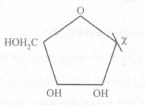
| Category | Compound |
| Cholesterol | Guanine |
| Amino acid | NH2 |
| Nucleotide | Adenine |
| Nucleoside | Uracil |
20.
Explain the structure of DNA with Watson and Crick modal.
21.
What are the types of cofactors? Explain each of them.
22.
Explain the role of Latin and Greek names in Biology.
23.
Describe the structure of DNA as proposed by Watson and Crick.
24.
Briefly describe the Enzyme cofactors.
25.
What are enzyme Inhibitors? Explain the two types of inhibitors?
26.
27.
Write a note on the Structure of proteins.
28.
Explain the different types of protein bonding
29.
Can we use recent molecular tools to identify and classify organisms?
30.
Differentiate between probiotics and pathogenic bacteria.
1.
(a)
DNA and RNA
2.
(b)
Evolutionary and Phylogenetic
3.
(a)
4.
(a)
Taxonomic Key
5.
(d)
Insecta
6.
(a)
Taxon
7.
(a)
8.
(d)
All the above
9.
(d)
Hormones
10.
(a)
Arginine
11.
12.
1. PUFA or Polyunsaturated fatty acids have one or more double bonds.
2. The clotting property of blood decreases due to high proportion of PUFA. Thus chances of blockage or blood clots are reduced.
13.
1. Yes. Reducing sugars have a free aldehyde or ketone group. They reduce cupric ions of Benedict's or Fehling's solution to form cuprous ions. Eg: Glucose.
2. Non-reducing sugars do not have a free aldehyde or ketone group. They do not respond to Benedict's / Fehling's solution. Eg: Sucrose.
14.
1. It is an RNA which translates the code from mRNA and transfers amino acids to the ribosome to build proteins.
2. It is highly folded into an elaborate 3D structure and comprises about 15% of total RNA
15.
16.
17.
| S.No | Reducing Sugars | non-reducing Sugars |
|---|---|---|
| 1 | The sugars have a free aldehyde or ketone group The sugars can reduce cupric ions of Benedict's or Fehling's solution to form brick red precipitate cuprous ions | A free aldehyde or ketone group is absent. They do not reduce cupric ions of Benedict's or Fehling's solution to cuprous ions |
| 2 | Eg: Glucose. | Eg: Sucrose. |
18.
| Nitrogenous base | Inorganic base |
| In nitrogenous base the basic character is because of lone pair electron called lewis base | Inorganic base is because of hydroxyl ion that is Arrhenius base |
| Eg: Pyridine, Pyrimidine | Eg: NaOH |
19.
| Category | Compound |
| Nucleoside | Uracil |
A Nitrogenous base is linked to pentose sugar through a N-glycosidic linkage and forms a nucleoside.
20.
(i) Watson and Crick shared the Nobel Prize in 1962 for their discovery, along with Maurice Wilkins, who. had produced the crystallographic data supporting the model. Rosalind Franklin (1920-1958) had earlier produced the first clear crystallographic evidence for a helical structure. James Watson and Francis Crick of Cavendish laboratory in Cambridge built a scale model of double helical structure of DNA which is the most prevalent form of DNA, the B-DNA. This is the secondary structure of DNA.
(ii) As proposed by James Watson and Francis Crick, DNA consists of right-handed double helix with 2 helical polynucleotide chains that are coiled around a common axis to form right-handed B form of DNA. The coils are held together by hydrogen bonds which occur between complementary pairs of nitrogenous bases. The sugar is called 2'. A deoxyribose because there is no hydroxyl at position 2'. Adenine and thiamine base pairs -has two hydrogen bonds while guanine and cytosine base pairs have three hydrogen bonds.
Chargaff's Rule:
(a) A = T; G = C
(b) A + G = T + C
(c) A: T = G: C = 1
(iii) As published by Erwin Chargaff in 1949, a purine pairs with pyrimidine and vice versa. Adenine (A) always pairs with Thymine (T) by double bond and Guanine (G) always pairs with Cytosine (C) by triple bond.
21.
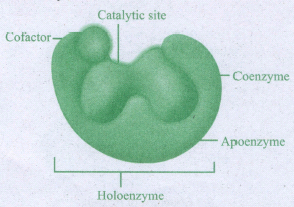
(i) Many enzymes require non-protein components called cofactors for their efficient activity. Cofactors may vary from simple inorganic ions to complex organic molecules. They are of three types: inorganic ions, prosthetic groups and coenzymes.
(ii) Holoenzyme: Active enzyme with its non-protein component.
(iii) Apoenzyme: The inactive enzyme without its non-protein component.
(iv) Inorganic ions help to increase the rate of reaction catalysed by enzymes. Example: Salivary amylase activity is increased in the presence of chloride ions.
(v) Prosthetic groups are organic molecules that assist in catalytic function of an enzyme. Flavin adenine dinucleotide (FAD) contains riboflavin (Vit B2), the function of which is to accept hydrogen. 'Haem' is an iron-containing prosthetic group with an iron atom at its centre.
(vi) Coenzymes are organic compounds which act as cofactors but do not remain attached to the enzyme. The essential chemical components of many coenzymes are vitamins. ego NAD, NADP, Coenzyme A, ATP.
22.
(i) The word biology itself is a greek word where bios means life and logos means study.
(ii) The role for latin and greek words are used in classification especially in Binomial classification.
(iii) Named to understand and remember the scientific names of organisms.
(iv) The Binomial nomenclature (L.Bio-two; Nomen-Name) Vector animals and Plants is largely derived from latin and Greek words.
(v) Binomial nomenclature was originally codified in the works of Carolus Linnaeus (1753), Species Plantarum.
(vi) Latin is now used by classical scholars, certain purpose in botany and in the medicine field.
(vii) The purpose is to give every species a distinct name which will be recognized everywhere became common names abundant species vary from country to country or even from region to region within a country.
(viii) using latin and greek forms simply refresh the main language of science when this system was invented.
(ix) Other languages words now used are given grammatical endings derived from the classical languages. Ex: Blakea atton boroaghi.
23.
Structure of DNA:
1. Watson and Crick shared the Nobel Prize in 1962 for their discovery, along with Maurice Wilkins, who had produced the crystallographic data supporting the model.
2. Rosalind Franklin (1920-1958) had earlier produced the first clear crystallographic evidence for a helical structure.
3. James Watson and Francis Crick of Cavendish built a scale model of double helical structure of DNA which is the most prevalent form of DNA, the B-DNA. This is the secondary structure of DNA.
4. DNA consists of right handed double helix with 2 helical polynucleotide chains that are coiled around a common axis to form right handed B form of DNA. .
5. The coils are held together by hydrogen bonds which occur between complementary pairs of nitrogenous bases. The sugar is called 2'-deoxyribose because there is no hydroxyl at position 2'.
6. Adenine and thymine base pairs has two hydrogen bonds while guanine and cytosine base pairs have three hydrogen bonds. As published by Erwin Chargaff in 1949, a purine pairs with pyrimidine and vice versa.
7. Adenine (A) always pairs with Thymine (T) by double bond and Guanine (G) always pairs with Cytosine (C) by triple bond.
Chargaff 's Rule:
A = T; G=C
A + G =T+ C
A : T=G:C = l
Features of DNA:
1. If one strand runs in the 5'-3' direction, the other runs in 3'-5' direction and thus are antiparallel (they run in opposite direction). The 5' end has the phosphate group and 3'end has the OH group.
2. The angle at which the two sugars protrude from the base pairs is about 120°, for the narrow angle and 240° for the wide angle.
3. Each base is 0.34 nm apart and a complete turn of the helix comprises 3.4 nm or 10 base pairs per turn in the predominant B form of DNA
4. DNA helical structure has a diameter of 20 A and a pitch of about 34 A. X-ray crystal study of DNA takes a stack of about 10 bp to go completely around the helix (360°).
5. Thermodynamic stability of the helix and specificity of base pairing includes
(i) The hydrogen bonds between nitrogenous bases.
(ii) Stacking interaction between bases of electron cloud interactions (IT - IT) between the bases
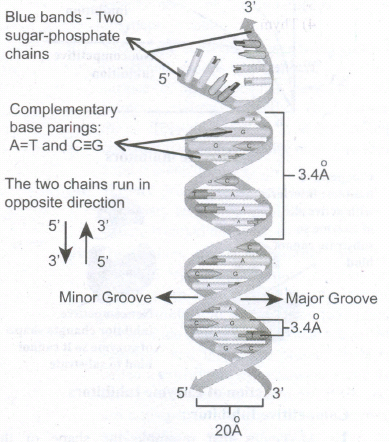
6. The phosphodiester linkages gives an inherent polarity to the DNA helix. They form strong covalent bonds, gives the strength and stability to the polynucleotide chain.
7. Plectonemic coiling - the two strands of the DNA are wrapped around each other in a helix, making it impossible to simply move them apart without breaking the entire structure. Whereas in paranemic coiling the two strands simply lie alongside one another, making them easier to pull apart.
8. Based on the helix and the distance between each turns, the DNA is of three forms - A DNA, B DNA and Z DNA.
24.
Many enzymes require non-protein components called cofactors for their efficient activity. Cofactors may vary from simple inorganic ions to complex organic molecules. They are of three types: Inorganic ions, Prosthetic groups and Coenzymes.
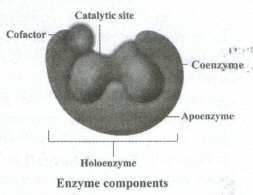
1. Holoenzyme - Active enzyme with its non protein component.
2. Apoenzyme - The inactive enzyme without its non-protein component.
3. Inorganic ions help to increase the rate of the reaction catalysed by enzymes. Eg: Salivary amylase activity is increased in the presence of chloride ions.
4. Prosthetic groups are organic molecules that assist in the catalytic function of an enzyme. Flavin adenine dinucleotide (FAD) contains riboflavin (vit B2), the function of which is to accept hydrogen. ";
5. Coenzymes are organic compounds which act as cofactors but do not remain attached to the enzyme. The essential chemical components of many coenzymes are vitamins. Eg. NAD, NADP, Coenzyme A, ATP.
25.
Certain substances present in the cells may react with the enzyme and lower the rate of reaction. These substances are called inhibitors. It is of two types competitive and non-competitive inhibitors.
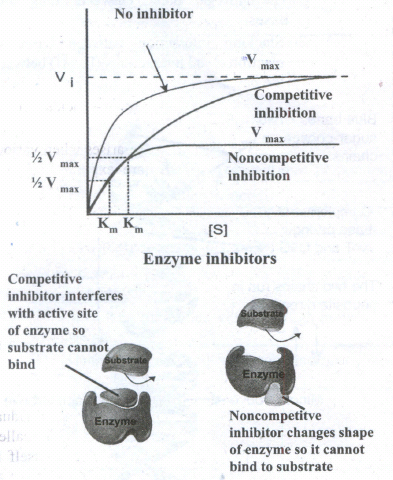
Competitive Inhibitor:
1. Molecules that resemble the shape of the substrate and may compete to occupy the active site of enzyme are known as competitive inhibitors.
2. Eg: The enzyme that catalyses the reaction between carbon dioxide and the CO2 acceptor molecule in photosynthesis, known as ribulose bisphosphate carboxylase oxygenase (RUBISCO) is competitively inhibited by oxygen/carbon-di-oxide in the chloroplast. The competitive inhibitor is malonate for succinic dehydrogenase.
Non-competitive Inhibitors:
1. There are certain inhibitors which may be unlike the substrate molecule but still combines with the enzyme.
2. This either blocks the attachment of the substrate to active site or change the shape so that it is unable to accept the substrate. Eg: The effect of the amino acids alanine on the enzyme pyruvate kinase in the final step of glycolysis.
(i) Certain non-reversible / irreversible inhibitors bind tightly and permanently to an enzyme and destroy its catalytic properties entirely. These could also be termed as poisons. Eg: Cyanide ions which blocks cytochrome oxidase in terminal oxidation in cell aerobic respiration.
26.
27.
1. Based on the R group amino acids are classified as acidic, basic, polar, non-polar.
2. The amino group of one amino acid reacts with carboxyl group of other amino acid, forming a peptide bond.
3. Two amino acids can react together with the loss of water to form a dipeptide. Long strings of amino acids linked by peptide bonds are called polypeptides. In 1953 Fred Sanger first sequenced the Insulin protein.
Structure of Protein:
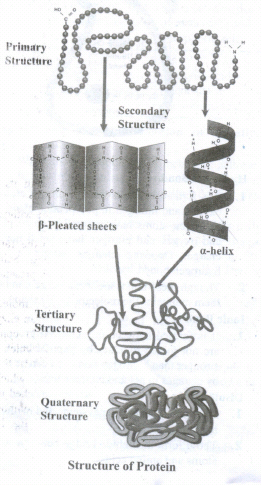
1. Protein is synthesised on the ribosome as a linear sequence of amino acids which are held together by peptide bonds.
2. After synthesis, the protein attains conformational change into a specific 3D form for proper functioning.
3. According to the mode of folding, four levels of protein organisation have been recognised namely primary, secondary, tertiary and quaternary
(i) The primary structure is linear arrangement of amino acids in a polypeptide chain.
(ii) Secondary structure arises when various functional groups are exposed on outer surface of the molecular interaction by forming hydrogen bonds. This causes the amino acid chain to twist into coiled configuration called a-helix or to fold into a flat \(\beta \) -pleated sheets.
(iii) Tertiary protein structure arises when the secondary level proteins fold into globular structure called domains.
(iv) Quaternary protein structure may be assumed by some complex proteins in which more than one polypeptide forms a large multi-unit protein. The individual polypeptide chains of the protein are called subunits and the active protein itself is called a multimer. Eg: Enzymes serve as catalyst for chemical reactions in cell and are non-specific. Antibodies are complex glycoproteins with specific regions of attachment for various organisms.
28.
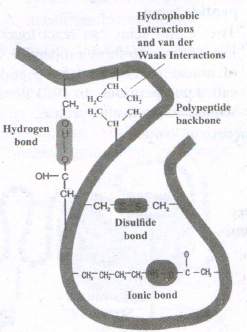
Hydrogen Bond:
1. It is formed between some hydrogen atoms of oxygen and nitrogen in a polypeptide chain. The hydrogen atoms have a small positive charge and oxygen and nitrogen have small negative charge. Opposite charges attract to form hydrogen bonds.
2. Though these bonds are weak, large number of them maintains the molecule in 3D shape.
Ionic Bond:
1. It is formed between any charged groups that are not joined together by peptide bond. It is stronger than hydrogen bond and can be broken by changes in pH and temperature.
Disulfide Bond:
1. Some amino acids like cysteine and methionine have sulphur.
2. These form disulphide bridge between sulphur atoms and amino acids.
Hydrophobic Bond:
1. This bond helps some protein to maintain structure.
2. When globular proteins are in solution, their hydrophobic groups point inwards away from water.
29.
(i) Yes we can use recent molecular tools to identify and classify organisms.
(ii) Eg: Automated species identification tools electron microscopy (for cellular organelles and molecular structures by neo taxonomical tools) behaviour of organisms by ethology of taxonomical tools and development of electronic digital images and description by INOTAXA or e- Taxonomic resources.
30.
| Probiotics | Pathogenic bacteria |
| Probiotic bacteria are beneficial. | Pathogenic bacteria are harmful. |
| Probiotic bacteria may be decomposers, photosynthetic and few may be pathogenic. | All are pathogenic and causing diseases. |

11th Standard Syllabus & Materials
11th Standard
TN 11th Tamil பீடு பெற நில் - செய்யுள் - காவடிச்சிந்து Important Questions And Answers Study Material - QB365 Set A
NEW11th Standard
TN 11th Tamil பீடு பெற நில் - உரைநடை - மலை இடப்பெயர்கள் : ஓர் ஆய்வு Important Questions And Answers Study Material - QB365 Set A
NEW11th Standard
TN 11th Tamil மாமழை போற்றுதும் - துணைப்பாடம் - யானை டாக்டர் Important Questions And Answers Study Material - QB365 Set A
NEW11th Standard
TN 11th Tamil மாமழை போற்றுதும் - செய்யுள் - ஐங்குறுநூறு Important Questions And Answers Study Material - QB365 Set A



Tamilnadu Stateboard 11th Standard Subjects

Maths

Commerce

Economics
Biology

Business Maths and Statistics

Accountancy

Computer Science

Physics

Chemistry
Maths
Biology
Economics
Physics
Chemistry

History
Business Maths and Statistics

Computer Science
Accountancy

Computer Applications
History
Computer Technology
Commerce
Computer Applications
Computer Technology

Tamil

English

French
Tamilnadu Stateboard Standards

