
 100% FREE ACCESS
11th Standard Syllabus & Materials
11th Standard
TN 11th Tamil இயற்கை வேளாண்மை,சுற்றுச்சூழல் -செய்யுள் - மனோன்மணீயம் Important Questions And Answers Study Material - QB365 Set A
NEW11th Standard
TN 11th Tamil என்னுயிர் என்பேன் -துணைப்பாடம் - இசைத்தமிழர் இருவர் Important Questions And Answers Study Material - QB365 Set A
NEW11th Standard
TN 11th Tamil மொழி கலை -செய்யுள் - ஒவ்வொரு புல்லையும் Important Questions And Answers Study Material - QB365 Set A
NEW11th Standard
TN 11th Tamil பீடு பெற நில் - இலக்கணம் - பகுபத உறுப்புகள் Important Questions And Answers Study Material - QB365 Set A
NEW11th Standard
TN 11th Tamil பீடு பெற நில் - துணைப்பாடம் - வாடிவாசல் Important Questions And Answers Study Material - QB365 Set A
NEW11th Standard
TN 11th Tamil பீடு பெற நில் - செய்யுள் - குறுந்தொகை Important Questions And Answers Study Material - QB365 Set A

Published on: 22/09/2018
Model paper
Download Tamil Nadu 11th Standard Biology question papers, model tests, one-mark questions, important questions, and public exam papers in PDF format. Free study materials and answer keys for TN State Board students.
Questions + Answers key
Take MCQ Biology Test1.
Osphradium of Pila globosa is _________
thermoreceptor
Pheretima
chemoreceptor
tangoreceptor
2.
Peripatus is known as a connecting link, because it has the characters of both _________
Fishes & amphibians
Reptiles & birds
Aves & fishes
Arthropoda & annelids
3.
Mollusca is _______
Triploblastic, acoelomate
Triploblastic, coelomate
Diploblastic, acoelomate
Diploblastic, coelomate
4.
Cavity of coelenterates is called ____________
coelenteron
coelom
cavity
none of these
5.
Classification of sponges is primarily based on the __________
body organization
body plan
skeleton
canal system
6.
Exoskeleton of which phylum consists of chitinous cuticle?
Annelida
Porifera
Arthropoda
Echinodermata
7.
The respiratory pigment in cockroach is _____.
Haemoglobin
Haemocyanin
Oxyhaemoglobin
None of the above
8.
Identify the Archaebacterium.
Acetobacter
Erwinia
Treponema
Methanobacterium
9.
Identify the incorrect statement about the Gram positive bacteria.
Teichoic acid absent
High percentage of peptidoglycan is found in cell wall
Cell wall is single layered
Lipopolysaccharide is present in cell wall
10.
Which one of the following statement about virus is correct?
Possess their own metabolic system
They are facultative parasites
They contain DNA or RNA
Enzymes are present
11.
Explain the reactions taking place in mitochondrial inner membrane.
12.
Grasses have an adaptive mechanism to compensate photorespiratory losses. Name and describe the mechanism.
13.
Explain Lysogenic cycle of a phage.
14.
A tree is believed to be releasing oxygen during night time. Do you believe the truthfulness of this statement? Justify your answer by giving reasons?
15.
Why blood is considered as a typical connective tissue?
16.
Identify the structure that the archenteron becomes in a developing animal.
17.
Compare closed and open circulatory system.
18.
List the features that all vertebrates show at some point in their development.
19.
Why reproduction cannot be the defining characteristic of living organisms?
20.
Why virus cannot grow on non-living culture medium.
21.
Why reproduction is necessary? Is it essential for survival? If a living organism does not reproduce, to which category will it belong, living or nonliving?
22.
Is bacterial photosynthesis similar to photosynthesis in higher plants? Reason out.
23.
Are viruses useful to us? Justify.
24.
New phages are not formed in lysogenic cycle. Explain.
25.
Write the general characters of the phylum cnidaria.
26.
27.
Define Aerobic respiration of bacteria.
28.
Write the characteristics of Bacterial chromosome.
29.
Write the importance of Need of Classification.
30.
Describe the step of Adsorption in lytic cycle of phages.
31.
Enumerate about Growth.
32.
Respiratory quotient is zero in succulent plants. Why?
33.
What is meant by 'living fabrics'?
34.
Name the excretory organs found in different animals (any four with examples).
35.
Match the following.
| Column I | Column II |
| (P) Euplectella | i) Sea anemone |
| (Q) Adamsia | ii) Filarial worm |
| (R) Wuchereria | iii) Venus flower basket |
| (S) Antedom | iv) Sea-Lily |
(a) (P-iii) (Q-i) (R-ii) (S-iv)
(b) (P-iv) (Q-ii) (R-iii) (S-i)
(c) (P-i) (Q-ii) (R-iv) (S-iii)
(d) (P-ii) (Q-i) (R-iv) (S-iii)
36.
Observe the animal below and answer the following questions.
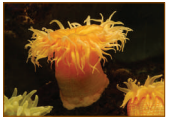
a. Identify the animal
b. What type of symmetry does this animal exhibit?
c. Is this animal Cephalized?
d. How many germ layers does this animal have?
e. How many openings does this animal's digestive system have?
f. Does this animal have neurons?
37.
Identify the diagram and label any 2 parts.
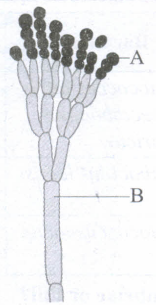
38.
What is Fimbriae or Pili?
39.
What are the three main symmetries of viruses?
40.
Distinguish Prokaryotic and Eukaryotic organisms.
1.
(c)
chemoreceptor
2.
(d)
Arthropoda & annelids
3.
(b)
Triploblastic, coelomate
4.
(a)
coelenteron
5.
(c)
skeleton
6.
(c)
Arthropoda
7.
(d)
None of the above
8.
(d)
Methanobacterium
9.
(d)
Lipopolysaccharide is present in cell wall
10.
(c)
They contain DNA or RNA
11.
Electron Transport Chain (ETC) (Terminal oxidation)
(i) During glycolysis, link reaction and Krebs cycle the respiratory substrates are oxidized at several steps and as a result many reduced coenzymes NADH + H+ and FADH2 are produced.
(ii) These reduced coenzymes are transported to inner membrane of mitochondria and are converted back to their oxidized forms produce electrons and protons.
(iii) In mitochondria, the inner membrane is folded in the form of finger projections towards the matrix called cristae.
(iv) In cristae many oxysomes (F1 particles) are present which have electron transport carriers are present.
(v) According to Peter Mitchell's Chemiosmotic theory this electron transport is coupled to ATP synthesis. Electron and hydrogen(proton) transport takes place across four multiprotein complexes(I-IV). They are:
a) Complex-I (NADH dehydrogenase)
(i) It contains a flavoprotein(FMN) and associated with non-heme iron Sulphur protein (Fe-S). This complex is responsible for passing electrons and protons from mitochondrial NADH (Internal) to Ubiquinone(UQ).
\(\mathrm{NADH}+\mathrm{H}^{+}+\mathrm{UQ} \rightleftharpoons \mathrm{NAD}^{+}+\mathrm{UQH}_{2}\)
(ii) In plants, an additional NADH dehydrogenase (External) complex is present on the outer surface of inner membrane of mitochondria which can oxidise cytosolic NADH + H+.
(iii) Because mitochondrial inner membrane cannot allow NADH molecules directly in to the matrix. Ubiquinone (UQ) or Coenzyme Quinone (CoQ) is a small, lipid soluble electron, proton carrier located within the inner membrane of mitochondria.
b) Complex-II (Succinic dehydrogenase)
(i) It contains FAD flavoprotein is associated with non-heme iron Sulphur (Fe-S) protein.
(ii) This complex receives electrons and protons from succinate in Krebs cycle and is converted into fumarate and passes to ubiquinone.

c) Complex-III (Cytochrome bc1 complex)
(i) This complex oxidises reduced ubiquinone (ubiquinol) and transfers the electrons through Cytochrome bc1 Complex (Iron Sulphur center bc1 complex) to cytochrome c.
(ii) Cytochrome c is a small protein attached to the outer surface of inner membrane and act as a mobile carrier to transfer electrons between complex III to complex IV.
\(\mathrm{UQH}_{2}+2 \mathrm{CytC}_{\text {oxidised }} \rightleftharpoons \mathrm{UQ}+2 \mathrm{Cytc}_{\text {reduced }}+2 \mathrm{H}^{+}\)
d) Complex IV (Cytochrome c oxidase)
(i) This complex contains two copper centers (A and B) and cytochromes a and a3. Complex IV is the terminal oxidase and brings about the reduction of 1/2 O2 to H2O.Two protons are needed to form a molecule of H2O (terminal oxidation).
\(2 \mathrm{CytC}_{\text {oxidised }}+2 \mathrm{H}^{+}+1 / 2 \mathrm{O}_{2} \rightleftharpoons 2 \mathrm{CytC}_{\text {reduced }}+\mathrm{H}_{2} \mathrm{O}\)
(ii) The transfer of electrons from reduced coenzyme NADH to oxygen via complexes I to IV is coupled to the synthesis of ATP from ADP and inorganic phosphate (Pi) which is called Oxidative phosphorylation.
(iii) The F0F1- ATP synthase (also called complex V) consists of F0 and F1. F1 converts ADP and Pi to ATP and is attached to the matrix side of the inner membrane.
(iv) F0 is present in inner membrane and acts as a channel through which protons come into matrix.
12.
(i) C4 cycle/Di - carboxylic acid pathway/ Di - carboxylation pathway is an adaptive mechanism.
(ii) It takes place in two phases. First phase takes place in stroma of mesophyll cells, where the CO2 acceptor molecule 3-Carbon compound, phosphoenol pyruvate (PEP) to form 4-carbon oxalo acetic acid (OAA). The first product is a 4-carbon and so it is named as C4 cycle. Oxalo acetic acid is a dicarboxylic acid and hence this cycle is also known as dicarboxylic acid pathway.
(iii) Carbondioxide fixation takes place in two places one in mesophyll and another in bundle sheath cell.
(iv) C4 plants requires 5 ATP and 2NADPH + H+ to fix one molecule of CO2.
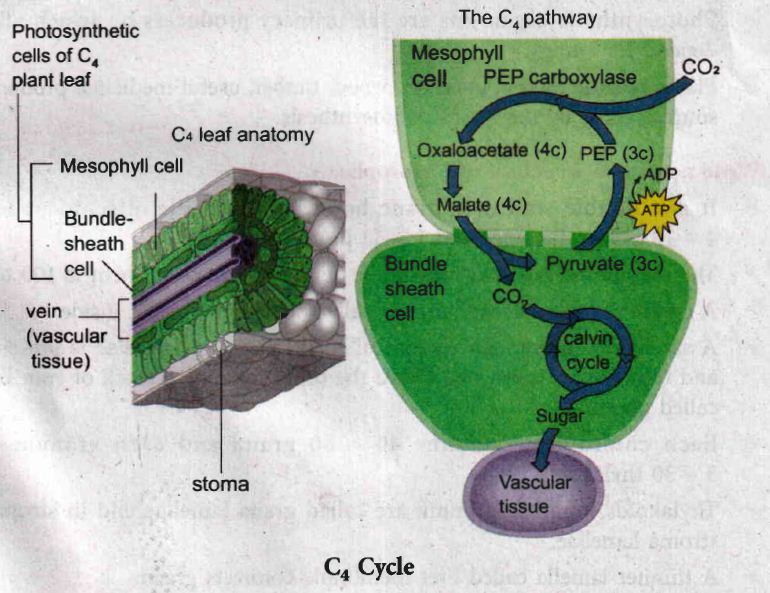
Stage: I Mesophyll Cells
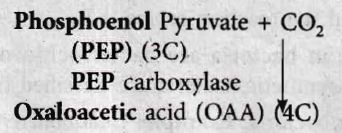
(i) Oxaloacetic acid (OAA) is converted into malic acid or aspartic acid and is transported to the bundle sheath cells through plasmodesmata.
Stage: II Bundle Sheath Cells
(i) Malic acid undergoes decarboxylation and produces a 3 carbon compound Pyruvic acid and CO2.
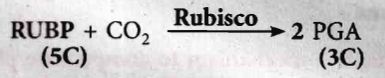
(ii) The released CO2 combines with RUBP and follows the calvin cycle and finally sugar is released to the phloem.
(iii) Pyruvic acid is transported to the mesophyll cells.
13.
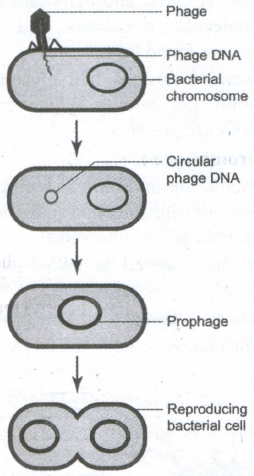
1. In the lysogenic cycle the phage DNA gets integrated into the DNA of the host cell and gets multiplied along with nucleic acid of the host. No independent viral particle is formed.
2. As soon as the phage injects its linear DNA into the host cell it becomes circular and integrates into the bacterial chromosome by recombination. The integrated phage DNA is now called prophage.
3. The activity of the prophage gene is repressed by two repressor proteins which are synthesized by phage genes. This checks the synthesis of new phages within the host cell.
4. However, each time the bacterial cell divides, the prophage multiplies along with the bacterial chromosome.
5. On exposure to UV radiation and chemicals the excision of phage DNA may occur and results in lytic cycle.
14.
(i) No. there is no scientific proof for this statement. During day time photosynthesis takes place oxygen is evolved.
(ii) This reaction requires light hence the above statement is incorrect.
15.
(i) Blood is a typical fluid connective tissue because it functions as the transport medium for the cardiovascular system.
(ii) Eg: Transport of nutrients and wastes and transport of respiratory gases throughout the body.
16.
(i) In the gastrula stage of embryo on the root of gastrocoel an archenteron is formed.
(ii) Archenteron develops chordodorsatis or notochord dorsally.
(iii) Its anterior end forms brain and posterior axis form spinal cord.
Eg: Hemichordates and chordates.
17.
The circulatory system is of two types,
1. Open type: The blood remains filled in tissue spaces due to the absence of blood capillaries.
Eg: Arthropods, Molluscs, Echinoderms, and Urochordates
2. Closed type: The blood Is circulated through blood vessels of varying diameters (arteries, veins, and capillaries)
Eg: Annelids, Cephalochordates and Vertebrates.
18.
(i) All the vertebrates commonly have dorsal nervous system
(ii) At the stage of development they have blastopore of embryo
(iii) Heart is developed ventrally
(iv) All vertebrates are three layered
(a) Ectoderm
(b) Mesoderm and
(c) Endoderm
(v) All verteberates are bilaterians
(vi) All verteberates are enterocoelomates
19.
1. There are many organisms, which never reproduce in their life, although all other characteristics of living things are present in them.
2. Eg: Sterile worker bees, mules, infertile human couples etc.,
3. Hence reproduction cannot be an all-inclusive defining property of living things.
20.
A virus cannot grow on non-living culture medium because it needs living cells for its metabolism and multiplication. They are obligate parasites.
21.
1. Reproduction is required for the perpetuation of a population.
2. It is not necessary for the survival of living organisms.
3. Many organisms. Eg: Mules, Sterile worker bees, infertile human couples are not able to reproduce, while they have all other defining properties of life, so they can be called as Living
22.
| S.No | Bacteria | Higher plants |
| 1 | H2S is hydrogen donor. | H2O is hydrogen donor. |
| 2 | Oxygen is not evolved | Oxygen is evolved |
| 3 | Chlorobium Chlorophyll is an example of pigment | Chlorophylls are the pigments involved in photosynthesis. |
23.
Though viruses are harmful, viruses of Baculoviridae group are commercially used as insecticides. Hence viruses act as biopesticides. Eg : Entomopox viruses
24.
The integrated phage DNA (Prophage) activity is suppressed by repressor proteins which checks the synthesis of new phage.
25.
1.The cnidaria is aquatic, radially symmetrical, and diploblastic.
2. The tentacles have stinging cells called cnidocytes or cnidoblasts or nematocysts.
3. They exhibit tissue level of organization.
4. They have a central gastrovascular cavity called coelenteron.
5. Digestion is both extracellular and intracellular.
6. Alternation of generation is seen in cnidarians which have polyp and medusa forms.
7. Development is indirect with planula larva e.g. Physalia.
26.
27.
1. These bacteria require oxygen as terminal acceptor and will not grow under anaerobic conditions (i.e. in the absence of O2) Example: Streptococcus Obligate aerobes of bacteria.
2. Some Micrococcus species are obligate aerobes (i.e. they must have oxygen to survive).
28.
1. The bacterial chromosome is, a single circular DNA molecule, tightly coiled and is not enclosed in a membrane as in Eukaryotes.
2. This genetic material is called Nucleoid or Genophore. It is amazing to note that the DNA of E.coli which measures about Imm long when uncoiled, contains all the genetic information of the organism.
3. The DNA is not bound to histone proteins. The single chromosome or the DNA molecule is circular and at one point it is attached to the plasma membrane and it is believed that this attachment may help in the separation of two chromosomes after DNA replication.
29.
1) Classification is essential to achieve following needs.
2) To relate things based on common characteristic features.
3) To define organisms based on the salient features.
4) Helps in knowing the relationship amongst different groups of organisms.
5) It helps in understanding the evolutionary relationship between organisms.
30.
1. Phage (T4) particles interact with cell wall of host (E.coli). The phage tail makes contact between the two, and tail fibres recognize the specific receptor sites present on bacterial cell surface.
2. The lipopolysaccharides of tail fibres act as receptor in phages.
31.
1. Growth is an intrinsic property of all living organisms through which they can Increase cells both in number and mass.
2. Unicellular and multicellular organisms grow by cell division.
3. In plants, growth is indefinite and occurs throughout their life.
4. In animals, growth is definite and occurs for some period.
5. However, cell division occurs in living organisms to repair and heal the worn out tissues.
32.
Because carbohydrates are partially oxidised to organic acid, particularly malic acid without corresponding release of CO2 but O2 is consumed. Hence the RQ value will be zero.
\(\underset { Glucose }{ 2{ C }_{ 6 }{ H }_{ 12 }{ O }_{ 6 }+3{ O }_{ 2 }\rightarrow } \underset { malic\quad acid }{ 3{ C }_{ 4 }{ H }_{ 6 }{ O }_{ 5 }+3{ H }_{ 2 }O+Energy } \)
RQ of glucose in succulents = \(\frac { Zero \ molecule \ of \ { CO }_{ 2 } }{ 3 \ molecules \ of \ { CO }_{ 2 } } \) = 0 (Zero)
33.
Tissues are organized in specific proportions and patterns to form organs like lungs, heart, stomach, kidneys, ovaries, testes etc. Hence the tissues are called the 'living fabrics'.
34.
| Excretory organ | Animal |
| 1. Flame cells /Solenocytes | Flatworms |
| 2. Nephridia | Annelids |
| 3. Malpighian tubules | Insects |
| 4. Kidneys | Vertebrates |
| 5. Green glands | Crustaceans |
35.
[Ans.(a)]
36.
a. Sea anemone
b. Radial symmetry
c. Not cephalized
d. Two
e. A single
f. Yes
37.
Penicillium - Conidia formation.
A- Conidium
B - Conidiophore
38.
1. Pili or Fimbriae are hair like appendages found on surface of cell wall of gram-negative bacteria.
Eg: Enterobacterium.
2. The pili are 0.2 to 20 11m long with a diameter of about 250A
3. In addition to normal pili there are special type of pili which help in conjugation called sex pili are also found.
39.
Generally, viruses are of three types based on shape and symmetry
1. Cuboid symmetry - Eg: Adenovirus, Herpesvirus.
2. Helical symmetry - Eg: Influenza virus, TMV.
3. Complex or Atypical symmetry - Eg: Bacteriophage, Vaccinia virus.
40.
| S.No | Prokaryotic | Eukaryotic |
|---|---|---|
| 1. | Unicellular Organisms | Unicellular or multicellular organisms |
| 2. | Lack membrane-bound nucleus | Definite nucleus is present bound by nuclear membrane |
| 3. | Organelles like mitochondria, endoplasmic reticulum are absent. | Organelles like mitochondria, endoplasmic reticulum are present. |
| 4. | Eg: Amoeba | Eg: Oedogonium |

11th Standard Syllabus & Materials
11th Standard
TN 11th Tamil பீடு பெற நில் - செய்யுள் - காவடிச்சிந்து Important Questions And Answers Study Material - QB365 Set A
NEW11th Standard
TN 11th Tamil பீடு பெற நில் - உரைநடை - மலை இடப்பெயர்கள் : ஓர் ஆய்வு Important Questions And Answers Study Material - QB365 Set A
NEW11th Standard
TN 11th Tamil மாமழை போற்றுதும் - துணைப்பாடம் - யானை டாக்டர் Important Questions And Answers Study Material - QB365 Set A
NEW11th Standard
TN 11th Tamil மாமழை போற்றுதும் - செய்யுள் - ஐங்குறுநூறு Important Questions And Answers Study Material - QB365 Set A



Tamilnadu Stateboard 11th Standard Subjects

Maths

Commerce

Economics
Biology

Business Maths and Statistics

Accountancy

Computer Science

Physics

Chemistry
Maths
Biology
Economics
Physics
Chemistry

History
Business Maths and Statistics

Computer Science
Accountancy

Computer Applications
History
Computer Technology
Commerce
Computer Applications
Computer Technology

Tamil

English

French
Tamilnadu Stateboard Standards

