
 100% FREE ACCESS
11th Standard Syllabus & Materials
11th Standard
TN 11th Tamil இயற்கை வேளாண்மை,சுற்றுச்சூழல் -செய்யுள் - மனோன்மணீயம் Important Questions And Answers Study Material - QB365 Set A
NEW11th Standard
TN 11th Tamil என்னுயிர் என்பேன் -துணைப்பாடம் - இசைத்தமிழர் இருவர் Important Questions And Answers Study Material - QB365 Set A
NEW11th Standard
TN 11th Tamil மொழி கலை -செய்யுள் - ஒவ்வொரு புல்லையும் Important Questions And Answers Study Material - QB365 Set A
NEW11th Standard
TN 11th Tamil பீடு பெற நில் - இலக்கணம் - பகுபத உறுப்புகள் Important Questions And Answers Study Material - QB365 Set A
NEW11th Standard
TN 11th Tamil பீடு பெற நில் - துணைப்பாடம் - வாடிவாசல் Important Questions And Answers Study Material - QB365 Set A
NEW11th Standard
TN 11th Tamil பீடு பெற நில் - செய்யுள் - குறுந்தொகை Important Questions And Answers Study Material - QB365 Set A

Published on: 27/12/2018
11th Half Yearly Model Question
Download Tamil Nadu 11th Standard Biology question papers, model tests, one-mark questions, important questions, and public exam papers in PDF format. Free study materials and answer keys for TN State Board students.
Questions + Answers key
Take MCQ Biology Test1.
What are phytochromes?
2.
A cross section of tree trunk contains 60 lighter and 60 darker rings. Determine the age of the tree and justify.
3.
Why do some people have curly hair?
4.
Explain the different types of placentation with example.
5.
Write the characteristics of phycomycetes in fungus.
6.
Write the physiological effects of Cytokinins.
7.
Write the role of nitrogenase enzyme in nitrogen fixation?
8.
What is the significance of melanin?
9.
10.
What is colitis?
11.
Draw a neat labelled diagram of the digestive system of frog.
12.
Do you agree with the statement 'Bryophytes need water for fertilization'? Justify your answer.
13.
Energy needed for ATP synthesis in PS II comes from____________.
Proton gradient
Electron gradient
Reduction of glucose
Oxidation of glucose
14.
Which among the following are common to facilitated diffusion and active transport?
depend on respiratory energy
transport along concentration gradient
involvement of carrier proteins
all the above
15.
Which of the following has exoskeleton of scales and paired copulatory organ or penis?
Sharks
Lizards
Urodela
Urochordata
16.
__________________ribosomes are present in the outer surface of the endoplasmic reticulum.
Cisternae
Vesicles
Tubules
Rough Endoplasmic Reticulum
17.
Tubular corolla with a single strap-shaped limb ________________.
Personate
Ligulate
Apotepalous
Syntepalous
18.
State whether the statement is true or false
To sustain themselves, earthworms must guide their way through the soil using their powerful muscles. They gather nutrients by ingesting organic matter and soil, absorbing what they need into their bodies.The two ends of the earthworm can equally ingest soil.
True
False
19.
Select the correctly matched one
| A) Human urine | i) Auxin –B |
| B) Corn gram oil | ii) GA3 |
| C) Fungus | iii) Abscisic acid II |
| D) Herring fish sperm | iv) Kinetin |
| E) Unripe maize grains | v) Auxin A |
| F) Young cotton bolls | vi) Zeatin |
| A | B | C | D | E | F |
| iii | iv | v | vi | i | ii |
| A | B | C | D | E | F |
| v | i | ii | iv | vi | iii |
| A | B | C | D | E | F |
| iii | v | vi | i | ii | iv |
| A | B | C | D | E | F |
| ii | iii | v | vi | iv | i |
20.
Read the following sentences and identify the correctly matched sentences.
i. In exarch condition, the protoxylem lies outside of metaxylem.
ii. In endarch condition, the protoxylem lie towards the centre.
iii. In centarch condition, metaxylem lies in the middle of the protoxylem.
iv. In mesarch condition, protoxylem lies in the middle of the metaxylem.
i, ii and iii only
ii, iii and iv only
i, ii and iv only
All of these
21.
The cerebrum is divided into ________ lobes.
6
7
8
4
22.
Which of the given option shows all wrong statements for thyroid gland.
Statement
(i) It inhibits process of RBC formation
(ii) It helps in maintenance of water and electrolytes
(iii) Its more secretion can reduce blood pressure
(iv) It Stimulates osteoblast
(i) and (ii)
(iii) and (iv)
(i) and (iv)
(i) and (iii)
23.
Say True or False.
Worker bee prepares bee-bread to feed the larvae
True
false
24.
CO2 is transported through blood to lungs as _____.
carbonic acid
oxyhaemoglobin
carbamino haemoglobin
carboxy haemoglobin
25.
Aldosterone acts at the distal convoluted tubule and collecting duct resulting in the absorption of water through _____.
Aquaporins
Spectrins
GLUT
Chloride channels
26.
A living organism is differentiated from non-living structure based on _______.
Reproduction
Growth
Metabolism
All the above
27.
Food poisoning is caused by ______________
Yersinia
Clostridium
Treponema
Vibrio
28.
Example for negatively geotropic roots __________
Ipomoea, Dahlia
Asparagus, Ruellia
Vitis, Portulaca
Avicennia, Rhizophora
29.
What is "bundle cap" or "hard bast"?
30.
What is etiolation?
31.
Name any two unique structures/organelles of a plant cell.
32.
If too much of protein consumed more than the normal need, what will happen to the excess of protein consumed?
33.
Name the following.
i. The largest bee in the colony.
ii. The kind of flight which the new virgin queen takes along with the drones out of the hive.
34.
Name the contractile proteins present in the skeletal muscle
35.
Explain the heart’s role in secreting a hormone that regulates renal function? What hormone is this?
36.
If the afferent arteriole of the nephron constricts, what happens to the GFR in that nephron? If the efferent arteriole constricts what happens to the GFR in that nephron? Assume that no autoregulation takes place.
37.
Head of cockroach is called hypognathous. Why?
38.
How does the male frog attract the female for mating?
39.
Differentiate protostomia and Deuterostomia.
40.
Distinguish between apocarpous and syncarpous ovary.
41.
Explain Chemiosmotic theory.
42.
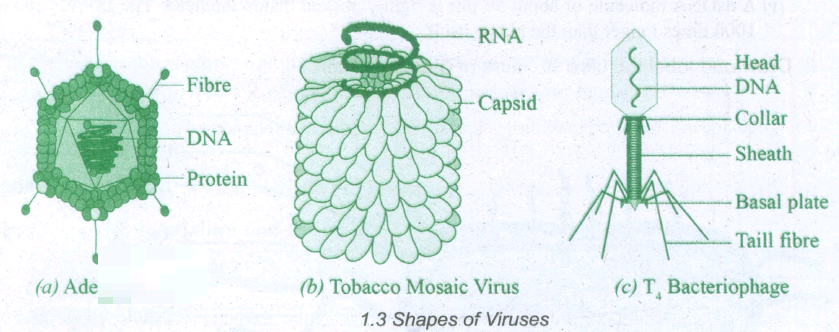
Draw the structure of different types of viruses and explain.
43.
Name the layers of adrenal cortex and mention their secretions.
44.
Identify the following structures and explain their significance in renal physiology?
(a) Juxtaglomerular apparatus
(b) Podocytes
(c) Sphincters in the bladder
45.
Describe the internal structure of human heart.
46.
Write down the economic importance of Family Fabaceae.
1.
Phytochrome is a bluish biliprotein pigment responsible for perception of light in photo physiological process. It was named by Butler et a1 and exists in two inter convertible forms - Pr (red . r light absorbing pigment)' and (Pfr - far red light absorbing pigment).
2.
60 years old - Age of the Tree.
Reason:
(i) In the cross section of the tree trunk, the lighter (spring wood) and darker (Autumn wood) rings appear in the form of concentric circles.
(ii) One spring wood circle and one autumn wood circle together constitute an annual ring.
(iii) Thus one dark and one light ring would have been formed every year.
(iv) 60 dark and 60 light rings indicate the age of the tree as 60 years.
3.
Human hair is made of protein. The more the distance between the sulphur atoms, the more the proteins bend; the more the hair curls.
4.
| 1. Marginal (i) It is with the placentae along the margin of a unicarpellate ovary. (ii) Eg: Fabaceae. |
4. Axile (i) The placentae arises from the column in a compound ovary with septa. (ii) Eg: Hibiscus, tomato lemon |
| 2. Superficial (i) Ovules arise from the surface of the septa. (ii) Eg: Nymphaeaceae |
5. Parietal (i) It is the placentae on the ovary walls or upon intruding partitions of a unilocular, compound Ovary. (ii) Eg: Mustard, Argemone, cucumber. |
| 3. Free-central (i) It is with the placentae along the column in a compound ovary without septa. (ii) Eg: Caryophyllaceae, Dianthus, Primrose |
6. Basal (i) It is the placenta at the base of the ovary. (ii) Eg: Sunflower(Asteraceae) Marigold |
5.
1. Among these 'Phycomycetes' include fungal species of Oomycetes, Chytridiomycetes and Zygomycetes which are considered as lower fungi indicatlng algal origin of fungi.
2. Constantine J. Alexopoulos and Charles W. Mims in the year 1979 proposed the classification of fungi in the book entitled 'Introductory Mycology'.
3. They classified fungi into three divisions namely Gymnomycota, Mastigomycota and Amastigomycota. There are 8 subdivisions, 11 classes, 1 form class and 3 form subclasses in the classification proposed by them.
4. The salient features of some of the classes - Oomycetes, Zygomycetes, Ascomycetes, Basidiomycetes and Form class Deuteromycetes are discussed below.
5. With the advent of molecular methods, fungi traditionally studied by mycologists at present fall into 3 kingdom of Eukaryota.
6. The Eumycota include only fungi and protozoa and chromista which accommodates (myxomycetes, Oomycetes) formerly placed in fungi.
6.
Physiological effect:
1) Cytokinin promotes cell division in the presence of auxin (IAA).
2) Induces cell enlargement associated with IAA and gibberellins
3) Cytokinin can break the dormancy of certain light-sensitive seeds like tobacco and induces seed germination.
4) Cytokinin promotes the growth of lateral bud in the presence of apical bud.
5) Application of cytokinin delays the process of aging by nutrient mobilization.
6) It is known as Richmond Lang effect.
7) Cytokinin
(i) increases rate protein synthesis
(ii) induces the formation of inter-fascicular cambium
(iii) overcomes apical dominance
(iv) induces formation of new leaves, chloroplast and lateral shoots.
8) Plants accumulate solutes very actively with the help of cytokinins.
7.
(i) Nitrogen fixation process requires Nitrogenase enzyme complex, Minerals (Mo, Fe and S), anaerobic condition, ATP, electron and glucose 6 phosphate as H+ donor.
(ii) Nitrogenase enzyme is active only in anaerobic condition.
(iii) To create this anaerobic condition a pigment known as leghaemoglobin is synthesized in the nodules which acts as oxygen scavenger and removes the oxygen.
8.
Melanocytes are the cells responsible for producing the skin pigment, melanin, which gives skin its colour and protects it from the sun's UV rays.
9.
10.
1. The intestinal tract is more prone to bacterial, viral and parasitic worm infections.
2. This infection may cause inflammation of the inner lining of the colon called colitis.
3. The most common symptoms of colitis are rectal bleeding, abdominal cramps, and diarrhoea.
11.
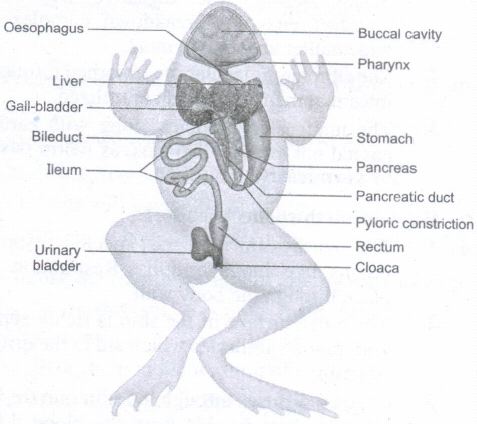
12.
Yes. The antheridia produce biflagellate antherozoids which swim in thin film of water and reach the archegonium and fuse with the egg to form diploid Zygote. Hence they need water for completing their life cycle.
13.
(a)
Proton gradient
14.
(a)
depend on respiratory energy
15.
(b)
Lizards
16.
(d)
Rough Endoplasmic Reticulum
17.
(b)
Ligulate
18.
(b)
False
19.
(b)
| A | B | C | D | E | F |
| v | i | ii | iv | vi | iii |
20.
(c)
i, ii and iv only
21.
(c)
8
22.
(d)
(i) and (iii)
23.
(a)
True
24.
(c)
carbamino haemoglobin
25.
(a)
Aquaporins
26.
(d)
All the above
27.
(b)
Clostridium
28.
(d)
Avicennia, Rhizophora
29.
In Dicot stem, a few layers of sclerenchyma cells occur in patches outside the phloem in each vascular bundle. This patch of sclerenchyma is called Bundle cap or Hard bast.
30.
Absence of light may lead to yellowish colour in plants. This is called etiolation. Light is important for photosynthesis.
31.
Cell wall, Chloroplast
32.
If too much of protein is consumed, the body cannot store the excess amino acids formed from the digestion of proteins. The liver breaks down the excess amino acids and produces urea. Blood in the hepatic vein has a high concentration of urea than the blood in other vessels namely, hepatic portal vein and hepatic artery.
33.
1. Queen bee
2. Nuptial flight
34.
Actin, myosin, meromyosin, tropomyosin and troponin.
35.
Excessive stretch of cardiac atrial cells cause an increase in blood flow to the auricles of the heart and release ANF (Atrial natriuretic peptide or factor) which stimulates the increase Na+ excretion. Chemoreceptors like carotid bodies formed in the heart.
36.
(i) Blood supply to kidney's is reduced.
(ii) Disposal of blood from the kidney's is reduced.
(iii) Autoregulation of micturition is disturbed.
37.
(i) The head is small, triangular and lies at right angle to the longitudinal axis of the body.
(ii) The mouth parts are directed downwards so it is hypognathous.
38.
Male frog attracts female frog by amplifying its croaking sound during breeding season.
39.
Protostomia:
It includes the eumetazoans in which the embryonic blastopore develops into mouth.
Deuterostomia:
a. Eumetazoans in which anus is formed from or near the blastopore and the mouth is formed away from the blastopore.
b. They have a true coelom called enterocoel, formed from the archenteron.
40.
1. In the multicarpellary ovary, when the carpels are free, it is called Apocarpous ovary. Eg: Polyalthia.
2. When the carpels are united, it is called Syncarpous ovary, Eg: Hibiscus.
41.
Chemiosmotic theory was proposed by P. Mitchell (1966)
1) ATP synthesis is linked to development of proton gradient a cross the membranes thylakoids.
2) Electrons are transported along the membrane through PS I and PS II and connected by cytochrome b6 - f complex.
3) Splitting of water molecule takes place inside of the membrane. Protons or H+ ions accumulate within the lumen of the thylakoid (1000-2000 times) Protons are less in number in strong. A proton gradient is formed.
4) These protons move across the membrane because the primary acceptor of electron is located outside the membrane.
5) The proton gradient is broken down due to the movement of proton across the membrane to the strong through CF6 of the ATP synthase enzyme.
This proton motive force created in the lumen of thylakoid or chemical stimulates ATP generation.
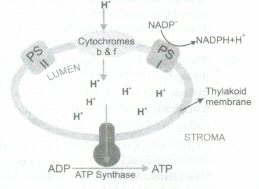
The evolution of one oxygen molecule (4 electrons required) requires 8 quanta of light. C3 plants utilise 3 ATPs and 2 NADPH + H+ to evolve one Oxygen molecule. To evolve 6 molecules of Oxygen 18 ATPs and 12 NADPH + H+ are utili sed. C4 plants utilise 5 ATPs and 2 ADPH + H+ to evolve one oxygen molecule. To evolve 6 molecules of Oxygen, 30 ATPs and 12 NADPH + H+ are utilised.
42.
Viruses are ultramicroscopic particles. They are smaller than bacteria and their diameter range from 20 to 300 nm (lnm = 1O-9'metres). Bacteriophage measures about 10 - 100 nm in size.
The size ofTMV is 300 x 20 nm.
Generally viruses are ofthree typesbased on shape and symmetry.
(i) Cuboid symmetry - ego Adenovirus, Herpes virus.
(ii) Helical symmetry - ego Influenza virus, TMV.
(iii) Complex or Atypical - ego Bacteriophage, Vaccinia virus
43.
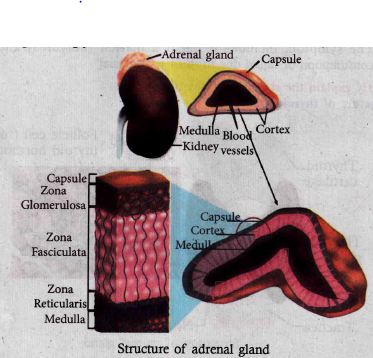
(i) A pair of adrenal glands are located at the anterior end of the kidneys. The outer region is the cortex and the inner region is the medulla.
(ii) The adrenal cortex has three distinct zones, they are 1. Zona glomerulosa 2. Zona fasciculata and 3. Zona reticularis.
(iii) Zona glomerulosa an outer thin layer constitutes about 15% of adrenal cortex and its secretes mineralocorticoids.
(iv) Zona fasciculata, the middle layer constitutes about 75% of adrenal cortex and secretes glucocorticoids such as cortisol, corticosterone and trace amounts of adrenal androgen and oestrogen.
(v) Zona Reticularis, an inner zone of adrenal cortex constitute about 10% of adrenal cortex and secretes the adrenal cortex androgen, trace amount of oestrogen and glucocorticoids.
44.
(a) Some nephrons, have very long loop of Henle that run deep into the medulla are called juxtamedullary nephrons which aid in filtration from glomerulus.
(b) Podocytes are the filtration slits.
(c) Sphincters of urinary bladder are internal paired (involuntary) and external paired (voluntary) control micturition.
45.
Structure of human heart (L.S)
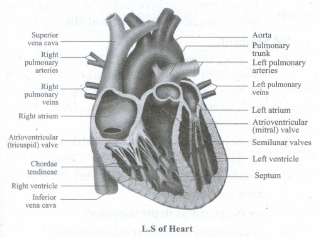
(i) Raymond de Vieussens in 1706 described the structure of heart.
(ii) Heart is made up of cardiac muscles.
(iii) Heart lies in the thoracic cavity (mediastinum) the space between the two lungs).
(iv) Its apex part is slightly tilted towards left.
(v) In adult human it weighs about 300g.
(vi) Its size is roughly equal to a closed fist of forelimb.
(vii) Heart is divisible into 4 chambers upper two small atria and lower two large ventricles.
(viii) Atria are separated by interauricular septum.
(ix) Ventricles are separated by interventricular septum.
(x) Due to the presence of these septae mixing of blood is prevented.
(xi) The walls of ventricles are thicker than atria.
(xi) The thickness of ventricles is due to the presence of papillary muscles.
(xii) The heart is enveloped by three layers an outer epicardium, middle myocardium and an inner endocardium.
(xiii) Overall the heart is enveloped by double membranous pericardium called pericardium.
(xiv) The space between the two membranes is interpericardial space filled by pericardial fluid.
(xv) Atria communicate with the ventricles by atrioventricular apertures.
(i) Such apertures are guarded by atrioventricular valves
(a) Tricuspid valve between right atrium and right ventricle
(b) Bicuspid or mitral valve between left atrium and left ventricle
(ii) Atrio-ventricular valves prevent the backward flow of blood from ventricles to atria.
(iii) Semilunar valves in ventricles prevent the backward flow of blood into ventricles and direct the flow of blood into aorta and pulmonary artery in the left ventricle and right ventricle respectively.
(iv) Each semilunar valve is made up of three half moon shaped cusps.
(v) The middle myocardium shows an irregular muscular ridges called trabeculae carneae.
(vi) The modified trabeculae carneae are called chordae tendineae.
(vii) The chordae tendineae hold the valves in the heart under fixed position.
(viii) The chordae tendineae are attached to the lower end of the heart by papillary muscles.
(ix) The main venous blood vessels like Inferior vena cava and superior vena cava and a small coronary sinus collect deoxygenated blood from entire body and transport such deoxygenated into right atrium.
(x) Pulmonary veins from the lungs bring oxygenated to the left atrium.
46.
| Economic importance | Binomial | Useful part | Uses |
| Pulses | Cajanus cajan (Pigeon Pea) Phaseolus vulgaris (French bean) |
Seeds | Sources of protein and starch of our food |
| Food plants | Sesbania grandiflora (agathi, vegetable humming bird) Cyamopsis tetragonoloba (cluster bean) |
Leaves Tender fruits |
Greens Vegetable |
| Oil Plants | Arachis hypogaea (Ground nut) Pongamia pinnata (Pungam) |
Seeds Seeds |
Oil extracted from the seeds is edible and used for cooking. |
| Timber Plants | Dalbergia latifolia (rose wood) Pterocarpus santalinus (red sandalwood) |
Timber | Timber is used for making furniture, cabinet articles and as building materials. |
| Medicinal Plants | Crotalaria albida Mucuna pruriens |
Roots Seeds |
Used as purgative Neurological remedy |
| Fibre Plants | Crotalaria juncea (sunhemp), Sesbania aegyptiaca (sesban) | Stem fibres (Bast) | Used for making ropes |
| Dye Plants | Indigofera tinctoria (Avuri) | Leaves | Indigo dye obtained from leaves is used to colour printing and in paints. Blue dye is obtained. |
| Green Manuring | Indigofera tinctoria Tephrosea purpurea Gliricidia sepium |
Entire plant | Used as green manure because of the presence of nitrogen fixing bacteria in the lateral roots. |
| Ornamental Plants | Butea frondosa (Flame of the forest), Clitoria ternatea, Lathyrus odoratus (Sweet pea) and Lupinus hirsutus (Lupin) |
Entire plant | Grown as ornamental plants |

11th Standard Syllabus & Materials
11th Standard
TN 11th Tamil பீடு பெற நில் - செய்யுள் - காவடிச்சிந்து Important Questions And Answers Study Material - QB365 Set A
NEW11th Standard
TN 11th Tamil பீடு பெற நில் - உரைநடை - மலை இடப்பெயர்கள் : ஓர் ஆய்வு Important Questions And Answers Study Material - QB365 Set A
NEW11th Standard
TN 11th Tamil மாமழை போற்றுதும் - துணைப்பாடம் - யானை டாக்டர் Important Questions And Answers Study Material - QB365 Set A
NEW11th Standard
TN 11th Tamil மாமழை போற்றுதும் - செய்யுள் - ஐங்குறுநூறு Important Questions And Answers Study Material - QB365 Set A



Tamilnadu Stateboard 11th Standard Subjects

Maths

Commerce

Economics
Biology

Business Maths and Statistics

Accountancy

Computer Science

Physics

Chemistry
Maths
Biology
Economics
Physics
Chemistry

History
Business Maths and Statistics

Computer Science
Accountancy

Computer Applications
History
Computer Technology
Commerce
Computer Applications
Computer Technology

Tamil

English

French
Tamilnadu Stateboard Standards

