
 100% FREE ACCESS
11th Standard Syllabus & Materials
11th Standard
TN 11th Tamil இயற்கை வேளாண்மை,சுற்றுச்சூழல் -செய்யுள் - மனோன்மணீயம் Important Questions And Answers Study Material - QB365 Set A
NEW11th Standard
TN 11th Tamil என்னுயிர் என்பேன் -துணைப்பாடம் - இசைத்தமிழர் இருவர் Important Questions And Answers Study Material - QB365 Set A
NEW11th Standard
TN 11th Tamil மொழி கலை -செய்யுள் - ஒவ்வொரு புல்லையும் Important Questions And Answers Study Material - QB365 Set A
NEW11th Standard
TN 11th Tamil பீடு பெற நில் - இலக்கணம் - பகுபத உறுப்புகள் Important Questions And Answers Study Material - QB365 Set A
NEW11th Standard
TN 11th Tamil பீடு பெற நில் - துணைப்பாடம் - வாடிவாசல் Important Questions And Answers Study Material - QB365 Set A
NEW11th Standard
TN 11th Tamil பீடு பெற நில் - செய்யுள் - குறுந்தொகை Important Questions And Answers Study Material - QB365 Set A

Published on: 17/01/2020
Download Tamil Nadu 11th Standard Biology question papers, model tests, one-mark questions, important questions, and public exam papers in PDF format. Free study materials and answer keys for TN State Board students.
Questions + Answers key
Take MCQ Biology Test1.
What are the industrial uses of alcoholic fermentation?
2.
Explain the application of exosmosis in food preservation.
3.
Explain the role of hemicellulose, pectin & glycoprotein in primary cell wall.
4.
What is plasticity?
5.
A timber merchant bought 2 logs of wood from a forest & named them A & B, The log A was 50 year old & B was 20 years old. Which log of wood will last longer for the merchant? Why?
6.
Describe the features of human kidney.
7.
8.
Could the number of eggs or young ones produced by an oviparous and viviparous female be equal? Why?
9.
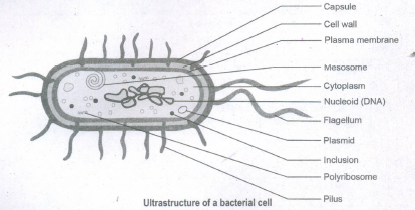
Differentiate between probiotics and pathogenic bacteria.
10.
Write the distinguishing features of Monera.
11.
Do you think shape of chloroplast is unique for algae? Justify your answer.
12.
How many times the blood is diluted for RBC cell counting under 45 X objective of the microscope?
1 : 10 times
1 : 20 times
1 : 200 times
1 : 100 times
13.
__________ is a free living Nitrogen fixing fungi.
Anabaena
Pullularia
Chlorobium
Mucor
14.
Level of .......... increases during drought.
Auxin
Ethylene
ABA
Cytokinin
15.
Glycolysis was worked out in_____________.
Castor
Bacteria
Neurospora
Yeast
16.
Fibrinogen is concerned with __________.
transport of ions
transport of lipids
transport of hormones
coagulation of blood
17.
In protandrous condition, what is correct?
ova mature earlier than sperms
sperms mature earlier than ova
both sperms and ova mature at the same time
both sperms and ova do not mature at all
18.
Plants that grows completely under water are called as ____________type of aquatic plants.
emergent
free floating
submerged
mangroves
19.
What is the leaf of Zorniadiphyliain Fabaceae?
Bifoliate
Trifoliate
Raceme
Panicle
20.
Father of Indian Mycology ________.
P.A.Micheli
C.H.Blackley
EJ.Butler
A.F. Blakeseley
21.
22.
When a leaf trace extends from a vascular bundle in a dicot stem, what would be the arrangement of vascular tissues in the veins of the leaf?
Xylem would be on top and the phloem on the bottom
Phloem would be on top and the xylem on the bottom
Xylem would encircle the phloem
Phloem would encircle the xylem
23.
Which of the following statement concerning the somatic division of the peripheral neural system is incorrect?
Its pathways innervate skeletal muscles
Its pathways are usually voluntary
Some of its pathways are referred to as reflex arcs
Its pathways always involve four neurons
24.
25.
What taxonomic aid gives comprehensive information about a taxon?
Taxonomic Key
Herbarium
Flora
Monograph
26.
Keeping in view the fluid mosaic model for the structure of cell membrane which one of the following statements is correct with respect to the movement of lipids and proteins from one lipid monolayer to the other.
Neither lipid nor proteins can flip-flop
Both lipid and proteins can flip flop
While lipids can rarely flip-flop proteins cannot
While proteins can flip-flop lipids cannot
27.
Explain the physiological effects of ABA.
28.
29.
Explain The Dry Fruit.
30.
Comparison of microscopes
31.
Write about the different types of compound epithelium.
32.
Explain about the different respira ory volumes and capacities ot lungs.
33.
Grasses have an adaptive mechanism to compensate photorespiratory losses. Name and describe the mechanism.
34.
Write the similarities and difference between
a. Radicle buds and foliar buds
b. Phylloclade and cladode
35.
Write the characteristic features of DNA.
36.
Write down any two functions of melatonin.
37.
Which is the longest phase of cell cycle? What happens during that phase?
38.
Compare the Gynoecium of Pisum sativum and Datura metal.
39.
What you know about Helicoid inflorescence in monochasial cyme.
40.
Why the cells of sclerenchyma and tracheids become dead?
41.
Comment on homeostasis.
42.
Mention the uses of honey
43.
What might be the effect on a person whose diet has less iron content?
1.
Industrial uses of alcoholic fermentation:
1) In bakeries, it is used for preparing bread, cakes, biscuits.
2) In beverage industries for preparing wine and alcoholic drinks.
3) In producing vinegar and in tanning, curing of leather.
4) Ethanol is used to make gasohol (a fuel that is used for cars in Brazil).
2.
1. Plasmolysis plays an important role In preservation of meat, jellies and other food stuffs and prevents them from being destroyed by bacteria and fungi.
2. In salting of food stuffs to be preserved, Bacteria and fungi get plasmolysed and killed due to exosmosis.
3.
Hemicellulose binds the microfibrils with matrix and glycoproteins control the orientation of microfibrils while pectin serves as filling material of the matrix.
4.
1) Plants follow different pathways in response to environment or phases of life to form different kinds of structures. This ability is called plasticity.
2) Example: Heterophylly in cotton and coriander. In such plants, the leaves of the juvenile plant are different in shape from those in mature plants.
3) On the other hand, the difference in shapes of leaves produced in air and those produced in water in buttercup also represent the heterophyllous development due to the environment. This phenomenon ofheterophylly is an example of plasticity.
5.
(i) The log A will last longer for the merchant.
(ii) In any tree the outer part of the wood is pale in colour, is called Sap Wood, while the centre part is darker called Heart Wood.
(iii) Due to the presence of tyloses and their contents, the heartwood becomes coloured, dead and the hardest part of the wood.
(iv) The heartwood is more durable and more resistant to the attack of microorganisms and insects.
6.
Kidneys-external
(i) A paired bean-shaped kidney lie one on either side of the vertebral column.
(ii) Kidneys are covered by renal capsule.
(iii) Kidneys are reddish brown in colour.
(iv) Each kidney weighs about 120-170 grams.
(v) The envelops of kidney are
(a) Renal fascia
(b) Peritoneal fat capsule
(c) Fibrous capsule
(vi) In the superior lumbar region lies the kidney at the levels of the last thoracic vertebra(T12) and third lumbar vertebra(L3).
(vii) The right kidney is placed slightly lower than the left kidney because a large right lobe of liver occupies more space in lower abdominal cavity.
Kidneys-Internal Region
(i) The longitudinal section(Ls) of kidney shows two regions
(a) cortex
(i) An outer region of kidney extends in between medullary pyramids as the renal columns of Bertini.
(ii) Renal artery enters the kidney.
(iii) Renal vein and pelvis of ureter come out of kidney.
(iv) An inner concave surface shows a notch called hilum.
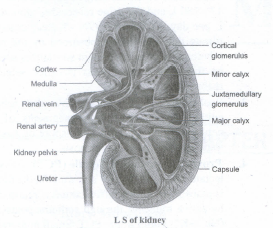
(b) Medulla
(i) An inner medulla is divisible into few conical tissue masses called renal pyramids or medullary pyramids.
(ii) Hilum is the passage of blood vessels, pelvis of ureter and nerves.
(iii) Inner to the hilum is a broad funnel shaped space called renal pelvis found with projections called calyces.
(iv) Pelvis is continuous with the ureter.
(v) The walls of the calyces, pelvis and ureter have smooth muscles which contract rhythmically.
(vi) The calyces collect the urine and empties into the ureter.
(vii) Bladder stores urine temporarily.
(viii) Bladder opens into urethra.
(ix) Urethra opens exterior to release out urine.
7.
8.
(i) Eggs or young ones produced by an oviparous (egg laying)and viviparous (directly yield young ones) female animals may not be equal.
(ii) Numerous eggs are laid by oviparous, so the number of produced offsprings is indefinite.
(iii) Eggs laid by oviparous, female may not develop into adults due to predators.
(iv) Oviparous female includes polyembryony.
(v) Viviparous produced by females need protection from predators associated with parental cares.
(vi) Development of young ones of oviparous female occurs in environment whereas the development of young ones of viviparous female occurs in the female reproductive system of adults.
9.
| Probiotics | Pathogenic bacteria |
| Probiotic bacteria are beneficial. | Pathogenic bacteria are harmful. |
| Probiotic bacteria may be decomposers, photosynthetic and few may be pathogenic. | All are pathogenic and causing diseases. |
10.
| S.No | Criteria | Monera |
| 1. | Cell type | Prokaryotic |
| 2. | Level of organization |
Mostly unicellular, rarely Multicellular |
| 3. | Cell wall | Present (made up of peptidoglycan and mucopeptides) |
| 4. | Nutrition | Autotrophic (Phototrophic, Chemoautotrophic) Heterotrophic (Parasitic and Saprophytic) |
| 5. | Motility | Motile or non-motile |
| 6. | Organisms | Archaebacteria, Eubacteria, Cyanobacteria, Actinomycetes and Mycoplasma |
11.
Yes, the shape of chloroplast is unique for algae.
| S.No | Shapes | Examples |
| 1 | Cup shaped | Chlamydomonas |
| 2 | Discoid | Chara |
| 3 | Girdle shaped | Ulothrix |
| 4 | Reticulate | Oedogonium |
| 5 | Spiral | Spirogyra |
| 6 | Stellate | Zygnema |
| 7 | Plate like | Mougeotia/td> |
12.
(c)
1 : 200 times
13.
(b)
Pullularia
14.
(c)
ABA
15.
(d)
Yeast
16.
(d)
coagulation of blood
17.
(b)
sperms mature earlier than ova
18.
(c)
submerged
19.
(a)
Bifoliate
20.
(c)
EJ.Butler
21.
(c)
22.
(a)
Xylem would be on top and the phloem on the bottom
23.
(d)
Its pathways always involve four neurons
24.
(c)
25.
(a)
Taxonomic Key
26.
(c)
While lipids can rarely flip-flop proteins cannot
27.
ABA - Abscisic acid is a phytohormone
Physiological effects:
1) It helps in reducing transpiration rate by closii stomata. It inhibits K+ uptake by guard cells and promotes the leakage of malic acid. It results in closure of stomata.
2) It spoils chlorophylls, proteins and nucleic acids of leaves making them yellow.
3) Inhibition of cell division and cell elongation,
4) ABA is a powerful growth inhibitor. It causes 50% inhibition of growth in Oat coleoptile.
5) It induces bud and seed dormancy.
6) It promotes the abscission of leaves, flowers and fruits by forming abscission layers.
7) ABA plays an important role in plants during water stress and during drought conditions. It results in loss of turgor and closure of stomata.
8) It has anti-auxin and anti-gibberellin property.
9) Abscisic acid promotes senescence in leaves by causing loss of chlorophyll pigment decreasing the rate of photosynthesis and changing the rate of proteins and nucleic acid synthesis.
28.
29.
They develops from single ovary where the pericarp is l dry and not differentiated into epicarp, mesocarp and endocarp. It is further subdivided into two types.
Dry Dehiscent Fruit
Pericarp is dry and splits open along the sutures to liberate seeds. They can be classified into following types.
Follicle:
Fruit develops from monocarpellary, superior ovary and dehisces along one suture. Example: calotropis.
Legume or pod:
Fruit develops from monocarpellary, superior ovary and dehisces through both dorsal and ventral sutures. Example: Pisum.
Siliqua:
Fruit develops from bicarpellary, syncarpous, superior ovary initially one chambered but subsequently becomes two chambered due to the formation of false septum (replum). The fruit dehisces along two suture. Example: Brassica.
Silicula:
Fruit similar to sliqua but shorter and broader. Example: Capsella, Lepidium, Alyssum.
Capsule:
Fruit develops from multicarpellary, syncarpous, superior ovary. Based on the dehiscence pattern they are sub divided into.
Septicidal:
Capsule splitting along septa and valves remaining attached to septa. Example: Linum, Aristolochia.
Loculicidal:
Capsule splitting along locules and values remaining attached to septa. Example: Lady's finger. Septifragal:
Capsule splitting so that valves fall off leaving seeds attached to the centra. axis. Example: Datura. Poricidal:
Dehiscence through terminal pores. Example Papaver.
Denticidal:
Capsule opening at top exposing a number of teeth. Example: Primula, Cerastium. Circumscissile (pyxidium) Dehisces transversely so that top comes off as a lid or operculum. Example: Anagallis arvensis, Portulaca, Operculina.
Dry Indehiscent Fruit:
Dry fruit which does not split open at maturity. It is subdivided into.
Achene:
Single seeded dry fruit developing from single carpel with superior ovary. Achenes commonly develop from apocarpous pistil, Fruit wall is free from seed coat. Example: Clematis, Delphinium, Strawberry.
Cypsela:
Single seeded dry fruit, develops from bicarpellary, syncarpous, inferior ovary with reduced scales, hairy or feathery calyx lobes. Example: Tridax, Helianthus.
Caryopsis:
It is a one seeded fruit which develops from a monocarpellary, superior ovary. Pericarp is inseparably fused with seed. Example: Oryza, Triticum.
Nut:
They develops from mulicarpellary, syncarpous, superior ovary with hard, woody or bony pericarp. It is a one-seeded fruit. Example: Quercus, Anacardium.
Samara:
A dry indehiscent, one seeded fruit in which the pericarp devlops into thin winged structure around the fruit. Example: Acer, Pterocarpous.
Utricle:
They develop from. bicarpellary, unilocular, syncarpus, superior ovary with pericarp loosely enclosing the seeds. Example: Chenopodium.
Schizocarpic Fruit :
This fruit type is intermediate between dehiscent and indehiscent fruit. The fruit instead of dehiscing rather split into number of segments, each containing one or more seeds. They are of following types.
Cremocarp:
Fruit develops from bicarpellary, syncarpous, inferior ovary and splitting into two one seeded segments known as mericarps. Example: Coriander, Carrot.
Carcerulus:
Fruit develops from bicarpellary, syncarpous, superior ovary and splitting into four one seeded segments known as nutlets. Example: Leucas, Ocimum, Abutilon
Lomentum:
The fruit is derived from monocarpellary, unilocular ovary. A leguminous fruit, constricted between the seeds to form a number of one seeded compartment that separates at maturity. Example: Desmodium, Arachis, Mimosa
Regma:
They develops from tricarpellary, syncarpous, superior, trilocular ovary and splits into one- seeded cocci which remain attached to carpophore. Example: Ricinus, Geranium.
30.
Comparison of Microscopes
| Features | Light Microscope | DarkField Microscope | Phase Contrast Microscope | Transmission Electron Microscope | Scanning Electron Microscope |
| Source of illumination for Image Formation. | Visible Light | Visible Light | Visible Light | Electrons | Electrons |
| Types of cells visualized | Types of cells visualized Individual cells can be visualized, | Types of cells visualized Individual cells can be visualized, | Types of cells visualized Individual cells can be visualized, | Thin section of the specimen are obtained. The electron began pass through the sections and form an image with high magnification and high resolution. | The specimen is coated with gold and the electrons are reflected back and give the details of surface topography of the specimen. |
| Image | 2-D | 2-D | 2-D | 2-D | 3-D |
| Nature of Lenses | Glass lenses | Glass lenses | Glass lenses | One electrostatic lens with few electromagnetic lenses | One electrostatic lens with few electromagnetic lenses |
| Medium | Air/Oil | Air/Oil | Air/Oil | Vacuum | Vacuum |
| Specimen mounting | Glass sides | Glass sides | Glass sides | Mounted on coated or uncoated copper grids | Mounted on aluminium stubs and are coated in gold |
| Focusing and Magnification Adjustment | Changing Objectives | Changing objectives | Changing Objectives | Electrical, using deflection coil | Electrical, using deflection coil |
| Means for obtaining specimen Contrast | Light diffraction | Through patch stop | Through phase plate | Electron Scattering | Electron Scattering |
| Microscope picture |  |
 |
 |
 |
 |
31.
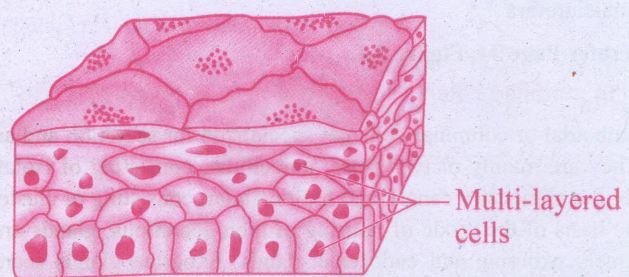
There are four types of compound epithelium namely, stratified squamous epithelium, cuboidal epithelium, columnar epithelium and transitional epithelium.
Stratified squamous epithelium is of two types called keratinized type which forms the dry epidermis of the skin and the non keratinized type forms the moist lining of the esophagus, mouth, conjunctiva of the eyes and vagina. Stratified cuboidal epithelium mostly found in the ducts of sweat glands and mammary glands. Stratified columnar epithelium has limited distribution in the body, found around the lumen of the pharynx, male urethra and lining of some glandular ducts.
Transitional Epithelium is found lining the ureters, urinary bladder and part of the urethra. This epithelium allows stretching and is protective in function.
32.
Respiratory Volumes - Tidal Volume (TV): Tidal volume is the amount of air inspired or expired wit each normal breath. It is approximately 500 mL., i.e. a normal human adult can inspire or expire approximately 6000 to 8000mL of air per minute. During vigorous exercise, the tidal volume is about 4 -10 times higher.
Inspiratory Reserve volume (RV): Additional volume of air a person can inspire by forceful inspiration is called Inspiratory Reserve Volume. The normal value is 2500 to 3000 mL.
Expiratory Reserve volume (ERV): Additional volume of air a person can forcefully exhale by forceful expiration is called Expiratory Reserve Volume. The normal value is 1000 -1100 mL.
Residual Volume (RV):The volume of air remaining in the lungs after a forceful expiration. It is approximately 1100 - 1200 mL.
Respiratory capacities - Vital capacity (VC): The maximum volume of air that can be moved out during a smgle breath following a maximal inspiration. A person first inspires maximally then expires maximally. VC = ERV + TV + IRV.
Inspiratory capacity (IC): The total volume of air a person can inhale after normal expiration ..
It includes tidal vo ume and inspiratory reserve volume. IC = TV + IRV.
Expiratory capacity (EC): The total volume of air a person can exhale after normal inspiration: It mcludes tidal volume and expiratory reserve volume. EC = TV + ERV.
Total Lung Capacity (TLC): The total volume of air which the lungs can accommodate after forced inspiration is called Total Lung Capacity. This includes the vital capacity and the esidual volume. It is approximately 6000mL. TLC = VC + RV.
Miunte Respiratory Volume: The amount of air that moves into the respiratory passage per minute is called minute respiratoru volume.
Normal TV=500mL; Normal respiratory rate=12 times/minute. Therefore, miute respiratory volume=6 Litres/minute (for a normal healthy man).
33.
(i) C4 cycle/Di - carboxylic acid pathway/ Di - carboxylation pathway is an adaptive mechanism.
(ii) It takes place in two phases. First phase takes place in stroma of mesophyll cells, where the CO2 acceptor molecule 3-Carbon compound, phosphoenol pyruvate (PEP) to form 4-carbon oxalo acetic acid (OAA). The first product is a 4-carbon and so it is named as C4 cycle. Oxalo acetic acid is a dicarboxylic acid and hence this cycle is also known as dicarboxylic acid pathway.
(iii) Carbondioxide fixation takes place in two places one in mesophyll and another in bundle sheath cell.
(iv) C4 plants requires 5 ATP and 2NADPH + H+ to fix one molecule of CO2.
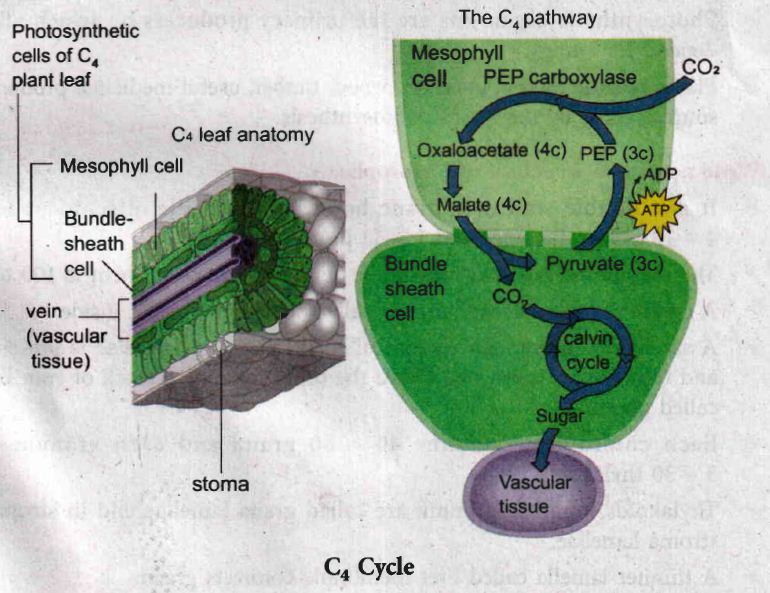
Stage: I Mesophyll Cells
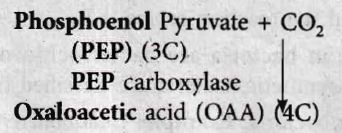
(i) Oxaloacetic acid (OAA) is converted into malic acid or aspartic acid and is transported to the bundle sheath cells through plasmodesmata.
Stage: II Bundle Sheath Cells
(i) Malic acid undergoes decarboxylation and produces a 3 carbon compound Pyruvic acid and CO2.
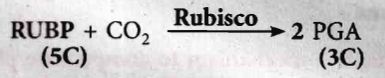
(ii) The released CO2 combines with RUBP and follows the calvin cycle and finally sugar is released to the phloem.
(iii) Pyruvic acid is transported to the mesophyll cells.
34.
| a | Radical buds | Foliar buds |
| Differences | Radicle buds arise from the lateral roots. Eg. Sweet potato | Foliar buds develop from veins or from margins of the leaves. Eg. Begonia |
| Similarities | It is a type of adventitious root | It is a type of adventitious root |
| b | Phylloclade | Cladode |
| Differences | Presence of series of nodes and internodes. Eg: Casuarina | Presence of one or two internodes only. Eg: Asparagus |
| Similarities | Phylloclade is a stem modification | Cladode is a stem modification |
35.
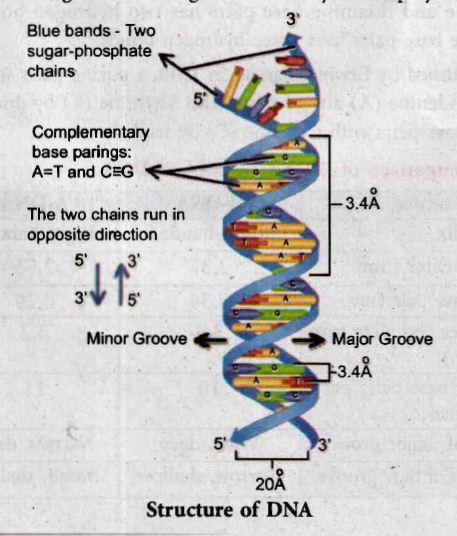
Features of DNA:
1. If one strand runs in the 5'- 3' direction, the other runs in 3'- 5' direction and thus are antiparallel (they run in opposite direction). The 5' end has the phosphate group and 3' end has the OH group.
2. The angle at which the two sugars protrude from the base pairs is about 120°, for the narrow angle and 240° for the wide angle. The narrow-angle between the sugars generates a minor groove and the large angle on the other edge generates major groove.
3. Each base is 0.34 nm apart and a complete turn of the helix comprises 3.4 nm or 10 base pairs per turn in the predominant B form of DNA.
4. DNA helical structure has a diameter of 20 A° and a pitch of about 34 A°. X-ray crystal study of DNA takes a stack of about 10 bp to go completely around the helix (360°).
5. Thermodynamic stability of the helix and specificity of base pairing includes
(i) the hydrogen bonds between the complementary bases of the double helix
(ii) stacking interaction between bases tend to stack about each other perpendicular to the direction of helical axis. Electron cloud interactions ((Π – Π)) between the bases in the helical stacks contribute to the stability of the double helix.
6. The phosphodiester linkages give an inherent polarity to the DNA helix. They form strong covalent bonds, give the strength and stability to the polynucleotide chain.
7. Plectonemic coiling - The two strands of the DNA are wrapped around each other in a helix, making it impossible to simply move them apart without breaking the entire structure. Whereas in paranemic coiling the two strands simply lie alongside one another, making them easier to pull apart.
8. Based on the helix and the distance between each turn the DNA is of three forms - A DNA, B DNA and Z DNA.
36.
1. It plays a central role in the regulation circadian rhythm of our body.
2. Maintains the normal sleep wake cycle
3. Also regulates the timing of sexual maturation of gonads.
37.
Interphase is the longest phase. Cells are metabolically active and involved in protein synthesis and growth.
38.
| S.No | Gynoecium of Pi sum sativum | Gynoecium of Datura metal |
| 1 | Mono Carpellary | Bicarpellary |
| 2 | Unilocular | Tetralocular |
| 3 | Ovules on marginal placentation | Ovules on axile placentation |
| 4 | Feathery stigma | Bilobed stigma |
39.
Axis develops on only one side and forms a coil structure at least at the earlier development stage. Example: Hamelia, potato.
40.
The cells of sclerenchyma & tracheids become dead because they lack protoplasm
41.
(i) Hormones coordinate different physical, physiological, mental activities and maintain homeostasis.
(ii) Maintenance of constant internal environment of the body by the different coordinating system.
42.
1. It is used as an antiseptic, laxative and as a sedative.
2. It is generally used in Ayurvedic and Unani systems of medicine.
3. It is also used in the preparation of cakes, breads, and biscuits.
43.
If a person diet does not contain iron, the synthesis of haemoglobin is lowered in bone marrow because each haemoglobin consists of 4 iron atoms to accept 4 O2

11th Standard Syllabus & Materials
11th Standard
TN 11th Tamil பீடு பெற நில் - செய்யுள் - காவடிச்சிந்து Important Questions And Answers Study Material - QB365 Set A
NEW11th Standard
TN 11th Tamil பீடு பெற நில் - உரைநடை - மலை இடப்பெயர்கள் : ஓர் ஆய்வு Important Questions And Answers Study Material - QB365 Set A
NEW11th Standard
TN 11th Tamil மாமழை போற்றுதும் - துணைப்பாடம் - யானை டாக்டர் Important Questions And Answers Study Material - QB365 Set A
NEW11th Standard
TN 11th Tamil மாமழை போற்றுதும் - செய்யுள் - ஐங்குறுநூறு Important Questions And Answers Study Material - QB365 Set A



Tamilnadu Stateboard 11th Standard Subjects

Maths

Commerce

Economics
Biology

Business Maths and Statistics

Accountancy

Computer Science

Physics

Chemistry
Maths
Biology
Economics
Physics
Chemistry

History
Business Maths and Statistics

Computer Science
Accountancy

Computer Applications
History
Computer Technology
Commerce
Computer Applications
Computer Technology

Tamil

English

French
Tamilnadu Stateboard Standards

