
 100% FREE ACCESS
11th Standard Syllabus & Materials
11th Standard
TN 11th Tamil இயற்கை வேளாண்மை,சுற்றுச்சூழல் -செய்யுள் - மனோன்மணீயம் Important Questions And Answers Study Material - QB365 Set A
NEW11th Standard
TN 11th Tamil என்னுயிர் என்பேன் -துணைப்பாடம் - இசைத்தமிழர் இருவர் Important Questions And Answers Study Material - QB365 Set A
NEW11th Standard
TN 11th Tamil மொழி கலை -செய்யுள் - ஒவ்வொரு புல்லையும் Important Questions And Answers Study Material - QB365 Set A
NEW11th Standard
TN 11th Tamil பீடு பெற நில் - இலக்கணம் - பகுபத உறுப்புகள் Important Questions And Answers Study Material - QB365 Set A
NEW11th Standard
TN 11th Tamil பீடு பெற நில் - துணைப்பாடம் - வாடிவாசல் Important Questions And Answers Study Material - QB365 Set A
NEW11th Standard
TN 11th Tamil பீடு பெற நில் - செய்யுள் - குறுந்தொகை Important Questions And Answers Study Material - QB365 Set A

Published on: 17/01/2020
Download Tamil Nadu 11th Standard Biology question papers, model tests, one-mark questions, important questions, and public exam papers in PDF format. Free study materials and answer keys for TN State Board students.
Questions + Answers key
Take MCQ Biology Test1.
Write the importance of direct oxidative pathway.
2.
Explain the types of carrier proteins.
3.
Explain the excretory system of Frog.
4.
What is plasticity?
5.
A timber merchant bought 2 logs of wood from a forest & named them A & B, The log A was 50 year old & B was 20 years old. Which log of wood will last longer for the merchant? Why?
6.
Which of these functions could or could not be carried out by a red blood cell? Briefly justify your answer.
a. Protein synthesis
b. Cell division
c. Lipid synthesis
d. Active transport
Protein synthesis
Cell division
Lipid synthesis
Active transport
7.
Observe the animal below and answer the following questions.
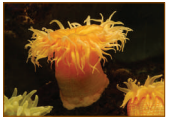
a. Identify the animal
b. What type of symmetry does this animal exhibit?
c. Is this animal Cephalized?
d. How many germ layers does this animal have?
e. How many openings does this animal's digestive system have?
f. Does this animal have neurons?
8.
Differentiate between probiotics and pathogenic bacteria.
9.
What is Plasmodesmata?
10.
Briefly outline the classification of enzymes.
11.
Write the distinguishing features of Monera.
12.
Do you think shape of chloroplast is unique for algae? Justify your answer.
13.
Normally, the heart beats ___________ times a minute when we are at rest.
60-100
70-100
80-100
100-120
14.
Bio Assay of ABA was done with
cotton bolls
Pineapple
Rice
Sugarcane
15.
___________ is an activator for RUBP Carboxylase and PEP Carboxylase.
Manganese
Magnesium
Zinc
Chlorine
16.
The factors associated with compensation point are_____________.
Light and Humidity
O2 and CO2
CO2 and light
CO2 and Temperature
17.
________ are the blood cells which have two lobes which are joined by thin strands.
Neutrophils
Basophils
Eosinophils
Lymphocytes
18.
Rolling or folding of individual leaves is called_____________
venation
phyllotaxy
ptyxis
branching
19.
What is the habit of Xanthorrhoea?
Trees
Erect
Climbing
Phylloclades
20.
PHB means:
Poly Hexo Butyrate
Poly Hydrolxl Butyle
Poly - β Hydroxl Butyrate
Poly Hedral Butyrate
21.
Identify true statement regarding light reaction of photosynthesis.
Splitting of water molecule is associate with PS I.
PS I and PS II involved in the formation of NADPH + H+
The reaction center of PS I is Chlorophyll a with absorption peak at 680 nm.
The reaction center of PS II is Chlorophyll a with absorption peak at 700 nm.
22.
Refer to the given figure and select the correct statement.
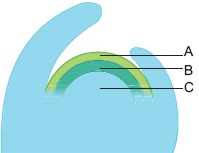
i. A, B, and C are histogen of shoot apex
ii. A Gives rise to medullary rays.
iii. B Gives rise to cortex
iv. C Gives rise to epidermis
i and ii only
ii and iii only
i and iii only
iii and iv only
23.
Which of the following cranial nerve controls the movement of eyeball ?
Trochlear nerve
Optic nerve
Olfactory nerve
Vagus nerve
24.
The sphincter of Oddi guards _____.
Hepatopancreatic duct
Common bile duct
Pancreatic duct
Cystic duct
25.
The heart of cockroach has __________ chambers.
10
12
13
8
26.
A living organism is differentiated from non-living structure based on _______.
Reproduction
Growth
Metabolism
All the above
27.
Sequences of which of the following is used to know the phylogeny.
mRNA
rRNA
tRNA
HnRNA
28.
Malfunctioning of the kidneys can be treated by haemodialysis? Explain.
29.
Will a defoliated plant respond to photoperiodic cycle? Give reasons.
30.
Write the differences between dense regular connective tissues and dense irregular connective tissues.
31.
Draw the structure of different types of viruses and explain.
32.
Explain different types of Aestivation.
33.
Grasses have an adaptive mechanism to compensate photorespiratory losses. Name and describe the mechanism.
34.
Write a note on surfactants.
35.
Describe the structure of Mitochondria.
36.
Write the similarities and difference between
a. Radicle buds and foliar buds
b. Phylloclade and cladode
37.
What is the Role of the Nucleus?
38.
Mention about inflorescence and flower of Datura metal.
39.
Define axillary type of inflorescence.
40.
Why the cells of sclerenchyma and tracheids become dead?
41.
What is Canal of Schlemm?
42.
Specify the symptoms of acromegaly
43.
What are the components of the sericulture industry?
1.
Significance of pentose phosphate pathway:
1) HMP shunt is associated with the generation of two important products,NADPH and pentose sugars, which play a vital role in anabolic reactions.
2) Coenzyme NADPH generated is used for reductive biosynthesis and counter damaging the effects of oxygen free radicals
3) Ribose 5 phosphate and its derivatives are used in the synthesis of DNA, RNA, ATP, NAD+, FAD and coenzyme A.
4) Erythrose is used for synthesis of anthocyanin, lignin and other aromatic compounds.
5) It is characterized by the production of CO2 and it is used for Carbon fixation in photosynthesis
2.
There are 3 types of carrier proteins classified on the basis of handling of molecules and direction of transport in facilitated diffusion. They are,
i) Uniport
ii) Symport
iii) Antiport.
i) Uniport: In this molecule of a single type move across a membrane independent of other molecules in one direction
ii) symport or co-transport: The term symport is used to denote an integral membrane protein that simultaneously transports two types of molecules across the membrane in the same direction.
iii) Antiport or Counter Transport: An antiport is an integral membrane transport protein that simultaneously transports two different molecules, in opposite directions, across the membrane.
3.
Elimination of nitrogenous waste and salt and water balance are performed by a well developed excretory system. It consists of a pair of kidneys, ureters, urinary bladder and cloaca. Kidneys are dark red, long, flat organs situated on either sides of the vertebral column in the body cavity. Kidneys are Mesonephric. Several nephrons are found in each kidney. They separate nitrogenous waste from the blood and excrete urea, so frogs are called ureotelic organisms. A pair of ureters emerges from the kidneys and opens into the cloaca. A thin walled unpaired urinary bladder is present ventral to the rectum and opens into the cloaca.
4.
1) Plants follow different pathways in response to environment or phases of life to form different kinds of structures. This ability is called plasticity.
2) Example: Heterophylly in cotton and coriander. In such plants, the leaves of the juvenile plant are different in shape from those in mature plants.
3) On the other hand, the difference in shapes of leaves produced in air and those produced in water in buttercup also represent the heterophyllous development due to the environment. This phenomenon ofheterophylly is an example of plasticity.
5.
(i) The log A will last longer for the merchant.
(ii) In any tree the outer part of the wood is pale in colour, is called Sap Wood, while the centre part is darker called Heart Wood.
(iii) Due to the presence of tyloses and their contents, the heartwood becomes coloured, dead and the hardest part of the wood.
(iv) The heartwood is more durable and more resistant to the attack of microorganisms and insects.
6.
Reason : None of these functions can be carried out by RBC. Red Blood Cells (RBC) contain haemoglobin pigment and play a major role in transport of respiratory gases.
7.
a. Sea anemone
b. Radial symmetry
c. Not cephalized
d. Two
e. A single
f. Yes
8.
| Probiotics | Pathogenic bacteria |
| Probiotic bacteria are beneficial. | Pathogenic bacteria are harmful. |
| Probiotic bacteria may be decomposers, photosynthetic and few may be pathogenic. | All are pathogenic and causing diseases. |
9.
Plasmodesmata act as a channel between the protoplasm of adjacent cells through which many substances pass through.
10.
Classification of enzymes:
Enzymes are classified into six groups based on their mode of action.
| Enzymes | Mode of action | General scheme of reaction | Example |
|---|---|---|---|
| Oxidoreductases | Oxidation and reduction (redox) reactions. | Ared + Box \(\longrightarrow\)Aox + Bred | Dehydrogenase. |
| Transferase | Transfer a group of atoms from one molecule to another. | A - B + C \(\longrightarrow\) A + C-B | Transaminase, Phosphotransferase. |
| Hydrolases | Hydrolysis of substrate by addition of water molecule. | A - B + H2O \(\longrightarrow\) A - H + B - OH | Digestive enzymes. |
| Isomerase | Control the conversion of one isomer to another by transferring a group of atoms from one molecule to another. | A - B - C \(\longrightarrow\) A - C-B | Isomerase. |
| Lyase | Break chemical bond without addition of water | A - B \(\longrightarrow\) A + B | Decarboxylase. |
| Ligase | Formation of new chemical bonds using ATP as a source of energy | A + B + ATP \(\longrightarrow\) A - B + ADP + Pi | DNA ligase |
11.
| S.No | Criteria | Monera |
| 1. | Cell type | Prokaryotic |
| 2. | Level of organization |
Mostly unicellular, rarely Multicellular |
| 3. | Cell wall | Present (made up of peptidoglycan and mucopeptides) |
| 4. | Nutrition | Autotrophic (Phototrophic, Chemoautotrophic) Heterotrophic (Parasitic and Saprophytic) |
| 5. | Motility | Motile or non-motile |
| 6. | Organisms | Archaebacteria, Eubacteria, Cyanobacteria, Actinomycetes and Mycoplasma |
12.
Yes, the shape of chloroplast is unique for algae.
| S.No | Shapes | Examples |
| 1 | Cup shaped | Chlamydomonas |
| 2 | Discoid | Chara |
| 3 | Girdle shaped | Ulothrix |
| 4 | Reticulate | Oedogonium |
| 5 | Spiral | Spirogyra |
| 6 | Stellate | Zygnema |
| 7 | Plate like | Mougeotia/td> |
13.
(a)
60-100
14.
(c)
Rice
15.
(b)
Magnesium
16.
(c)
CO2 and light
17.
(c)
Eosinophils
18.
(c)
ptyxis
19.
(a)
Trees
20.
(c)
Poly - β Hydroxl Butyrate
21.
(b)
PS I and PS II involved in the formation of NADPH + H+
22.
(c)
i and iii only
23.
(b)
Optic nerve
24.
(a)
Hepatopancreatic duct
25.
(c)
13
26.
(d)
All the above
27.
(b)
rRNA
28.
1. Malfunctioning of the kidneys can lead to accumalation of urea and other toxic substances, leading to kidney failure. In such patients toxic urea can be removed from the blood by a process called haemodlalysis
2. A dialysing machine or an artificial kidney is connected to the patient's body. A dialysing machine consists of a long cellulose tube surrounded by the dialysing fluid in a water bath.
3. The patient's blood is drawn from a convenient artery and pumped into the dialysing unit after adding an anticoagulant like heparin.
4. The tiny pores in the dialysis tube allows small molecules such as glucose, salts and urea to enter into the water bath, whereas blood cells and protein molecules do not enter these pores.
5. This stage is similar to the filtration process in the glomerulus. The dialysing liquid in the water bath consists of solution of salt and sugar in correct proportion in order to prevent loss of glucose and essential salts from the blood.
6. The cleared blood is then llutnQed back. to the. body through a vein.
29.
No. a defoliated plant will not respond to photoperiodic cycle because the hormonal substance responsible for flowering is found in the leaves of the plant.
30.
1. Dense regular connective tissues primarily contain collagen fibres in rows. between many parallel bundles of tissues and a few elastic fibres. The major cell type is fibroblast. It attaches muscles and bones and withstands great tensile stress when pulling force is applied in one direction. This connective tissue is present in tendons, that attach skeletal muscles to bones and ligaments attach one bone to another.
2. Dense irregular connective tissues have bundles of thick collagen fibres and fibroblasts which are arranged irregularly. The major cell type is the fibroblast. It is able to withstand tension exerted in many directions and provides structural strength. Some elastic fibres are also present. It is found in the skin as the leathery dermis and forms fibrous capsules of organs such as kidneys, bones cartilages, muscles, nerves and joints. Elastic connective tissue contains high proportion of elastic fibres. It allows recoil of tissues following stretching. It maintains the pulsatile flow of blood through the arteries and the passive recoil of lungs following inspiration. It is found in the walls of large arteries; ligaments associated with vertebral column and within the walls of the bronchial tubes.
31.
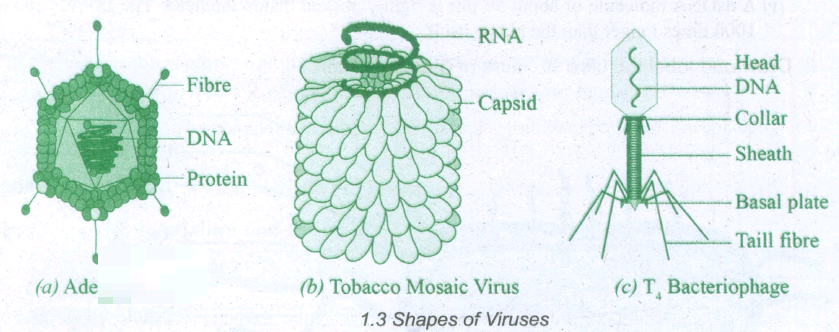
Viruses are ultramicroscopic particles. They are smaller than bacteria and their diameter range from 20 to 300 nm (lnm = 1O-9'metres). Bacteriophage measures about 10 - 100 nm in size.
The size ofTMV is 300 x 20 nm.
Generally viruses are ofthree typesbased on shape and symmetry.
(i) Cuboid symmetry - ego Adenovirus, Herpes virus.
(ii) Helical symmetry - ego Influenza virus, TMV.
(iii) Complex or Atypical - ego Bacteriophage, Vaccinia virus
32.
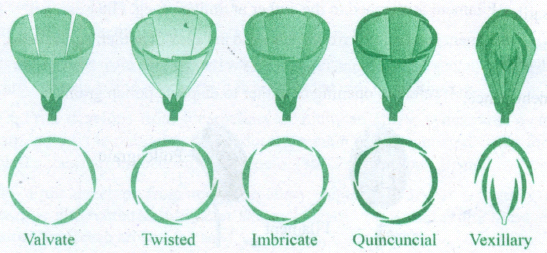
(i) Valvate: Margins of sepals or petals do not overlap but just touch each other. eg. Calyx in members of Malvaceae, Calotropis, Annona.
(ii) Twisted or convolute or contorted: One margin of each petal or sepal overlapping on the other petal. ego Petals of chinarose.
(iii) Imbricate: Sepals and petals irregularly overlap on each other; one member of the whorl is exterior, one interior and rest of the three having one margin exterior and the other interior. ego Cassia, Delonix. There are three types: (i) Ascendingly imbricate, (ii) Quincuncial, (iii) Vexillary.
(iv) Quincuncial: It is a type of imbricate aestivation in which two petals are external and two internal and one petal with one margin internal and the other margin external. ego Guava,calyx of Ipomoea, Catharanthus.
(v) Vexillary: Large posterior petals both margins overlap lateral petals. Lateral petals other margin overlaps anterior petals. eg. Pea, bean.
33.
(i) C4 cycle/Di - carboxylic acid pathway/ Di - carboxylation pathway is an adaptive mechanism.
(ii) It takes place in two phases. First phase takes place in stroma of mesophyll cells, where the CO2 acceptor molecule 3-Carbon compound, phosphoenol pyruvate (PEP) to form 4-carbon oxalo acetic acid (OAA). The first product is a 4-carbon and so it is named as C4 cycle. Oxalo acetic acid is a dicarboxylic acid and hence this cycle is also known as dicarboxylic acid pathway.
(iii) Carbondioxide fixation takes place in two places one in mesophyll and another in bundle sheath cell.
(iv) C4 plants requires 5 ATP and 2NADPH + H+ to fix one molecule of CO2.
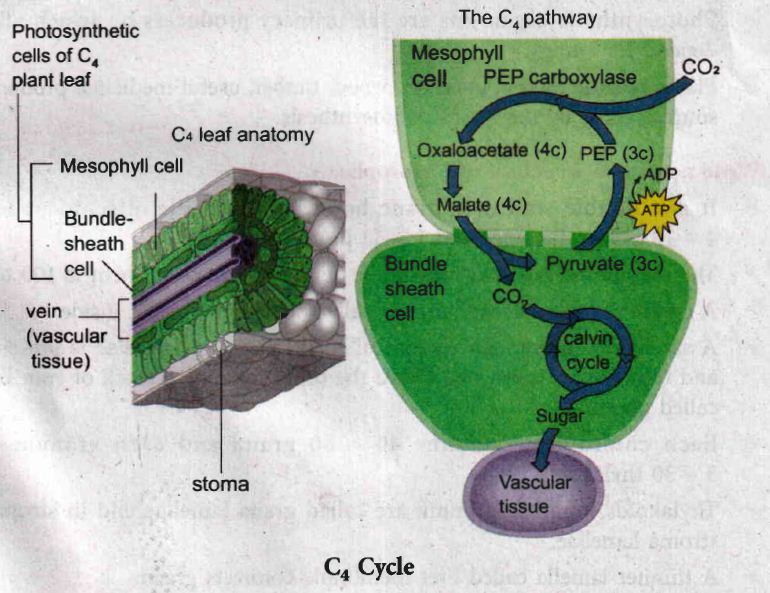
Stage: I Mesophyll Cells
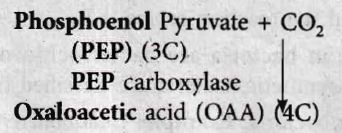
(i) Oxaloacetic acid (OAA) is converted into malic acid or aspartic acid and is transported to the bundle sheath cells through plasmodesmata.
Stage: II Bundle Sheath Cells
(i) Malic acid undergoes decarboxylation and produces a 3 carbon compound Pyruvic acid and CO2.
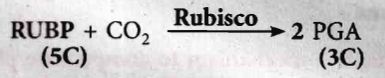
(ii) The released CO2 combines with RUBP and follows the calvin cycle and finally sugar is released to the phloem.
(iii) Pyruvic acid is transported to the mesophyll cells.
34.
1. The thin squamous epithelial cells of the alveoli are composed of Type I and Type II cells.
2. Type I cells are very thin so that gases can diffuse rapidly through them.
3. Type II cells are thicker, synthesize and secrete a substance called Surfactant.
4. Surfactants are the thin non-cellular films made of protein and phospholipids covering the alveolar membrane.
5. The surfactant lowers the surface tension in the alveoli and prevents the lungs from collapsing.
6. It also prevents pulmonary oedema.
7. Premature Babies have low levels of surfactant in the alveoli may develop the newborn respiratory distress syndrome (NRDS) because the synthesis of surfactants begins only after the 25th week of gestation.
35.
Structure of Mitochondria
1. It was first observed by A. Kolliker (1880), 1897, 1898 and named as mitochondria.
2. They are ovoid, rounded, rod-shaped and pleomorphic structures.
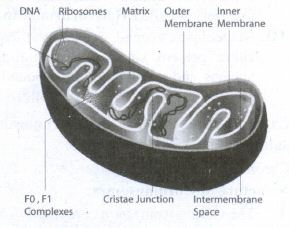
3. Mitochondrion consists of double membrane, the outer and inner membrane. The outer membrane is smooth, highly permeable to small molecules and it contains proteins called Porins, which form channels that allow free diffusion of molecules smaller than about 1000 daltons.
4. The inner membrane divides the mitochondrion into two compartments, outer chamber between two membranes and the inner chamber filled with matrix.
5. The inner membrane is convoluted (infoldings), called crista (plural: cristae). Cristae contain most of the enzymes for electron transport system.
6. Inner chamber of the mitochondrion is filled with proteinaceous material called mitochondrial matrix.
7. The inner membrane consists of stalked particles called elementary particles or Fernandez Moran particles, FI particles or Oxysomes. Each particle consists of a base, stem and a round head.
8. In the head ATP synthase is present for oxidative phosphorylation.
9. Inner membrane is impermeable to most ions, small molecules and maintains the proton gradient that drives oxidative phosphorylation Mitochondria contain 73% of proteins, 25-30% of lipids, 5-7% of RNA, DNA (in traces) and enzymes (about 60 types).
10. Mitochondria are called powerhouse of a cell, as they produce energy-rich ATP. All the enzymes of Kreb's cycle are found in the matrix except succinate dehydrogenase.
11. Mitochondria consist of circular DNA and 70S ribosome. They multiply by fission and replicate by strand displacement model. Because of the presence of DNA it is semi-autonomous organelle.
36.
| a | Radical buds | Foliar buds |
| Differences | Radicle buds arise from the lateral roots. Eg. Sweet potato | Foliar buds develop from veins or from margins of the leaves. Eg. Begonia |
| Similarities | It is a type of adventitious root | It is a type of adventitious root |
| b | Phylloclade | Cladode |
| Differences | Presence of series of nodes and internodes. Eg: Casuarina | Presence of one or two internodes only. Eg: Asparagus |
| Similarities | Phylloclade is a stem modification | Cladode is a stem modification |
37.
the nucleus is the organising centre of the cell. The information in the nucleus is contained within structures called chromosomes. These uniquely:
(i) Control activities of the cell.
(ii) Genetic information copied from cell to cell while the cell divides.
Hereditary characters are passed onto new individuals when gametic cells fuse together in sexual reproduction.
38.
1.Inflorescence: Solitary and axillary cyme.
2.Flower: Flowers are large, greenish white, bracteate, ebracteolate, pedicellate, complete, heterochlamydeous, pentamerous, regular, actinomorphic, bisexual and hypogynous.
39.
1. Inflorescence present in the axile of the nearest vegetative leaf.
2. Example: Hibiscus rosa-sinensis
40.
The cells of sclerenchyma & tracheids become dead because they lack protoplasm
41.
At the junction of the sclera and the cornea, is a channel called 'canal of schlemm' which continuously drains out the excess of aqueous humour in the human eye.
42.
Acromegaly is due to excessive secretion of growth hormone in adults.
Symptoms of acromegaly are :
Over growth of hand bones, feet bones, jawbones malfunctioning of gonads, enlargement of viscera, tongue, lungs, heart, liver, spleen, and also endocrine glands like thyroid, adrenal etc.
43.
It is an agro-based industry comprising three main components:
1. Cultivation of food plants for the silkworms.
2. Rearing of silkworms.
3. Reeling and spinning of silk.

11th Standard Syllabus & Materials
11th Standard
TN 11th Tamil பீடு பெற நில் - செய்யுள் - காவடிச்சிந்து Important Questions And Answers Study Material - QB365 Set A
NEW11th Standard
TN 11th Tamil பீடு பெற நில் - உரைநடை - மலை இடப்பெயர்கள் : ஓர் ஆய்வு Important Questions And Answers Study Material - QB365 Set A
NEW11th Standard
TN 11th Tamil மாமழை போற்றுதும் - துணைப்பாடம் - யானை டாக்டர் Important Questions And Answers Study Material - QB365 Set A
NEW11th Standard
TN 11th Tamil மாமழை போற்றுதும் - செய்யுள் - ஐங்குறுநூறு Important Questions And Answers Study Material - QB365 Set A



Tamilnadu Stateboard 11th Standard Subjects

Maths

Commerce

Economics
Biology

Business Maths and Statistics

Accountancy

Computer Science

Physics

Chemistry
Maths
Biology
Economics
Physics
Chemistry

History
Business Maths and Statistics

Computer Science
Accountancy

Computer Applications
History
Computer Technology
Commerce
Computer Applications
Computer Technology

Tamil

English

French
Tamilnadu Stateboard Standards

