
 100% FREE ACCESS
11th Standard Syllabus & Materials
11th Standard
TN 11th Tamil இயற்கை வேளாண்மை,சுற்றுச்சூழல் -செய்யுள் - மனோன்மணீயம் Important Questions And Answers Study Material - QB365 Set A
NEW11th Standard
TN 11th Tamil என்னுயிர் என்பேன் -துணைப்பாடம் - இசைத்தமிழர் இருவர் Important Questions And Answers Study Material - QB365 Set A
NEW11th Standard
TN 11th Tamil மொழி கலை -செய்யுள் - ஒவ்வொரு புல்லையும் Important Questions And Answers Study Material - QB365 Set A
NEW11th Standard
TN 11th Tamil பீடு பெற நில் - இலக்கணம் - பகுபத உறுப்புகள் Important Questions And Answers Study Material - QB365 Set A
NEW11th Standard
TN 11th Tamil பீடு பெற நில் - துணைப்பாடம் - வாடிவாசல் Important Questions And Answers Study Material - QB365 Set A
NEW11th Standard
TN 11th Tamil பீடு பெற நில் - செய்யுள் - குறுந்தொகை Important Questions And Answers Study Material - QB365 Set A

Published on: 27/11/2019
Taxonomy and Systematic Botany
Download Tamil Nadu 11th Standard Biology question papers, model tests, one-mark questions, important questions, and public exam papers in PDF format. Free study materials and answer keys for TN State Board students.
Questions + Answers key
Take MCQ Biology Test1.
Binomial system of nomenclature was introduced by ...........
Linnaeus
Bauhin
de Candolle
Engler
2.
Plantae is a ................
Kingdom
Species
Genus
Order
3.
............. is the lowest rank of classification.
Genus
Family
Species
Taxon
4.
Flowers are zygomorphic in ______.
Ceropegia
Thevetia
Datura
Solanum
5.
Phylogenetic classification is the most favoured classification because it reflects _______.
Comparative Anatomy
Number of flowers produced
Comparative cytology
Evolutionary relationships
6.
What is the significance of Molecular taxonomy?
7.
List out the uses of Herbarium.
8.
Give the floral characters of Clitoria ternatea.
9.
What is the role of national gardens in conserving biodiversity - Discuss.
10.
Name any 3 Ornamental plants of Solanaceae.
11.
What is atropine?
12.
How is a key helpful in the identification and classification of an organism?
13.
Mention four nomenclatural types.
14.
Where will you place the plants which contains two cotyledons with cup shaped thalamus?
15.
What do you know about karyotaxonomy?
16.
Write the different types of inflorescence found in Solanaceae.
17.
What is Monograph?
18.
List the characters of a species.
19.
How does molecular markers work to unlock the evolutionary history of organisms?
1.
(b)
Bauhin
2.
(a)
Kingdom
3.
(c)
Species
4.
(a)
Ceropegia
5.
(d)
Evolutionary relationships
6.
Significance of Molecular Taxonomy:
1. It helps to identify a very large number of species of plants and animals by the use of conserved molecular sequences.
2. Using DNA data evolutionary patterns of biodiversity are now investigated.
3. DNA taxonomy plays a vital role in phytogeography, which ultimately helps in genome mapping and biodiversity conservation.
4. DNA-based molecular markers used for designing DNA based molecular probes, have also been developed under the branch of molecular systematics.
7.
Uses of Herbarium:
1. Herbarium provides resource material for systematic research and studies.
2. It is a place for orderly arrangement of voucher specimens.
3. Voucher specimen serves as a reference for comparing doubtful newly collected fresh specimens.
4. Voucher specimens play a role in studies like floristic diversity, environmental assessment, ecological mechanisms and survey of unexplored areas.
5. Herbarium provides opportunity for documenting biodiversity and studies related to the field of ecology and conservation biology.
8.
Habit : Twining climber
Root : Branched tap root system having nodules.
Stem : Aerial, weak stem and a twiner
Leaf : Imparipinnately compound, alternate, stipulate showing reticulate venation. Leaflets are stipellate. Petiolate and stipels are pulvinated.
Inflorescence : Solitary and axillary
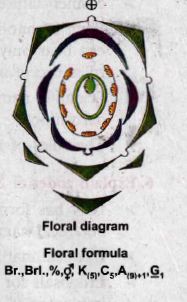
Flower : Bracteate, bracteolate, bracteoles usually large, pedicellate, heterochlamydeous, complete, bisexual, pentamerous, zygomorphic and hypogynous.
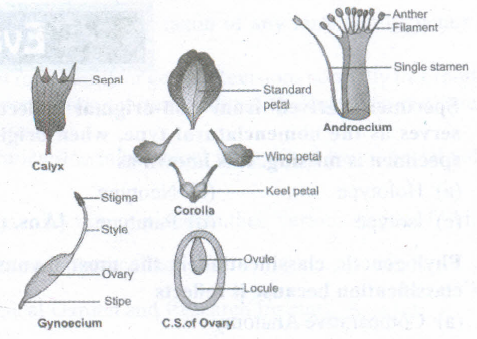
Calyx : Sepals 5, synsepalous, green showing valvate aestivation. Odd sepal is anterior in position.
Corolla : Petals 5, white or blue polypetalous, irregular papilionaceous corolla showing descendingly imbricate aestivation.
Androecium : Stamens 10, diadelphous (9)+1 nine stamens fused to form a bundle and the tenth stamen is free. Anthers are dithecous, basifixed, introrse and dehiscing by longitudinal slits.
Gynoecium : Monocarpellary, unilocular, with many ovules on marginal placentation, ovary superior, style simple and incurved with feathery stigma.
Fruit : Legume
Seed : Non-endospermous, reniform.
9.
Role of Botanical Garden:
Botanical Gardens play the following important roles.
1. Gardens have a wide range of species and supply taxonomic material for botanical research.
2. It can integrate information of diverse fields like Anatomy, Embryology, Phytochemistry, Cytology, Physiology and Ecology.
3. Act as a conservation centre for diversity, rare and endangered species.
4. It offers annual list of available species and a free exchange of seeds.
5. Botanical garden gives information about method of propagation, sale of plant material to the general public.
10.
1. Cestrum diurnum,
2. Cestrum nocturnum,
3. Petunia hybrida.
11.
A powerful alkaloid 'atropine' obtained from root of Atropa belladonna is used in belladonna plasters, tinctures etc. for relieving pain and also for dilating pupils of eyes for eye - testing.
12.
Key is a taxonomic aid for identification of unknown organism based on similarities and dissimilarities.
13.
Holotype, Isotype, Lectotype, Neotype.
14.
Polypetalae: Plants with free petals and dichlamydeous flowers come under polypetalae. It is further divided into three series - (iii) Calyciflorae: It includes plant having flowers with cup shaped thalamus and with inferior or sometimes with half inferior ovary. It includes 5 orders and 27 families.
15.
(i) Chromosomes are the carriers of genetic information. Increased knowledge about the chromosomes have been used for extensive biosystematic studies and resolving many taxonomic problems.
(ii) Utilization of the characters and phenomena of cytology for the explanation of taxonomic problem is known as cytotaxonomy or karyotaxonomy.
(iii) The characters of chromosome such as number, size, morphology and behaviour during meiosis have proved to be of taxonomic value.
16.
Types of inflorescence:
1. Axillary or Terminal cymose (Solanum)
2. Solitary Flowers (Datura stramonium)
3. Extra axillary scorpiod cyme (Solanum nigrum)
4. Umbellate cyme (Withania somnifera)
17.
1. A Monograph is a complete global account of a taxon of any rank - family, genus or species at a given time.
2. This includes the existing taxonomic knowledge and all relevant information about the group concerned such as anatomy, chemistry, palynology, chromosome number etc.
3. Eg: Family Lentibulariaceae M.K. Janarthanam and A.N. Henry.
18.
Species is a group of individual organisms which have the following characters.
1. A population of organisms which closely resemble each other more than the other population.
2. They descend from a common ancestor.
3. In sexually reproducing organisms, they interbreed freely in nature, producing fertile offspring.
19.
(i) It is a method to identify genetic markers using a randomly synthesized primer that will anneal (recombine (DNA) in the double stranded form) to complementary regions located in various locations of isolated DNA. If another complementary site is present on the opposing DNA strand at a distance that is not too great then the reaction will amplify this region of DNA.
(ii) RAPDs (Random Amplified Polymorphic DNA) like microsatellites may often be used for genetic studies within species but may also be successfully employed in phylogenetic studies to address relationships within a species or between closely related species.

11th Standard Syllabus & Materials
11th Standard
TN 11th Tamil பீடு பெற நில் - செய்யுள் - காவடிச்சிந்து Important Questions And Answers Study Material - QB365 Set A
NEW11th Standard
TN 11th Tamil பீடு பெற நில் - உரைநடை - மலை இடப்பெயர்கள் : ஓர் ஆய்வு Important Questions And Answers Study Material - QB365 Set A
NEW11th Standard
TN 11th Tamil மாமழை போற்றுதும் - துணைப்பாடம் - யானை டாக்டர் Important Questions And Answers Study Material - QB365 Set A
NEW11th Standard
TN 11th Tamil மாமழை போற்றுதும் - செய்யுள் - ஐங்குறுநூறு Important Questions And Answers Study Material - QB365 Set A



Tamilnadu Stateboard 11th Standard Subjects

Maths

Commerce

Economics
Biology

Business Maths and Statistics

Accountancy

Computer Science

Physics

Chemistry
Maths
Biology
Economics
Physics
Chemistry

History
Business Maths and Statistics

Computer Science
Accountancy

Computer Applications
History
Computer Technology
Commerce
Computer Applications
Computer Technology

Tamil

English

French
Tamilnadu Stateboard Standards

