
 100% FREE ACCESS
11th Standard Syllabus & Materials
11th Standard
TN 11th Tamil இயற்கை வேளாண்மை,சுற்றுச்சூழல் -செய்யுள் - மனோன்மணீயம் Important Questions And Answers Study Material - QB365 Set A
NEW11th Standard
TN 11th Tamil என்னுயிர் என்பேன் -துணைப்பாடம் - இசைத்தமிழர் இருவர் Important Questions And Answers Study Material - QB365 Set A
NEW11th Standard
TN 11th Tamil மொழி கலை -செய்யுள் - ஒவ்வொரு புல்லையும் Important Questions And Answers Study Material - QB365 Set A
NEW11th Standard
TN 11th Tamil பீடு பெற நில் - இலக்கணம் - பகுபத உறுப்புகள் Important Questions And Answers Study Material - QB365 Set A
NEW11th Standard
TN 11th Tamil பீடு பெற நில் - துணைப்பாடம் - வாடிவாசல் Important Questions And Answers Study Material - QB365 Set A
NEW11th Standard
TN 11th Tamil பீடு பெற நில் - செய்யுள் - குறுந்தொகை Important Questions And Answers Study Material - QB365 Set A

Published on: 16/09/2019
Download Tamil Nadu 11th Standard Biology question papers, model tests, one-mark questions, important questions, and public exam papers in PDF format. Free study materials and answer keys for TN State Board students.
Questions + Answers key
Take MCQ Biology Test1.
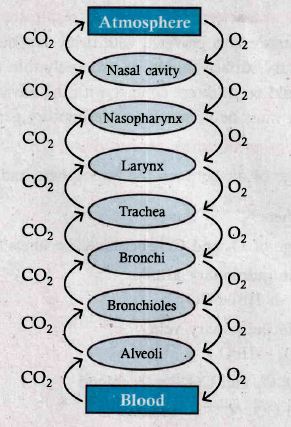
Sketch a flow chart to show the path way of air flow during respiration.
2.
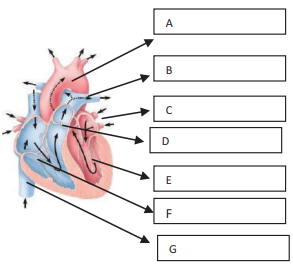
Name and Label the given diagrams to show A, B, C, D, E, F, and G
3.
How respiration takes place in cockroach?
4.
What is an epithelium? Enumerate the characteristic features of different epithelia.
5.
Explain the different types of fleshy fruit with suitable example.
6.
Write the characteristic features of DNA.
7.
Give a general account on lichens.
8.
9.
Write about Pachytene and Diplotene of Prophase I.
10.
What is the difference between a Zoo and Wild Life Sanctuary?
1.
2.
A. Aortic arch
B. Left Pulmonary Artery
C. Left Pulmonary Vein
D. Semilunar Valve
E. Left Ventricle
F. Right Ventricle
G. Inferior Vena Cava
3.
1. The respiratory system of cockroach is well developed compared with other terrestrial insects.
2. Branched tubes known as trachea open through 10 pairs of small holes called spiracles or stigmata, present on the lateral side of the body.
3. Terminal branches of tracheal tubes are called tracheoles which carry oxygen to the entire body. The spiracles open and close by valves regulated by sphincter or spiracular muscles. Each tracheole is filled with a watery fluid through which exchange of gases takes place.
4. During high muscular activity, a part of the fluid is drawn into the tissues to enable more oxygen intake and rapid diffusion.
5. The passage of air in the tracheal system is:

4.
Epithelium:
A grouped sheet of cells which covers the body surface or lines the body cavity forming epithelial tissues constitute epithelium.
Characteristic features of different epithelia
(1) Simple epithelium:
(a) Common Features:-
(i) It is composed of a single layer of cells (uniseriate).
(ii) This cells are found in the organs of absorption, secretion and filtration. It is further classified into
(A) Squamous epithelium
Features:-
(1) flattened cells form a thin single layer
(i) Formed layer has irregular boundaries
(ii) It is located in kidney glomeruli, alveoli/air sacs of lungs, lining of heart, blood vessels and lymphatic vessels.
Function:-
(i) Involved in functions like forming a diffusion boundary and filtration in sites where protection is unimportant.
(B) Cuboidal epithelium
Features:-
(i) Cube like cells form a single layer.
(ii) It is found in kidney tubules, ducts and secretory parts of small glands and surface of the ovary.
Function:-
It promotes secretion and absorption.
(C) Columnar epithelium
Features:-
(i) Tall pillar like cells form a single layer.
(ii) Nuclei are round or oval shaped located at the base of the cytoplasm.
(iii) It lines the digestive tract from the stomach to rectum (gastro intestinal tract).
(iv) Its lining shows two types of modifications.
(a) Cells show microvilli at their apical surfaces for absorption.
(b) Goblet cells secrete the protective lubricating mucus.
Functions:-
(i) Absorption, secretion of mucus, enzymes and other substances.
(ii) Ciliated type propels mucus by ciliary actions which is found on lining of small bronchioles, fallopian tubes and uterus.
(iii) Non-ciliated type lines most of the digestive tract, gall bladder and secretory ducts of glands for secretion.
(D) Pseudo- stratified epithelium
(i) Unequal sized columnar cells form a single layer.
(ii) It is naturally single layered but appears to be multilayered due to the various locations of nuclei in cytoplasm.
Function:-
(i) Protection, secretion and absorption.
(ii) Ciliated forms line the trachea and the upper respiratory tract for the passage of air.
(iii) Non-ciliated forms line the epididymis, large ducts of glands and tracts of male urethra for secretion and protection.
(2) Compound Epithelium
Common Features:-
Glandular epithelium
(i) Specialized cuboidal and columnar cells constitute glandular epithelium for secretion.
(ii) Stratified epithelia are built for protection or to resist abrasion.
Types
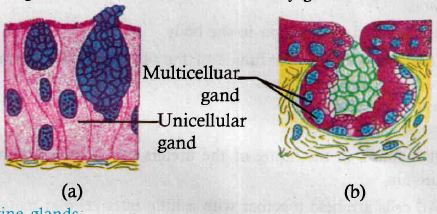
(a) Unicellular:-
Eg: isolated glandular cells like goblet cells of alimentary canal.
(b) Multi cellular:-
Eg: Cluster of cells found in salivary glands.
Exocrine glands
(i) Glands with ducts secrete mucus, saliva, ear wax, oil, milk, digestive enzymes and other cellular products.
Other features and functions of compound epithelium.
(i) Has a limited role in secretion and absorption.
(ii) It may be striated and transitional.
(iii) Cells form many layers (Strata).
Main functions:
(i) To provide protection against mechanical and chemical stresses.
(ii) Covers the dry surface of the skin, the moist surface of buccal cavity, pharynx, inner lining of salivary glands and pancreatic ducts.
Types:
There are four types
(a) Stratified squamous epithelium
(b) Stratified cuboidal epithelium
(c) Stratified columnar epithelium
(d) Transitional epithelium
(a) Stratified squamous epithelium Features:
Divisible into two types
(i) Keratinized
(ii) Non-keratinized
Functions:
(i) Keratinized:- forms the dry epidermis of the skin
(ii) Non- keratinized:- forms the moist lining of the oesophagus, mouth, conjunctiva of eyes and vagina.
(b) Stratified cuboidal epithelium:
Features:
(i) Cells are cubical forming multilayers mostly found in the ducts of sweat and mammary glands.
Function
(ii) Aids in protecting and promoting sweating and lactation.
(c) Stratified columnar epithelium Features:
(i) Has limited distribution in the body.
(ii) It is found around the lumen of the pharynx, male urethra and lining of some glandular ducts.
(d) Transitional epithelium Features:
(i) It is found in the lining of the ureters, urinary bladder and a part of urethra.
(ii) All cells are held together with a little inter cellular material.
(iii) There are specialised junctions link between the structural and functional activities between its individual cells.
| S.No. | Types of junctions | Functions |
| (1) | Tight junctions | Help to stop substances from leaking across a tissue |
| (2) | Adhering junctions | Perform cementing to keep neighbouring cells together |
| (3) | Gap junctions | Facilitate the cells to communicate with each other by connecting the cytoplasm of adjoining cells for rapid transfer of ions, many small molecules and some big molecules. |
5.
The fruits are derived from single pistil where the pericarp is fleshy, succulent and differentiated into epicarp, mesocarp and endocarp. It is subdivided into the following.
(i) Berry: Fruit develops from bicarpellary or multicarpellary, syncarpous ovary. Here the epicarp is thin, the mesocarp and endocarp remain undifferentiated. They form a pulp in which the seeds are embedded. Eg: Tomato, Grapes, Brinjal.
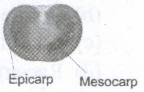
(ii) Drupe: Fruit develops from monocarpellary, superior ovary. It is usually one seeded. Pericarp is differentiated into outer skinny epicarp, fleshy and pulpy mesocarp and hard and stony endocarp around the seed. Eg: Mango, Coconut.
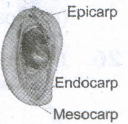
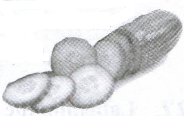
(iii) Pepo: Fruit develops from tricarpellary inferior ovary. Pericarp turns leathery or woody which encloses, fleshy mesocarp and smooth endocarp. Eg: Cucumber, Watermelon, Bottle gourd, Pumpkin.
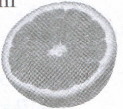
(iv) Hesperidium:Fruit develops from multicarpellary, multilocular, syncarpous, superior ovary. The fruit wall is differentiated into leathery epicarp with oil glands, a middle fibrous mesocarp. The endocarp forms distinct chambers, containing juicy hairs. Eg: Orange, Lemon.
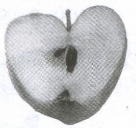
(v) Pome: It develops from multicarpellary, syncarpous, inferior ovary. The receptacle also develops along with the ovary and becomes fleshy, enclosing the true fruit. In pome the epicarp is thin skin like and endocarp is cartilaginous. Eg: Apple, Pear.
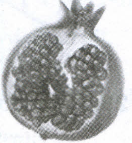
(vi) Balausta: A fleshy indehiscent fruit developing from multicarpellary, multilocular inferior ovary whose pericarp is tough and leathery. Seeds are attached irregularly with testa being the edible portion. Eg: Pomegranate.
6.
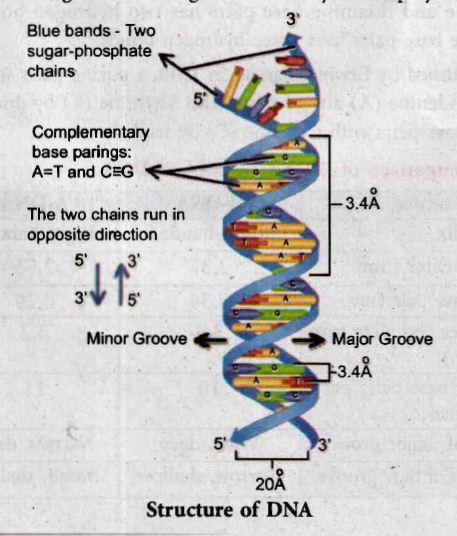
Features of DNA:
1. If one strand runs in the 5'- 3' direction, the other runs in 3'- 5' direction and thus are antiparallel (they run in opposite direction). The 5' end has the phosphate group and 3' end has the OH group.
2. The angle at which the two sugars protrude from the base pairs is about 120°, for the narrow angle and 240° for the wide angle. The narrow-angle between the sugars generates a minor groove and the large angle on the other edge generates major groove.
3. Each base is 0.34 nm apart and a complete turn of the helix comprises 3.4 nm or 10 base pairs per turn in the predominant B form of DNA.
4. DNA helical structure has a diameter of 20 A° and a pitch of about 34 A°. X-ray crystal study of DNA takes a stack of about 10 bp to go completely around the helix (360°).
5. Thermodynamic stability of the helix and specificity of base pairing includes
(i) the hydrogen bonds between the complementary bases of the double helix
(ii) stacking interaction between bases tend to stack about each other perpendicular to the direction of helical axis. Electron cloud interactions ((Π – Π)) between the bases in the helical stacks contribute to the stability of the double helix.
6. The phosphodiester linkages give an inherent polarity to the DNA helix. They form strong covalent bonds, give the strength and stability to the polynucleotide chain.
7. Plectonemic coiling - The two strands of the DNA are wrapped around each other in a helix, making it impossible to simply move them apart without breaking the entire structure. Whereas in paranemic coiling the two strands simply lie alongside one another, making them easier to pull apart.
8. Based on the helix and the distance between each turn the DNA is of three forms - A DNA, B DNA and Z DNA.
7.
(i) The symbiotic association between algae and fungi is called lichens.
(ii) The algal partner is called Phycobiont or Photobiont and the fungal partner is called Mycobiont.
(iii) Algae provide nutrition for fungal partner in turn fungi provide protection and also help to fix the thallus to the substratum through rhizines.
(iv) Asexual reproduction takes place through fragmentation, soredia and Isidia. Phycobionts reproduce by akinetes, hormogonia, aplanospore, etc., Mycobionts undergo sexual reproduction and produce ascocarps.
Classification:
(i) Based on the habitat lichens are classified into following types: Corticolous (on Bark) Lignicolous (on Wood) Saxicolous (on rocks) Terricolous (on ground) Marine (on siliceous rocks of sea) Fresh water (on siliceous rock of fresh water).
(ii) On the basis of morphology of the thallus they are divided into Leprose (a distinct fungal layer is absent) Crustose-crust like; Foliose-leaf like; Fruticose-branched pendulous shrub like.
(iii) The distribution of algal cells distinguishes lichens into two forms namely Homoiomerous (Algal cells evenly distributed in the thallus) and Heteromerous (a distinct layer of algae and fungi present)
(iv) If the fungal partner of lichen belongs to ascomycetes, it is called Ascolichen and if it is basidiomycetes it is called Basidiolichen.
8.
9.
(i) Pachytene:
1. At this stage bivalent chromosomes are clearly visible as tetrads. Bivalent of meiosis I consists of 4 chromatids and 2 centromeres.
2. Synapsis is completed and recombination nodules appear at a site where crossing over takes place between non-sister chromatids of homologous chromosomes.
3. Recombination of homologous chromosomes is completed by the end of the stage but the chromosomes are linked at the sites of crossing over. This is mediated by the enzyme recombinase.
(ii) Diplotene:
1. Synaptonemal complex disassembles and dissolves. The homologous chromosomes remain attached at one or more points where crossing over has taken place.
2. These points of attachment where 'X' shaped structures occur at the sites of crossing over is called Chiasmata. Chiasmata are chromatin structures at sites where recombination has taken place.
10.
| Zoo | Wild life sanctuary |
| Wild animals kept in protected environments under human care Eg: Zoological parks | Wild animals are maintained in the protected areas under various projects for various animals and maintained by the services of Government. |

11th Standard Syllabus & Materials
11th Standard
TN 11th Tamil பீடு பெற நில் - செய்யுள் - காவடிச்சிந்து Important Questions And Answers Study Material - QB365 Set A
NEW11th Standard
TN 11th Tamil பீடு பெற நில் - உரைநடை - மலை இடப்பெயர்கள் : ஓர் ஆய்வு Important Questions And Answers Study Material - QB365 Set A
NEW11th Standard
TN 11th Tamil மாமழை போற்றுதும் - துணைப்பாடம் - யானை டாக்டர் Important Questions And Answers Study Material - QB365 Set A
NEW11th Standard
TN 11th Tamil மாமழை போற்றுதும் - செய்யுள் - ஐங்குறுநூறு Important Questions And Answers Study Material - QB365 Set A



Tamilnadu Stateboard 11th Standard Subjects

Maths

Commerce

Economics
Biology

Business Maths and Statistics

Accountancy

Computer Science

Physics

Chemistry
Maths
Biology
Economics
Physics
Chemistry

History
Business Maths and Statistics

Computer Science
Accountancy

Computer Applications
History
Computer Technology
Commerce
Computer Applications
Computer Technology

Tamil

English

French
Tamilnadu Stateboard Standards

