
 100% FREE ACCESS
11th Standard Syllabus & Materials
11th Standard
TN 11th Tamil இயற்கை வேளாண்மை,சுற்றுச்சூழல் -செய்யுள் - மனோன்மணீயம் Important Questions And Answers Study Material - QB365 Set A
NEW11th Standard
TN 11th Tamil என்னுயிர் என்பேன் -துணைப்பாடம் - இசைத்தமிழர் இருவர் Important Questions And Answers Study Material - QB365 Set A
NEW11th Standard
TN 11th Tamil மொழி கலை -செய்யுள் - ஒவ்வொரு புல்லையும் Important Questions And Answers Study Material - QB365 Set A
NEW11th Standard
TN 11th Tamil பீடு பெற நில் - இலக்கணம் - பகுபத உறுப்புகள் Important Questions And Answers Study Material - QB365 Set A
NEW11th Standard
TN 11th Tamil பீடு பெற நில் - துணைப்பாடம் - வாடிவாசல் Important Questions And Answers Study Material - QB365 Set A
NEW11th Standard
TN 11th Tamil பீடு பெற நில் - செய்யுள் - குறுந்தொகை Important Questions And Answers Study Material - QB365 Set A

Published on: 21/09/2019
Download Tamil Nadu 11th Standard Biology question papers, model tests, one-mark questions, important questions, and public exam papers in PDF format. Free study materials and answer keys for TN State Board students.
Questions + Answers key
Take MCQ Biology Test1.
Vital capacity is _____.
TV + IRV
TV + ERV
RV + ERV
TV + IRV + ERV
2.
Which of the following is not the function of liver?
Production of insulin
Detoxification
Storage of glycogen
Production of bile
3.
4.
Which of the following is not present in same rank?
Primata
Orthoptera
Diptera
Insecta
5.
Example for negatively geotropic roots __________
Ipomoea, Dahlia
Asparagus, Ruellia
Vitis, Portulaca
Avicennia, Rhizophora
6.
Gynoecium with united carpels is termed as ______.
Apocarpous
Multicarpellary
Syncarpous
None of the above
7.
Flowers are zygomorphic in ______.
Ceropegia
Thevetia
Datura
Solanum
8.
The correct sequence in cell cycle is ______.
S-M-G1-G2
S-G1-G2-M
G1-S-G2-M
M-G-G2-S
9.
Which of following represents gametophytic generation in pteridophytes?
Prothallus
Thallus
Cone
Rhizophore
10.
Digestive secretions are secreted only when needed Discuss.
11.
Write the types of respiration seen in frog.
12.
13.
Why lateral roots are endogenous?
14.
State the protoplasm theory.
15.
What is plectostele? Give example.
16.
Explain the different types of fleshy fruit with suitable example.
17.
Write the characteristic features of DNA.
18.
19.
20.
What is the role of national gardens in conserving biodiversity - Discuss.
21.
22.
List any five salient features of the family Felidae.
23.
Differentiate between probiotics and pathogenic bacteria.
24.
Differentiate between aggregate fruit with multiple fruit.
25.
Write the distinguishing features of Monera.
26.
Given an account of G0 phase.
1.
(d)
TV + IRV + ERV
2.
(a)
Production of insulin
3.
(c)
4.
(d)
Insecta
5.
(d)
Avicennia, Rhizophora
6.
(c)
Syncarpous
7.
(a)
Ceropegia
8.
(c)
G1-S-G2-M
9.
(a)
Prothallus
10.
(i) Ingested food is to be completely digested.
(ii) Digestive medium should become normal conditions.
(iii) Maximum utilization of digestive secretions is to be performed for the digestion of food.
(iv) The stimulation of digestive hormonal secretions is to be regulated.
11.
1. Cutaneous respiration: by skin
2. Lamellar or bronchial respiration (young and developing tadpole):- by external and internal gills
3. Pulmonary respiration: by lungs
4. Buccopharyngeal respiration: by buccal cavity
12.
13.
Lateral roots develop as extensions of the cells of pericycle in the anatomy of the root. Therefore they are said to be endogenous in origin.
14.
(i) Corti first observed protoplasm Felix Dujardin (1835) observed a living juice in animal cell and called it "Sarcode". Purkinje (1839) coined the term protoplasm for sap inside a plant cell. Hugo Van Mohl (1846) indicated importance of protoplasm.
(ii) Max Schultze (1861) established similarity between Protoplasm and Sarcode and O. Hertwig (1892) proposed a theory which later called the 'protoplasm theory' Huxley (1868) proposed protoplasm as a "physical basis of life".
15.
Xylem plates alternate with phloem plates. Eg: Lycopodium clavatum.
16.
The fruits are derived from single pistil where the pericarp is fleshy, succulent and differentiated into epicarp, mesocarp and endocarp. It is subdivided into the following.
(i) Berry: Fruit develops from bicarpellary or multicarpellary, syncarpous ovary. Here the epicarp is thin, the mesocarp and endocarp remain undifferentiated. They form a pulp in which the seeds are embedded. Eg: Tomato, Grapes, Brinjal.
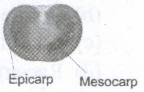
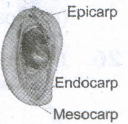
(ii) Drupe: Fruit develops from monocarpellary, superior ovary. It is usually one seeded. Pericarp is differentiated into outer skinny epicarp, fleshy and pulpy mesocarp and hard and stony endocarp around the seed. Eg: Mango, Coconut.
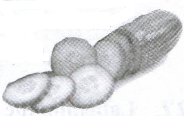
(iii) Pepo: Fruit develops from tricarpellary inferior ovary. Pericarp turns leathery or woody which encloses, fleshy mesocarp and smooth endocarp. Eg: Cucumber, Watermelon, Bottle gourd, Pumpkin.
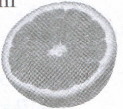
(iv) Hesperidium:Fruit develops from multicarpellary, multilocular, syncarpous, superior ovary. The fruit wall is differentiated into leathery epicarp with oil glands, a middle fibrous mesocarp. The endocarp forms distinct chambers, containing juicy hairs. Eg: Orange, Lemon.
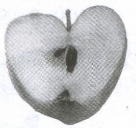
(v) Pome: It develops from multicarpellary, syncarpous, inferior ovary. The receptacle also develops along with the ovary and becomes fleshy, enclosing the true fruit. In pome the epicarp is thin skin like and endocarp is cartilaginous. Eg: Apple, Pear.
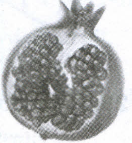
(vi) Balausta: A fleshy indehiscent fruit developing from multicarpellary, multilocular inferior ovary whose pericarp is tough and leathery. Seeds are attached irregularly with testa being the edible portion. Eg: Pomegranate.
17.
Features of DNA:
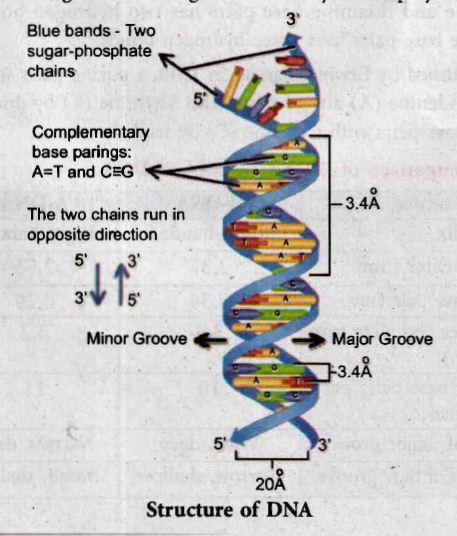
1. If one strand runs in the 5'- 3' direction, the other runs in 3'- 5' direction and thus are antiparallel (they run in opposite direction). The 5' end has the phosphate group and 3' end has the OH group.
2. The angle at which the two sugars protrude from the base pairs is about 120°, for the narrow angle and 240° for the wide angle. The narrow-angle between the sugars generates a minor groove and the large angle on the other edge generates major groove.
3. Each base is 0.34 nm apart and a complete turn of the helix comprises 3.4 nm or 10 base pairs per turn in the predominant B form of DNA.
4. DNA helical structure has a diameter of 20 A° and a pitch of about 34 A°. X-ray crystal study of DNA takes a stack of about 10 bp to go completely around the helix (360°).
5. Thermodynamic stability of the helix and specificity of base pairing includes
(i) the hydrogen bonds between the complementary bases of the double helix
(ii) stacking interaction between bases tend to stack about each other perpendicular to the direction of helical axis. Electron cloud interactions ((Π – Π)) between the bases in the helical stacks contribute to the stability of the double helix.
6. The phosphodiester linkages give an inherent polarity to the DNA helix. They form strong covalent bonds, give the strength and stability to the polynucleotide chain.
7. Plectonemic coiling - The two strands of the DNA are wrapped around each other in a helix, making it impossible to simply move them apart without breaking the entire structure. Whereas in paranemic coiling the two strands simply lie alongside one another, making them easier to pull apart.
8. Based on the helix and the distance between each turn the DNA is of three forms - A DNA, B DNA and Z DNA.
18.
19.
20.
Role of Botanical Garden:
Botanical Gardens play the following important roles.
1. Gardens have a wide range of species and supply taxonomic material for botanical research.
2. It can integrate information of diverse fields like Anatomy, Embryology, Phytochemistry, Cytology, Physiology and Ecology.
3. Act as a conservation centre for diversity, rare and endangered species.
4. It offers annual list of available species and a free exchange of seeds.
5. Botanical garden gives information about method of propagation, sale of plant material to the general public.
21.
22.
(i) This family consists of more than one species in the genus it is known as polytypic genus.
(ii) Species are intrageneric
(iii) A single genus is Felis which has a number of closely related species.
(iv) Different species of a single genus show the same morphological characteristics but their behavior varies
(v) Eg: Felis domestica (Domestic cat)
Felis margarita (Jungle cat)
Felis silvestris (Wild cat)
23.
| Probiotics | Pathogenic bacteria |
| Probiotic bacteria are beneficial. | Pathogenic bacteria are harmful. |
| Probiotic bacteria may be decomposers, photosynthetic and few may be pathogenic. | All are pathogenic and causing diseases. |
24.
| S.No. | Aggregate fruit | Multiple fruit |
| 1 | Aggregate fruits develop from a single flower having an apocarpous pistil. Each of the free carpel develops into a simple fruitlet. A collection of simple fruitlets makes an Aggregate fruit. An individual ovary develops into a drupe, achene, follicle or berry | A Multiple or composite fruit develops from the whole inflorescence along with its peduncle on which they are borne |
| 2 | Eg: Polyalthia | Eg: Pineapple |
25.
| S.No | Criteria | Monera |
| 1. | Cell type | Prokaryotic |
| 2. | Level of organization |
Mostly unicellular, rarely Multicellular |
| 3. | Cell wall | Present (made up of peptidoglycan and mucopeptides) |
| 4. | Nutrition | Autotrophic (Phototrophic, Chemoautotrophic) Heterotrophic (Parasitic and Saprophytic) |
| 5. | Motility | Motile or non-motile |
| 6. | Organisms | Archaebacteria, Eubacteria, Cyanobacteria, Actinomycetes and Mycoplasma |
26.
(i) Some cells exit G1 and enter a quiescent stage called G0, where the cell remain metabolically active without proliferation.
(ii) Cells can exist for long periods in G0 phase. In G0 cells cease growth with reduced rate of RNA and protein synthesis.
(iii) The G0 phase is not permanent. Mature neuron and skeletal muscle cell remain permanently in G0.
(iv) Many cells in animals remain in G0 unless called on to proliferate by appropriate growth factors or other extracellular signals. G0 cells are not dormant.

11th Standard Syllabus & Materials
11th Standard
TN 11th Tamil பீடு பெற நில் - செய்யுள் - காவடிச்சிந்து Important Questions And Answers Study Material - QB365 Set A
NEW11th Standard
TN 11th Tamil பீடு பெற நில் - உரைநடை - மலை இடப்பெயர்கள் : ஓர் ஆய்வு Important Questions And Answers Study Material - QB365 Set A
NEW11th Standard
TN 11th Tamil மாமழை போற்றுதும் - துணைப்பாடம் - யானை டாக்டர் Important Questions And Answers Study Material - QB365 Set A
NEW11th Standard
TN 11th Tamil மாமழை போற்றுதும் - செய்யுள் - ஐங்குறுநூறு Important Questions And Answers Study Material - QB365 Set A



Tamilnadu Stateboard 11th Standard Subjects

Maths

Commerce

Economics
Biology

Business Maths and Statistics

Accountancy

Computer Science

Physics

Chemistry
Maths
Biology
Economics
Physics
Chemistry

History
Business Maths and Statistics

Computer Science
Accountancy

Computer Applications
History
Computer Technology
Commerce
Computer Applications
Computer Technology

Tamil

English

French
Tamilnadu Stateboard Standards

