
 100% FREE ACCESS
11th Standard Syllabus & Materials
11th Standard
TN 11th Tamil இயற்கை வேளாண்மை,சுற்றுச்சூழல் -செய்யுள் - மனோன்மணீயம் Important Questions And Answers Study Material - QB365 Set A
NEW11th Standard
TN 11th Tamil என்னுயிர் என்பேன் -துணைப்பாடம் - இசைத்தமிழர் இருவர் Important Questions And Answers Study Material - QB365 Set A
NEW11th Standard
TN 11th Tamil மொழி கலை -செய்யுள் - ஒவ்வொரு புல்லையும் Important Questions And Answers Study Material - QB365 Set A
NEW11th Standard
TN 11th Tamil பீடு பெற நில் - இலக்கணம் - பகுபத உறுப்புகள் Important Questions And Answers Study Material - QB365 Set A
NEW11th Standard
TN 11th Tamil பீடு பெற நில் - துணைப்பாடம் - வாடிவாசல் Important Questions And Answers Study Material - QB365 Set A
NEW11th Standard
TN 11th Tamil பீடு பெற நில் - செய்யுள் - குறுந்தொகை Important Questions And Answers Study Material - QB365 Set A

Published on: 12/12/2019
Tissue Level of Organisation
Download Tamil Nadu 11th Standard Biology question papers, model tests, one-mark questions, important questions, and public exam papers in PDF format. Free study materials and answer keys for TN State Board students.
Questions + Answers key
Take MCQ Biology Test1.
Differentiate simple epithelium from squamous epithelium.
2.
Name the different types of cell junction and its functions.
3.
Distinguish between Neurons and Neuroglia
4.
5.
Give an account on different varieties of specialised connective tissue.
6.
Write the differences between dense regular connective tissues and dense irregular connective tissues.
7.
Write about the special features of simple epithelium, its location, and its different types. Draw suitable diagrams also.
8.
Write a note on muscle tissue.
9.
10.
Skin is ____________
Cubiodal epithelium
Stratified epithelium
Coloumnar epithelium
Pseudostratified epithelumn
11.
The cartilage cells are called _____________
Chondrocytes
Osteocytes
Melanocytes
Lymphocytes
12.
-------is closely attached to skeletal bones.
Smooth muscle
cardiac muscle
Muscle fibers
Striped muscle
13.
The Goblet cells are modifications of________________
Cuboidal epithelium
Columnar epithelium
Squamous epithelium
Simple epithelium
14.
Name the disease in which the person finds it difficult to remember recent events and has mood swings
Parkinson's disease
Ehlers- Danlos syndrome
Alzheimer's disease
Sjogren's syndrome
15.
What is the study of tissues called?
16.
What type of connective tissue is damaged when one get cut on his index finger accidently?
17.
Name the diseases of nervous system and mention it symptoms
18.
Name the functions of epithelial tissue
19.
What are the major functions of connective tissues?
1.
| Simple Epithelium | Squamous epithelium |
| Simple epithelium is composed of a single layer of cells. | The squamous epithelium is made of a single thin layer of flattened cells with irregular boundaries. |
| They are found in the organs of absorption, secretion and filtration. Simple epithelial tissue is further classified into squamous epithelium, cuboidal epithelium, columnar epithelium, ciliated epithelium and pseudostratified epithelium. | They are found in the kidney glomeruli, air sacs of lungs, lining of heart, blood vessels and lymphatic vessels and are involved in functions like forming a diffusion boundary and filtration in sites where protection is not important. |
2.
Tight junctions help to stop substances from leaking across a tissue. Adhering junctions perform cementing to keep neighbouring cells together. Gap junctions facilitate the cells to communicate with each other by connecting the cytoplasm of adjoining cells, for rapid transfer of ions, small molecules and sometimes big molecules.
3.
| Neuron | Neuroglia |
| 1. They have two types of process - axon and dendron | They have only one process |
| 2. They have synapse | Do not have synapse |
| 3. No power of division | Have power of division |
| 4. conduct nerve impulses. | They are nutritive and defensive in function and serve as packing cells. |
4.
5.
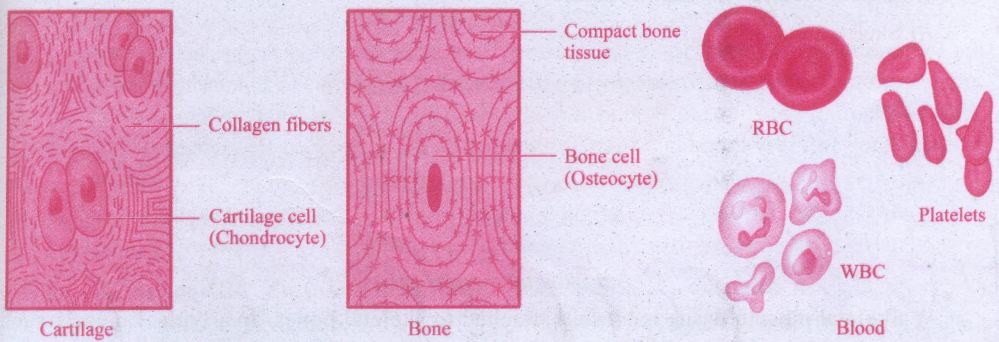
Specialised connective tissues are classified as cartilage, bones and blood. Cartilage is (ii, solid and pliable and resists compression. Cells of this tissue (chondrocytes) are enclosed in small cavities within the matrix secreted by them. Most of the cartilages in vertebrate embryos are replaced by bones in adults. Cartilage is present in the tip of nose, outer ear joints, ear pinna, between adjacent bones of the vertebral column, limbs and hands in adults.
Bones have a hard and non-pliable ground substance rich in calcium salts and collagen fibres which gives strength to the bones. It is the main tissue that provides structural frame to the body. Bones support and protect softer tissues and organs. The bone cells (osteocytes) are present in the spaces called lacunae. Limb bones, such as the long bones of the legs, serve weight-bearing functions. They also interact with skeletal muscles attached to them to bring about movements. The bone marrow in some bones is the site of production of blood cells.
Blood is the fluid connective tissue containing plasma, red blood cells (RBC), white blood cells (WBC) and platelets. It functions as the transport medium for the cardiovascular system, carrying nutrients, wastes, respiratory gases throughout the body.
6.
1. Dense regular connective tissues primarily contain collagen fibres in rows. between many parallel bundles of tissues and a few elastic fibres. The major cell type is fibroblast. It attaches muscles and bones and withstands great tensile stress when pulling force is applied in one direction. This connective tissue is present in tendons, that attach skeletal muscles to bones and ligaments attach one bone to another.
2. Dense irregular connective tissues have bundles of thick collagen fibres and fibroblasts which are arranged irregularly. The major cell type is the fibroblast. It is able to withstand tension exerted in many directions and provides structural strength. Some elastic fibres are also present. It is found in the skin as the leathery dermis and forms fibrous capsules of organs such as kidneys, bones cartilages, muscles, nerves and joints. Elastic connective tissue contains high proportion of elastic fibres. It allows recoil of tissues following stretching. It maintains the pulsatile flow of blood through the arteries and the passive recoil of lungs following inspiration. It is found in the walls of large arteries; ligaments associated with vertebral column and within the walls of the bronchial tubes.
7.
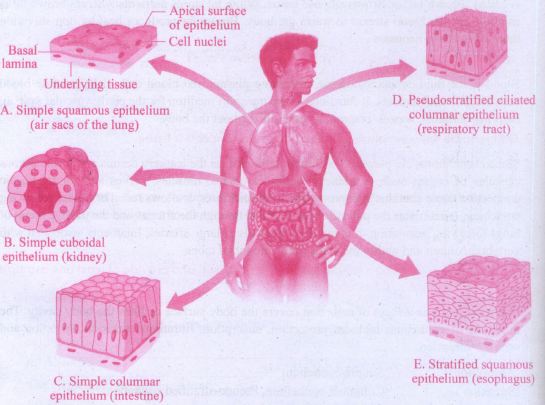
(i) Simple epithelium is composed of a single layer of cells. They are found in the organs of absorption, secretion and filtration. Simple epithelial tissue is further classified into squamous epithelium, cuboidal epithelium, columnar epithelium, ciliated epithelium and pseudostratified epithelium. The squamous epithelium is made of a single thin layer of flattened cells with irregular boundaries. They are found in the kidney glomeruli, air sacs of lungs, lining of heart, blood vessels and lymphatic vessels and are involved in functions like forming a diffusion boundary and filtration in sites where protection is not important.
(ii) The cuboidal epithelium is made of a single layer of cube-like cells. This tissue is commonly found in the kidney tubules, ducts and secretory portions of small glands and surface of the ovary. Its main functions are secretion and absorption.
(iii) The columnar epithelium is composed of single layer of tall cells with round to oval nuclei at the base. It lines the digestive tract from the stomach to the rectum.
(iv) The functions of this epithelium include absorption, secretion of mucus, enzymes and other substances.
(v) This ciliated type propels mucus by ciliary actions and it lines the small bronchioles, fallopian tubes, and uterus. Nonciliated type lines most of the digestive tract, gallbladder and secretory ducts of glands.
(vi) Pseudo-stratified epithelial cells are columnar but unequal in size. Although the epithelium is single layered yet it appears to be multi-layered because the nuclei lie at different levels in different cells. Hence, it is also called pseudostratified epithelium and its functions are protection, secretion and absorption. Ciliated forms line the trachea and the upper respiratory tract. The non ciliated forms, line the epididymis, large ducts of a glands and tracts of male urethra
8.
Muscle tissue:
1. Each muscle is made of many long, cylindrical fibres arranged in parallel arrays. These fibres are composed of numerous fine fibrils, called myofibrils. Muscle fibres contract (shorten) in response to stimulation, then relax (lengthen) and return to their uncontracted state in a coordinated fashion. In general muscles play an active role in all the movements of the body.
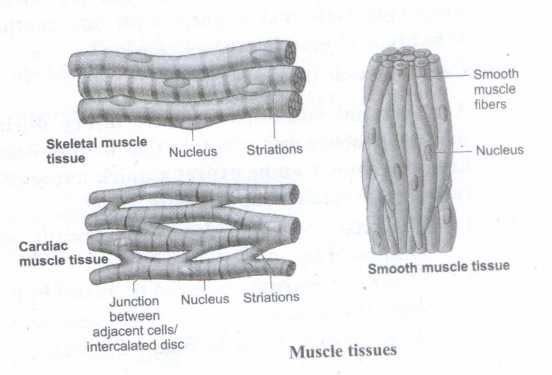
2. Muscles are of three types, a. Skeletal, b. Smooth and c. Cardiac.
a) Skeletal muscle tissue:
(i) It is closely attached to skeletal bones.
(ii) In a typical muscle such as the biceps, the striated (striped) skeletal muscle fibres are bundled together in a parallel fashion.
(iii) A sheath of tough connective tissue encloses several bundles of muscle fibres.
b) Smooth muscle tissue:
(i) The smooth muscle fibres taper at both ends (fusiform) and do not show striations.
(ii) Cell junctions hold them together and they are bundled together in a connective tissue sheath. The walls of internal organs such . as the blood vessels, stomach and intestine contain this type of muscle tissue.
(iii) Smooth muscles are 'involuntary' as their functions cannot be directly controlled.
c) Cardiac muscle tissue:
(i) It is a contractile tissue present only in the heart.
(ii) Cell junctions fuse the plasma membranes of cardiac muscle cells and make them stick together.
(iii) Communication junctions (intercalated discs) at some fusion points allow the cells to contract as a unit, i.e., when one cell receives a signal to contract, its neighbours are also stimulated to contract.
9.
10.
(b)
Stratified epithelium
11.
(a)
Chondrocytes
12.
(d)
Striped muscle
13.
(b)
Columnar epithelium
14.
(c)
Alzheimer's disease
15.
Histology.
16.
The Areolar connective tissue is damaged when finger gets cut.
17.
Parkinson's disease: A degenerative disorder of the nervous system that affects movement, often including tremors.
Alzheimer's disease: It is a chronic neurodegenerative disease which includes the symptoms of difficulty in remembering recent events, problems with language, disorientation and mood swings.
18.
The functions of epithelium include protection, absorption, filtration, excretion, secretion and sensory reception
19.
Major functions of connective tissues are binding and support, protection, insulation and transportation of substances.

11th Standard Syllabus & Materials
11th Standard
TN 11th Tamil பீடு பெற நில் - செய்யுள் - காவடிச்சிந்து Important Questions And Answers Study Material - QB365 Set A
NEW11th Standard
TN 11th Tamil பீடு பெற நில் - உரைநடை - மலை இடப்பெயர்கள் : ஓர் ஆய்வு Important Questions And Answers Study Material - QB365 Set A
NEW11th Standard
TN 11th Tamil மாமழை போற்றுதும் - துணைப்பாடம் - யானை டாக்டர் Important Questions And Answers Study Material - QB365 Set A
NEW11th Standard
TN 11th Tamil மாமழை போற்றுதும் - செய்யுள் - ஐங்குறுநூறு Important Questions And Answers Study Material - QB365 Set A



Tamilnadu Stateboard 11th Standard Subjects

Maths

Commerce

Economics
Biology

Business Maths and Statistics

Accountancy

Computer Science

Physics

Chemistry
Maths
Biology
Economics
Physics
Chemistry

History
Business Maths and Statistics

Computer Science
Accountancy

Computer Applications
History
Computer Technology
Commerce
Computer Applications
Computer Technology

Tamil

English

French
Tamilnadu Stateboard Standards

