
 100% FREE ACCESS
11th Standard Syllabus & Materials
11th Standard
TN 11th Tamil இயற்கை வேளாண்மை,சுற்றுச்சூழல் -செய்யுள் - மனோன்மணீயம் Important Questions And Answers Study Material - QB365 Set A
NEW11th Standard
TN 11th Tamil என்னுயிர் என்பேன் -துணைப்பாடம் - இசைத்தமிழர் இருவர் Important Questions And Answers Study Material - QB365 Set A
NEW11th Standard
TN 11th Tamil மொழி கலை -செய்யுள் - ஒவ்வொரு புல்லையும் Important Questions And Answers Study Material - QB365 Set A
NEW11th Standard
TN 11th Tamil பீடு பெற நில் - இலக்கணம் - பகுபத உறுப்புகள் Important Questions And Answers Study Material - QB365 Set A
NEW11th Standard
TN 11th Tamil பீடு பெற நில் - துணைப்பாடம் - வாடிவாசல் Important Questions And Answers Study Material - QB365 Set A
NEW11th Standard
TN 11th Tamil பீடு பெற நில் - செய்யுள் - குறுந்தொகை Important Questions And Answers Study Material - QB365 Set A

Published on: 18/07/2019
Download Tamil Nadu 11th Standard Biology question papers, model tests, one-mark questions, important questions, and public exam papers in PDF format. Free study materials and answer keys for TN State Board students.
Questions + Answers key
Take MCQ Biology Test1.
Monotropa derives nutrition by ___________
Root Nodules
Lichens
Mycorrhizae
Roots
2.
A plant growth promoter got from fungi is ___________
Rennet
Gibberellin
Ergot
Griseofulvin
3.
Basidiomycetes do not possess this feature.
Clamp connection
Club Fungi
Dolipore septum
Lack sexual reproduction
4.
Identify the incorrect statement about the Gram positive bacteria.
Teichoic acid absent
High percentage of peptidoglycan is found in cell wall
Cell wall is single layered
Lipopolysaccharide is present in cell wall
5.
Which one of the following statement about virus is correct?
Possess their own metabolic system
They are facultative parasites
They contain DNA or RNA
Enzymes are present
6.
What is Viroid?
7.
How was the word virus derived?
8.
What is Homeostasis?
9.
How do living things grow?
10.
Differentiate Homoiomerous and Heteromerous lichens.
11.
Write down the non-living characteristic features of virus.
12.
Write down the living characteristic features of virus.
13.
What are the three main symmetries of viruses?
14.
List some viral diseases which occur in Humans.
15.
Why do farmers plant leguminous crops in crop rotations/mixed cropping?
16.
Write the distinguishing features of Monera.
17.
Give a concise account on virulent cycle / Explain Lytic cycle of a phage.
18.
Describe the structure of Tobacco Mosaic Virus.
19.
Give a general account on lichens.
20.
1.
(c)
Mycorrhizae
2.
(b)
Gibberellin
3.
(d)
Lack sexual reproduction
4.
(d)
Lipopolysaccharide is present in cell wall
5.
(c)
They contain DNA or RNA
6.
1. It is a circular molecule of ssRNA without a capsid
2. Discovered by T.O. Diener in 1971.
3. RNA has low molecular weight.
4. It causes citrus exocortis & potato spindle tuber disease in plants.
7.
The word virus is derived from Latin meaning 'Poison'.
8.
Property of self-regulation and tendency to maintain a steady state within an external environment which is liable to change is called Homeostasis. It is essential for the living organisms.
9.
Growth is an intrinsic property of all living organisms through which they can increase cells both in number and mass.
10.
| Homoiomerous | Heteromerous |
| Algal cells evenly distributed in the thallus | A distinct layer of algae and fungi present |
11.
1. Can be crystallized.
2. Absence of metabolism.
3. Inactive outside the host.
4. Do not show functional autonomy.
5. Energy producing enzyme system absent.
12.
1. Presence of nucleic acid and protein.
2. Capable of mutation.
3. Ability to multiply within living cells.
4. Ability to infect and cause diseases in living beings.
5. Show irritability.
6. Host-specific.
13.
Generally, viruses are of three types based on shape and symmetry
1. Cuboid symmetry - Eg: Adenovirus, Herpesvirus.
2. Helical symmetry - Eg: Influenza virus, TMV.
3. Complex or Atypical symmetry - Eg: Bacteriophage, Vaccinia virus.
14.
Human Diseases:
1. Common cold.
2. Hepatitis B.
3. Cancer.
4. SARS (Severe Acute Respiratory Syndrome).
5. AIDS (Acquired Immunodeficiency Syndrome).
6. Rabies.
7. Mumps.
8. Polio.
9. Chikungunya.
10. Smallpox.
11. Chickenpox.
12. Measles.
15.
During crop rotations and mixed cropping. Farmers plant leguminous crops to increase the soil fertility.
| S.No | Beneficial aspects | Bacteria | Role |
| 1. | Ammonification |
1. Bacillus ramosus 2. Bacillus mycoides |
Convert complex proteins in the dead bodies of plants and animals into ammonia which is later converted into ammonium salt |
| 2. | Nitrification |
1. Nitrobacter 2. Nitrosomonas |
Convert ammonium salts into nitrites and nitrates |
| 3. | Nitrogen fixation |
1. Azotobacter 2. Clostridium 3. Rhizobium |
(i) Converting atmospheric nitrogen into organic nitrogen |
| (ii) The nitrogenous compounds are also oxidized to nitrogen | |||
| (iii) All these activities of bacteria increase soil fertility |
16.
| S.No | Criteria | Monera |
| 1. | Cell type | Prokaryotic |
| 2. | Level of organization |
Mostly unicellular, rarely Multicellular |
| 3. | Cell wall | Present (made up of peptidoglycan and mucopeptides) |
| 4. | Nutrition | Autotrophic (Phototrophic, Chemoautotrophic) Heterotrophic (Parasitic and Saprophytic) |
| 5. | Motility | Motile or non-motile |
| 6. | Organisms | Archaebacteria, Eubacteria, Cyanobacteria, Actinomycetes and Mycoplasma |
17.
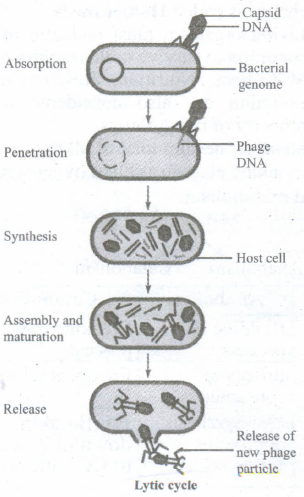
Lytic Cycle :
During lytic cycle of the phage the disintegration of host bacterial cell occurs and the progeny virions are released The steps involved in the lytic cycle are as follows:
1. Adsorption:
(i) Phage (T4) particles interact with cell wall of host (E.coli).
(ii) The phage tail makes contact between the two, and tail fibres recognize the specific receptor sites present on bacterial cell surface.
(iii) The lipopolysaccharides of tail fibres act as receptor in phages.
(iv) The process involving the recognition of phage to bacterium is called landing. Once the contact is established between tail fibres and bacterial cell, tail fibres bend to anchor the pins and base plate to the cell surface.
(v) This step is called pinning.
2. Penetration:
(i) The penetration process involves mechanical and enzymatic digestion of the cell wall of the host.
(ii) At the recognition site phage digests certain cell wall structure by viral enzyme (lysozyme).
(iii) After pinning the tail sheath contracts (by using ATP) and appears shorter and thicker.
(iv) After contraction the base plate enlarges through which DNA is injected into the cell wall without using metabolic energy.
(v) The step involving injection of DNA particle alone into the bacterial cell is called Transfection.
(vi) The empty protein coat leaving the outside of the cell is known as 'ghost'.
3. Synthesis:
(i) This step involves the degradation of bacterial chromosome, protein synthesis and DNA replication.
(ii) The phage nucleic acid takes over the host biosynthetic machinery. Host DNA gets inactivated and breaks down.
(iii) Phage DNA suppresses the synthesis of bacterial protein and directs the metabolism of the cell to synthesize the proteins of the phage particles and simultaneously replication of phage DNA also takes place.
4. Assembly and Maturation:
(i) The DNA of the phage and protein coat are synthesized separately and are assembled to form phage particles.
(ii) The process of assembling the phage particles is known as maturation.
(iii) After 20 minutes of infection about 300 new phages are assembled.
5. Release:
The phage particles get accumulated inside the host cell and are released by the lysis of host cell wall.
18.
Tobacco mosaic virus was discovered in 1892 by Dmitri Ivanovsky from Tobacco plant.
Structure of Tobacco mosaic virus:
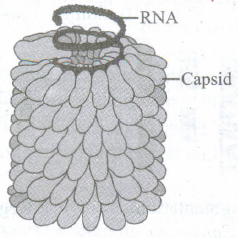
1. TMV is a rod-shaped helical virus measuring about 280 x 150\(\mu\)m with a molecular weight of 39 x 106 Daltons.
2. The virion is made up of two constituents, a protein coat called capsid and a core called nucleic acid.
3. The capsid is made up of approximately 2130 identical protein subunits called capsomeres.
4. The Nucleic acid consists of central single stranded RNA molecule.
5. The genetic information necessary for the formation of a complete TMV particle is contained in its RNA. It has 6,500 nucleotides.
19.
(i) The symbiotic association between algae and fungi is called lichens.
(ii) The algal partner is called Phycobiont or Photobiont and the fungal partner is called Mycobiont.
(iii) Algae provide nutrition for fungal partner in turn fungi provide protection and also help to fix the thallus to the substratum through rhizines.
(iv) Asexual reproduction takes place through fragmentation, soredia and Isidia. Phycobionts reproduce by akinetes, hormogonia, aplanospore, etc., Mycobionts undergo sexual reproduction and produce ascocarps.
Classification:
(i) Based on the habitat lichens are classified into following types: Corticolous (on Bark) Lignicolous (on Wood) Saxicolous (on rocks) Terricolous (on ground) Marine (on siliceous rocks of sea) Fresh water (on siliceous rock of fresh water).
(ii) On the basis of morphology of the thallus they are divided into Leprose (a distinct fungal layer is absent) Crustose-crust like; Foliose-leaf like; Fruticose-branched pendulous shrub like.
(iii) The distribution of algal cells distinguishes lichens into two forms namely Homoiomerous (Algal cells evenly distributed in the thallus) and Heteromerous (a distinct layer of algae and fungi present)
(iv) If the fungal partner of lichen belongs to ascomycetes, it is called Ascolichen and if it is basidiomycetes it is called Basidiolichen.
20.

11th Standard Syllabus & Materials
11th Standard
TN 11th Tamil பீடு பெற நில் - செய்யுள் - காவடிச்சிந்து Important Questions And Answers Study Material - QB365 Set A
NEW11th Standard
TN 11th Tamil பீடு பெற நில் - உரைநடை - மலை இடப்பெயர்கள் : ஓர் ஆய்வு Important Questions And Answers Study Material - QB365 Set A
NEW11th Standard
TN 11th Tamil மாமழை போற்றுதும் - துணைப்பாடம் - யானை டாக்டர் Important Questions And Answers Study Material - QB365 Set A
NEW11th Standard
TN 11th Tamil மாமழை போற்றுதும் - செய்யுள் - ஐங்குறுநூறு Important Questions And Answers Study Material - QB365 Set A



Tamilnadu Stateboard 11th Standard Subjects

Maths

Commerce

Economics
Biology

Business Maths and Statistics

Accountancy

Computer Science

Physics

Chemistry
Maths
Biology
Economics
Physics
Chemistry

History
Business Maths and Statistics

Computer Science
Accountancy

Computer Applications
History
Computer Technology
Commerce
Computer Applications
Computer Technology

Tamil

English

French
Tamilnadu Stateboard Standards

