
 100% FREE ACCESS
11th Standard Syllabus & Materials
11th Standard
TN 11th Tamil இயற்கை வேளாண்மை,சுற்றுச்சூழல் -செய்யுள் - மனோன்மணீயம் Important Questions And Answers Study Material - QB365 Set A
NEW11th Standard
TN 11th Tamil என்னுயிர் என்பேன் -துணைப்பாடம் - இசைத்தமிழர் இருவர் Important Questions And Answers Study Material - QB365 Set A
NEW11th Standard
TN 11th Tamil மொழி கலை -செய்யுள் - ஒவ்வொரு புல்லையும் Important Questions And Answers Study Material - QB365 Set A
NEW11th Standard
TN 11th Tamil பீடு பெற நில் - இலக்கணம் - பகுபத உறுப்புகள் Important Questions And Answers Study Material - QB365 Set A
NEW11th Standard
TN 11th Tamil பீடு பெற நில் - துணைப்பாடம் - வாடிவாசல் Important Questions And Answers Study Material - QB365 Set A
NEW11th Standard
TN 11th Tamil பீடு பெற நில் - செய்யுள் - குறுந்தொகை Important Questions And Answers Study Material - QB365 Set A

Published on: 27/11/2019
Vegetative Morphology
Download Tamil Nadu 11th Standard Biology question papers, model tests, one-mark questions, important questions, and public exam papers in PDF format. Free study materials and answer keys for TN State Board students.
Questions + Answers key
Take MCQ Biology Test1.
Ternate phyllotaxy is seen in _____
Nerium
Ocimum
Allamanda
Guava
2.
The root in Dahlia is described as ___
Annulated
Fasciculated
Nodulose
Beaded
3.
_____ is a biennial.
Cabbage
Bamboo
Groundnut
Peas
4.
Bryophyllum and Dioscorea are examples of ______.
Foliar bud, apical bud
Foliar bud, cauline bud
Cauline bud, apical bud
Cauline bud, foliar bud
5.
Curcuma amada, Curcuma domestica, Asparagus, Maranta are example of __________
Tuberous root
Beaded root
Moniliform root
Nodulose root
6.
Write different types of Underground stem modifications.
7.
What are the different types of phyllotaxy?
8.
Write a note on Adventitious roots modified for storage.
9.
10.
Write the similarities and difference between
a. Radicle buds and foliar buds
b. Phylloclade and cladode
11.
Name the various regions of the root.
12.
Define Root cap.
13.
What is primary root?
14.
How root climbers differ from stem climbers?
15.
Classification of Root modification.
16.
Describe Palmately reticulate venation. Mention its types with example.
17.
Explain the structure of a pitcher.
18.
What are buttress roots?
19.
How are Tap roots modified for storage?
1.
(a)
Nerium
2.
(b)
Fasciculated
3.
(a)
Cabbage
4.
(b)
Foliar bud, cauline bud
5.
(d)
Nodulose root
6.
i) Perennial and some biennial herbs have underground stems, which are generally known as root stocks. Rootstock functions as a storage and protective organ.
ii) It remains alive below the ground during unfavourable conditions and resumes growth during the favourable conditions.
iii) Underground stems are not roots because they possess nodes, internodes, scale-leaves and buds. iv) Rootstock also lack root cap and root hairs but they possess terminal bud which is a characteristics of stem.
Bulb
i) It is a condensed conical or convex stem surrounded by fleshy scale leaves. They are of two types
1. Tunicated (coated) bulb: In which the stem is much condensed and surrounded by several concentric
layers of scale leaves.
i) The inner scales commonly fleshy, the outer ones dry.
ii) These are two types (a) Simple Tunicated bulb
Example: Allium cepa (b) Compound Tunicated bulb. Example: Allium sativum.
2. Scaly bulb: They are narrow, partially overlap
iii) each other by their margins only. Example: Tulipa spp.
iv) Pseudobulb is a short erect aerial storage or propagating stem of certain epiphytic and terrestrial sympodial orchids. Example: Bulbophyllum.
Corm
i) This is a succulent underground stem with an erect growing tip.
ii) The corm is surrounded by scale leaves and exhibit nodes and internodes. Example: Amorphophallus, Gladiolus, Colacasia, Crocus, Colchicum
Rhizome
i) This is a underground stem grows horizontally with several lateral growing tips.
ii) Rhizome posses conspiquous nodes and internodes covered by scale leaves.
Example: Zingiber officinale, Canna, Curcuma longa, Maranta arundinacea, Nymphaea, Nelumbo.
Tuber
This is a succulent underground spherical or globose stem with many embedded axillary buds called "eyes". Example: Solanum tuberosum, Helicnthus tuberosus.
7.
1. The arrangement of leaves on the stem or the branches is known as phyllotaxy. (Gk. Phyllon = leaf, taxis = arrangement).
2. Phyllotaxy is to avoid overcrowding of leaves so as to expose the leaves to maximum sunlight for photosynthesis.
3. The four main types of phyllotaxy are Alternate, Opposite, Ternate, Whorled.
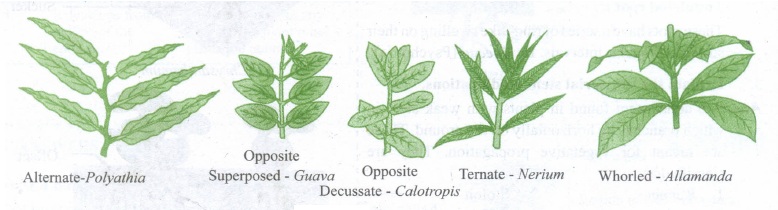
Alternate phyllotaxy:
In this type there is only one leaf per node and leaves on the successive nodes are arranged alternately to each other. Spiral arrangement of leaves show vertical rows are called orthostichies. They are two types.
(a) Alternate spiral: In which the leaves are arranged alternately in a spiral manner. Eg: Hibiscus.
(b) Alternate distichous or Bifarious: In which the leaves are organized alternatively in two rows on either side of the stem. Eg: Polyalthia.
Opposite phyllotaxy: In this type each node possess two leaves opposite to each other. They are organized in two different types.
(a) Opposite superposed: The pair of leaves arranged in succession are in the same direction, that is two opposite leaves at a node lie exactly above those at the lower node. Eg: Psidium.
(b) Opposite decussate: In this type of phyllotaxy one pair of leaves is placed at right angles to the next upper or lower pair of leaves. Eg: Calotropis.
Ternate phyllotaxy: In this type there are three leaves attached at each node. Eg: Nerium.
Whorled (verticillate) type of phyllotaxy: In this type more than three leaves are present in a whorl at each node forming a circle or whorl. Eg: Allamanda.
8.
Tuberous root: These are swollen without any definite shape. They are produced singly and not in clusters. Eg. Ipomoea batatas.
Fasciculated root: These are in a cluster from the base of the stem. Eg: Dahlia, Asparagus.
Nodulose root: Swelling occurs only near the tips. Eg: Maranta (arrowroot) Curcuma Amada (mango ginger).
Moniliform or Beaded root: These roots swell at frequent intervals giving them a beaded appearance. Eg. Vitis, Portulaca.
Annulated root: These roots have a series of ring-like swelling on their surface at regular intervals. Eg: Ipecac (Psychotria).
9.
10.
| a | Radical buds | Foliar buds |
| Differences | Radicle buds arise from the lateral roots. Eg. Sweet potato | Foliar buds develop from veins or from margins of the leaves. Eg. Begonia |
| Similarities | It is a type of adventitious root | It is a type of adventitious root |
| b | Phylloclade | Cladode |
| Differences | Presence of series of nodes and internodes. Eg: Casuarina | Presence of one or two internodes only. Eg: Asparagus |
| Similarities | Phylloclade is a stem modification | Cladode is a stem modification |
11.
1. Root cap region
2. Meristematic zone
3. Zone of elongation
4. Zone of maturation
12.
Root tip is covered by dome-shaped parenchymatous cells called root cap. It protects the meristematic cells in the apex.
13.
Primary root is direct prolongation of the radicle. In most dicots it persists and forms the main root of the plant or tap root forming the tap root system.
14.
(i) Root climbers: Plants climbing with the help of adventitious roots (arising from node). Eg: Piper betel, Piper nigrum, Pothos.
(ii) Stem climbers: These climbers lack specialised structure for climbing and the stem itself coils around the support. Eg: Ipomoea, Clitoria, Quisqualis.
15.
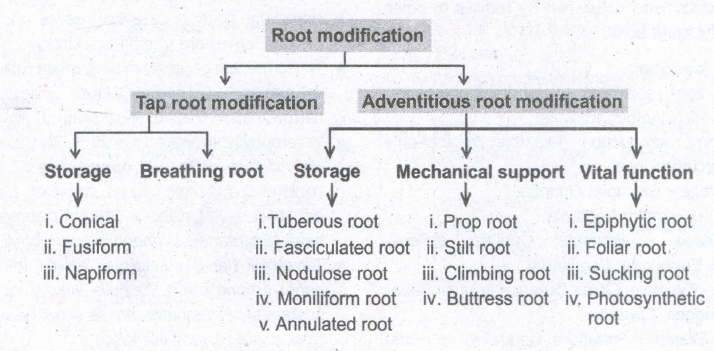
16.
Palmately reticulate venation (multicostate): In this type of venation there aretwo or more principal veins arising from a single point and they proceed outwards or upwards. The two types of palmate reticulate venation are
(i) Divergent type: When all principal veins originate from the base and diverge from one another towards the margin of the leaf as in Cucurbita, Luffa, Carica papaya, etc.
(ii) Convergent: When the veins converge to the apex of the leaf, as in Indian plum (Zizyphus), bay leaf (Cinnamomum)
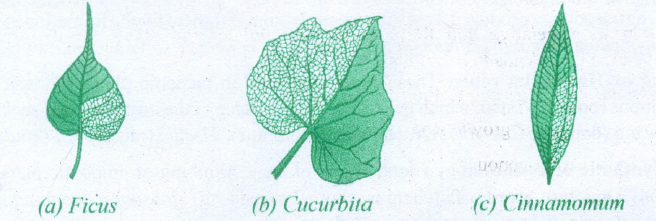
(a) Pinnately reticulate
(b) Palmately reticulate (Divergent)
(c) Palmately reticulate (Convergent)
17.
The leaf becomes modified into a pitcher in Nepenthes and Sarracenia. In Nepenthes the basal part of the leaf is laminar and the midrib continues as a coiled tendril structure. The apical part of the leaf is modified into a pitcher. The mouth of the pitcher is closed by a lid which is the modification of leaf apex.
18.
In certain trees broad plank-like outgrowths develop towards the base all around the trunk. They grow obliquely downwards and give support to huge trunks of trees. This is an adaptation for tall rain forest trees. Eg: silk cotton tree (Bombax), White cotton tree (kapok).
19.
1. Conical Root: These are cone-like, broad at the base and gradually tapering towards the apex. Eg: Daucus carota.
2. Fusiform root: These roots are swollen in the middle and tapering towards both ends. Eg: Raphanus sativus
3. Napiform root: It is very broad and suddenly tapers like a tail at the apex. Eg: Beta vulgaris.

11th Standard Syllabus & Materials
11th Standard
TN 11th Tamil பீடு பெற நில் - செய்யுள் - காவடிச்சிந்து Important Questions And Answers Study Material - QB365 Set A
NEW11th Standard
TN 11th Tamil பீடு பெற நில் - உரைநடை - மலை இடப்பெயர்கள் : ஓர் ஆய்வு Important Questions And Answers Study Material - QB365 Set A
NEW11th Standard
TN 11th Tamil மாமழை போற்றுதும் - துணைப்பாடம் - யானை டாக்டர் Important Questions And Answers Study Material - QB365 Set A
NEW11th Standard
TN 11th Tamil மாமழை போற்றுதும் - செய்யுள் - ஐங்குறுநூறு Important Questions And Answers Study Material - QB365 Set A



Tamilnadu Stateboard 11th Standard Subjects

Maths

Commerce

Economics
Biology

Business Maths and Statistics

Accountancy

Computer Science

Physics

Chemistry
Maths
Biology
Economics
Physics
Chemistry

History
Business Maths and Statistics

Computer Science
Accountancy

Computer Applications
History
Computer Technology
Commerce
Computer Applications
Computer Technology

Tamil

English

French
Tamilnadu Stateboard Standards

