
 100% FREE ACCESS
11th Standard Syllabus & Materials
11th Standard
TN 11th Tamil இயற்கை வேளாண்மை,சுற்றுச்சூழல் -செய்யுள் - மனோன்மணீயம் Important Questions And Answers Study Material - QB365 Set A
NEW11th Standard
TN 11th Tamil என்னுயிர் என்பேன் -துணைப்பாடம் - இசைத்தமிழர் இருவர் Important Questions And Answers Study Material - QB365 Set A
NEW11th Standard
TN 11th Tamil மொழி கலை -செய்யுள் - ஒவ்வொரு புல்லையும் Important Questions And Answers Study Material - QB365 Set A
NEW11th Standard
TN 11th Tamil பீடு பெற நில் - இலக்கணம் - பகுபத உறுப்புகள் Important Questions And Answers Study Material - QB365 Set A
NEW11th Standard
TN 11th Tamil பீடு பெற நில் - துணைப்பாடம் - வாடிவாசல் Important Questions And Answers Study Material - QB365 Set A
NEW11th Standard
TN 11th Tamil பீடு பெற நில் - செய்யுள் - குறுந்தொகை Important Questions And Answers Study Material - QB365 Set A

Published on: 19/08/2019
Botany - Cell - The Unit of Life
Download Tamil Nadu 11th Standard Biology question papers, model tests, one-mark questions, important questions, and public exam papers in PDF format. Free study materials and answer keys for TN State Board students.
Questions + Answers key
Take MCQ Biology Test1.
Janus Green is used to stain ____
Starch
Nucleus
Mitochondria
Chromosome
2.
The term protoplasm was coined by______.
A Purkinje
Mohl
Schultze
Felix
3.
_________ provides 3 dimensional images of surface of microscopic objects.
TEM
SEM
Phase Contrast microscope
Dark field microscope
4.
Keeping in view the fluid mosaic model for the structure of cell membrane which one of the following statements is correct with respect to the movement of lipids and proteins from one lipid monolayer to the other.
Neither lipid nor proteins can flip-flop
Both lipid and proteins can flip flop
While lipids can rarely flip-flop proteins cannot
While proteins can flip-flop lipids cannot
5.
The two subunits of ribosomes remain united at critical ion level of _______.
Magnesium
Calcium
Sodium
Ferrous
6.
What are nucleolar organizers?
7.
Define 'magnification' of a Microscope.
8.
Name the two kinds of electron microscope.
9.
State the protoplasm theory.
10.
Bring out the significance of Transmission Electron Microscope.
11.
What are the functions of Chloroplast?
12.
Differentiate between Chromoplasts and Leucoplasts.
13.
How are Chromosomes classified based on the position of centromere?
14.
Differentiate the 70s Ribosomes and 80s Ribosomes.
15.
16.
Describe the Fine Structure of a cell wall.
17.
Discuss in detail about the physical properties of protoplasm.
18.
Draw the ultrastructure of plant cell.
19.
1.
(c)
Mitochondria
2.
(a)
A Purkinje
3.
(b)
SEM
4.
(c)
While lipids can rarely flip-flop proteins cannot
5.
(a)
Magnesium
6.
In a Chromosome apart from primary constriction, secondary constrictions occur. The nucleoli develop from secondary constrictions and such secondary constrictions are called nucleolar organizer regions.
7.
Magnification:
1. The optical increase in the size of an image is called magnification. It is calculated by the following formula.
2. Magnification = \(\frac { size\ of\ image\ seen\ with\ the\ microscope }{ size\ of\ the\ image\ seen\ with\ normal\ eye } \)
8.
1. Transmission Electron Microscope (TEM).
2. Scanning Electron Microscope (SEM).
9.
(i) Corti first observed protoplasm Felix Dujardin (1835) observed a living juice in animal cell and called it "Sarcode". Purkinje (1839) coined the term protoplasm for sap inside a plant cell. Hugo Van Mohl (1846) indicated importance of protoplasm.
(ii) Max Schultze (1861) established similarity between Protoplasm and Sarcode and O. Hertwig (1892) proposed a theory which later called the 'protoplasm theory' Huxley (1868) proposed protoplasm as a "physical basis of life".
10.
(i) A beam of electrons passes through the specimen to form an image. It provides two-dimensional image.
(ii) The magnification is 1-3 lakhs times and resolving power is 2 - 10 Å.
11.
1. Photosynthesis.
2. Light reactions takes place in granum.
3. Dark reactions take place in stroma.
4. Chloroplast is involved in photorespiration.
12.
| S.No | Chromoplasts | Leucoplasts |
| 1. | Coloured Plastids. | Colourless Plastids store food materials |
| 2. | Eg: Chloroplast Occurs in green algae and higher plants Pigments chlorophyll a and b | Eg: Amyloplast - Stores - Starch. |
13.
1. Telocentric (Terminal centromere).
2. Acrocentric (terminal centromere capped by Telomere).
3. Sub-metacentric (centromere subterminal).
4. Metacentric (centromere median).
14.
| S.No | 70s Ribosomes | 80s Ribosomes |
| 1. | They have 30S small subunit and 50S large subunit | They have 40S small subunit and 60S large subunit |
| 2. | Found in Prokaryotes. | Found in Eukaryotes. |
| 3. | 16S rRNA in small subunit. | 18S rRNA in small subunit. |
15.
16.
Cell wall is the outermost protective cover of cell. It was first observed by Robert Hooke. In plants it is made up of cellulose, hemicellulose, pectin, lignin, cutin, suberin and silica. In a plant cell wall shows three distinct regions (a) Primary wall (b) Secondary wall (c) Middle lamellae
(a) Primary wall:
(i) It is the first layer inner to middle lamellae, primarily consisting of loose network of cellulose microfibrils in a gel matrix.
(ii) It is thin, elastic and extensible. In most plants the microfibrils are made up of cellulose oriented differently based on shape and thickness of the wall.
(iii) The matrix of the primary wall is composed of hemicellulose, pectin, glycoprotein and water.
(iv) Hemicellulose binds the microfibrils with matrix and glycoproteins control the orientation of microfibrils while pectin serves as filling material of the matrix.
(v) Cells such as parenchyma and meristems have only primary wall.
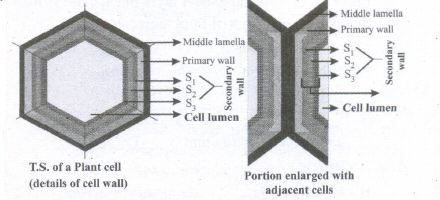
Plant Cell Wall
b. Secondary wall :
(i) Secondary wall is laid during maturation. It plays a key role in determining the shape of a cell. It is thick, inelastic and is made up of cellulose and lignin.
(ii) The secondary wall is divided into three sub layers termed as SI' S2 and S3 where the cellulose microfibrils are compactly arranged with different orientation forming a laminated structure and the cell wall strength is increased.
c. Middle lamellae:
(i) It is the outermost layer made up of calcium and magnesium pectate, deposited at the time of cytokinesis.
(ii) It is a thin amorphous layer which cements two adjacent cells. It is optically inactive (isotropic).
(iii) Plasmodesmata and Pits: Plasmodesmata act as a channel between the protoplasm of adjacent cells through which many substances pass through.
(iv) Moreover, at few regions the secondary wall layer is laid unevenly whereas the primary wall and middle lamellae are laid continuously such regions are called pits
(v) The pits of adjacent cells are opposite to each other. Each pit has a pit chamber and a pit membrane.
(vi) The pit membrane has many minute pores and thus they are permeable. The pits are of two types namely simple and bordered pit.
17.
1.Protoplasm is translucent, odourless and polyphasic fluid
2. It is a crystal colloid solution which is a mixture of chemical substances forming crystalloid i.e. true solution (sugars, salts, acids, bases) and others forming colloidal solution (Proteins and lipids).
3. The pH of the protoplasm is around 6.8, contain 90% water (10% in dormant seeds).
4. Protoplasm is neither a good nor a bad conductor of electricity. It forms a delimiting membrane on coming in contact with water and solidifies when heated.
5. Cohesiveness: Particles or molecules of protoplasm are adhered with each other by forces, such as Van der Waal's bonds, that hold long chains of molecules together. This property varies with the strength of these forces.
6. Contractility: The contractility of protoplasm is important for the absorption and removal of water especially stomatal operations.
7. Surface tension: The proteins and lipids of the protoplasm have less surface tension, hence they are found at the surface forming the membrane. On the other hand the chemical substances (NaCl) have high surface tension, so they occur in deeper parts of the cell protoplasm.
18.
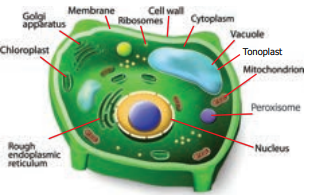
Ultrastructure of Plant Cell
19.

11th Standard Syllabus & Materials
11th Standard
TN 11th Tamil பீடு பெற நில் - செய்யுள் - காவடிச்சிந்து Important Questions And Answers Study Material - QB365 Set A
NEW11th Standard
TN 11th Tamil பீடு பெற நில் - உரைநடை - மலை இடப்பெயர்கள் : ஓர் ஆய்வு Important Questions And Answers Study Material - QB365 Set A
NEW11th Standard
TN 11th Tamil மாமழை போற்றுதும் - துணைப்பாடம் - யானை டாக்டர் Important Questions And Answers Study Material - QB365 Set A
NEW11th Standard
TN 11th Tamil மாமழை போற்றுதும் - செய்யுள் - ஐங்குறுநூறு Important Questions And Answers Study Material - QB365 Set A



Tamilnadu Stateboard 11th Standard Subjects

Maths

Commerce

Economics
Biology

Business Maths and Statistics

Accountancy

Computer Science

Physics

Chemistry
Maths
Biology
Economics
Physics
Chemistry

History
Business Maths and Statistics

Computer Science
Accountancy

Computer Applications
History
Computer Technology
Commerce
Computer Applications
Computer Technology

Tamil

English

French
Tamilnadu Stateboard Standards

