
 100% FREE ACCESS
11th Standard Syllabus & Materials
11th Standard
TN 11th Tamil இயற்கை வேளாண்மை,சுற்றுச்சூழல் -செய்யுள் - மனோன்மணீயம் Important Questions And Answers Study Material - QB365 Set A
NEW11th Standard
TN 11th Tamil என்னுயிர் என்பேன் -துணைப்பாடம் - இசைத்தமிழர் இருவர் Important Questions And Answers Study Material - QB365 Set A
NEW11th Standard
TN 11th Tamil மொழி கலை -செய்யுள் - ஒவ்வொரு புல்லையும் Important Questions And Answers Study Material - QB365 Set A
NEW11th Standard
TN 11th Tamil பீடு பெற நில் - இலக்கணம் - பகுபத உறுப்புகள் Important Questions And Answers Study Material - QB365 Set A
NEW11th Standard
TN 11th Tamil பீடு பெற நில் - துணைப்பாடம் - வாடிவாசல் Important Questions And Answers Study Material - QB365 Set A
NEW11th Standard
TN 11th Tamil பீடு பெற நில் - செய்யுள் - குறுந்தொகை Important Questions And Answers Study Material - QB365 Set A

Published on: 12/09/2019
Botany - Photosynthesis
Download Tamil Nadu 11th Standard Biology question papers, model tests, one-mark questions, important questions, and public exam papers in PDF format. Free study materials and answer keys for TN State Board students.
Questions + Answers key
Take MCQ Biology Test1.
Identify true statement regarding light reaction of photosynthesis.
Splitting of water molecule is associate with PS I.
PS I and PS II involved in the formation of NADPH + H+
The reaction center of PS I is Chlorophyll a with absorption peak at 680 nm.
The reaction center of PS II is Chlorophyll a with absorption peak at 700 nm.
2.
The correct sequence of flow of electrons in the light reaction is _______.
PS II, plastoquinone, cytochrome, PS I, ferredoxin.
PS I, plastoquinone, cytochrome, PS II ferredoxin.
PS II, ferredoxin, plastoquinone, cytochrome, PS I.
PS II, plastoquinone, cytochrome, PS II, ferredoxin.
3.
Assertion (A): Increase in proton gradient inside lumen responsible for ATP synthesis
Reason (R): Oxygen evolving complex of PS I located on thylakoid membrane facing Stroma, releases H+ ions
Both Assertion and Reason are True.
Assertion is True and Reason is False.
Reason is True and Assertion is False.
Both Assertion and Reason are False.
4.
Two groups (A & B) of bean plants of similar size and same leaf area were placed in identical conditions. Group A was exposed to light of wavelength 400-450nm & Group B to light of wavelength of 500-550nm. Compare the photosynthetic rate of the 2 groups giving reasons.
5.
Grasses have an adaptive mechanism to compensate photorespiratory losses. Name and describe the mechanism.
6.
When there is plenty of light and higher concentration of O2, what kind of pathway does the plant undergo? Analyse the reasons.
7.
In Botany class, teacher explains, Synthesis of one glucose requires 30 ATPs in C4 plants and only 18 ATPs in C3 plants. The same teacher explains C4 plants are more advantageous than C3 plants. Can you identify the reason for this contradiction?
1.
(b)
PS I and PS II involved in the formation of NADPH + H+
2.
(a)
PS II, plastoquinone, cytochrome, PS I, ferredoxin.
3.
(b)
Assertion is True and Reason is False.
4.
(i) Group A shows maximum photosynthesis. chlorophyll pigments of the spectrum is (400 - 450 nm), hence the photosynthesis is high.
(ii) Group B will show negligible amount of photosynthesis, because chlorophyll does not absorb any light in this region (500 - 550nm). It reflects green.
5.
(i) C4 cycle/Di - carboxylic acid pathway/ Di - carboxylation pathway is an adaptive mechanism.
(ii) It takes place in two phases. First phase takes place in stroma of mesophyll cells, where the CO2 acceptor molecule 3-Carbon compound, phosphoenol pyruvate (PEP) to form 4-carbon oxalo acetic acid (OAA). The first product is a 4-carbon and so it is named as C4 cycle. Oxalo acetic acid is a dicarboxylic acid and hence this cycle is also known as dicarboxylic acid pathway.
(iii) Carbondioxide fixation takes place in two places one in mesophyll and another in bundle sheath cell.
(iv) C4 plants requires 5 ATP and 2NADPH + H+ to fix one molecule of CO2.
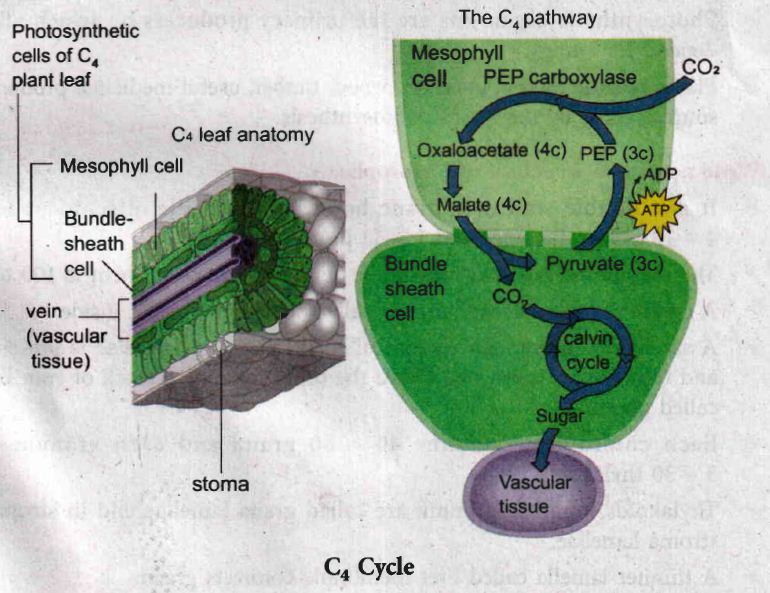
Stage: I Mesophyll Cells
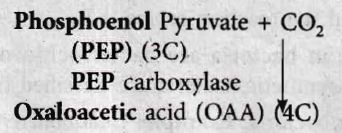
(i) Oxaloacetic acid (OAA) is converted into malic acid or aspartic acid and is transported to the bundle sheath cells through plasmodesmata.
Stage: II Bundle Sheath Cells
(i) Malic acid undergoes decarboxylation and produces a 3 carbon compound Pyruvic acid and CO2.
(ii) The released CO2 combines with RUBP and follows the calvin cycle and finally sugar is released to the phloem.
(iii) Pyruvic acid is transported to the mesophyll cells.

6.
The plants undergoes Photorespiration.
(i) It is the excess respiration taking place in photosynthetic cells due to absence of CO2 and increase of O2.
(ii) This condition changes the carboxylase role of RUBISCO into oxygenase.
7.
C4 plants are more advantageous than C3 plants because increasing the proportion of C4 plants on earth could assist biosequestration of CO2 and represent an important cilmate change avoidance strategy.

11th Standard Syllabus & Materials
11th Standard
TN 11th Tamil பீடு பெற நில் - செய்யுள் - காவடிச்சிந்து Important Questions And Answers Study Material - QB365 Set A
NEW11th Standard
TN 11th Tamil பீடு பெற நில் - உரைநடை - மலை இடப்பெயர்கள் : ஓர் ஆய்வு Important Questions And Answers Study Material - QB365 Set A
NEW11th Standard
TN 11th Tamil மாமழை போற்றுதும் - துணைப்பாடம் - யானை டாக்டர் Important Questions And Answers Study Material - QB365 Set A
NEW11th Standard
TN 11th Tamil மாமழை போற்றுதும் - செய்யுள் - ஐங்குறுநூறு Important Questions And Answers Study Material - QB365 Set A



Tamilnadu Stateboard 11th Standard Subjects

Maths

Commerce

Economics
Biology

Business Maths and Statistics

Accountancy

Computer Science

Physics

Chemistry
Maths
Biology
Economics
Physics
Chemistry

History
Business Maths and Statistics

Computer Science
Accountancy

Computer Applications
History
Computer Technology
Commerce
Computer Applications
Computer Technology

Tamil

English

French
Tamilnadu Stateboard Standards

