
 100% FREE ACCESS
11th Standard Syllabus & Materials
11th Standard
TN 11th Tamil இயற்கை வேளாண்மை,சுற்றுச்சூழல் -செய்யுள் - மனோன்மணீயம் Important Questions And Answers Study Material - QB365 Set A
NEW11th Standard
TN 11th Tamil என்னுயிர் என்பேன் -துணைப்பாடம் - இசைத்தமிழர் இருவர் Important Questions And Answers Study Material - QB365 Set A
NEW11th Standard
TN 11th Tamil மொழி கலை -செய்யுள் - ஒவ்வொரு புல்லையும் Important Questions And Answers Study Material - QB365 Set A
NEW11th Standard
TN 11th Tamil பீடு பெற நில் - இலக்கணம் - பகுபத உறுப்புகள் Important Questions And Answers Study Material - QB365 Set A
NEW11th Standard
TN 11th Tamil பீடு பெற நில் - துணைப்பாடம் - வாடிவாசல் Important Questions And Answers Study Material - QB365 Set A
NEW11th Standard
TN 11th Tamil பீடு பெற நில் - செய்யுள் - குறுந்தொகை Important Questions And Answers Study Material - QB365 Set A

Published on: 15/10/2019
Botany - Plant Growth and Development
Download Tamil Nadu 11th Standard Biology question papers, model tests, one-mark questions, important questions, and public exam papers in PDF format. Free study materials and answer keys for TN State Board students.
Questions + Answers key
Take MCQ Biology Test1.
What is abscission layer?
2.
Draw a growth curve.
3.
List the types of Senescence.
4.
Mention some 'physiological changes occuring during senescence.
5.
What are climacteric fruits?
6.
Mention the agricultural role of gibberellic acids?
7.
Name the plant growth regulators?
8.
Write the internal factors for condition of growth.
9.
What is sigmoid curve? Mention their phases
10.
What is plasticity?
1.
1. Leaf abscission takes place at the base of petiole which is marked internally by a distinct zone of few layers of thin walled cells arranged transversely. This zone is called abscission zone or abscission layer. An abscission layer is greenish-grey in colour.
2. The cells of abscission layer separate due to dissolution of middle lamella and primary wall of cells by the activity of enzymes pectinase and cellulase resulting in loosening of cells. Tyloses are also formed blocking the conducting vessels.
3. Degrading of chlorophyll occur leading to the change in the colour of leaves, leaf detachment from the plant and leaf fall.
2.
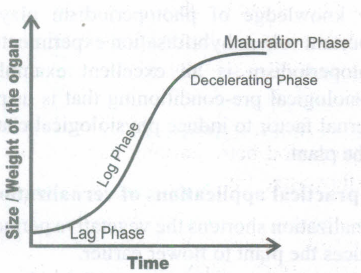
3.
Leopold (1961) has recognised four types of senescence:
1. Overall senescence
2. Top senescence
3. Deciduous senescence
4. Progressive senescence
4.
1) Cells undergo changes in structure.
2) Vacuole of the cell acts as lysosome and secretes hydrolytic enzymes.
3) The starch content is decreased in the cells.
4) Photosynthesis is reduced due to loss of chlorophyll accompanied by synthesis and accumulation of anthocyanin pigments, therefore the leaf becomes red.
5.
1) In most of the plants" there is sharp rise in respiration rate near·the end of the development of fruit, called climacteric rise.
2) Such fruits are called climacteric fruits. The ripening on demand can be induced in these fruits by using ethylene.
Eg: Tomato, Apples, Banana, Mango, etc.,
6.
Agricultural role:
1. Formation of seedless fruits'without fertilization is induced by gibberellins Example: Seedless tomato, apple and cucumber.
2. It promotes the formation of male flowers in cucurbitaceae. It helps in crop improvement.
3. Uniform bolting and increased uniform seed production
4. Improves number and size of fruits in grapes
5. Promotes elongation of inter-node in sugarcane without decreasing sugar content.
6. Promotion of flowering in long day plants even under short day conditions.
7.
Five major groups of hormones viz., auxins, gibberellins, cytokinins, ethylene and abscisic acid are presently known to coordinate and regulate growth and development in plants.
8.
lnternal Factors:
1. Genes are intracellular factors for growth.
2. Phytohormones are intracellular factors for growth. Example: auxin, gibberellin, cytokinin, etc.
3. C/N Ratio: The ratio of carbohydrates and nitrogenous compounds regulate the specific pattern of growth in plants
9.
Stages in Growth rate:
The total period from initial to the final stage of growth is called the grand period of growth. The total growth is plotted against time and 'S' shaped sigmoid curve (Grand period curve) is obtained. It consists of four phases. They are:
I) Lag phase
2) Log phase
3) Decelerating phase
4) Maturation phase
10.
1) Plants follow different pathways in response to environment or phases of life to form different kinds of structures. This ability is called plasticity.
2) Example: Heterophylly in cotton and coriander. In such plants, the leaves of the juvenile plant are different in shape from those in mature plants.
3) On the other hand, the difference in shapes of leaves produced in air and those produced in water in buttercup also represent the heterophyllous development due to the environment. This phenomenon ofheterophylly is an example of plasticity.

11th Standard Syllabus & Materials
11th Standard
TN 11th Tamil பீடு பெற நில் - செய்யுள் - காவடிச்சிந்து Important Questions And Answers Study Material - QB365 Set A
NEW11th Standard
TN 11th Tamil பீடு பெற நில் - உரைநடை - மலை இடப்பெயர்கள் : ஓர் ஆய்வு Important Questions And Answers Study Material - QB365 Set A
NEW11th Standard
TN 11th Tamil மாமழை போற்றுதும் - துணைப்பாடம் - யானை டாக்டர் Important Questions And Answers Study Material - QB365 Set A
NEW11th Standard
TN 11th Tamil மாமழை போற்றுதும் - செய்யுள் - ஐங்குறுநூறு Important Questions And Answers Study Material - QB365 Set A



Tamilnadu Stateboard 11th Standard Subjects

Maths

Commerce

Economics
Biology

Business Maths and Statistics

Accountancy

Computer Science

Physics

Chemistry
Maths
Biology
Economics
Physics
Chemistry

History
Business Maths and Statistics

Computer Science
Accountancy

Computer Applications
History
Computer Technology
Commerce
Computer Applications
Computer Technology

Tamil

English

French
Tamilnadu Stateboard Standards

