
 100% FREE ACCESS
11th Standard Syllabus & Materials
11th Standard
TN 11th Tamil இயற்கை வேளாண்மை,சுற்றுச்சூழல் -செய்யுள் - மனோன்மணீயம் Important Questions And Answers Study Material - QB365 Set A
NEW11th Standard
TN 11th Tamil என்னுயிர் என்பேன் -துணைப்பாடம் - இசைத்தமிழர் இருவர் Important Questions And Answers Study Material - QB365 Set A
NEW11th Standard
TN 11th Tamil மொழி கலை -செய்யுள் - ஒவ்வொரு புல்லையும் Important Questions And Answers Study Material - QB365 Set A
NEW11th Standard
TN 11th Tamil பீடு பெற நில் - இலக்கணம் - பகுபத உறுப்புகள் Important Questions And Answers Study Material - QB365 Set A
NEW11th Standard
TN 11th Tamil பீடு பெற நில் - துணைப்பாடம் - வாடிவாசல் Important Questions And Answers Study Material - QB365 Set A
NEW11th Standard
TN 11th Tamil பீடு பெற நில் - செய்யுள் - குறுந்தொகை Important Questions And Answers Study Material - QB365 Set A

Published on: 06/09/2019
Botany - Taxonomy and Systematic Botany
Download Tamil Nadu 11th Standard Biology question papers, model tests, one-mark questions, important questions, and public exam papers in PDF format. Free study materials and answer keys for TN State Board students.
Questions + Answers key
Take MCQ Biology Test1.
Flowers are zygomorphic in ______.
Ceropegia
Thevetia
Datura
Solanum
2.
Perianth is present in_______.
Clitoria ternatea
Datura metel
Allium cepa
Pongamia pinnata
3.
The taxonomy which involves the similarities & dissimilarities among the immune system of different taxa is termed as ______.
Chemotaxonomy
Molecular systematics
Serotaxonomy
Numerical taxonomy
4.
Phylogenetic classification is the most favoured classification because it reflects _______.
Comparative Anatomy
Number of flowers produced
Comparative cytology
Evolutionary relationships
5.
Specimen derived from non-original collection serves as the nomenclature type, when original specimen is missing. It is known as ________ .
Holotype
Neotype
Isotype
Paratype
6.
How will you distinguish Solanaceae members from Liliaceae members?
7.
Give the floral characters of Clitoria ternatea.
8.
What is the role of national gardens in conserving biodiversity - Discuss.
9.
Where will you place the plants which contains two cotyledons with cup shaped thalamus?
10.
How does molecular markers work to unlock the evolutionary history of organisms?
1.
(a)
Ceropegia
2.
(c)
Allium cepa
3.
(c)
Serotaxonomy
4.
(d)
Evolutionary relationships
5.
(b)
Neotype
6.
| S.No | Solanaceae | Liliaceae |
|---|---|---|
| 1. | It belongs to dicotyledons | It belongs to monocotyledons |
| 2. | Habit- mostly annual herbs, shrubs & small trees |
Mostly perennial herbs |
| 3. | Root- branched tap root | Adventitious & fibrous |
| 4. | Calyx & corolla present | Only perianth is present |
| 5. | Stamens 5, epipetalous | Stamens 6 arranged in 2 whorls of 3 each. |
| 6. | Bicarpellary, bilocular | Tricarpellary, trilocular |
| 7. | Capsule or berry | Septicidal or loculicidal capsule or a berry |
7.
Habit : Twining climber
Root : Branched tap root system having nodules.
Stem : Aerial, weak stem and a twiner
Leaf : Imparipinnately compound, alternate, stipulate showing reticulate venation. Leaflets are stipellate. Petiolate and stipels are pulvinated.
Inflorescence : Solitary and axillary
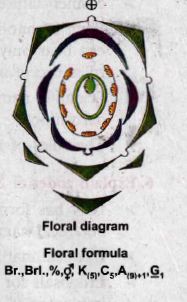
Flower : Bracteate, bracteolate, bracteoles usually large, pedicellate, heterochlamydeous, complete, bisexual, pentamerous, zygomorphic and hypogynous.
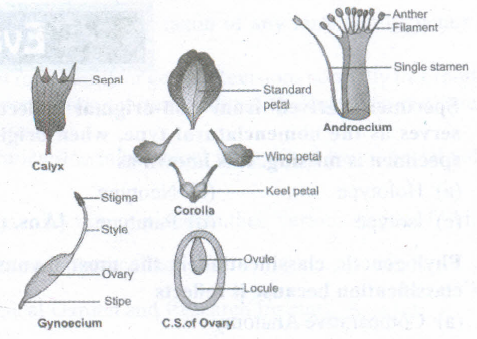
Calyx : Sepals 5, synsepalous, green showing valvate aestivation. Odd sepal is anterior in position.
Corolla : Petals 5, white or blue polypetalous, irregular papilionaceous corolla showing descendingly imbricate aestivation.
Androecium : Stamens 10, diadelphous (9)+1 nine stamens fused to form a bundle and the tenth stamen is free. Anthers are dithecous, basifixed, introrse and dehiscing by longitudinal slits.
Gynoecium : Monocarpellary, unilocular, with many ovules on marginal placentation, ovary superior, style simple and incurved with feathery stigma.
Fruit : Legume
Seed : Non-endospermous, reniform.
8.
Role of Botanical Garden:
Botanical Gardens play the following important roles.
1. Gardens have a wide range of species and supply taxonomic material for botanical research.
2. It can integrate information of diverse fields like Anatomy, Embryology, Phytochemistry, Cytology, Physiology and Ecology.
3. Act as a conservation centre for diversity, rare and endangered species.
4. It offers annual list of available species and a free exchange of seeds.
5. Botanical garden gives information about method of propagation, sale of plant material to the general public.
9.
Polypetalae: Plants with free petals and dichlamydeous flowers come under polypetalae. It is further divided into three series - (iii) Calyciflorae: It includes plant having flowers with cup shaped thalamus and with inferior or sometimes with half inferior ovary. It includes 5 orders and 27 families.
10.
(i) It is a method to identify genetic markers using a randomly synthesized primer that will anneal (recombine (DNA) in the double stranded form) to complementary regions located in various locations of isolated DNA. If another complementary site is present on the opposing DNA strand at a distance that is not too great then the reaction will amplify this region of DNA.
(ii) RAPDs (Random Amplified Polymorphic DNA) like microsatellites may often be used for genetic studies within species but may also be successfully employed in phylogenetic studies to address relationships within a species or between closely related species.

11th Standard Syllabus & Materials
11th Standard
TN 11th Tamil பீடு பெற நில் - செய்யுள் - காவடிச்சிந்து Important Questions And Answers Study Material - QB365 Set A
NEW11th Standard
TN 11th Tamil பீடு பெற நில் - உரைநடை - மலை இடப்பெயர்கள் : ஓர் ஆய்வு Important Questions And Answers Study Material - QB365 Set A
NEW11th Standard
TN 11th Tamil மாமழை போற்றுதும் - துணைப்பாடம் - யானை டாக்டர் Important Questions And Answers Study Material - QB365 Set A
NEW11th Standard
TN 11th Tamil மாமழை போற்றுதும் - செய்யுள் - ஐங்குறுநூறு Important Questions And Answers Study Material - QB365 Set A



Tamilnadu Stateboard 11th Standard Subjects

Maths

Commerce

Economics
Biology

Business Maths and Statistics

Accountancy

Computer Science

Physics

Chemistry
Maths
Biology
Economics
Physics
Chemistry

History
Business Maths and Statistics

Computer Science
Accountancy

Computer Applications
History
Computer Technology
Commerce
Computer Applications
Computer Technology

Tamil

English

French
Tamilnadu Stateboard Standards

