
 100% FREE ACCESS
11th Standard Syllabus & Materials
11th Standard
TN 11th Tamil இயற்கை வேளாண்மை,சுற்றுச்சூழல் -செய்யுள் - மனோன்மணீயம் Important Questions And Answers Study Material - QB365 Set A
NEW11th Standard
TN 11th Tamil என்னுயிர் என்பேன் -துணைப்பாடம் - இசைத்தமிழர் இருவர் Important Questions And Answers Study Material - QB365 Set A
NEW11th Standard
TN 11th Tamil மொழி கலை -செய்யுள் - ஒவ்வொரு புல்லையும் Important Questions And Answers Study Material - QB365 Set A
NEW11th Standard
TN 11th Tamil பீடு பெற நில் - இலக்கணம் - பகுபத உறுப்புகள் Important Questions And Answers Study Material - QB365 Set A
NEW11th Standard
TN 11th Tamil பீடு பெற நில் - துணைப்பாடம் - வாடிவாசல் Important Questions And Answers Study Material - QB365 Set A
NEW11th Standard
TN 11th Tamil பீடு பெற நில் - செய்யுள் - குறுந்தொகை Important Questions And Answers Study Material - QB365 Set A

Published on: 05/12/2018
Business Mathematics is the easiest subject to increase the score if practiced well. Grab this 5 marks model question paper for 11th state board Business Maths and practice to get the high score in exams. In this question paper, questions are prepared based on the state board syllabus with the book back and creative questions. This is the most important half yearly model question paper for 11th business maths.
Important 5 mark questions from all the chapters are included for practicing to score good marks in board exams.
By practicing with this important model question paper student can gain more knowledge and confidence to crack the exams. Our aim is to bring out the best scores on board exams. Creative questions were added in this question paper in order to enhance the student's knowledge and get the idea that how to answer strategic questions asked in the board exams. Now you can use this model question paper for practice on your own to score more on your board exams.
This question paper is designed based on the academic syllabus. It will be more helpful for the Matriculation and state board students to prepare for their exams."
Download Tamil Nadu 11th Standard Business Maths and Statistics question papers, model tests, one-mark questions, important questions, and public exam papers in PDF format. Free study materials and answer keys for TN State Board students.
Questions + Answers key
Take MCQ Business Maths and Statistics Test
1.
Resolve into partial fractions for the following : \(\frac{x-2}{(x+2)(x-1)^2}\)
2.
If cosA = \(\frac{4}{5}\)and cosB = \(\frac{12}{13}\),\(\frac{3\pi}{3}<(A, B)<2 \pi,\)
3.
Show by the principle of mathematical induction that 23n–1 is a divisible by 7, for all \(n \in N\).
4.
Find the Quartile deviation.
| Wages (Rs) | 20-30 | 30-40 | 40-50 | 50-60 | 60-70 |
| No. of labourers | 3 | 5 | 20 | 10 | 5 |
5.
The first of three urns contains 7 White and 10 Black balls, the second contains 5 White and 12 Black balls and third contains 17 White balls and no Black ball. A person chooses an urn at random and draws a ball from it. And the ball is found to be White. Find the probabilities that the ball comes from
(i) the first urn
(ii) the second urn
(iii) the third urn
6.
A man invests Rs. 13,500 partly in 6% of Rs. 100 shares at Rs. 140 and the remaining in 5% of Rs. 100 shares at Rs 125. If his total income is Rs. 560, how much has he invested in each?
7.
Calculate coefficient of correlation for the ages of husbands and their respective wives:
| Age of husbands | 23 | 27 | 28 | 29 | 30 | 31 | 33 | 35 | 36 | 39 |
| Age of wives | 18 | 22 | 23 | 24 | 25 | 26 | 28 | 29 | 30 | 32 |
8.
9.
10.
Verify the relationship of elasticity of demand, average revenue and marginal revenue for the demand law p = 50 - 3x.
11.
Prove that cos 4x = 1 - 8 sin2x cos2x.
12.
An arch is in the form of a parabola with its axis vertical. The arch is 10 m high and 5 m wide at the base. How high is the arch 2 m from the vertex of the parabola?
13.
Using binomial theorem, find the value of \({ \left( \sqrt { 2 } +1 \right) }^{ 5 }+{ \left( \sqrt { 2 } -1 \right) }^{ 5 }\)
14.
Prove that \(\frac { \sin { \left( { 180 }^{ o }+A \right) \cos { \left( { 90 }^{ o }-A \right) \tan { \left( { 270 }^{ o }-A \right) } } } \quad \quad }{ \sec { \left( { 540 }^{ o }-A \right) \cos { \left( { 360 }^{ o }+A \right) \ cosec { \left( { 270 }^{ o }+A \right) } } } } =-\sin { A } \cos ^{ 2 }{ A } \)
15.
An amount of Rs. 5000 is put into three investments at the rate of interest of 6%, 7% and 8% per annum respectively. The total annual income is Rs. 358. If the combined income from the first two investments is Rs. 70 more than the income from the third, find the amount of each investments by matrix method.
16.
Examine the following functions for continuity at indicated points
\(f(x)=\left\{\begin{array}{cl} \frac{x^2-4}{x-2}, & \text { if } x \neq 2 \\ 0, & \text { if } x=2 \end{array} \right.\) at x = 2
17.
Suppose the inter-industry flow of the product of two industries are given as under.
| Production sector | Consumption sector | Domestic demand | Total output | |
| X | Y | |||
| X | 30 | 40 | 50 | 120 |
| Y | 20 | 10 | 30 | 60 |
Determine the technology matrix and test Hawkin's -Simon conditions for the viability of the system. If the domestic demand changes to 80 and 40 units respectively, what should be the gross output of each sector in order to meet the new demands.
18.
Differentiate the following with respect to x.
(i) xx
(ii) (log x)cos x
19.
You are given the following data:
| Details | X | Y |
| Arithmetic Mean | 36 | 85 |
| Standard Deviation | 11 | 8 |
If the Correlation coefficient between X and Y is 0.66, then find (i) the two regression coefficients, (ii) the most likely value of Y when X = 10
20.
The profit Rs.y accumulated in thousand in x months is given by y = -x2 + 10x - 15. Find the best time to end the project.
1.
\({{x-2}\over{(x+2){(x-1)}^{2}}}={{A}\over{x+2}}+{{B}\over{x-1}}+{{C}\over{{(x-1)}^{2}}}\)
\(\frac{x-2}{(x+2)(x-1)^2}=\frac{A(x-1)^2+B(x+2)(x-1)+C(x+2)}{(x+2)(x-1)^2}\)
x - 2 = A(x - 1)2+ B(x + 2)(x - 1)+ C(x + 2) ..(1)
x = -2 in (1) we get,
-2 - 2 = A (-3)2 \(\Rightarrow\) - 4 = 9 A \(\Rightarrow\) A = \({{-4}\over{9}}\)
x = 1 in (1) we get,
1- 2 = C(1 + 2) \(\Rightarrow\) -1 = 3C \(\Rightarrow\) C = \({{-1}\over{3}}\)
Equate coefficient of x2 on both sides of (1)
0 = A + B
\(B=-A=\frac{4}{9}\)
\(\therefore\) \({{x-2}\over{(x+1){(x-1)}^{2}}}-{{-{{4}\over{9}}}\over{x+2}}+{{{{4}\over{9}}}\over{x-1}}+{{-{{1}\over{3}}}\over{{(x-1)}^{2}}}+{{-4}\over{9(x+2)}}+{{4}\over{9(x-1)}}-{{1}\over{3{(x+1)}^{2}}}\)
2.
Since \(\cfrac { 3\pi }{ 2 } <\left( A,B \right) <2\pi \), both A and B lie in the fourth quadrant,
\(\therefore \) sinA and sinB are negative
Given \(cosA=\cfrac { 4 }{ 5 } \ cosB=\cfrac { 12 }{ 13 } \)
Therefore \(\sin A=-\sqrt{1-\cos ^2 A}\)
\(=-\sqrt{1-\frac{16}{25}}\)
\(=-\sqrt{\frac{25-16}{25}}\)
\(=-\frac{3}{5}\)
\(\operatorname{Sin} B =-\sqrt{1-\cos ^2 B} \)
\(=-\sqrt{1-\frac{144}{169}} \)
\(=-\sqrt{\frac{169-144}{169}} \)
\(=-\frac{5}{13}\)
\(sin(A-B)=sinAcosB-cosAsinB\\ =\left( \cfrac { -3 }{ 5 } \right) \left( \cfrac { 12 }{ 13 } \right) -\left( \cfrac { 4 }{ 5 } \right) \left( \cfrac { -5 }{ 13 } \right) \\ =\cfrac { -36 }{ 65 } +\cfrac { 20 }{ 65 } =\cfrac { -6 }{ 65 } \)
3.
Let the given statement P(n) be defined as \(P(n)={ 2 }^{ 3n }-1\)
Step 1: put \(n=1\)
\(\therefore P(1)={ 2 }^{ 3 }-1\)
= 7 is divisible by 7
i.e., P(1) is true.
Step 2: Let us assume that the statement is true for n = k i.e., p(k) is true
We assume 23k-1 is divisible by 7
\(\Rightarrow { 2 }^{ 3k }-1=7m\)
Step 3: To prove that P(k + 1) is true
\(P(k+1)={ 2 }^{ 3(k+1) }-1\)
\(={ 2 }^{ (3k+3) }-1\)
\(=2^{3 k} \cdot 2^3-1\)
\(= { 2 }^{ 3k }.8-1\)
\(= { 2 }^{ 3k }.\left( 7+1 \right) -1\)
\(={ 2 }^{ 3k }.7+{ 2 }^{ 3k }-1\)
\( ={ 2 }^{ 3k }.7+7m=7\left( { 2 }^{ 3k }+m \right) \)
which is divisible by 7
P(k +1) is true whenever p(k) is true
\(\therefore P(n)\) ) is true for all \(n \in N\)
Hence the proof.
4.
| Wages (Rs) (x) | No. of labourers(f) | Cumulative Frequency (c.f.) |
|---|---|---|
| 20-30 | 3 | 3 |
| 30-40 | 5 | 8 |
| 40-50 | 20 | 28 |
| 50-60 | 10 | 38 |
| 60-70 | 5 | N = 43 |
Q1= Size of \({ \left( \frac { N }{ 4 } \right) }^{ th }\)value = size of\({ \left( \frac { 43 }{ 4 } \right) }^{ th }\) value
= Size of 10.75th value
Q1 lies in the interval (40-50) and its corresponding values are L = 40, f = 20, pcf = 8, c = 10
\({ Q }_{ 1 }=L+\left( \frac { \frac { N }{ 4 } -pcf }{ f } \right) \times c=40+\frac { 10.75-8 }{ 20 } \times 10\)
\(=40+\frac { 2.75 }{ 2 } =40+1.375\)
Q1 = 43.38
Q3=Size of \({ \left( \frac { 3N }{ 4 } \right) }^{ th }\) value = size of\({ \left( \frac { 3\times 43 }{ 4 } \right) }^{ th }\) value
= Size of (32.25)th value
\(\therefore\) Q3 lies in (50-60) and its corresponding values are L = 50, f = 10, pcf = 28 and c = 10
\({ Q }_{ 3 }=L+\left( \frac { \frac { 3N }{ 4 } -pcf }{ f } \right) \times c=50+\frac { 32.25-28 }{ 10 } \times 10\)
\(\therefore\) Q3 = 50 + 4.25 = 54.25
\(\therefore\) Quartile deviation QD = \(\frac { 1 }{ 2 } ({ Q }_{ 3 }-{ Q }_{ 1 })=\frac { 1 }{ 2 } (54.25-43.38)=\frac { 1 }{ 2 } (10.87)=5.435\)
5.
Let the events E1, E2, E3 and A be defined as
E1 = I urn is chosen
E2 = II urn is chosen
E3 = III urn is chosen
A - Ball drawn is white in color
\(\therefore\) P(E1) = P(E2) = P(E3) = \(\frac{1}{3}\)
P(A/E1) \(=\frac{7}{17},\)
P(A/E2 ) \(=\frac{5}{17},\)
P(A/E3 ) \(=\frac{17}{17},\)
(i) \(P(E_{ 1 }/A)\)
\(=\frac { P({ E }_{ 1 }).P(A/{ E }_{ 1 }) }{ P({ E }_{ 1 }).P(A/{ E }_{ 1 })+P({ E }_{ 2 }).P(A/{ E }_{ 2 })+P({ E }_{ 3 }).P(A/{ E }_{ 3 }) } \)
(By Baye's theorem)
\(=\frac { \frac { 1 }{ 3 }. \frac { 7 }{ 17 } }{ \frac { 1 }{ 3 }. \frac { 7 }{ 17 } +\frac { 1 }{ 3 } . \frac { 5 }{ 17 } +\frac { 1 }{ 3 } . \frac { 17 }{ 17 } } \)
\(=\frac {\frac {7}{51}}{\frac {7+5+17}{51}}=\frac{7}{29}\)
(ii) \(P(E_{ 2 }/A)\) \(=\frac {\frac {1}{3}.\frac{5}{17}}{\frac {29}{51}}=\frac{5}{29}\)
(iii) \(P(E_{ 3 }/A)\) \(=\frac {\frac {1}{3}.\frac{17}{17}}{\frac {29}{51}}=\frac{17}{29}\)
6.
Let investment in 6% stock be x
\(\therefore\) Investment in 5% stock = 13,500 - x.
At 6% stock
If Investment = 140, Income = 6
If Investment = x, Income \(=\frac { 6x }{ 140 }=\frac { 3x }{ 70 } \)
At 5% stock
If Investment = 125, Income = 5
If Investment = 13,500 - x,
Income = \(\frac { 5(13,500-x )}{ 125 } \)
\(=\frac { 13,500 -x}{ 25 } =540-\frac { x }{ 25 } \)
Total income = 560
\( \frac { 3x }{ 70 } +540-\frac { x }{ 25 } =560\)
\(\frac { 3x }{ 70 } -\frac { x }{ 25 } =20\)
\(\frac { 15x-14x }{ 350 } =20\)
x = 350 x 20 = Rs. 7000
\(\therefore\) Amount invested in 6% stock = Rs. 7000
Amount invested in 5% stock = 13500 - 7000
= Rs. 6500
7.
| X | Y | X2 | Y2 | XY |
| 23 | 18 | 529 | 324 | 414 |
| 27 | 22 | 729 | 484 | 594 |
| 28 | 23 | 784 | 529 | 644 |
| 29 | 24 | 841 | 576 | 696 |
| 30 | 25 | 900 | 625 | 750 |
| 31 | 26 | 961 | 676 | 806 |
| 33 | 28 | 1089 | 784 | 924 |
| 35 | 29 | 1225 | 841 | 1015 |
| 36 | 30 | 1296 | 900 | 1080 |
| 39 | 32 | 1521 | 1024 | 1248 |
| \(\Sigma X\) = 311 | \(\Sigma Y\) = 257 | \(\Sigma X^2\) = 9875 | \(\Sigma Y^2\) = 6763 | \(\Sigma XY\) = 8171 |
\(r =\frac{N \Sigma X Y-(\Sigma X)(\Sigma Y)}{\sqrt{N \Sigma X^2-(\Sigma X)^2} \sqrt{N \Sigma Y^2-(\Sigma Y)^2}} \)
\(=\frac{10(8171)-(311)(257)}{\sqrt{10(9875)-(311)^2} \sqrt{10(6763)-(257)^2}} \)
\(=\frac{81710-79927}{\sqrt{98750-96721} \times \sqrt{67630-66049}} \)
\(=\frac{1783}{\sqrt{2029 \times 1581}} \)
\(r =\frac{1783}{1791.05}=0.9955\)
8.
9.
10.
p = 50 – 3x
\({dp\over dx}=-3\) ⇒ \({dx\over dp}=-{1\over 3}\)
Elasticity of demand: \(η_d=-{p\over x}.{dx\over dp}\)
\(=-{50-3x\over x}\left(-{1\over3}\right)\)\(={50-3x\over 3x}\ \ ...(1)\)
Now, Revenue: R = px
= (50 - 3x)x = 50x - 3x2
Average revenue: AR = p = 50 - 3x
Marginal revenue: \(MR={dR\over dx} = 50 - 6x\)
\({AR\over AR-MR}={50-3x\over (50-3x)-(50-6x)}\)
\(={50-3x\over 3x}\ \ ...(2)\)
From (1) and (2), we get
\(η_d={AR\over AR-MR}\), Hence verified.
11.
LHS = cos 4x = cos 2(2x)
= 2 cos22x-1 [∴ cos 2A = 2cos2A - 1]
= 2 [2 cos2x - 1]2 - 1 = 2 [4 cos4x - 4cos2x + 1] - 1
= 8 cos4x - 8 cos2x + 2 - 1 = 1 - 8 cos2x + 8 cos4x
= 1 - 8 cos2x (1 - cos2x) = 1 - 8 cos2x . sin2x = RHS.
12.
Since the axis of the parabola is vertical, its equation will be x2 = 4ay.
Arch is 10 m high and 5 m wide at base.
\(\therefore\) Point \((\frac{5}{2},10)\) lies on the parabola
\(\therefore\) \(\frac{25}{4}\) = 4a(10)⇒ 4a = \(\frac{25}{40}\) = \(\frac{5}{8}\)(y)
\(\therefore\) Equation of the parabola becomes x2 = \(\frac{5}{8}\)(y)
Let the width of the arch 2 m from the vertex is 2b, then point (b, 2) lies on the parabola
\(\therefore\) b2 = \(\frac { 5(2) }{ 8 } =\frac { 10 }{ 8 } =\frac { 5 }{ 4 } \Rightarrow b=\frac { \sqrt { 5 } }{ 2 } \)
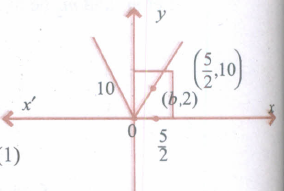
\(\therefore\) width of arch is 2b = 2.\(\frac{\sqrt{5}}{2}\) = √5m = 2.23m(app)
13.
Given \(({\sqrt{2}+1})^{5}+{(\sqrt{2}-1)}^{5}\)
=[\({ \left( \sqrt { 2 } \right) }^{ 5 }\)+ 5CI \({ \left( \sqrt { 2 } \right) }^{ 4}\) (1)1 + 5C2 \({ \left( \sqrt { 2 } \right) }^{ 3 }\) .(1)2 + 5C3 \({ \left( \sqrt { 2 } \right) }^{ 2 }\) . (1)3+ 5C4 \({ \left( \sqrt { 2 } \right) }^{ 1}\) .(1)4 + (1)5] +[\({ \left( \sqrt { 2 } \right) }^{ 5 }\) - 5CI \({ \left( \sqrt { 2 } \right) }^{ 4}\) (l)1 + 5C2 \({ \left( \sqrt { 2 } \right) }^{ 3 }\) (1)2 - 5C3 \({ \left( \sqrt { 2 } \right) }^{ 2 }\) (1)3+ 5C4 \({ \left( \sqrt { 2 } \right) }^{ }\) (1)4 -15 ]
=2[\({ \left( \sqrt { 2 } \right) }^{ 5 }\) + 10\({ \left( \sqrt { 2 } \right) }^{ 3 }\) +5 \({ \left( \sqrt { 2 } \right) }^{ }\)] = 2[ 4\(\sqrt { 2 } \) + 20\(\sqrt 2\) + 5.\(\sqrt 2\)] = 2[29.\( \sqrt { 2 } \)] = 58\( \sqrt 2\)
14.
\(\frac { \sin { \left( { 180 }^{ o }+A \right) \cos { \left( { 90 }^{ o }-A \right) \tan { \left( { 270 }^{ o }-A \right) } } } \quad \quad }{ \sec { \left( { 540 }^{ o }-A \right) \cos { \left( { 360 }^{ o }+A \right) \csc { \left( { 270 }^{ o }+A \right) } } } } \)
\(=\frac{(-\sin A)(\sin A)(\cot A)}{\sec (360+180-A) \cos A(-\sec A)} \)
\(=\frac{(-\sin A)(\sin A) \frac{\cos A}{\sin A}}{(-\sec A) \cos A(-\sec A)} \)
\(=-\frac{\sin A \cos A}{\frac{1}{\cos A} \cos A \frac{1}{\cos A}} \)
\(=-\sin A \cos ^2 A\)
= R.H.S
Hence proved.
15.
Let x, y and z be the investments at the rate of interest 6%, 7% and 8% per annum respectively.
Then x + y + z = 5000 ...(1)
Also, \(\frac{6x}{100}+\frac{7y}{100}+\frac{8z}{100}=358\)
\(\Rightarrow\) 6x + 7y + 8z = 35800 ...(2)
And \(\frac{6x}{100}+\frac{7y}{100}=70+\frac{8z}{100}\) (Given)
\(\Rightarrow\) 6x + 7y - 8z = 7000 ...(3)
From (1), (2) and (3),
\(\left[ \begin{matrix} 1 & 1 & 1 \\ 6 & 7 & 8 \\ 6 & 7 & -8 \end{matrix} \right] \left[ \begin{matrix} x \\ y \\ z \end{matrix} \right] =\left[ \begin{matrix} 5000 \\ 35800 \\ 7000 \end{matrix} \right] \)
AX = B where A = \(\left[ \begin{matrix} 1 & 1 & 1 \\ 6 & 7 & 8 \\ 6 & 7 & -8 \end{matrix} \right] ,\quad X=\left[ \begin{matrix} x \\ y \\ z \end{matrix} \right] ,\quad Z=\left[ \begin{matrix} 5000 \\ 35800 \\ 7000 \end{matrix} \right] \)
\(\therefore |A|\) \(=\begin{bmatrix} 1&1&1\\6&7&8\\6&7&-8 \end{bmatrix}=1(-56-56)-1(-48-48)1(42-42)\)
\(=-16\neq0\Rightarrow{A}^{-1}\) exists.
A11 = -112, A12 = 96, A13= 0
A21 = 15, A22 = -14 A23 = -1
A31 = 1, A32 = -2, A33 = -1
\(\therefore \ adj\ A=\begin{bmatrix} -112&96&0\\15&-14&-1\\1&-2&1 \end{bmatrix}^{T}=\begin{bmatrix} -112&15&1\\96&-14&-2\\0&-1&1\end{bmatrix}\)
\(\therefore \quad A^{ -1 }=\quad \frac { 1 }{ |A| } adjA=-\frac { 1 }{ 16 } \left[ \begin{matrix} -112 & 15 & 1 \\ 96 & -14 & -2 \\ 0 & -1 & 1 \end{matrix} \right] \)
Hence, the solution is given by
\(X={A}^{-1}B=-\frac{1}{16}\begin{bmatrix} -112&15&1 \\96 &-4&-2\\0&-1&1 \end{bmatrix}\begin{bmatrix} 5000\\35800\\7000 \end{bmatrix}=-{{1}\over{16}}\begin{bmatrix} -560000+537000+7000\\480000-501200-14000\\0-35800+7000 \end{bmatrix}\)
\(X=\begin{bmatrix} 1000\\2200\\1800 \end{bmatrix}\) [ \(\because\) x = 1000, y = 2200, z = 1800]
Hence, the three investment are of Rs. 1000,Rs. 2200 and Rs. 1800.
16.
Given f(2) = 0
= 2 + 2
\(=4 \neq 0\)
\(\therefore \lim _{x \rightarrow 2} f(x) \neq f(2)\)
The function is not continuous at x = 2
17.
a11 = 30, a12 = 40, x1 = 120
a21 = 20, a22 = 10, x2 = 60
\({b}_{11}={{{a}_{11}}\over{x_1}}={{30}\over{120}}={{1}\over{4}}\)
\({b}_{12}={{{a}_{12}}\over{{x}_{2}}}={{40}\over{60}}={{2}\over{3}}\)
\({b}_{21}={{{a}_{21}}\over{x_1}}={{20}\over{120}}={{1}\over{6}}\)
\({b}_{22}={{{a}_{22}}\over{{x}_{1}}}={{10}\over{60}}={{1}\over{6}}\)
The technology matrix is B = \(\begin{bmatrix}{{1}\over{4}}&{{2}\over{3}}\\ {{1}\over{6}}&{{1}\over{6}} \end{bmatrix}\)
I - B = \(\begin{bmatrix} 0&0\\0&1 \end{bmatrix}-\begin{bmatrix} {{1}\over{4}} &{{2}\over{3}}\\{{1}\over{6}}&{{1}\over{6}} \end{bmatrix}=\begin{bmatrix} {{3}\over{4}}&{{-2}\over{3}}\\ {{-1}\over{6}}&{{5}\over{6}} \end{bmatrix}\)
\(|I-B|=\frac{3}{4} \times \frac{5}{6}-\frac{2}{3} \times \frac{1}{6}=\frac{5}{8}-\frac{1}{9}=\frac{37}{72}=0\)
Since diagonals of I - B are positive and | I - B | is positive, the system is viable
\({(I-B)}^{-1}={{1}\over{|I-B|}}adj\ (I-B)={{72}\over{37}}\begin{bmatrix}{{5}\over{6}}&{{2}\over{3}}\\{{1}\over{6}}&{{3}\over{4}} \end{bmatrix}\)
X = (I - B)-1 D where D = \(\begin{bmatrix} 80\\40 \end{bmatrix}\)
\(={{72}\over{37}}\begin{bmatrix}{{5}\over{6}}&{{2}\over{3}}\\{{1}\over{6}}&{{3}\over{4}} \end{bmatrix}\begin{bmatrix} 80 \\ 40 \end{bmatrix}\)
\(=\frac{72}{37}\left(\begin{array}{cc} 66.67 & +26.67 \\ 13.33 & +30 \end{array}\right)=\frac{72}{37}\left(\begin{array}{l} 93.34 \\ 43.33 \end{array}\right)\)
\(=\left(\begin{array}{c} 181.63 \\ 84.32 \end{array}\right)\)
The output for production sector X and Y are 181.63 and 84.32 respectively.
18.
(i) Let y = xx
Taking logarithm on both sides logy = x log x
Differentiating with respect to x,
\(\cfrac { 1 }{ y } .\cfrac { dy }{ dx } =x.\cfrac { 1 }{ x } +logx.1\)
\(\cfrac { dy }{ dx } =y\left[ 1+logx \right] \)
\( \therefore \cfrac { dy }{ dx } ={ x }^{ x }\left[ 1+logx \right] \)
(ii) Let y = (logx)cosx
Taking logarithm on both sides log y = cos x log(logx)
Differentiating with respect to x,
\(\cfrac { 1 }{ y } .\cfrac { dy }{ dx } =cosx\cfrac { 1 }{ logx } .\cfrac { 1 }{ x } +\left[ log\left( logx \right) \right] \left( -sinx \right) \)
\(\cfrac { dy }{ dx } =y\left[ \cfrac { cosx }{ xlogx } -sinxlog\left( logx \right) \right] \)
\(=\left( logx \right) ^{ cosx }\left[ \cfrac { cosx }{ xlogx } -sinxlog\left( logx \right) \right] \)
19.
\(\bar{X}=36, \bar{Y}=85 \)
\(\sigma_x=11, \sigma_y=8, r=0.66 \)
\(b_{y x}=r \frac{\sigma_y}{\sigma_x}=0.66\left(\frac{8}{11}\right)=0.48 \)
\(b_{x y}=r\left(\frac{\sigma_x}{\sigma_y}\right)=0.66\left(\frac{11}{8}\right)=0.91\)
(i) Regression equation of Y on X is
\(Y-\bar{Y} =b_{y x}(X-\bar{X}) \)
Y - 85 = 0.48 X - 17.28
Y = 0.48 X + 67.72 .
Regression equation of X on Y is
\(X-\bar{X} =b_{x y}(Y-\bar{Y}) \)
X - 36 = 0.91Y - 77.35
X = 0.91 Y - 41.35
(ii) If X = 10
Y = 4.8 + 67.72 = 72.52
20.
Y = -x2 + 10 x - 15
\(\Rightarrow\) x2 - 10x = - y - 15
\(\Rightarrow\) (x- 5)2 = -y - 15 + 25
\(\Rightarrow\) (x- 5)2 = -y + 10
\(\Rightarrow\) (x - 5)2 = (-y - 10)
The best time to end the project is when x = 5 months.

11th Standard Syllabus & Materials
11th Standard
TN 11th Tamil பீடு பெற நில் - செய்யுள் - காவடிச்சிந்து Important Questions And Answers Study Material - QB365 Set A
NEW11th Standard
TN 11th Tamil பீடு பெற நில் - உரைநடை - மலை இடப்பெயர்கள் : ஓர் ஆய்வு Important Questions And Answers Study Material - QB365 Set A
NEW11th Standard
TN 11th Tamil மாமழை போற்றுதும் - துணைப்பாடம் - யானை டாக்டர் Important Questions And Answers Study Material - QB365 Set A
NEW11th Standard
TN 11th Tamil மாமழை போற்றுதும் - செய்யுள் - ஐங்குறுநூறு Important Questions And Answers Study Material - QB365 Set A



Tamilnadu Stateboard 11th Standard Subjects

Maths

Commerce

Economics

Biology
Business Maths and Statistics

Accountancy

Computer Science

Physics

Chemistry
Maths
Biology
Economics
Physics
Chemistry

History
Business Maths and Statistics

Computer Science
Accountancy

Computer Applications
History
Computer Technology
Commerce
Computer Applications
Computer Technology

Tamil

English

French
Tamilnadu Stateboard Standards
