
 100% FREE ACCESS
11th Standard Syllabus & Materials
11th Standard
TN 11th Tamil இயற்கை வேளாண்மை,சுற்றுச்சூழல் -செய்யுள் - மனோன்மணீயம் Important Questions And Answers Study Material - QB365 Set A
NEW11th Standard
TN 11th Tamil என்னுயிர் என்பேன் -துணைப்பாடம் - இசைத்தமிழர் இருவர் Important Questions And Answers Study Material - QB365 Set A
NEW11th Standard
TN 11th Tamil மொழி கலை -செய்யுள் - ஒவ்வொரு புல்லையும் Important Questions And Answers Study Material - QB365 Set A
NEW11th Standard
TN 11th Tamil பீடு பெற நில் - இலக்கணம் - பகுபத உறுப்புகள் Important Questions And Answers Study Material - QB365 Set A
NEW11th Standard
TN 11th Tamil பீடு பெற நில் - துணைப்பாடம் - வாடிவாசல் Important Questions And Answers Study Material - QB365 Set A
NEW11th Standard
TN 11th Tamil பீடு பெற நில் - செய்யுள் - குறுந்தொகை Important Questions And Answers Study Material - QB365 Set A

Published on: 28/12/2018
+1 First Revision Test
Download Tamil Nadu 11th Standard Business Maths and Statistics question papers, model tests, one-mark questions, important questions, and public exam papers in PDF format. Free study materials and answer keys for TN State Board students.
Questions + Answers key
Take MCQ Business Maths and Statistics Test
1.
The two events A and B are mutually exclusive if _________.
\(P\left( A\cap B \right) =0\)
\(P\left( A\cap B \right) =1\)
\(P\left( A\cup B \right) =0\)
\(P\left( AUB \right) =1\)
2.
3.
4.
The present value of the perpetual annuity of Rs. 2000 paid monthly at 10 % compound interest is _______.
Rs. 2,40,000
Rs. 6,00,000
Rs. 20,40,000
Rs. 2,00,400
5.
A invested some money in 10% stock at Rs.96. If B wants to invest in an equally good 12% stock, he must purchase a stock worth of _______.
Rs. 80
Rs. 115.20
Rs. 120
Rs. 125.40
6.
The correlation coefficient is ________.
r(X, Y) = \(\frac { { \sigma }_{ x }{ \sigma }_{ y } }{ cov(x,y) } \)
r(X, Y) = \(\frac { cov(x,y) }{ { \sigma }_{ x }{ \sigma }_{ y } } \)
r(X, Y) = \(\frac { cov(x,y) }{ { \sigma }_{ y } } \)
r(X, Y) = \(\frac { cov(x,y) }{ { \sigma }_{ x } } \)
7.
The demand function is always _______.
Increasing function
Decreasing function
Non-decreasing function
Undefined function
8.
9.
Network problems have advantage in terms of project _______.
Scheduling
Planning
Controlling
All the above
10.
In the given graph the coordinates of M1 are
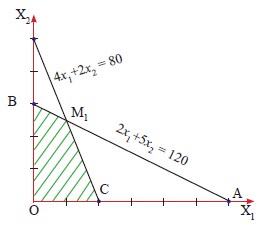
x1 = 5, x2 = 30
x1 = 20, x2 = 16
x1 = 10, x2 = 20
x1 = 20, x2 = 30
11.
f(x) = - 5 , for all \(x\in R\), is a ________.
an identity function
modulus function
exponential function
constant function
12.
The graph of the line y = 3 is _______.
Parallel to x-axis
Parallel to y-axis
Passing through the origin
Perpendicular to x-axis
13.
The value of \(cosec^{-1}\left(\frac{2}{\sqrt{3}}\right)\) is ________.
\(\frac{\pi}{4}\)
\(\frac{\pi}{2}\)
\(\frac{\pi}{3}\)
\(\frac{\pi}{6}\)
14.
The value of sec A sin(270o + A) is ______.
-1
cos2 A
sec2 A
1
15.
Combined equation of co-ordinate axes is _______.
x2-y2 = 0
x2+y2 = 0
xy = c
xy = 0
16.
If kx2 + 3xy - 2y2 = 0 represent a pair of lines which are perpendicular then k is equal to _______.
1/2
-1/2
2
-2
17.
The number of permutations of n different things taken r at a time, when the repetition is allowed is ________.
rn
nr
\(\frac { n! }{ (n-r)! } \)
\(\frac { n! }{ (n+r)! } \)
18.
The term containing x3 in the expansion of (x - 2y)7 is _________.
3rd
4th
5th
6th
19.
Which of the following matrix has no inverse.
\(\begin{pmatrix} -1 & 1 \\ 1 &-4 \end{pmatrix}\)
\(\begin{pmatrix} 2 & -1 \\ -4 &2 \end{pmatrix}\)
\(\begin{pmatrix} cos\ a & sin\ a \\ -sin\ a & cos\ a \end{pmatrix}\)
\(\begin{pmatrix} sin\ a & cos\ a \\ -cos\ a & sin\ a \end{pmatrix}\)
20.
The inverse matrix of \(\begin{pmatrix} \frac { 1 }{ 5 } & \frac { 5 }{ 25 } \\ \frac { 2 }{ 5 } & \frac { 1 }{ 2 } \end{pmatrix}\) is ________.
\({{7}\over{30}}\begin{pmatrix} \frac { 1 }{ 2 } & \frac { 5 }{ 12 } \\ \frac { 2 }{ 5 } & \frac { 4 }{ 5 } \end{pmatrix}\)
\({{7}\over{30}}\begin{pmatrix} \frac { 1 }{ 2 } & \frac { -5 }{ 12 } \\ \frac { -2 }{ 5 } & \frac { 1 }{ 5 } \end{pmatrix}\)
\({{30}\over{7}}\begin{pmatrix} \frac { 1 }{ 2 } & \frac { 5 }{ 12 } \\ \frac { 2 }{ 5 } & \frac { 4 }{ 5 } \end{pmatrix}\)
\({{30}\over{7}}\begin{pmatrix} \frac { 1 }{ 2 } & \frac { -5 }{ 12 } \\ \frac { -2 }{ 5 } & \frac { 4 }{ 5 } \end{pmatrix}\)
21.
Differentiate the following functions with respect to x, \(\frac{1-3x}{1+3x}\)
23.
24.
If \(\tan^2x=2\tan^2\phi+1\), prove that \(\cos2x+sin^2\phi=0\)
25.
Find the minors and cofactors of all the elements of the following determinants \(\begin{vmatrix}5&20\\ 0&-1 \end{vmatrix}\)
26.
If tanA =\(\frac{1}{7}\) and tanB =\(\frac{1}{3}\), show that cos2A = sin4B
27.
Find the middle term in the expansion of \((\frac{x}{3}+9y)^2\)
28.
If \(A=\left[ \begin{matrix} 2 & 4 \\ -3 & 2 \end{matrix} \right] \)then, find A -1.
29.
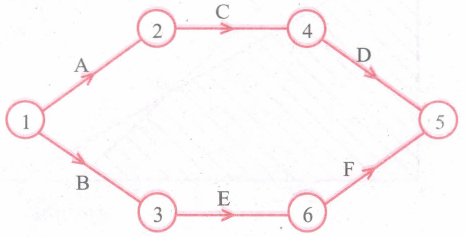
Develop a network based on the following information.
| Activity | A | B | C | D | B | E |
| Immediate Predecessor | - | - | A | C | E | F |
30.
If I deposit Rs.500 every year for a period of 10 years in a bank which gives C.I 5% per year, Find out the amount I will receive at the end of 10 years
31.
Calculate the correlation co-efficient from the following data:
| X | 12 | 9 | 8 | 10 | 11 | 13 | 7 |
| Y | 14 | 8 | 6 | 9 | 11 | 12 | 3 |
32.
Ten cards numbered 1 to 10 are placed in a box, mixed up thoroughly and then one card is drawn randomly. If it is known that the number on the drawn card is more than 4. What is the probability that it is an even number?
33.
34.
A man buys 500 shares of amount Rs. 100 at Rs. 14 below par. How much money does he pay?
35.
The demand function of a commodity is p = 200 - \(\frac { x }{ 100 } \) and its cost is C = 40x + 12000 where p is a unit price in rupees and x is the number of units produced and sold. Determine (i) profit function (ii) average profit at an output of 10 units (iii) marginal profit at an output of 10 units and (iv) marginal average profit at an output of 10 units.
36.
The total cost C in Rupees of making x units of product is C(x) = 50 + 4x + 3√x. Find the marginal cost of the product at 9 units of output.
37.
Differentiate the following with respect to x. sin2 x
38.
For what value of \(\lambda \) are the three lines 2x-5y+3 = 0, 5x-9y+\(\lambda \)=0 and x-2y+1=0 are concurrent?
39.
The profit Rs.y accumulated in thousand in x months is given by y = -x2 + 10x - 15. Find the best time to end the project.
40.
Find the center and radius of the circle (x + 2) ( x - 5) + (y - 2 ) ( y - 1) = 0
41.
How many chords can be drawn through 21 points on a circle?
42.
43.
Evaluate \(\frac { n! }{ r!(n-r)! } \) when n = 5 and r = 2
44.
Show that the function f(x) = |x| is not differentiable at x = 0.
45.
Show that the maximum value of the function f(x) = x3 - 27x + 108 is 108 more than the minimum value.
46.
A manufacturer makes two types of toys A and B. Three machines are needed for this purpose and the time (min) required for each toy on the machine is given below:
| Type | Machine I | Machine II | Machine III |
| A | 12 | 18 | 6 |
| B | 6 | 0 | 9 |
Each machine is available for a maximum of 6 hours/day. If the profit on each toy of type A is Rs.7.50 and for B is Rs.5. Show that 15 toys of type A and 30 of type B should be manufactured in a day to get maximum profit.
47.
Equal amounts are invested in 12% stock at 95 (brokerage). If 12% stock brought at Rs.120 more by way of dividend income than the other, find the amount invested in each stock?
48.
Find the maximum and minimum values of x3-6x2+7
49.
Three coins are tossed simultaneously. Consider the events A ‘three heads or three tails’, B ‘atleast two heads’ and C ‘at most two heads’ of the pairs (A, B), (A, C) and (B, C), which are independent? Which are dependent?
50.
The following data relate to advertisement expenditure(in lakh of rupees) and their corresponding sales( in crores of rupees)
| Advertisement expenditure | 40 | 50 | 38 | 60 | 65 | 50 | 35 |
| Sales | 38 | 60 | 55 | 70 | 60 | 48 | 30 |
Estimate the sales corresponding to advertising expenditure of Rs. 30 lakh.
51.
Compute the earliest start time, earliest finish time, latest start time and latest finish time of each activity of the project given below:
| Activity | 1-2 | 1-3 | 2-4 | 2-5 | 3-4 | 4-5 |
| Duration( in days) | 8 | 4 | 10 | 2 | 5 | 3 |
52.
Prove that \(\frac { 4tan\ x(1-{ tan }^{ 2 }x) }{ 1-6{ tan }^{ 2 } x+{ tan }^{ 4 } x } =tanx\)
53.
Resolve into partial fractions : \(\frac { { x }^{ 2 }+x+1 }{ { x }^{ 2 }+2x+1 } \)
54.
Prove that \(\tan { \left( \pi +x \right) } \cot { \left( x-\pi \right) } -\left( \cos { \left( 2\pi -x \right) } \cos { \left( 2\pi +x \right) } \right) =\sin ^{ 2 }{ x } \)
1.
(b)
\(P\left( A\cap B \right) =1\)
2.
(d)
3.
(b)
4.
\(P =\frac{\frac{a}{i}}{k} \)
\(=\frac{\frac{2000}{0.1}}{12}=2,40,000\)
5.
\(x=\frac{12 \times 96}{10}=115.20\)
6.
(b)
r(X, Y) = \(\frac { cov(x,y) }{ { \sigma }_{ x }{ \sigma }_{ y } } \)
7.
(b)
Decreasing function
8.
(b)
9.
(d)
All the above
10.
(c)
x1 = 10, x2 = 20
11.
(d)
constant function
12.
(a)
Parallel to x-axis
13.
(c)
\(\frac{\pi}{3}\)
14.
\(\sec A(-\cos A)=\frac{1}{\cos A}(-\cos A)=-1\)
15.
Equation of x axis y = 0, equation of y axis x = 0
\(\therefore\) combined equation xy = 0
16.
\(a+b=0 \Rightarrow k-2=0\)
17.
(b)
nr
18.
(c)
5th
19.
\(\text {Since }|A|=4-4=0\)
20.
\(A=\left(\begin{array}{cc} \frac{4}{5} & \frac{-5}{12} \\ \frac{-2}{5} & \frac{1}{2} \end{array}\right)\)
\(|A|=\frac{2}{5}-\frac{1}{6}=\frac{12-5}{30}=\frac{7}{30}\)
\(A^{-1}=\frac{1}{|A|} \text { adjA }=\frac{30}{7}\left(\begin{array}{ll} \frac{1}{2} & \frac{5}{12} \\ \frac{2}{5} & \frac{4}{5} \end{array}\right)\)
21.
Differentiating \(y=\frac { 1-3x }{ 1+3x } \) with respect to x.
\(\cfrac { dy }{ dx } =\cfrac { \left( 1+3x \right) \frac { d }{ dx } \left( 1-3x \right) -\left( 1-3x \right) \frac { d }{ dx } \left( 1+3x \right) }{ \left( 1+{ 3x }^{ 2 } \right) } \)
= \(\cfrac { \left( 1+3x \right) \left( -3 \right) -\left( 1-3x \right) (3) }{ \left( 1+3x \right) ^{ 2 } } \)
= \(\cfrac { -6 }{ \left( 1+3x \right) ^{ 2 } } \)
22.
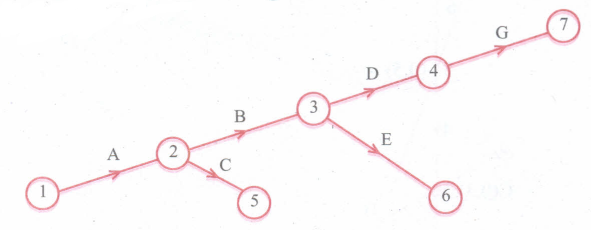
Using the precedence relationship and following the rules of network construction, the required network is shown in the following figure.
23.
24.
We have \(\cos 2x=\frac{1-\tan^2x}{1+\tan^2x}\)
\(\therefore LHS=\cos2x+\sin^2\phi=\frac{1-\tan^2x}{1+\tan^2x}+\sin^2\phi\)
\(=\frac{1-\left(2\tan^\phi+1\right)}{1+(2\tan^2\phi)+1}+\sin^2\phi\) \([\because tan^{ 2 }x=2tan^{ 2 }\phi +1]\)
\(=\frac{-2\tan^2\phi}{2(1+\tan^2\phi)}+\sin^2\phi=\frac{-\tan^2\phi}{\sec^2\phi}+\sin^2\phi\)
\(=\frac{-\sin^2\phi}{\cos^2\phi.\frac{1}{\cos^2\phi}}+\sin^2\phi=-\sin^2\phi+\sin^2\phi=0=RHS\)
Hence Proved.
25.
Let A = \(\begin{vmatrix}5&20\\ 0&-1 \end{vmatrix}\)
Minor of 5 = M11 = -1
Minor of 20 = M12 = 0
Minor of 0 = M21 = 20
Minor of -1 = M22 = 5
Co-factor of 5 = A11 = -1
Co-factor of 20 = A12 = 0
Co-factor of 0 = A21 = -20
Co-factor of -1 = A22 = 5
26.
\(cos2A=\cfrac { 1-{ tan }^{ 2 }A }{ 1+{ tan }^{ 2 }A } =\cfrac { 1-\frac { 1 }{ 49 } }{ 1+\frac { 1 }{ 49 } } =\cfrac { 48 }{ 49 } \times \cfrac { 49 }{ 50 } \) = \(\cfrac { 24 }{ 25 } \) ..(1)
Now, sin4B = 2sin2B cos2B
\(\\ \\ \\ =2\cfrac { 2tanB }{ 1+{ tan }^{ 2 }B } \times \cfrac { 1-{ tan }^{ 2 }B }{ 1+{ tan }^{ 2 }B } \)
\( =\cfrac { 4\times \frac { 1 }{ 3 } }{ 1+\frac { 1 }{ 9 } } \times \cfrac { 1-\frac { 1 }{ 9 } }{ 1+\frac { 1 }{ 9 } } =\cfrac { 24 }{ 25 } \) ..(2)
From(1) and (2) we get, cos2A = sin4B.
27.
Compare \(\left( \cfrac { x }{ 3 } +9y \right) ^{ 9 }\) with \(\left( x+a \right) ^{ n }\)
Since n = 9, we have 10 terms(even)
\(\therefore\) There are two middle terms namely \(\cfrac { { t }_{ n+1 } }{ 2 } ,\cfrac { { t }_{ n+3 } }{ 2 } i.e.,\cfrac { { t }_{ 9+1 } }{ 2 } ,\cfrac { { t }_{ 9+3 } }{ 2 } \)
General term in the expansion of \(\left( x+a \right) ^{ n }\) is
\({ t }_{ r+1 }=n{ C }_{ r }{ x }^{ n-r }{ a }^{ r }\) ..(1)
Here t5 and t6 are middle terms.
put r = 4 in (1)
\({ t }_{ 4+1 }={ t }_{ 5 }=9{ C }_{ 4 }\left( \cfrac { x }{ 3 } \right) ^{ 5 }.\left( 9y \right) ^{ 4 }\)
\(=9{ C }_{ 4 }\cfrac { { x }^{ 5 } }{ { 3 }^{ 5 } } .{ 9 }^{ 4 }{ y }^{ 4 }\)
\(=\cfrac { 9\times 8\times 7\times 6 }{ 4\times 3\times 2\times 1 } .\cfrac { { x }^{ 5 } }{ { 3 }^{ 5 } } .{ 9 }^{ 4 }{ y }^{ 4 }=3402{ x }^{ 5 }{ y }^{ 4 }\)
put r = 5 in (1),
\(\\ { t }_{ 5+1 }={ t }_{ 6 }=9{ C }_{ 5 }\left( \cfrac { x }{ 3 } \right) ^{ 4 }.\left( 9y \right) ^{ 5 }\)
\(={ 9C }_{ 5 }\cfrac { { x }^{ 4 } }{ { 3 }^{ 4 } } .{ 9 }^{ 5 }{ y }^{ 5 }\)
\(=91854{ x }^{ 4 }{ y }^{ 5 }\)
28.
\(A=\left[ \begin{matrix} 2 & 4 \\ -3 & 2 \end{matrix} \right] \)
\(|A|=\left[ \begin{matrix} 2 & 4 \\ -3 & 2 \end{matrix} \right] \)
=16 ≠ 0
Since A is a nonsingular matrix, A -1 exists
Now adj \(A=\left[ \begin{matrix} 2 & -4 \\3 & 2 \end{matrix} \right] \)
\({ A }^{ -1 }=\frac { 1 }{ \left| A \right| } adjA\)
\(=\frac { 1 }{ 16 } \left[ \begin{matrix} 2 & -4 \\ 3 & 2 \end{matrix} \right] \)
29.
Using the immediate precedence relationship and following the rules of network construction, the required network is shown in the diagram.
30.
Given a = Rs.500,i = 5% =0.05,n =10
A=\(\cfrac { a }{ i } \left[ 1-\left( 1+i \right) ^{ -n } \right] \)
=\(\cfrac { 500 }{ 0.05 } \left( 1.05 \right) \left[ \left( 1.05 \right) ^{ 10 }-1 \right] \)
=10,500 [1.629-1]
=10,500(0.629)
= Rs.6604.50
\(\therefore\) At the end of 10 years. I will receive Rs.6604.5
(1.05)10 = 10 log(1.05)
= 10(0.0212)
= 0.2120
Antilog of 0.2120 is 1.629
31.
N=7
| X | Y | x2 | y2 | xy |
| 12 | 14 | 144 | 196 | 168 |
| 9 | 8 | 81 | 64 | 72 |
| 8 | 6 | 64 | 36 | 48 |
| 10 | 9 | 100 | 81 | 90 |
| 11 | 11 | 121 | 121 | 121 |
| 13 | 12 | 169 | 144 | 156 |
| 7 | 3 | 49 | 9 | 21 |
| 70 | 63 | 728 | 651 | 676 |
Karl Pearson correlation co-efficient
r(x, y) =\(\frac { N\sum { XY-(\sum { X)(\sum { Y) } } } }{ \sqrt { N.\sum { { X }^{ 2 }-({ \sum { X) } }^{ 2 } } } .\sqrt { N.{ \sum { Y } }^{ 2 }-({ \sum { Y) } }^{ 2 } } } \)
=\(\frac { 7(676)-(70)(63) }{ \sqrt { 7(728)-{ (70) }^{ 2 } } \sqrt { 7(651)-{ (63) }^{ 2 } } } \)
=\(\frac { 4732-4410 }{ (14)(24.2487) } =\frac { 322 }{ 229.4818 } \)=0.9485
32.
S = {1, 2, 3,.....10}
n(S) = 10
Let B be the event of drawing a card greater than 4
B = {5, 6,.... 10}
\(P(B) =\frac { 6 }{ 10 } \)
Let A be the event of getting an even number
A = {2, 4, 6, 8, 10}
\(P(A) =\frac { 5 }{ 10 } \)
\(A\cap B\) = {6, 8, 10}
\(P(A\cap B)=\frac { 3 }{ 10 } \)
\(P(A/B)=\frac {P(A\cap B)}{P(B)}=\frac{\frac{3}{10}}{\frac{6}{10}}=\frac{3}{6}=\frac{1}{2}\)
33.
34.
Number of shares = 500
Face value of a share = Rs. 100
Discount = Rs. 14
Market value of a share = 100 – 14 = Rs. 86 (face value – discount)
Market value of 500 shares = Number of shares × market value of a share
= 500 × 86 = 43,000
Market value of 500 shares = Rs. 43,000
35.
p = 200 - \(\frac { x }{ 100 } \)
R = px \(=200x-{x^2\over100}\)
C = 40x + 120
(i) Profit function = R - C
\(=200x-{x^2\over100}-40x-120\)
\(={x^2\over100}-160x-120\)
(ii) Averange Profit \(=\mathrm{A} \cdot \mathrm{P}=\frac{p(x)}{x}=\frac{R(x)-c(x)}{x}\)
\(=\frac{200 x \frac{-x^2}{100}+40 x+1}{x}=160-\frac{x}{100}-\frac{120}{x}\)
At x = 10 units
\(\text {A.P } =160-\frac{1}{10}-\frac{120}{10} \)
\(=160-12.1= 147.90\)
(iii) Marginal profit \(=\mathrm{M} \cdot \mathrm{P}=\frac{d p}{d x}=\frac{d}{d x} p(x)\)
\(=160-\frac{2 x}{100} \)
\(=160-\frac{x}{50}\)
At x = 10 units
\(\text {M.P }=160-\frac{1}{5}=160-0.2= 159.80\)
(iv) Marginal average profit = M.A.P \( =\frac{d(A P)}{d x}\)
\(=-\frac{1}{100}+\frac{120}{x^2}\)
At x = 10 units
\(\text {M.A.P }=-\frac{1}{100}+\frac{120}{100}= 1.19\)
36.
C(x) = 50 + 4x + 3√x
Marginal cost (MC) =\({Dc\over dx}-{d\over dx}[C(x)]\)
\(={d\over dx}\left[50+4x+3\sqrt3\right]=4{3\over 2\sqrt3}\)
When x = 9, \({dC\over dx}=4{3\over 2\sqrt9}\)\(=4{1\over 2}\)(or) Rs.4.50
∴ MC is Rs.4.50 , when the level of output is 9 units.
37.
y = sin2 x
dy/dx = 2 sin x cos x
= sin 2x
38.
The given lines are
2x - 5y + 3 = 0
5x - 9y + \(\lambda \) = 0
x - 2y + 1 = 0
The condition for the lines to be concurrent is
\(\left| \begin{matrix} 2 & -5 & 3 \\ 6 & -9 & \lambda \\ 1 & -2 & 1 \end{matrix} \right| =0\quad \)
Expanding along R1 , we get
\(2\left| \begin{matrix} -9 & \lambda \\ -2 & 1 \end{matrix} \right| +5\left| \begin{matrix} 5 & \lambda \\ 1 & 1 \end{matrix} \right| +3\left| \begin{matrix} 5 & -9 \\ 1 & -2 \end{matrix} \right| =0\)
\(\Rightarrow 2(-9+2\lambda )+5(5-\lambda )+3(-10+9)=0\)
\(\Rightarrow -18+4\lambda +25-5\lambda -30+27=0\)
\(\Rightarrow -\lambda +4=0\Rightarrow \lambda =+4\)
39.
Y = -x2 + 10 x - 15
\(\Rightarrow\) x2 - 10x = - y - 15
\(\Rightarrow\) (x- 5)2 = -y - 15 + 25
\(\Rightarrow\) (x- 5)2 = -y + 10
\(\Rightarrow\) (x - 5)2 = (-y - 10)
The best time to end the project is when x = 5 months.
40.
(x + 2) ( x - 5) + (y -2 ) ( y -1) = 0
\(\Rightarrow\) x2 -5x + 2x - 10 + y2 - y - 2y + 2 = 0
\(\Rightarrow\) x2 + y2 - 3x - 3y - 8 = 0
here 2g = -3 \(\Rightarrow\) \(g=-\frac { 3 }{ 2 }\)
2f = -3 \(\Rightarrow\) \(f=-\frac { 3 }{ 2 } \)
and C = -8
Center of the circle (-g, -f) = \(\left( \frac { 3 }{ 2 } ,\frac { 3 }{ 2 } \right) \)
A radius of the circle is \(\sqrt { { g }^{ 2 }+{ f }^{ 2 }-c } \)
Radius of the circle is \(= \sqrt { \frac { 9 }{ 4 } +\frac { 9 }{ 4 } +8 }\)
\(=\sqrt{\frac{18}{4}+8}=\sqrt{\frac{9}{2}+8}\)
\(r=\sqrt{\frac{25}{2}}=\frac{5}{\sqrt{2}} \text { units }\)
41.
To draw a line we need two points
No. of chords \(=21 C_2=\frac{21 \times 20}{2 \times 1}=210\)
42.
43.
\(\frac{n !}{r !(n-r) !}=\frac{5 !}{2 ! 3 !}\)
\(=\frac{5 \times 4 \times 3 \times 2 \times 1}{2 \times 1 \times 3 \times 2 \times 1}=10\)
44.
\(f(x)=|x|=\left\{\begin{array}{cll} x & \text { if } & x \geq 0 \\ -x & \text { if } & x<0 \end{array}\right.\)
\(\mathrm{L}\left[f^{\prime}(0)\right]=\lim _{x \rightarrow 0^{-}} \frac{f(x)-f(0)}{x-0}\)
\(=\lim _{h \rightarrow 0} \frac{f(0-h)-f(0)}{0-h-0}, x=0-h\)
\(=\lim _{h \rightarrow 0} \frac{f(-h)-f(0)}{-h}\)
\(=\lim _{h \rightarrow 0} \frac{|-h|-|0|}{-h}\)
\(=\lim _{h \rightarrow 0} \frac{|-h|}{-h}\)
\(=\lim _{h \rightarrow 0} \frac{h}{-h}\)
\(=\lim _{h \rightarrow 0}(-1)=-1\)
\(\mathrm{R}\left[f^{\prime}(0)\right]=\lim _{x \rightarrow 0^{+}} \frac{f(x)-f(0)}{x-0}\)
\(=\lim _{h \rightarrow 0} \frac{f(0+h)-f(0)}{0+h-0}, x=0+h\)
\(=\lim _{h \rightarrow 0} \frac{f(h)-f(0)}{h}\)
\(=\lim _{h \rightarrow 0} \frac{|h|-|0|}{h}\)
\(=\lim _{h \rightarrow 0} \frac{|h|}{h}\)
\(=\lim _{h \rightarrow 0} \frac{h}{h}\)
\(=\lim _{h \rightarrow 0} 1=1\)
\(\text { Here, } \mathrm{L}\left[f^{\prime}(0)\right] \neq \mathrm{R}\left[f^{\prime}(0)\right]\)
\(\therefore\) f(x) is not differentiable at x = 0
45.
Given f(x)= x3-27x+108
f'(x) = = 3x2 - 27
f'(x) = 0 ⇒ 3x2 - 27 = 0
⇒ x2 - 9 = 0 [Divided by 3]
⇒ x2=9
⇒ x= 3, - 3
Also,f"(x) = 6x
when x = 3, f"(x) = 6(3) = 18 > 0
∴ f is minimum at x = 3.
∴ Minimum Value = f(3) = 33 - 27(3) + 108
=27-81+108=54 ....(1)
when x = -3,f"(x) = 6(-3) = -18 < 0
∴ f is maximum at x = - 3
Maximum value = 1(-3) = (-3)3 - 27(-3) + 108
= -27 + 81 + 108 = 162 ...(2)
From (1) and (2)
Maximum value - Minimum value = 162 - 54 = 108.
Hence, the maximum value of f(x) is 108 more than the minimum value
46.
Let x1 toys of type A and x2 toys of type B are produced. Let Z be the maximum profit on two types of toys A and B.
| Type | Machine I | Machine II | Machine III | Profit |
|---|---|---|---|---|
| A | 12 | 18 | 6 | Rs. 7.50 |
| B | 6 | 0 | 9 | Rs. 5 |
| Time available | 6h = 360 min | 6h = 360 min | 6h = 360 min |
Thus, the mathematical formulation of the LPP is maximize Z = 7.50x1 + 5x2
Subject to the constraints
12x1 + 6x2 ≤ 360,18x1 ≤ 360,6x1 + 9x2 ≤ 360,x1,x2 ≥ 0
Consider the equations
12x1 + 6x2 ≤ 360
| \({ x }_{ 1 }\) | 0 | 30 |
| \({ x }_{ 2 }\) | 60 | 0 |
\(18{ x }_{ 1 }=360\)
| x1 | 20 |
\({ 6x }_{ 1 }+9{ x }_{ 2 }=360\)
| \({ x }_{ 1 }\) | 0 | 60 |
| \({ x }_{ 2 }\) | 40 | 0 |
X1 = 20 is a line parallel to x2-axis at a distance of 20 units from it
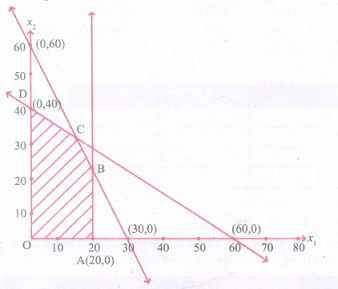
The feasible region is OABCD and its co-ordinates are O(0, 0) A(20, 0) D(0, 40), B is the point of intersection ofthe lines x1 = 20 and 12x1+ 6x2 = 360
\(\Rightarrow 2{ x }_{ 1 }+{ x }_{ 2 }=60\)
\(\Rightarrow 40+{ x }_{ 2 }=60\)
\( \Rightarrow { x }_{ 2 }=20\)
Verification of Band C:
\(\therefore \quad B\quad (20,20)\)
And C is the point of intersection of the lines
\(2{ x }_{ 1 }+{ x }_{ 2 }=60...(1)\)
\( (-)\quad \quad (-)\quad \quad (-)\)
\(2{ x }_{ 1 }+3{ x }_{ 2 }=120 \left[ \because \quad 6{ x }_{ 1 }+{ 9x }_{ 2 }=360 \right] ...(2)\)
\(-------------\)
\( -2x_{ 2 }=-60 \Rightarrow { x }_{ 2 }=30\)
\(2{ x }_{ 1 }+30=60 [\because \quad From\quad (1)] \Rightarrow { x }_{ 1 }=\frac { 30 }{ 2 } =15\)
\( \therefore \quad C\quad is\quad (15,30)\)
| Corner Points | Z = 7.5x1 + 5x2 |
|---|---|
| O(0,0) | 0 |
| A(20,0) | 150 |
| B(20, 20) | 250 |
| C(15,30) | 262.5 |
| D(0, 40) | 200 |
Maximum of Z occurs at (15,30)
Hence, the solution is x1 = 15, x2 = 30 and Zmax= 262.5
47.
Let the amount invested in each stock be Rs.x
For 12% Stock
Investment =Rs.x
Purchased Price = 89+1 = 90
Income=\(\frac {\text { Investment} }{ \text {Purchase Price } }\) x Dividend Rate
=\(\frac { x }{ 90 } \times 12=\frac { 2x }{ 15 } \) ...(1)
For 8% Stock
Investment = Rs.x
market Price = 95+1= 96
Dividend Rate = 8%
Income=\(\cfrac { x }{ 96 } \times 8 =\cfrac { x }{ 12 } \) ...(2)
Difference in income = Rs.120
From (1) and (2), \(\cfrac { 2x }{ 15 } -\cfrac { x }{ 12 } \) = 120
\(x\left( \cfrac { 2 }{ 15 } -\cfrac { 1 }{ 12 } \right) \) = 120
\(x\left( \cfrac { 8-5 }{ 60 } \right) \) = 120
\(\cfrac { 3x }{ 60 } \) = 120
\(\Rightarrow\) x = \(\cfrac { 120\times 60 }{ 3 } \) = Rs.2400
Hence, investment in each stock is Rs.2400
48.
Let y=x3-6x2+7
Differentiating w.r.t. 'x' we get,
\({dy\over dx}=3x^2-12x\)
\({dy\over dx}=0\)
\(\Rightarrow3x^2-12x=0\)
\(\Rightarrow3x(x-4)=0\)
\(\Rightarrow x=0 \ or \ x=4\)
\({d^2y\over dx^2}=6x-12\)
when x=0 \({d^2y\over dx^2}=-12<0\)
\(\therefore \) y is maximum at x=0
\(\therefore \) maximum value=03-6(0)2+7=7
when x=4, \({d^2y\over dx^2}=-6(4)-12=12>0\)
\(\therefore \) y is minimum at x=4
\(\therefore \) Minimum value =44-6(4)2+7=64-96+7=-25
Hence maximum value is 7 and minimum value is -25.
49.
Here the sample space of the experiment is
S = {HHH, HHT, HTH, HTT, THH, TTH, THT, TTT}
A = {Three heads or Three tails}
= {HHH, TTT}
B = {at least two heads}
= {HHH, HHT, HTH, THH} and
C = {at most two heads} = {HHT, HTH, HTT, THH, TTH, THT, TTT}
Also (A∩B) = {HHH}; (A∩C) = {TTT} and (B∩C) ={HHT, HTH, THH}
∴ P(A) = \(\frac { 2 }{ 8 } =\frac { 1 }{ 4 } \); P(B) =\(\frac{1}{2}\); P(C) = \(\frac{7}{8}\) and
P(A∩B)= \(\frac{1}{8}\), P(A∩C)=\(\frac{1}{8}\), P(B∩C)=\(\frac{3}{8}\)
Also P(A). P(B)=\(\frac { 1 }{ 4 } .\frac { 1 }{ 2 } =\frac { 1 }{ 8 } \)
P(A). P(C) =\(\frac { 1 }{ 4 } .\frac { 7 }{ 8 } =\frac { 7 }{ 32 } \)
and P(B). P(C) =\(\frac { 1 }{ 2 } .\frac { 7 }{ 8 } =\frac { 7 }{ 16 } \)
Thus, P(A∩B) = P(A). P(B)
P(A∩C) ≠ P(A) P(C) and
P(B∩C) ≠ P(B). P(C)
Hence, the events (A and B) are independent, and the events (A and C) and (B and C) are dependent.
50.
| X | Y | dx = X-48 | dy = Y-52 | dx2 | dy2 | dx dy |
|---|---|---|---|---|---|---|
| 40 | 38 | -8 | -14 | 64 | 196 | 112 |
| 50 | 60 | 2 | 8 | 4 | 64 | 16 |
| 38 | 55 | -10 | 3 | 100 | 9 | -30 |
| 60 | 70 | 12 | 18 | 144 | 324 | 216 |
| 65 | 60 | 17 | 8 | 289 | 64 | 136 |
| 50 | 48 | 2 | -4 | 4 | 16 | -8 |
| 35 | 30 | -13 | -22 | 169 | 484 | 286 |
| \(\Sigma X\) = 338 | \(\Sigma Y\) = 361 | \(\Sigma dx\) = 2 | \(\Sigma dy\) = -3 | \(\Sigma dx^2\) = 774 | \(\Sigma dy^2\) = 1157 | \(\Sigma dxdy\) = 728 |
\(\bar{X} =\frac{\Sigma X}{N}=\frac{338}{7}=48.29 \)
\(\bar{Y} =\frac{\Sigma Y}{N}=\frac{361}{7}=51.57 \)
\(b_{y x} =\frac{N \Sigma d x d y-\Sigma d x \Sigma d y}{N \Sigma d x^2-(\Sigma d x)^2} \)
\(=\frac{7(728)+6}{7(774)-4} \)
\(=\frac{5102}{5414}=0.942\)
Regression equation of Y on X is
\(Y-\overset{-}{Y}=b_{yx}(X-\overset{-}{X})\)
Y - 51.57 = 0.942(X - 48.29)
Y = 0.942X - 45.49 + 51.57
= 0.942X + 6.08
Y = 0.942(30) + 6.08
Y = 34.34 (In Crores of rupees)
51.
Earliest start time (EST) and latest finish time (LFT) of each activity are given in the following network.
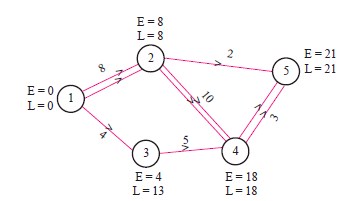
E1 = 0
E2 = E1 + t12 = 0 + 8 = 8
E3 = E1 + t13 = 0 + 4 = 4
E4 = E2 + t24 or E3 + t34 = 8 + 10 = 18
(take E2 + t24 or E3 + t34 whichever is maximum)
E5 = (E2 + t25 or E4 + t45) = 18 + 3 = 21
(take E2 + t25 or E4 + t45 whichever is maximum)
L5 = 21
L4 = L5 – t45 = 21 – 3 = 18
L3 = L4 – t34 = 18 – 5 = 13
L2 = L5 – t25 or L4 – t24 = 18 – 10 = 8
(take L5 – t25 or L4 – t24 whichever is minimum)
L1 = L2 – t12 or L3 - t13 = 8 – 8 = 0
(take L2 – t12 or L3 – t13 whichever is minimum)
Here the critical path is 1-2-4-5, which is denoted by double lines.
| Activity | Duration(tij) | EST | EFT=EST+tij | LST=LFT-tij | LFT |
| 1-2 | 8 | 0 | 8 | 0 | 8 |
| 1-3 | 4 | 0 | 4 | 9 | 13 |
| 2-4 | 10 | 8 | 18 | 8 | 18 |
| 2-5 | 2 | 8 | 10 | 19 | 21 |
| 3-4 | 5 | 4 | 9 | 13 | 18 |
| 4-5 | 3 | 18 | 21 | 18 | 21 |
The longest duration to complete this project is 21 days.
The path connected by the critical activities is the critical path(the longest path).
Critical path is 1-2-4-5 and project completion time is 21 days.
52.
RHS = tan 4x = tan2(2x)
= \(\frac { 2\quad tan\quad 2x }{ 1-{ tan }^{ 2 }2x } \left[ \because tan2x=\frac { 2\quad tan\quad x }{ 1-{ tan }^{ 2 }x } \right] \)
= \(\frac { 2.\frac { 2\quad tan\quad x }{ 1-{ tan }^{ 2 }x } }{ 1-\left( \frac { 2\quad tan\quad x }{ 1-{ tan }^{ 2 }x } \right) ^{ 2 } } =\frac { \frac { 4\quad tan\quad x }{ 1-{ tan }^{ 2 }x } }{ \frac { (1-{ tan }^{ 2 }x)^{ 2 }-4{ tan }^{ 2 }x }{ (1-{ tan }^{ 2 }x)^{ 2 } } } \)
= \(\frac { 4\quad tan\quad x }{ 1-{ tan }^{ 2 }\quad x } \times \frac { (1-{ tan }^{ 2 }\quad { x })^{ 2 } }{ 1+{ tan }^{ 4 }x-2\quad { tan }^{ 2 }x-4{ tan }^{ 2 }x } \)
= \(\frac { 4 tanx(1-{ tan }^{ 2 }\quad x) }{ 1+{ tan }^{ 4 }x-6\ { tan }^{ 2 }x } \) = LHS
53.
Since the numerator degree is equal to the degree of the denominator, let us divide.
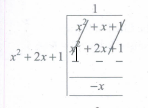
\(\therefore\) \({{x^2+x+1}\over{x^2+2x+1}}=1-{{x}\over{x^2+2x+1}}\) ...(1)
Consider \({{x}\over{x^2+2x+1}}={{x}\over{(x+1)^2}}={{A}\over{x+1}}+{{B}\over{{(x+1)}^{2}}}\)
\(\therefore\ {{x}\over{x^2+2x+11}}={{A(x+1)+B}\over{{(x+1)}^{2}}}\)
\(\Rightarrow\) x = A(x+ 1) + B ..(2)
Putting x = - 1 in (2) we get
-1 = 0 + B \(\Rightarrow\ \ \boxed{B=-1}\)
Putting x = 0 in (2) we get,
0 = A+B \(\Rightarrow\) A - 1 = 0 \(\Rightarrow\) \(\boxed{A=1}\)
\(\therefore\) \({{x}\over{{(x+1)}^{2}}}={{1}\over{x+1}}-{{1}\over{{(x+1)}^{2}}}\) ..(2)
Substituting (2) in (1) we get,
\({{x^2+x+1}\over{x^2+2x+1}}=1-{{1}\over{x+1}}+{{1}\over{{(x+1)}^{2}}}\)
54.
\(\mathrm{LHS}= \tan (\pi+x) \cot (x-\pi)-\cos (2 \pi-x) \cos (2 \pi+x)-\tan (\pi+x) \cot (\pi-x) -\cos (2 \pi-x) \cos (2 \pi+x)\)
\(=-(\tan x)(-\cot x)-(\cos x)(\cos x)\)
\(=\tan \left(\frac{1}{\tan x}\right)-\cos ^2 x\)
\(=1-\cos ^{ 2 }{ x } =\sin ^{ 2 }{ x } \ \left[ \because \ 1-\cos ^{ 2 }{ x } =\sin ^{ 2 }{ x } \right] \)
= RHS Hence Proved.

11th Standard Syllabus & Materials
11th Standard
TN 11th Tamil பீடு பெற நில் - செய்யுள் - காவடிச்சிந்து Important Questions And Answers Study Material - QB365 Set A
NEW11th Standard
TN 11th Tamil பீடு பெற நில் - உரைநடை - மலை இடப்பெயர்கள் : ஓர் ஆய்வு Important Questions And Answers Study Material - QB365 Set A
NEW11th Standard
TN 11th Tamil மாமழை போற்றுதும் - துணைப்பாடம் - யானை டாக்டர் Important Questions And Answers Study Material - QB365 Set A
NEW11th Standard
TN 11th Tamil மாமழை போற்றுதும் - செய்யுள் - ஐங்குறுநூறு Important Questions And Answers Study Material - QB365 Set A



Tamilnadu Stateboard 11th Standard Subjects

Maths

Commerce

Economics

Biology
Business Maths and Statistics

Accountancy

Computer Science

Physics

Chemistry
Maths
Biology
Economics
Physics
Chemistry

History
Business Maths and Statistics

Computer Science
Accountancy

Computer Applications
History
Computer Technology
Commerce
Computer Applications
Computer Technology

Tamil

English

French
Tamilnadu Stateboard Standards
