
 100% FREE ACCESS
11th Standard Syllabus & Materials
11th Standard
TN 11th Tamil இயற்கை வேளாண்மை,சுற்றுச்சூழல் -செய்யுள் - மனோன்மணீயம் Important Questions And Answers Study Material - QB365 Set A
NEW11th Standard
TN 11th Tamil என்னுயிர் என்பேன் -துணைப்பாடம் - இசைத்தமிழர் இருவர் Important Questions And Answers Study Material - QB365 Set A
NEW11th Standard
TN 11th Tamil மொழி கலை -செய்யுள் - ஒவ்வொரு புல்லையும் Important Questions And Answers Study Material - QB365 Set A
NEW11th Standard
TN 11th Tamil பீடு பெற நில் - இலக்கணம் - பகுபத உறுப்புகள் Important Questions And Answers Study Material - QB365 Set A
NEW11th Standard
TN 11th Tamil பீடு பெற நில் - துணைப்பாடம் - வாடிவாசல் Important Questions And Answers Study Material - QB365 Set A
NEW11th Standard
TN 11th Tamil பீடு பெற நில் - செய்யுள் - குறுந்தொகை Important Questions And Answers Study Material - QB365 Set A

Published on: 21/01/2020
Download Tamil Nadu 11th Standard Business Maths and Statistics question papers, model tests, one-mark questions, important questions, and public exam papers in PDF format. Free study materials and answer keys for TN State Board students.
Questions + Answers key
Take MCQ Business Maths and Statistics Test
1.
Show that the matrices \(A=\left[ \begin{matrix} 1 & 3 & 7 \\ 4 & 2 & 3 \\ 1 & 2 & 1 \end{matrix} \right] \)and \(B=\left[ \begin{matrix} \frac { -4 }{ 35 } & \frac { 11 }{ 35 } & \frac { -5 }{ 35 } \\ \frac { -1 }{ 35 } & \frac { -6 }{ 35 } & \frac { 25 }{ 35 } \\ \frac { 6 }{ 35 } & \frac { 1 }{ 35 } & \frac { -10 }{ 35 } \end{matrix} \right] \)are inverses of each other.
2.
The total revenue (TR) for commodity x is \(TR=12x+{x^2\over2}-{x^3\over 3}\)S.T. at the highest point of average revenue (AR), AR = MR
3.
The following table use the activities in a building project.
| Activity | 1-2 | 1-3 | 2-3 | 2-4 | 3-4 | 4-5 |
|---|---|---|---|---|---|---|
| Duration (days) | 21 | 26 | 11 | 13 | 5 | 11 |
Draw the network for the project, calculate the earliest start time, earliest finish time, latest start time and latest finish time of each activity and find the critical path. Compute the project duration.
4.
For the data on price (in rupees) and demand (in tonnes) for a commodity, calculate the co-efficient of correlations.
| Price(X) | 22 | 24 | 26 | 28 | 30 | 3 | 34 | 36 | 38 | 40 |
| Demand(Y) | 60 | 58 | 58 | 50 | 48 | 48 | 48 | 42 | 36 | 32 |
5.
In a Shooting test, the probabilities of hitting the target are \(\frac { 1 }{ 2 } \) for A, \(\frac { 2 }{ 3 } \) for B and \(\frac { 3 }{ 4 } \) for C. If all of them fire at the same target, calculate the probabilities that only one of them hit the target.
6.
One kind of the cake requires 200 g of flour and 25 g of fat, and another kind of cake requires 100 g of flour and 50 g of fat. Find the maximum number of cakes which can be made from 5 kg of flour and 1 kg of fat assuming that there is no shortage of other ingredients used in making the cakes?
7.
Kamal sold Rs.9000 worth 7% stock at 80 and invested the proceeds in 15% stock at 120. Find the change in his income?
8.
Bag I contains 3 Red and 4 Black balls while another Bag II contains 5 Red and 6 Black balls. One ball is drawn at random from one of the bags and it is found to be red. Find the probability that it was drawn from Bag I.
9.
The equations of two lines of regression obtained in a correlation analysis are the following 2X = 8 – 3Y and 2Y = 5 – X. Obtain the value of the regression coefficients and correlation coefficient.
10.
Calculate correlation coefficient for the following data.
| X | 25 | 18 | 21 | 24 | 27 | 30 | 36 | 39 | 42 | 48 |
| Y | 26 | 35 | 48 | 28 | 20 | 36 | 25 | 40 | 43 | 39 |
11.
Solve the following linear programming problem graphically.
Maximize Z = 3x1 + 5x2 subject to the constraints x1 + x2 ≤ 6, x1 ≤ 4; x2 ≤ 5, and x1, x2 ≥ 0
12.
A company uses 48000 units/year of a raw material costing Rs. 2.5 per unit. Placing each order costs Rs. 45 and the carrying cost is 10.8 % per year of the average inventory. Find the EOQ, total number of orders per year and time between each order. Also verify that at EOQ carrying cost is equal to ordering cost.
13.
Compute the earliest start time, earliest finish time, latest start time and latest finish time of each activity of the project given below:
| Activity | 1-2 | 1-3 | 2-4 | 2-5 | 3-4 | 4-5 |
| Duration( in days) | 8 | 4 | 10 | 2 | 5 | 3 |
14.
Prove that cot x cot 2x - cot 2x cot 3x - cot 3x cot x = 1.
15.
If \(y={ e }^{ a\cos ^{ -1 }{ x } }\) , show that \(\left( 1-{ x }^{ 2 } \right) \frac { { d }^{ 2 }y }{ { dx }^{ 2 } } -x\frac { dy }{ dx } -{ a }^{ 2 }y=0\)
16.
The sum of three numbers is 20. If we multiply the first by 2 and add the second number and subtract the third we get 23. If we multiply the first by 3 and add second and third to it, we get 46. By using matrix inversion method find the numbers.
17.
Let a, b and c denote the sides BC, CA and AB respectively of \(\Delta\) ABC. If \(\left| \begin{matrix} 1 & a & b \\ 1 & c & a \\ 1 & b & c \end{matrix} \right| =0\), then find the value of sin2 A + sin2B + sin2C.
18.
If\(A=\begin{bmatrix}1&3&3\\1&4&3\\1&3&4 \end{bmatrix}\)then verify that A (adj A) = |A| I and also find A-1.
19.
If A = \(\begin{bmatrix}3 & -1 & 1 \\ -15 & 6 & -5\\5 & -2 & 2 \end{bmatrix}\) then, find the Inverse of A.
20.
Resolve into partial fractions for the following : \(\frac{x+2}{(x-1)(x+3)^2}\)
1.
\(AB=\left[ \begin{matrix} 1 & 3 & 7 \\ 4 & 2 & 3 \\ 1 & 2 & 1 \end{matrix} \right] \left[ \begin{matrix} \frac { -4 }{ 35 } & \frac { 11 }{ 35 } & \frac { -5 }{ 35 } \\ \frac { -1 }{ 35 } & \frac { -6 }{ 35 } & \frac { 25 }{ 35 } \\ \frac { 6 }{ 35 } & \frac { 1 }{ 35 } & \frac { -10 }{ 35 } \end{matrix} \right] \)
\(=\left[ \begin{matrix} 1 & 3 & 7 \\ 4 & 2 & 3 \\ 1 & 2 & 1 \end{matrix} \right] \frac { 1 }{ 35 } \left[ \begin{matrix} -4 & 11 & -5 \\ -1 & -6 & 25 \\ 6 & 1 & -10 \end{matrix} \right] \)
\(=\frac { 1 }{ 35 } \left[ \begin{matrix} 35 & 0 & 0 \\ 0 & 35 & 0 \\ 0 & 0 & 35 \end{matrix} \right] \)
\(=\frac { 35 }{ 35 } \left[ \begin{matrix} 1 & 0 & 0 \\ 0 & 1 & 0 \\ 0 & 0 & 1 \end{matrix} \right] \)
\(=\left[ \begin{matrix} 1 & 0 & 0 \\ 0 & 1 & 0 \\ 0 & 0 & 1 \end{matrix} \right] =I\)
\(BA=\left[ \begin{matrix} \frac { -4 }{ 35 } & \frac { 11 }{ 35 } & \frac { -5 }{ 35 } \\ \frac { -1 }{ 35 } & \frac { -6 }{ 35 } & \frac { 25 }{ 35 } \\ \frac { 6 }{ 35 } & \frac { 1 }{ 35 } & \frac { -10 }{ 35 } \end{matrix} \right] \left[ \begin{matrix} 1 & 3 & 7 \\ 4 & 2 & 3 \\ 1 & 2 & 1 \end{matrix} \right] \)
\(=\frac { 1 }{ 35 } \left[ \begin{matrix} -4 & 11 & -5 \\ -1 & -6 & 25 \\ 6 & 1 & -10 \end{matrix} \right] \left[ \begin{matrix} 1 & 3 & 7 \\ 4 & 2 & 3 \\ 1 & 2 & 1 \end{matrix} \right] \)
\(=\frac { 1 }{ 35 } \left[ \begin{matrix} 35 & 0 & 0 \\ 0 & 35 & 0 \\ 0 & 0 & 35 \end{matrix} \right] \)
\(=\frac { 35 }{ 35 } \left[ \begin{matrix} 1 & 0 & 0 \\ 0 & 1 & 0 \\ 0 & 0 & 1 \end{matrix} \right] \)
\(=\left[ \begin{matrix} 1 & 0 & 0 \\ 0 & 1 & 0 \\ 0 & 0 & 1 \end{matrix} \right] =I\)
Thus AB = BA = I
Therefore A and B are inverses of each other.
2.
Given \(TR=12x+{x^2\over2}-{x^3\over 3}\)
Average Revenue \(AR={TR\over x}={12x+x^2/2-x^3/3\over x}\)
\(AR=12+{x\over2}-{x^2\over3}\) ...(1)
Let y \(=12+{x\over2}-{x^2\over3}\)
\({dy\over dx}={1\over2}-{2x\over 3}\)
Condition for maximum is
\({dy\over dx}=0\ and\ {d^2 y\over dx^2}<0\)
\(∴\ {1\over2}-{2x\over3}=0⇒{1\over2}={2x\over 3}\)
\(x={1\over2}\times{3\over 2}={3\over 4}\)
\({d^2y\over dx^2}={-2\over3}<0\)
∴ AR is maximum at x=3/4
when x=3/4, \(AR=12+{3/4\over2}-{\left(3/4\right)^2\over 3}\) [From )1)]
\(=12+{3\over8}-{9\over 48}=12.1875\) ....(2)
\(MR={{dR\over dx}}={d\over dx}\left(12x+{x^2\over 2}-{x^3\over 3}\right)=12+x-x^2\)
when x = 3/4, \(MR=12+{3\over 4}-\left(3\over4\right)^2=12+{3\over4}-{9\over 16}=12.1875 \) ..(3)
From (2) and (3), at the highest point of AR,
AR = MR = 12.1875
3.
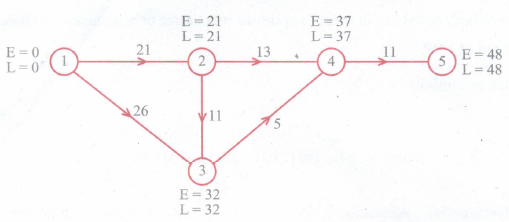
| E1= 0 | L5= 48 |
| E2= 0+21=21 | L4= 48 -11 = 37 |
| E3 =(21 + 11) or (0 + 26) Whichever is maximum =32 |
L3= 37 - 5 = 32 |
| E4= (32 + 5) or (21 + 13) =Whichever is maximum = 37 |
L2= (37 - 13) or (32 - 11) Whichever is minimum =21 |
| E5=37 + 11 = 48 | L1=(21 - 21) or (32 - 26) Whichever is minimum = 0 |
| Activity | Duration | EST | EFT = EST + tij | EFT = EST - tij | LFT |
|---|---|---|---|---|---|
| 1-2 | 21 | 0 | 21 | 21-21=0 | 21 |
| 1-3 | 26 | 0 | 26 | 32-26=6 | 32 |
| 2-3 | 11 | 21 | 32 | 32-11=21 | 32 |
| 2-4 | 13 | 21 | 34 | 37-13=24 | 37 |
| 3-4 | 5 | 32 | 37 | 37-5=32 | 37 |
| 4-5 | 11 | 37 | 48 | 48-11=37 | 48 |
EFT and LFT are same in the activities.
1 - 2, 2 - 3, 3 - 4 and 4 - 5
Hence, the critical path is 1 - 2 - 3 - 4 - 5 and the duration of project completion is 48 days .
4.
Let \(\bar { X } =\frac { \sum { X } }{ N } =\frac { 310 }{ 10 } \)=31
Here N=10 \(\bar { Y } =\frac { \sum { Y } }{ N } =\frac { 310 }{ 10 } \)=48
| X | Y | x=X-31 | y=Y-48 | x2 | y2 | xy |
| 22 | 60 | -9 | 12 | 81 | 144 | -108 |
| 24 | 58 | -7 | 10 | 49 | 100 | -70 |
| 26 | 58 | -5 | 10 | 25 | 100 | -50 |
| 28 | 50 | -3 | 2 | 9 | 4 | -6 |
| 30 | 48 | -1 | 0 | 1 | 0 | 0 |
| 32 | 48 | 1 | 0 | 1 | 0 | 0 |
| 34 | 48 | 3 | 0 | 9 | 0 | 0 |
| 36 | 42 | 5 | -6 | 25 | 36 | -30 |
| 38 | 36 | 7 | -12 | 49 | 144 | -84 |
| 40 | 32 | 9 | -16 | 81 | 256 | -144 |
| 310 | 480 | 0 | 0 | 330 | 784 | -492 |
Co-efficient correlation
r(x,y) =\(\frac { \sum { xy } }{ \sqrt { { \sum { x } }^{ 2 } } \sqrt { { \sum { y } }^{ 2 } } } =\frac { -492 }{ \sqrt { 330 } .\sqrt { 784 } } \)
\(\Rightarrow\)\(\frac { -492 }{ 18.1659\times 28 } =\frac { -492 }{ 508.6452 } \)
\(\Rightarrow\) r=-0.9673
5.
Given \(P(A)=\frac { 1 }{ 2 } \Rightarrow p(\bar { A } )=1-P(A)=1-\frac { 1 }{ 2 } =\frac { 1 }{ 2 } \)
\(P(B)=\frac { 2 }{ 3 } \Rightarrow P(\bar { B } )=1-\frac { 2 }{ 3 } =\frac { 1 }{ 3 } \)
\(P(C)=\frac { 3 }{ 4 } \Rightarrow P(\bar { C } )=1-P(C)=1-\frac { 3 }{ 4 } =\frac { 1 }{ 4 } \)
P(Only one of them hits the target)
\(=P(A\cap \bar { B } \cap \bar { C } )+P(\bar { A } \cap B\cap \bar { C } )+P(\bar { A } \cap \bar { B } \cap C)\)
\(=P(A).P(\bar { B) } .P(\bar { C) } +P(\bar { A } ).P(B).P(\bar { C } )+P(\bar { A } ).P(\bar { B } ).P(C)\)
\(=\frac { 1 }{ 2 } \times \frac { 1 }{ 3 } \times \frac { 1 }{ 4 } +\frac { 1 }{ 2 } \times \frac { 2 }{ 3 } \times \frac { 1 }{ 4 } +\frac { 1 }{ 2 } \times \frac { 1 }{ 3 } \times \frac { 3 }{ 4 } \)
\(=\frac { 1 }{ 24 } +\frac { 2 }{ 24 } +\frac { 3 }{ 24 } =\frac { 6 }{ 24 } =\frac { 1 }{ 4 } \)
6.
Let x1cakes of the one kind and x2 cakes of another kind are made. Let Z be the maximum number of cakes
| Ingredients | x1(g) | x2(g) | Total (kg) |
| Flour | 200 | 100 | 5 |
| Fat | 25 | 50 | 1 |
Thus, the mathematical formulation of the LPP is Maximize Z = x1+ x2
Subject to the constraints
\(200{ x }_{ 1 }+100{ x }_{ 2 }\le 5000\)
\(25{ x }_{ 1 }+50{ x }_{ 2 } \le 1000\)
\({ x }_{ 1 },{ x }_{ 2 }\ge 0\)
Consider the equations
\(200{ x }_{ 1 }+100{ x }_{ 2 }= 5000\)
| \({ x }_{ 1 }\) | 0 | 25 |
| \({ x }_{ 2 }\) | 50 | 0 |
\(25{ x }_{ 1 }+50{ x }_{ 2 }=1000\)
| \({ x }_{ 1 }\) | 0 | 25 |
| \({ x }_{ 2 }\) | 50 | 0 |
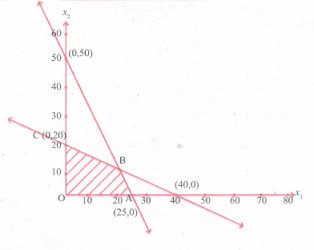
The feasible region is OABC and its co-ordinates are O(0, 0) A(25, 0) C(O, 20) and B is the point of intersection of the lines
200x1 + 100x2 = 1000 .... (1)
and 25x1 + 50x2 = 1000 ... (2)
Verification of B:
\((1) \Rightarrow 200{ x }_{ 1 }+100{ x }_{ 2 }=5000\)
\( (-)\quad \quad \quad (-)\quad \quad (-)\)
\( (2)\times 5\Rightarrow 50{ x }_{ 1 }+100{ x }_{ 2 }=2000\)
\(------------------\)
\(150x_{ 1 }=3000 \Rightarrow { x }_{ 1 }=20\)
\(From(2), 25(20)+50{ x }_{ 2 }=1000\Rightarrow 500+50{ x }_{ 2 }=1000 \Rightarrow 50{ x }_{ 2 }=500\)
\(\Rightarrow { x }_{ 2 }=10\)
\(\therefore B\ is\ (20,10)\)
| Corner Points | Z=x1 +x2 |
|---|---|
| O(0,0) | 0 |
| A(25, 0) | 25 |
| B(20, 10) | 30 |
| C(0,20) | 20 |
Maximum of Z occurs at B(20, 10)
Hence, the solution is x1 = 20, x2 = 10 and Zmax = 30.
7.
Stock = Rs.9000
FV =Rs.100
Dividend Rate = 7%
Income on 7% stock =\(\frac { \text {stock} }{ 100 } \)x FV x Rate percentage
=\(\frac { 9000 }{ 100 } \times 100\times \frac { 7 }{ 100 } \) = Rs.630 ...(1)
Cost of price of one share = 80
Sale proceeds = \(\frac { \text {stock} }{ 100 } \) x Cost Price
=\(\cfrac { 9000 }{ 100 } \)x 80 =7200
Investment = Rs.7200
Market Price = Rs.120
Dividend Rate =15%
Income =\(\frac {\text { Investment} }{ \text {Market Price } }\)x Dividend Rate
=\(\frac { 7200 }{ 120 } \)x15=Rs.900 .....(2)
Change in income = 930 - 630 = Rs.270
8.
Let E1, E2 and A be defined as
E1 = First bag is drawn
E2 = Second bag is drawn
A = Red ball is drawn
\(\therefore\) P(E1) = P(E2) = \(\frac{1}{2}\)
P(A/E1) = \(\frac{3}{7}\), P(A/E2) = \(\frac{5}{11}\)
By Baye's theorem,
\(P({ E }_{ 1 }/A)=\frac { P({ E }_{ 1 })P(A/{ E }_{ 1 }) }{ P({ E }_{ 1 })P(A/{ E }_{ 1 })+P({ E }_{ 2 })P(A/{ E }_{ 2 }) } \)
\(=\frac { 1/2\times 3/7 }{ 1/2\times 3/7+1/2\times 5/11 } \)
\(=\frac { 3/7 }{ 3/7+5/11 } =\frac { 3/7 }{ \frac { 33+35 }{ 77 } } =\frac { 3}{7 }\times \frac { 77 }{ 68 } =\frac { 33 }{ 68 } \)
9.
2X = 8 - 3Y
Regression equation of X on Y is
\(X=4-\frac{3}{2} Y \)
\(b_{x y}=-\frac{3}{2}<1\)
Regression equation of Y on X be
2Y = 5 - X
\(Y=\frac{5}{2}-\frac{X}{2} \)
\(b_{y x}=-\frac{1}{2}<1\)
\(\because\) both are negative, r is - ve.
\(r =-\sqrt{b_{x y} \cdot b_{y x}} \)
\(=-\sqrt{\left(\frac{1}{2}\right)\left(\frac{3}{2}\right)}=\frac{-\sqrt{3}}{2} \)
\(=-\frac{1.732}{2}=-0.866\)
10.
| X | Y | x2 | y2 | xy |
| 25 | 26 | 625 | 676 | 650 |
| 18 | 35 | 324 | 1225 | 630 |
| 21 | 48 | 441 | 2304 | 1008 |
| 24 | 28 | 576 | 784 | 672 |
| 27 | 20 | 729 | 400 | 540 |
| 30 | 36 | 900 | 1296 | 1080 |
| 36 | 25 | 1296 | 625 | 900 |
| 39 | 40 | 1521 | 1600 | 1560 |
| 42 | 43 | 1764 | 1849 | 1806 |
| 48 | 39 | 2304 | 1521 | 1872 |
| \(\sum\)X = 310 | \(\sum\)Y = 340 | \(\sum\)X2 = 10480 | \(\sum\)Y2 = 12280 | \(\sum\)XY = 10718 |
\(r(x, y)=\frac{N \Sigma X Y-\left(\sum X\right)\left(\sum Y\right)}{\sqrt{N \Sigma X^2-(\Sigma Y)^2} \sqrt{N \Sigma Y^2-(\Sigma Y)^2}} \)
\(=\frac{10(10718)-(310)(340)}{\sqrt{10(10480)-(310)^2} \sqrt{10(12280)-(340)^2}} \)
\(=\frac{107180-105400}{\sqrt{104800-96100} \sqrt{122800-115600}} \)
\(=\frac{1780}{\sqrt{8700 \times 7200}}=\frac{1780}{7914.54}=0.2249\)
11.
First we have to find the feasible region using the given conditions.
Since both the decision variables x1 and x2 are non-negative, the solution lies in the first quadrant write all the inequalities of the constraints in the form of equations.
\(\therefore \) We have the lines \(x_1+x_2 \leq 6 ; x_1 \leq 4; x_2 \leq 5\)
\({ x_{ 1 } }+{ x }_{ 2 }=6\) is a line passing through the points (0,6) and (6,0).
x1 = 4 is a line parallel to x2 axis at a distance of 4 units.
x2 = 5 is a line parallel to x1 axis at a distance of 5 units.
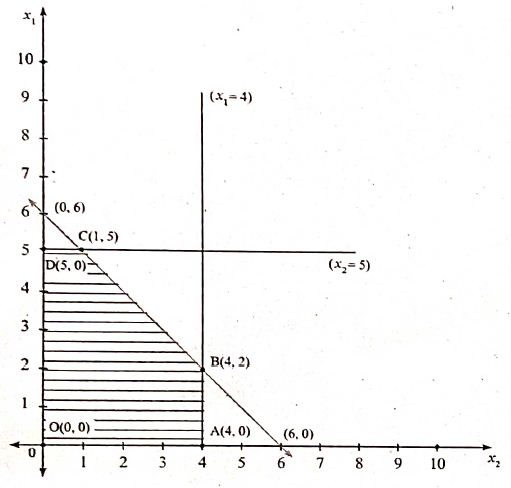
Now we draw the graph
| Corner points | Z = 3x1 + 5x2 |
| O(0,0) | 0 |
| A(4,0) | 12 |
| B(4,2) | 12 + 10 = 22 |
| C(1,5) | 3 + 25 = 28 |
| D(5,0) | 15 |
The optimal solution is occurs at C(1,5)
x1 = 1, x2 = 5, Zmax = 28
Verification
\(If \ x_1=4, \quad x_2=2 \quad \mathrm{~B}(4,2) \)
\(If \ x_2=5, \quad x_1=1 \quad C(1,5)\)
12.
Here demand rate R = 48000
Inventory cost C1 = 10.8% of 2.5 = \(\frac { 10.8 }{ 100 } \times 2.5=0.27\)
Ordering cost C3 = 45
Economic order quantity q0 = \(\sqrt { \frac { { 2C }_{ 3 }R }{ { C }_{ 1 } } } \)
\(\sqrt { \frac { 2\times 45\times 48000 }{ 0.27 } } \) = 4000 units
Number of orders per year = \(\frac { R }{ { q }_{ 0 } } \) = \(\frac { 48000 }{ 4000 } =12\)
Time between orders t0 = \(\frac { { q }_{ 0 } }{ R } \) = \(\frac { 1 }{ 12 } \) = 0.083 year
At EOQ, carrying cost :
= \(\frac { { q }_{ 0 } }{ 2 } \) x C1 \(=\frac { 4000 }{ 2 } \times 0.27\) = Rs. 540
Ordering cost = \(\frac { R }{ q_{ 0 } } \times { C }_{ 3 }\) = \(\frac { 48000 }{ 4800 } \times 45\) = Rs. 540
So at EOQ carrying cost is equal to ordering cost.
13.
Earliest start time (EST) and latest finish time (LFT) of each activity are given in the following network.
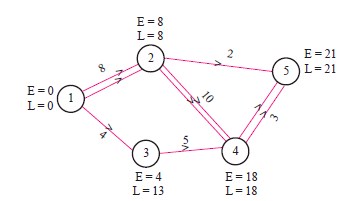
E1 = 0
E2 = E1 + t12 = 0 + 8 = 8
E3 = E1 + t13 = 0 + 4 = 4
E4 = E2 + t24 or E3 + t34 = 8 + 10 = 18
(take E2 + t24 or E3 + t34 whichever is maximum)
E5 = (E2 + t25 or E4 + t45) = 18 + 3 = 21
(take E2 + t25 or E4 + t45 whichever is maximum)
L5 = 21
L4 = L5 – t45 = 21 – 3 = 18
L3 = L4 – t34 = 18 – 5 = 13
L2 = L5 – t25 or L4 – t24 = 18 – 10 = 8
(take L5 – t25 or L4 – t24 whichever is minimum)
L1 = L2 – t12 or L3 - t13 = 8 – 8 = 0
(take L2 – t12 or L3 – t13 whichever is minimum)
Here the critical path is 1-2-4-5, which is denoted by double lines.
| Activity | Duration(tij) | EST | EFT=EST+tij | LST=LFT-tij | LFT |
| 1-2 | 8 | 0 | 8 | 0 | 8 |
| 1-3 | 4 | 0 | 4 | 9 | 13 |
| 2-4 | 10 | 8 | 18 | 8 | 18 |
| 2-5 | 2 | 8 | 10 | 19 | 21 |
| 3-4 | 5 | 4 | 9 | 13 | 18 |
| 4-5 | 3 | 18 | 21 | 18 | 21 |
The longest duration to complete this project is 21 days.
The path connected by the critical activities is the critical path(the longest path).
Critical path is 1-2-4-5 and project completion time is 21 days.
14.
LHS = cot x cot 2x - cot 2 x cot 3 x - cot 3x cot x
We have 3x = x + 2x
\(cot\quad 3x=\frac { cotx\quad cot2x-1 }{ cotx+cot2x } \) \(\left[ \therefore tan(A+B)=\frac { tanA+tanB }{ 1-tanAtanB } \right] \)
cross multiplying we get,
cot x cot 3x + cot 2x cot 3x = -1 + cot x cot 2x
\(\Rightarrow\) cot x cot 2x - cot 2x cot 3x - cot x cot 3x = 1
Hence proved
15.
Given y = ea cos-1 x ...(1)
Differentiating with respect to 'x' we get,
\({{dy}\over{dx}}={e}^{a\ {cos}^{-1}x}.{{d}\over{dx}}\left( a\ {\cos}^{-1}x \right)={e}^{a\ {cos}^{-1}x}.\left( {{-a}\over{\sqrt{1-{x}^{2}}}} \right)\)
\(={{-ay}\over{\sqrt{1-{x}^{2}}}}\) [ using (1) ]
\(\Rightarrow\sqrt{1-x^2}.{{dy}\over{dx}}=-ay\)
Squaring both sides we get,
\((1-x^2).{\left( {{dy}\over{dx}} \right)}^{2}=a^2y^2\)
Differentiating again with respect to 'x' we get,
\(\left( (1-x^2).2\left( {{dy}\over{dx}} \right)\left({{d^2y}\over{dx^2}} \right) +{\left({{dy}\over{dx}} \right)}^{2}(-2x)=a^2(2y)\left( {{dy}\over{dx}} \right) \right)\)
Dividing throughout by 2 \(\left({{dy}\over{dx}} \right)\) we get,
\((1-x^2).\left({{d^2y}\over{dx^2}} \right)-x\left( {{dy}\over{dx}} \right)=a^2 y\Rightarrow(1-x^2)\left( {{d^2y}\over{dx^2}} \right)-x\left( {{dy}\over{dx}} \right)-a^2y=0.\)
Hence proved.
16.
Let the 3 numbers be x, y and z.
Given x + y + z = 20
2x + y - z = 23
3x+ y + z = 46
It can be rewritten as
\(\begin{bmatrix} 1&1&1\\2&1&-1\\3&1&1 \end{bmatrix}\begin{bmatrix} x\\y\\z \end{bmatrix}=\begin{bmatrix} 20\\23\\46 \end{bmatrix}\)
\(\Rightarrow\) \(A X=B \Rightarrow X=A^{-1} B\)
Where \(A=\begin{bmatrix} 1&1& 1\\2&1&-1\\3&1&1 \end{bmatrix},X=\begin{bmatrix} x\\y\\z \end{bmatrix},B=\begin{bmatrix} 20\\23\\46 \end{bmatrix}\)
= 1 ( 1 + 1 ) - 1 ( 2 + 3 ) + 1 ( 2 - 3)
= 2 - 5 - 1 = 2 - 6 = - 4 \(\neq \) 0
\(\therefore\) A-1 exists.
\(\text {Co-factor matrix }=\left(\begin{array}{ccc} 2 & -5 & -1 \\ 0 & -2 & 2 \\ -2 & 3 & -1 \end{array}\right)\)
\(\therefore{A}^{-1}={{1}\over{|A|}}adj\ A={{-1}\over{4}}\begin{bmatrix} 2&0&-2\\-5&-2&3\\-1&2&-1 \end{bmatrix}\)
\(X={A}^{-1}B={{-1}\over{4}}\begin{bmatrix}2&0&-2\\5&-2&3\\-1&2&-1 \end{bmatrix}\begin{bmatrix} 20\\23\\46 \end{bmatrix}\)
\(= \begin{bmatrix} x\\y\\z \end{bmatrix},={{-1}\over{4}}\begin{bmatrix} 40+0-92\\-100-46+138\\-20+46-46 \end{bmatrix}={{-1}\over{4}}\begin{bmatrix} -5\\-8\\-20 \end{bmatrix}\)
\(X=\begin{bmatrix} 13\\2\\5 \end{bmatrix}\)
\(x=13, y=2, z=5\)
\(\therefore\) The 3 numbers are 13, 2 and 5.
17.
Given A = \(\left| \begin{matrix} 1 & a & b \\ 1 & c & a \\ 1 & b & c \end{matrix} \right| =0\)
Applying R2 \(\rightarrow\) R2-R1 and R3 \(\rightarrow\) R3 - R1
we get A = \(\left| \begin{matrix} 1 & a & b \\ 0 & c-a & a-b \\ 0 & b-a & c-b \end{matrix} \right| =0\)
Expanding along C1 we get
\(1\left| \begin{matrix} c-a & a-b \\ b-a & c-b \end{matrix} \right| =0\)
\(\Rightarrow\) (c - a) (c - b) - (b - a) (a - b) = 0
\(\Rightarrow\) c2 - bc - ac + ab - (ab - b2 - a2 + ab) = 0
\(\Rightarrow\) a2 + b2 + c2 - ab - bc - ca = 0
Multiplying both sides by 2 we get, 2a2 + 2b2 + 2c2 - 2ab - 2bc - 2ca = 0
\(\Rightarrow\) (a - b)2 + (b - c)2 + (c - a)2 = 0
\(\Rightarrow\) a = b = 0, b - c = 0,c - a = 0
\(\Rightarrow\) a = b = c
\(\Rightarrow\) \(\Delta\) ABC is equilateral.
\(\therefore A=B=C=\frac { \pi }{ 3 } \)
\(\therefore { sin }^{ 2 }A+{ sin }^{ 2 }B+{ sin }^{ 2 }C=3{ sin }^{ 2 }\frac { \pi }{ 3 } =3{ \left( sin\frac { \pi }{ 3 } \right) }^{ 2 }=3{ \left( \frac { \sqrt { 3 } }{ 2 } \right) }^{ 2 }=3\times \frac { 3 }{ 4 } =\frac { 9 }{ 4 } \)
18.
Given A = \(\begin{bmatrix}1 &3&3 \\1 &4&3\\1&3&4 \end{bmatrix} \)
\(A_{11}=\text {Cofactor of } 1=16-9=7\)
\(A_{12}=\text {Cofactor of } 3=-(4-3)=-1\)
\(A_{13}=\text {Cofactor of } 3=3-4=-1\)
\(A_{21}=\text {Cofactor of } 1=-(12-9)=-3 \)
\(A_{22}=\text {Cofactor of } 4=4-3=1 \)
\(A_{23}=\text {Cofactor of } 3=-(3-3)=0 \)
\( A_{31}=\text {Cofactor of } 1=9-12=-3 \)
\(A_{32}=\text {Cofactor of } 3=3-3=0 \)
\(A_{33}=\text {Cofactor of } 4=4-3=1\)
\(\text {Co-factor matrix }=\left(\begin{array}{ccc} 7 & -1 & -1 \\ -3 & 1 & 0 \\ -3 & 0 & 1 \end{array}\right)\)
A-1 = \(\begin{bmatrix} 7&-3&-3\\-1&1&0\\-1&0&1 \end{bmatrix}\)
\(|A| =1(16-9)-3(4-3)+3(3-4) \)
\(=7-3-3=1 \neq 0\)
\(\therefore \mathrm{A}^{-1} \text { exists }\)
\(\mathrm{A}(\operatorname{adj} \mathrm{A})=\left(\begin{array}{lll} 1 & 3 & 3 \\ 1 & 4 & 3 \\ 1 & 3 & 4 \end{array}\right)\left(\begin{array}{ccc} 7 & -3 & -1 \\ -1 & 1 & 0 \\ -1 & 0 & 1 \end{array}\right)\)
\(=\left(\begin{array}{lll} 7-3-3 & -3+3+0 & -3+0+3 \\ 7-4-3 & -3+4+0 & -3+0+3 \\ 7-3-4 & -3+3+0 & -3+0+4 \end{array}\right)\)
\(=\left(\begin{array}{lll} 1 & 0 & 0 \\ 0 & 1 & 0 \\ 0 & 0 & 1 \end{array}\right)=|A| I\)
\(=\mathrm{A}(\operatorname{adj} \mathrm{A})=|A| I\)
\(\mathrm{A}^{-1}=\frac{1}{|A|} \operatorname{adj} A=\left(\begin{array}{ccc} 7 & -3 & -3 \\ -1 & 1 & 0 \\ -1 & 0 & 1 \end{array}\right)\)
19.
\(A=\left(\begin{array}{ccc} 3 & -1 & 1 \\ -15 & 6 & -5 \\ 5 & -2 & 2 \end{array}\right)\)
\(|A|=3(12-10)+1(-30+25)+1(30-30)\)
\(=6-5=1 \neq 0\)
\(\therefore A^{-1} \text { exists }\)
\(\text {Co-factor matrix }=\left(\begin{array}{ccc} 2 & 5 & 0 \\ 0 & 1 & 1 \\ -1 & 0 & 3 \end{array}\right)\)
\(A^{-1}=\frac{1}{|A|} \operatorname{adj} A=\left(\begin{array}{ccc} 2 & 0 & -1 \\ 5 & 1 & 0 \\ 0 & 1 & 3 \end{array}\right)\)
20.
\(\frac{x+2}{(x-1)(x+3)^2}=\frac{A}{(x-1)}+\frac{B}{(x+3)}+\frac{C}{(x+3)^2}\)
\(=\frac{A(x+3)^2+B(x-1)(x+3)+C(x-1)}{(x-1)(x+3)^2}\)
\(\Rightarrow\) x + 2 = A ( x + 3 )2 + B ( x - 1 ) ( x + 3 ) + C( x - 1 ) ....(1)
Putting x = 1 in (1) we get,
\(3=A(4)^2 \Rightarrow A=\frac{3}{16}\)
Putting x = -3 in (1) we get
\(-1=C(-3-1)\)
\(C=\frac{1}{4}\)
Equate co-efficient of x2 on both sides of (1)
\(0 =A+B \Rightarrow B=-A=\frac{-3}{16} \)
\(\frac{x+2}{(x-1)(x+3)^2} =\frac{3}{16(x-1)}-\frac{3}{16(x+3)}+\frac{1}{4(x+3)^2}\)

11th Standard Syllabus & Materials
11th Standard
TN 11th Tamil பீடு பெற நில் - செய்யுள் - காவடிச்சிந்து Important Questions And Answers Study Material - QB365 Set A
NEW11th Standard
TN 11th Tamil பீடு பெற நில் - உரைநடை - மலை இடப்பெயர்கள் : ஓர் ஆய்வு Important Questions And Answers Study Material - QB365 Set A
NEW11th Standard
TN 11th Tamil மாமழை போற்றுதும் - துணைப்பாடம் - யானை டாக்டர் Important Questions And Answers Study Material - QB365 Set A
NEW11th Standard
TN 11th Tamil மாமழை போற்றுதும் - செய்யுள் - ஐங்குறுநூறு Important Questions And Answers Study Material - QB365 Set A



Tamilnadu Stateboard 11th Standard Subjects

Maths

Commerce

Economics

Biology
Business Maths and Statistics

Accountancy

Computer Science

Physics

Chemistry
Maths
Biology
Economics
Physics
Chemistry

History
Business Maths and Statistics

Computer Science
Accountancy

Computer Applications
History
Computer Technology
Commerce
Computer Applications
Computer Technology

Tamil

English

French
Tamilnadu Stateboard Standards
