
 100% FREE ACCESS
11th Standard Syllabus & Materials
11th Standard
TN 11th Tamil இயற்கை வேளாண்மை,சுற்றுச்சூழல் -செய்யுள் - மனோன்மணீயம் Important Questions And Answers Study Material - QB365 Set A
NEW11th Standard
TN 11th Tamil என்னுயிர் என்பேன் -துணைப்பாடம் - இசைத்தமிழர் இருவர் Important Questions And Answers Study Material - QB365 Set A
NEW11th Standard
TN 11th Tamil மொழி கலை -செய்யுள் - ஒவ்வொரு புல்லையும் Important Questions And Answers Study Material - QB365 Set A
NEW11th Standard
TN 11th Tamil பீடு பெற நில் - இலக்கணம் - பகுபத உறுப்புகள் Important Questions And Answers Study Material - QB365 Set A
NEW11th Standard
TN 11th Tamil பீடு பெற நில் - துணைப்பாடம் - வாடிவாசல் Important Questions And Answers Study Material - QB365 Set A
NEW11th Standard
TN 11th Tamil பீடு பெற நில் - செய்யுள் - குறுந்தொகை Important Questions And Answers Study Material - QB365 Set A

Published on: 21/01/2020
Download Tamil Nadu 11th Standard Business Maths and Statistics question papers, model tests, one-mark questions, important questions, and public exam papers in PDF format. Free study materials and answer keys for TN State Board students.
Questions + Answers key
Take MCQ Business Maths and Statistics Test
1.
The technology matrix of an economic system of two industries is \(\left[ \begin{matrix} 0.8 & 0.2 \\ 0.9 & 0.7 \end{matrix} \right] \) Test whether the system is viable as per Hawkins – Simon conditions.
2.
Find the mean deviation about the mean of the following observations 2, 3, 5, 6, 9, 10, 12, 17, 20, 26 and n = 10
3.
Solve the following LPP graphically. Maximize Z =−x1 + 2x2
Subject to the constraints −x1 + 3x2 ≤ 10, x1 + x2 ≤ 6,x1 − x2 ≤ 2 and x1,x2 ≥ 0
4.
If I deposit Rs.500 every year for a period of 10 years in a bank which gives C.I. 5% per year, find out the amount I will receive at the end of 10 years.
5.
Find the probability of drawing a one-rupee coin from a purse with two compartments one of which contains 3 fifty-paise coins and 2 one-rupee coins and other contains 2 fifty paise coins and 3 one-rupee coins.
6.
Calculate the co-efficient of correlation between x and y on the basis of the following observations. \(\sum\)x=125, \(\sum\)x2=1650, \(\sum\)y=100, \(\sum\)y2=1460, \(\sum\)xy=50, n=25.
7.
Calculate Quartile deviation and Coefficient of Quartile deviation of the following data.
| Marks: | 0 | 10 | 20 | 30 | 40 | 50 | 60 | 70 |
| No. of students: | 150 | 142 | 130 | 120 | 72 | 30 | 12 | 4 |
8.
X speaks truth 4 out of 5 times. A die is thrown. He reports that there is a six. What is the chance that actually there was a six?
9.
A bank pays 8% per annum interest compounded quarterly. Find the equal deposits to be made at the end of each quarter for 10 years to have Rs. 30,200? [(1.02)40 = 2.2080]
10.
From the following data compute the value of Harmonic Mean.
| Marks | 10 | 20 | 30 | 40 | 50 |
| No. of students | 20 | 30 | 50 | 15 | 5 |
11.
Calculate the value of Q1, Q3, D6 and P50 from the following data
| Roll No | 1 | 2 | 3 | 4 | 5 | 6 | 7 |
| Marks | 20 | 28 | 40 | 12 | 30 | 15 | 50 |
12.
Draw a network diagram for the project whose activities and their predecessor relationships are given below:
| Activity: | A | B | C | D | E | F | G | H | I | J | K |
| Predecessor activity: | - | - | - | A | B | B | C | D | F | H,I | F,G |
13.
A company is producing three products P1, P2 and P3, with profit contribution of Rs.20, Rs.25 and Rs.15 per unit respectively. The resource requirements per unit of each of the products and total availability are given below.
| Product | P1 | P2 | P3 | Total availability |
| Man hours/unit | 6 | 3 | 12 | 200 |
| Machine hours/unit | 2 | 5 | 4 | 350 |
| Material/unit | 1kg | 2kg | 1kg | 100kg |
Formulate the above as a linear programming model.
14.
Differentiate: \(\sin ^{ -1 }{ \left( \sqrt { \cos { x } } \right) } \)
15.
Find the equation of the circle which touches the line x = 0, y = 0 and x = a.
16.
Let p(n) be the statement "n2 + n is even". If p(k) is true, then show that P(k+1) is true.
17.
Using co-factors of elements of second column evaluate \(\left| \begin{matrix} 6 & -1 & 5 \\ 3 & 0 & 4 \\ -2 & 7 & -3 \end{matrix} \right| \)
18.
Prove that \(\left| \begin{matrix} x & sin\theta & cos\theta \\ -sin\theta & -x & 1 \\ cos\theta & 1 & x \end{matrix} \right| \) is independent of \(\theta\)
19.
Without actual expansion show that the value of the determinant \(\begin{vmatrix}5 &5^2 &5^3 \\5^2 & 5^3 & 5^4\\5^4&5^5&5^6 \end{vmatrix}\)is zero.
20.
Evaluate: \(\begin{bmatrix} 3&-2&4\\2&0&1\\1&2&3 \end{bmatrix}\)
1.
B = \(\left[ \begin{matrix} 0.8 & 0.2 \\ 0.9 & 0.7 \end{matrix} \right] \)
I - B=\(\left[ \begin{matrix} 1 & 0 \\ 0 & 1 \end{matrix} \right] \)-\(\left[ \begin{matrix} 0.8 & 0.2 \\ 0.9 & 0.7 \end{matrix} \right] \)
=\(\left[ \begin{matrix} 0.2 & -0.2 \\ - 0.9 & 0.3 \end{matrix} \right] \)
|I - B|= \(\left[ \begin{matrix} 0.2 & -0.2 \\ - 0.9 & 0.3 \end{matrix} \right] \)
= (0.2)(0.3) - (-0.2)(-0.9)
= 0.06 - 0.18
= 0.12 < 0
Since |I - B| is negative, Hawkins – Simon conditions are not satisfied.
Therefore, the given system is not viable.
2.
Mean \(\bar { x } =\frac { 2+3+5+6+9+10+12+17+20+26 }{ 10 } \)
\(=\frac { 110 }{ 10 } =11\)
| x | |D|=|x-\(\bar { x } \)| = |x-11| |
|---|---|
| 2 | 9 |
| 3 | 8 |
| 5 | 6 |
| 6 | 5 |
| 9 | 2 |
| 10 | 1 |
| 12 | 1 |
| 17 | 6 |
| 20 | 9 |
| 26 | 15 |
| \(\sum { |D|=62 } \) |
\(\therefore \) Mean deviation from mean = \(\frac { \sum { |D| } }{ n } =\frac { 62 }{ 10 } =6.2\)
3.
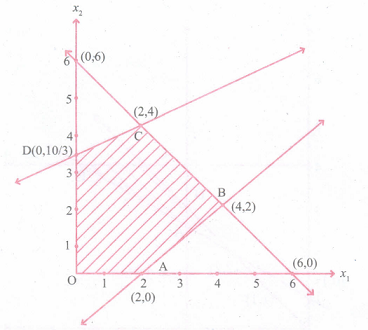
Since the decision variables x1 ,x2 are non-negative, the solution lies in the I quadrant of the plane.
Consider the equations
\(-{ x }_{ 1 }+3{ x }_{ 2 }=10\)
| \({ x }_{ 1 }\) | 0 | 2 |
|---|---|---|
| \({ x }_{ 2 }\) | 10/3 | 4 |
\({ x }_{ 1 }+{ x }_{ 2 }=6\)
| \({ x }_{ 1 }\) | 0 | 6 |
|---|---|---|
| \({ x }_{ 2 }\) | 6 | 6 |
\({ x }_{ 1 }{ -x }_{ 2 }=2\)
| \({ x }_{ 1 }\) | 4 | 2 |
|---|---|---|
| \({ x }_{ 2 }\) | 2 | 0 |
The feasible region is OABCD and its co-ordinates are O(0, 0)A(2, 0) B(4, 2) C(2, 4) and D(0, 10/3)
| Corner Points | \(Z=-{ x }_{ 1 }+2{ x }_{ 2 }\) |
|---|---|
| 0(0,0) | 0 |
| A(2, 0) | -2 |
| B (4, 2) | 0 |
| C(2,4) | 6 |
| D\(\left( 0,\frac { 10 }{ 3 } \right) \) | \(\frac { 20 }{ 3 } \) |
Maximum of Z occurs at\(D\left( 0,\frac { 10 }{ 3 } \right) \). Hence, the solution is \({ x }_{ 1 }=0,{ x }_{ 2 }=\frac { 10 }{ 3 } \quad and\quad { Z }_{ max }=\frac { 20 }{ 3 } \)
4.
Given a = Rs.500,i = 5% = 0.05,n =10
A =\(\cfrac { a }{ i } \left( 1+i \right) \left[ \left( 1+i \right) ^{ n }-1 \right] \)
\(=\frac { 500 }{ 0.05 } (1.05)\left[ (1.05)^{ 10 }-1 \right] \)
\(=10,500[1.629-1]\)
\(=10,500(0.629)\)
\(\therefore\) = Rs. 6604.50
At the end of 10 years, I will receive Rs. 6604.50.
\((1.05)^{ 10 }=10log(1.05)\)
\(=0.2120\)
Antilog of 0.2120 is 1.629
5.
Let E1 = the first compartment of the purse is chosen
E2 = the second compartment of the purse is chosen
A = a rupee coin is drawn from the purse.
Since one of the two compartments is chosen randomly
\(P({ E }_{ 1 })=\frac { 1 }{ 2 } =P({ E }_{ 2 })\)
Also, P(A/E1) = P(Drawing a rupee coin from the I compartment) = \(\frac { 2 }{ 5 } \)
P(A/E2) = P(Drawing a rupee coin from the II compartment) = \(\frac { 3 }{ 5 } \)
\(\therefore\) By the law of total probability,
P(drawing a one-rupee coin) = P(A) = P(E1).P(A/E1)+P(E2).P(A/E2)
\(=\frac { 1 }{ 2 } \times \frac { 2 }{ 5 } +\frac { 1 }{ 2 } \times \frac { 3 }{ 5 } =\frac { 2 }{ 10 } +\frac { 3 }{ 10 } =\frac { 5 }{ 10 } =\frac { 1 }{ 2 } \)
6.
Correlation co-efficient
r(X, Y) =\(\frac { N\sum { XY-(\sum { X)(\sum { Y) } } } }{ \sqrt { n\sum { { X }^{ 2 }-{ (\sum { X) } }^{ 2 } } } \sqrt { n\sum { { Y }^{ 2 }-({ \sum { Y) } }^{ 2 } } } } \)
=\(\frac { 25(50)-(125)(100) }{ \sqrt { (1650)(25)-{ (125) }^{ 2 } } \sqrt { (1460)(25)-{ (100) }^{ 2 } } } \)
=\(\frac { -450 }{ \sqrt { 1125\sqrt { 1060 } } } \)
r =-0.41
7.
| x | f | c.f |
| 0 | 150 | 150 |
| 10 | 142 | 292 |
| 20 | 130 | 422 |
| 30 | 120 | 542 |
| 40 | 72 | 614 |
| 50 | 30 | 644 |
| 60 | 12 | 656 |
| 70 | 4 | 660 |
| N = 660 |
Q1 = Size of \({ \left( \frac { N+1 }{ 4 } \right) }^{ th }\) value
= Size of (165.25)th value = 10
Q3 = Size of 3\({ \left( \frac { N+1 }{ 4 } \right) }^{ th }\)value
= size of (495.75)th value = 30
Q.D = \(\frac { 1 }{ 2 } ({ Q }_{ 3 }-{ Q }_{ 1 })=\frac {30-10}{2}=\frac { 20 }{ 2 } =10\)
Co-efficient of Q.D = \(\frac { { Q }_{ 3 }-{ Q }_{ 1 } }{ { Q }_{ 3 }+{ Q }_{ 1 } } =\frac { 20 }{ 40 } =\frac { 1 }{ 2 } \) = 0.5
8.
Let us define the following events.
E1: X speaks truth
E2: X tells a lie
E: X reports a six
From the data given in the problem, we have
P(E1) = \(\frac{4}{5}\); P(E2) = \(\frac{1}{5}\);
P(E/E1) = \(\frac{1}{6}\); P(E/E2) = \(\frac{5}{6}\)
The required probability that actually there was six (by Bayes theorem) is
\(P(E_1/E)=\frac{P(E_1)P(E/E_2)}{P(E_1)P(E/E_1)+P(E_2)P(E/E_2)}\) = \(\frac{\frac{4}{5}\times \frac{1}{6}}{(\frac{4}{5}\times \frac{1}{6})+(\frac{1}{5}\times \frac{5}{6})}=\frac{4}{9}\)
9.
A = 30,200 i = \(\frac{8}{400}\) = 0.02, n = 10 x 4 = 40
A = \(\cfrac { a }{ i } \left[ \left( 1+i \right) ^{ n }-1 \right] \)
30,200 \( =\cfrac { a }{ 0.02 } \left[ \left( 1.02 \right) ^{ 40 }-1 \right] \)
30,200 x 0.02 = a[2.2080-1]
a = \(\cfrac { 604 }{ 1.2080 } \) = Rs. 500
10.
Calculation of Harmonic Mean
| Marks X |
No. of Students f |
\(\frac{f}{x}\) |
| 10 | 20 | 2.000 |
| 20 | 30 | 1.500 |
| 25 | 50 | 2.000 |
| 40 | 15 | 0.375 |
| 50 | 5 | 0.100 |
| N = 120 | \(\sum { \left( \frac { 1 }{ X } \right) } \)= 5.975 |
\(HM=\frac { n }{ \sum { \left( \frac { f }{ X } \right) } } =\frac {120 }{ 5.975 } =20.08\)
11.
Marks are arranged in ascending order
12 15 20 28 30 40 50
n = number of observations = 7
Q1 = Size of \(\left( \frac { n+1 }{ 4 } \right) ^{th}\) value
= Size of \(\left( \frac { 7+1 }{ 4 } \right) ^{th}\) value
= Size of 2nd value = 15
Q3 = Size of \(\left( \frac { 3(n+1) }{ 4 } \right) ^{th}\) value
= Size of \(\\ \left( \frac { 3\times 8 }{ 4 } \right) ^{th}\) value
= Size of 6th value = 40
D6 = Size of \(\left( \frac { 6(n+1) }{ 10 } \right) \)th value
= Size of \(\\ \left( \frac { 6\times 8 }{ 10 } \right) ^{th}\) value
= Size of 4.8th value
= Size of 5th value = 30
P50 = Size of \(\left( \frac {50(n+1) }{ 100 } \right) ^{th}\) value
= Size of 4th value = 28
Hence Q1 = 15, Q3 = 40, D6 = 30 and P50 = 28
12.
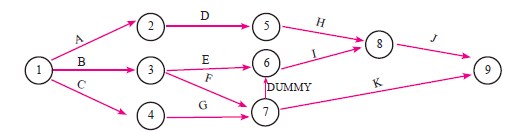
Using the precedence relationships and following the rules of network construction, the required network diagram is shown in following figure.
13.
(i) Variables: Let x1, x2 and x3 be the number of units of products P1, P2 and P3 to be produced.
(ii) Objective function: Profit on x1 units of the product P1 = 20 x1
Profit on x2 units of the product P2 = 25 x2
Profit on x3 units of the product P3 = 15 x3
Total profit = 20 x1 + 25 x2 + 15 x3
Since the total profit is to be maximized, we have to maximize Z = 20 x1 + 25 x2 + 15 x3
Constraints: 6x1 + 3x2 + 12x3 ≤ 200
2x1 + 5x2 + 4x3 ≤ 350
x1 + 2x2 + x3 ≤ 100
Non-negative restrictions: Since the number of units of the products A, B and C cannot be negative, we have x1, x2, x3 ≥ 0
Thus, we have the following linear programming model.
Maximize Z = 20 x1 + 25 x2 + 15 x3
Subject to 6 x1 + 3 x2 + 12 x3 ≤ 200
2x1 + 5x2 + 4x3 ≤ 350
x1 + 2x2 + x3 ≤ 100
x1, x2, x3 ≥ 0
14.
\(y=\sin ^{ -1 }{ \left( \sqrt { \cos { x } } \right) } \)
Differentiating with respect to 'x' we have
\(\frac { dy }{ dx } =\frac { d }{ dx } .\sin ^{ -1 }{ { \left( \cos { x } \right) }^{ \frac { 1 }{ 2 } } } =\frac { 1 }{ \sqrt { 1-{ \left( \sqrt { \cos { x } } \right) }^{ 2 } } } .\frac { d }{ dx } { \left( \cos { x } \right) }^{ \frac { 1 }{ 2 } }\)
\(=\frac { 1 }{ \sqrt { 1-\cos { x } } } .\frac { 1 }{ 2\sqrt { 1-\cos { x } } } .\frac { d }{ dx } \left( \cos { x } \right) \)
\(=\frac { 1 }{ 2\sqrt { \cos { x } } .\sqrt { 1-\cos { x } } } \left( -\sin { x } \right) =\frac { -\sin { x } }{ 2\sqrt { \cos { x } } .\sqrt { 1-\cos { x } } } \)
15.
The circle touches the coordinate axes and the line x = a is shown in the diagram.
\(\therefore \ centre\ is\ \left( \frac { a }{ 2 } ,\frac { a }{ 2 } \right) and\ r=\frac { a }{ 2 } \)
\(\therefore\) There may be two such circles, one lying
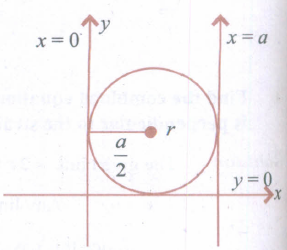
above X-axis and other below X-axis.
Equation of the circle lying above the X-axis is
\({ \left( x-\frac { a }{ 2 } \right) }^{ 2 }+{ \left( y+\frac { a }{ 2 } \right) }^{ 2 }={ \left( \frac { a }{ 2 } \right) }^{ 2 }\)
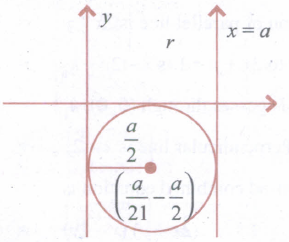
Equation of the circle lying below the X-axis is \({ \left( x-\frac { a }{ 2 } \right) }^{ 2 }+{ \left( y+\frac { a }{ 2 } \right) }^{ 2 }={ \left( \frac { a }{ 2 } \right) }^{ 2 }\)
16.
P(n): "n2 + n is even"
Given that P(k) is true.
\(\Rightarrow \) k2 + k is even
\(\Rightarrow \) k2 + k = 2\(\lambda \) for some \(\lambda \) ....(1)
To prove that P (k + 1) is true.
P (k + 1) : (k + 1)2+ (k + 1) is even
Consider (k + 1)2 + (k + 1)
= k2+2k+ 1 +k+ 1
= k2+2k+ 1 +k+ 1
= (k2+ k) + (2 k + 2)
= 2\(\lambda \) + 2 (k + 1) [from (1)]
= even + even
= Sum of two even numbers is always an even number .
∴ P (k + 1) is true.
17.
Let \(\triangle=\begin{vmatrix} 6&-1&5\\3&0&4\\-2&7&-3 \end{vmatrix}\)
Now M12 = \(\begin{vmatrix} 3&4\\-2&-3 \end{vmatrix}=-9-(-8)=-1\)
M22 = \(\begin{vmatrix} 6&5\\-2&-3 \end{vmatrix}=-18-(-10)=-8\)
M32 = \(\begin{vmatrix} 6&5\\3&4 \end{vmatrix}=24-15=9\)
Now expansion of |A| using co-factors of elements of second column we get,
|A| = a12 A12 + a21 A21 + a31A31
A12 = (-1)1 + 2 M12 (-1) (-1) = 1
A22 = (-1)2 + 2 M22 = 1(-8) = -8
A32 = (-1)3 + 2 M32 = -(9) = -9
\(\therefore\) |A| = -1(1) + 0(-8) + 7(-9) = -1 - 63 = -64.
18.
Let A = \(\left| \begin{matrix} x & sin\theta & cos\theta \\ -sin\theta & -x & 1 \\ cos\theta & 1 & x \end{matrix} \right| \)
Expanding along R1 we get
|A| = x\(\left| \begin{matrix} -x & 1 \\ 1 & x \end{matrix} \right| -sin\theta \left| \begin{matrix} -sin\theta & 1 \\ cos\theta & x \end{matrix} \right| +cos\theta \begin{vmatrix} -sin\theta & -x \\ cos\theta & 1 \end{vmatrix}\)
= x(-x2 - 1) - sin \(\theta\) (-x sin \(\theta\) - cos \(\theta\)) + cos \(\theta\) (-sin \(\theta\) + x cos \(\theta\))
\(=-x^{ 3 }-x+xsin^{ 2 }\theta +sin\theta cos\theta +xcos^{ 2 }\theta \)
= -x3 - x + x(sin2\(\theta\) + cos2\(\theta\))
= -x3 - x + x(1) [\(\because\) sin2\(\theta\) + cos2\(\theta\) ] = -1
= -x3 which is independent of \(\theta\)
19.
\(=\left|\begin{array}{ccc} 5 & 5^2 & 5^3 \\ 5^2 & 5^3 & 5^4 \\ 5^4 & 5^5 & 5^6 \end{array}\right|\)
Taking 5 and 52 common from R1 and R2
\(5 \times 5^2\left|\begin{array}{ccc} 1 & 5 & 5^2 \\ 1 & 5 & 5^2 \\ 5^4 & 5^5 & 5^6 \end{array}\right|=0\left(\text {Since } R_1=R_2\right)\)
20.
\(\left|\begin{array}{ccc} 3 & -2 & 4 \\ 2 & 0 & 1 \\ 1 & 2 & 3 \end{array}\right|=3[0-2]+2[6-1]+4[4-0]\)
\(=-6+10+16=20\)

11th Standard Syllabus & Materials
11th Standard
TN 11th Tamil பீடு பெற நில் - செய்யுள் - காவடிச்சிந்து Important Questions And Answers Study Material - QB365 Set A
NEW11th Standard
TN 11th Tamil பீடு பெற நில் - உரைநடை - மலை இடப்பெயர்கள் : ஓர் ஆய்வு Important Questions And Answers Study Material - QB365 Set A
NEW11th Standard
TN 11th Tamil மாமழை போற்றுதும் - துணைப்பாடம் - யானை டாக்டர் Important Questions And Answers Study Material - QB365 Set A
NEW11th Standard
TN 11th Tamil மாமழை போற்றுதும் - செய்யுள் - ஐங்குறுநூறு Important Questions And Answers Study Material - QB365 Set A



Tamilnadu Stateboard 11th Standard Subjects

Maths

Commerce

Economics

Biology
Business Maths and Statistics

Accountancy

Computer Science

Physics

Chemistry
Maths
Biology
Economics
Physics
Chemistry

History
Business Maths and Statistics

Computer Science
Accountancy

Computer Applications
History
Computer Technology
Commerce
Computer Applications
Computer Technology

Tamil

English

French
Tamilnadu Stateboard Standards
