
 100% FREE ACCESS
11th Standard Syllabus & Materials
11th Standard
TN 11th Tamil இயற்கை வேளாண்மை,சுற்றுச்சூழல் -செய்யுள் - மனோன்மணீயம் Important Questions And Answers Study Material - QB365 Set A
NEW11th Standard
TN 11th Tamil என்னுயிர் என்பேன் -துணைப்பாடம் - இசைத்தமிழர் இருவர் Important Questions And Answers Study Material - QB365 Set A
NEW11th Standard
TN 11th Tamil மொழி கலை -செய்யுள் - ஒவ்வொரு புல்லையும் Important Questions And Answers Study Material - QB365 Set A
NEW11th Standard
TN 11th Tamil பீடு பெற நில் - இலக்கணம் - பகுபத உறுப்புகள் Important Questions And Answers Study Material - QB365 Set A
NEW11th Standard
TN 11th Tamil பீடு பெற நில் - துணைப்பாடம் - வாடிவாசல் Important Questions And Answers Study Material - QB365 Set A
NEW11th Standard
TN 11th Tamil பீடு பெற நில் - செய்யுள் - குறுந்தொகை Important Questions And Answers Study Material - QB365 Set A

Published on: 21/01/2020
Download Tamil Nadu 11th Standard Business Maths and Statistics question papers, model tests, one-mark questions, important questions, and public exam papers in PDF format. Free study materials and answer keys for TN State Board students.
Questions + Answers key
Take MCQ Business Maths and Statistics Test
1.
If x = \(a\ \theta\) and \(y=\frac{a}{\theta}\), then prove that \(\frac{dy}{dx}+\frac{y}{x}=0\)
2.
If three angles A, B and C are in arithmetic progression, Prove that \(cotB=\frac { sinA-sinC }{ cosC-cosA } \)
3.
Using multiple angle identity, find tan60o
4.
Find the values of A and B if \(\frac { 1 }{ \left( { x }^{ 2 }-1 \right) } =\frac { A }{ x-1 } +\frac { B }{ x+1 } \)
5.
Evaluate: \(\left| \begin{matrix} 1 & 2 & 4 \\ -1 & 3 & 0 \\ 4 & 1 & 0 \end{matrix} \right| \)
6.
A retired person has Rs. 70,000 to invest and two types of bonds are available in the market for investment. First type of bond yields an annual income of 8% on the amount invested and the second type yields 10% per annum. As per norms, he has to invest a minimum of Rs. 10,000 in the first type and not more than Rs.30,000 in the second type. How should he plan his investment, so as to get maximum returns after one year of investment? Formulate the above as LPP.
7.
A toy company manufactures two types of dolls A and B. Market tests and available resources have indicated that the combined production level should not exceed 1200 dolls per week and the demand for dolls of type B is atmost half of that for dolls of type A. Further, the production level of dolls of type A can exceed three times the production of dolls of other type by at most 600 units. If the company makes profit of n2 and n6 per doll, how many of each should be produced weekly in order to maximize the profit. Formulate the above as mathematical LPP.
8.
If f(x,y) = 3x2 + 4y3 + 6xy - x2y3 + 6. Find fx(1, -1)
9.
Find the first quartile and third quartile for the given observations
2, 4, 6, 8, 10, 12, 14, 16, 18, 20, 22
10.
The total cost function for the production of x units of an item is given by c = 10 - 4x3 + 3x4 find the (i) average cost function (ii) marginal cost function (iii) marginal average cost fuction.
11.
The following table shows the sales and advertisement expenditure of a form
| Title | Sales | Advertisement expenditure(Rs.Cross) |
| Mean | 40 | 6 |
| SD | 10 | 1.5 |
Coefficient of correlation r = 0.9. Estimate the likely sales for a proposed advertisement expenditure of Rs. 10 crores.
12.
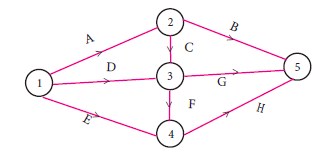
Draw the network for the project whose activities with their relationships are given below:
Activities A, D, E can start simultaneously; B, C > A; G, F > D, C; H > E, F.
13.
Prove that : \(\frac { \cos 2A-\cos 3A }{ \sin 2A-\sin 3A } =\tan\frac { A }{ 12 } \)
14.
Prove that the function given by f(x) = \(\left| x-1 \right| \), x \(\in\) R is not differentiable at x =1
15.
Find the values of the following sin 76o cos 16o + cos 76o sin 16o
16.
Convert the equation of the parabola x2+y=6x-14 into the standard form.
17.
Differentiate the following with respect to x \(\frac { 5 }{ { x }^{ 4 } } -\frac { 2 }{ { x }^{ 3 } } +\frac { 5 }{ x } \)
18.
Find the number of diagonals that can be drawn by joining the vertices of octagon?
19.
Find the cartesian equation of the circle whose parametric equations are x = 3 cos\(\theta\), y = 3 sin\(\theta,\) \(0\le \theta \le 2\pi \)
20.
Resolve into partial fractions :\(\frac { 12x-17 }{ (x-2)(x-1) } \)
21.
Find the values of x if \(\begin{vmatrix} 2 & 4 \\5 & 1 \end{vmatrix}=\begin{vmatrix} 2x & 4\\6 & x \end{vmatrix}.\)
22.
If A \(=\begin{bmatrix} 1 \\ -4\\3 \end{bmatrix}\) and B = [-1 2 1], verify that (AB)T = BT. AT
23.
Determine whether the following functions are odd or even?
\(f(x)=\left( \frac { { a }^{ x }-1 }{ { a }^{ x }+1 } \right) \)
24.
The technology matrix of an economic system of two industries is\(\begin{bmatrix} 0.50 & 0.30 \\ 0.41 & 0.33 \end{bmatrix}\). Test whether the system is viable as per Hawkins-Simon conditions.
25.
Resolve into partial fractions for the following : \(\frac{4 x+1}{(x-2)(x+1)}\)
1.
\(x=a\theta \)
\(\cfrac {dx }{ d\theta } =a\)
\(y=\cfrac { a }{ \theta } \)
\(\cfrac {dy }{ d\theta } =\cfrac { -a }{ { \theta }^{ 2 } } \)
\(\cfrac { dy }{ dx } =\cfrac { \frac { dy }{ d\theta } }{ \frac { dx }{ d\theta } } \)
\(=\cfrac { \left( \frac { -\alpha }{ { \theta }^{ 2 } } \right) }{ a } \)
\(=\cfrac { 1 }{ { \theta }^{ 2 } } \)
\(-\cfrac { y }{ x } \)
i.e.,\(\cfrac { dy }{ dx } +\cfrac { y }{ x } =0\)
Aliter :
Take \(xy=a\theta .\cfrac { a }{ \theta } \)
xy = a2
Differentiating with respect to x,
\(x\cfrac { dy }{ dx } +y=0\)
\( \cfrac { dy }{ dx } +\cfrac { y }{ x } =0\)
2.
\(\frac{\sin A-\sin C}{\cos C-\cos A} =\frac{2 \sin \left(\frac{A-C}{2}\right) \cos \left(\frac{A+C}{2}\right)}{2 \sin \left(\frac{A+C}{2}\right) \sin \left(\frac{A-C}{2}\right)}\)
\(=\frac{\cos \left(\frac{A+C}{2}\right)}{\sin \left(\frac{A+C}{2}\right)}=\cot \left(\frac{A+C}{2}\right)=\cot B\text { (since } A, B, C \text { are in } A . P ., B=\frac{A+C}{2} \text { ) }\)
3.
\(\tan2A=\cfrac { 2\tan A }{ 1-{ \tan }^{ 2 }A } \)
Put A = 30o in the above identity, we get
\({ \tan60 }^{ o }=\cfrac { 2\tan{ 60 }^{ o } }{ 1-{ \tan }^{ 2 }{ 30 }^{ o } } \)
= \(\cfrac { 2-\frac { 1 }{ \sqrt { 3 } } }{ 1-\frac { 1 }{ 3 } } =\cfrac { \frac { 2 }{ \sqrt { 3 } } }{ \frac { 2 }{ 3 } } =\cfrac { 2 }{ \sqrt { 3 } } \times \cfrac { 3 }{ 2 } =\sqrt { 3 } \)
4.
Let \(\frac { 1 }{ \left( { x }^{ 2 }-1 \right) } =\frac { A }{ x-1 } +\frac { B }{ x+1 } \)
Multiplying both sides by (x - 1)(x + 1), we get
1 = A(x +1) + ( Bx -1) ... (1)
Put x =1 in (1) we get, 1 = A(2)
\(\therefore\) A = \(\frac{1}{2}\)
Put x = -1 in (1) we get, 1 = A(0) + B(-2)
\(\therefore\) B = - \(\frac{1}{2}\)
5.
\(\left| \begin{matrix} 1 & 2 & 4 \\ -1 & 3 & 0 \\ 4 & 1 & 0 \end{matrix} \right| \) = 1 (Minor of 1) –2 (Minor of 2) + 4 (Minor of 4)
\(=1\left| \begin{matrix} 3 & 0 \\ 1 & 0 \end{matrix} \right| -2\left| \begin{matrix} -1 & 0 \\ 4 & 0 \end{matrix} \right| +4\left| \begin{matrix} -1 & 3 \\ 4 & 1 \end{matrix} \right| \)
= 0 – 0 – 52 = –52.
6.
(i) Variables:
Let x1, x2 represents the first and second type of bonds respectively.
(ii) Objective function:
Let Z be the maximum return
\(\therefore \quad Z=\frac { 8 }{ 100 } { x }_{ 1 }+\frac { 10 }{ 100 } { x }_{ 2 } \Rightarrow Z=0.08{ x }_{ 1 }+0.1{ x }_{ 2 }\)
(iii) Constraints:
\({ x }_{ 1 }+{ x }_{ 2 } \le 70,000\)
\({ x }_{ 1 } \ge 10,000\)
\( { x }_{ 2 } \le 30,000\)
(iv) Non-negative restrictions:
Since the number of first and second type of bonds cannot be negative,x1, x2 ≥ 0.
Hence, the mathematical formulation of the LPP is maximize \(Z=0.08{ x }_{ 1 }+0.1{ x }_{ 2 }\)
Subject to the constraints
\({ x }_{ 1 }+{ x }_{ 2 } \le 70,000\)
\( { x }_{ 1 }\ge 10,000\)
\({ x }_{ 2 }\le 30,000\)
and x1, x2 ≥ 0.
7.
(i) Variables:
Let x1, x2 represent the dolls of A and B produced in a week.
(ii) Objective function:
Let Z be the total profit in a week.
\(\therefore Z={ 12x }_{ 1 }+16{ x }_{ 2 }\)
Since we have to maximize the profit, we have maximize \(Z={ 12x }_{ 1 }+16{ x }_{ 2 }\)
(iii) Constraints:
\({ x }_{ 1 }+{ x }_{ 2 } \le 2000\)
\({ x }_{ 1 }-{ 2x }_{ 2 }\ge 0\)
\( { x }_{ 1 }-{ 3x }_{ 2 }\le 600\)
(iv) Non-negative restictions:
Since the number of dolls on type A and B cannot be negative, we have \({ x }_{ 1 },{ x }_{ 2 }\ge 0\)
Hence, the mathematical formation of LPP is
Maximize \(Z={ 12x }_{ 1 }+16{ x }_{ 2 }\)
Subject to the constraints
\({ x }_{ 1 }+{ x }_{ 2 } \le 2000\)
\({ x }_{ 1 }-{ 2x }_{ 2 }\ge 0\)
\( { x }_{ 1 }-{ 3x }_{ 2 }\le 600\)
and x1, x2 ≥ 0.
8.
Given f(x, y) =3x2+4y3+6xy-x2y3+6
Differentiating partially w.r.t. 'x' we get,
fx(x, y)=6x + 0 + 6y(1) -y3(2x) + 0
=6x + 6y- 2xy3
\(\therefore f_x(1,-1)=\) 6(1) +6(-1)-2(1)(-1)3
= 6-6+2
= 2
9.
Arranging in ascending order
2, 4, 6, 8, 10, 12, 14, 16, 18, 20, 22
n = 11
Q1 = size of \((\frac { { n+1} }{ 4 } )^{ th }\) value
= size of \({ \left( \frac { 11+1 }{ 4 } \right) }^{ th }\) value
= size of 3rd value = 6
Q3 = Size of \({ \left( \frac { 3(n+1) }{ 4 } \right) }^{ th }\) value
= size of \({ \left( 3\left( \frac { 11+1 }{ 4 } \right) \right) }^{ th }\) value
=size of 3(3)th value
= size of 9th value = 18
10.
Given C = 10- 4x3 + 3x4
(i) Average Cost (AC) = \({C\over x}=\frac { 10 }{ x } \) - 4x2 + 3x3
(ii) Marginal Cost (MC) = \({dC\over dx}\)= -12x2 + 12x3
(iii) Marginal Average Cost (MAC) = \({d\over dx }(AC)=-\frac { 10 }{ { x }^{ 2 } } \) - 8x + 9x2
11.
Let the sales be X and advertisement expenditure be Y
Given \(\bar { X } \) = 40, \(\bar { Y } \) = 6, σx = 10, σy = 1.5 and r = 0.9
Equation of line of regression x on y is
X -\(\bar { X } \) = r\(\frac { { \sigma }_{ x } }{ { \sigma }_{ y } } (Y-\bar { Y } )\)
X - 40 = (0.9)\(\frac{10}{1.5}\)(Y - 6)
X - 40 = 6Y - 36
X = 6Y + 4
When advertisement expenditure is 10 crores i.e., Y = 10 then sales X = 6(10) + 4 = 64 which implies sales is 64.
12.
The required network for the above information.
13.
\(\mathrm{LHS}=\frac{\cos 2 A-\cos 3 A}{\sin 2 A+\sin 3 A}\)
\(=\frac{-2 \sin \frac{2 A-3 A}{2} \sin \frac{2 A+3 A}{2}}{2 \sin \frac{2 A+3 A}{2} \cos \frac{2 A-3 A}{2}}\)
\(=\frac{\sin A / 2}{\cos A / 2}=\tan A / 2\)
= RHS
Hence proved.
14.
Given f(x) = |x - 1|
\(f(x) = \begin{cases} x-1\quad if\quad x\ge 1 \\ 1-x\quad if\quad x<1 \end{cases}\)
\(L\left[ f\left( 1 \right) \right] =\underset { h\rightarrow 0 }{ lim } \frac { f(1-h)-f(1) }{ 1-h-1 } \left[ \therefore f(x)=1-xifx<1 \right] \)
\(=\underset { h\rightarrow 0 }{ lim } \frac { \left[ 1-(1-h)-[1-1] \right] }{ 1-h-1 } \)
\(=\underset { h\rightarrow 0 }{ lim } \frac { (1-1+h)-0 }{ -h } =\underset { h\rightarrow 0 }{ lim } \frac { h }{ -h } =-1\);...(1)
\(R\left[ f\left( 1 \right) \right] =\underset { h\rightarrow 0 }{ lim } \frac { f(1+h)-f(1) }{ 1+h-1 } [\therefore f(x)-x-1ifx\ge 1]\)
\(=\underset { h\rightarrow 0 }{ lim } \frac { (1+h)-1-[1-1] }{ 1+h-1 } \)
= \(\underset { h\rightarrow 0 }{ lim } \frac { h-0 }{ h } =1\) ......(2)
From (1) and (2),
L[f '(1)]\(\neq \) \(R\left[ { f }^{ ' }\left( 1 \right) \right] \)
f(x) is not differentiable at x=1
15.
sin 76o cos 16o + cos 76o sin 16o
= sin (76 ° + 16°) = sin 92°
16.
Equation of the parabola is x2+y=6x-14
⇒ x2-6x=-y-14
⇒ x2-6x+9=-y-14+9 (Adding 9 both sides)
⇒ (x-3)2=-y-5
⇒ (x-3)2=-1(y+5)
⇒ x2=-y where X = x - 3, Y = y + 5
17.
Let y = \(\frac { 5 }{ { x }^{ 4 } } -\frac { 2 }{ { x }^{ 3 } } +\frac { 5 }{ x } \) = 5x-4 - 2x-3 + 5x-1
dy/dx = -20x-5 + 6x-4 - 5x-2
= \(-\frac { 20 }{ { x }^{ 5 } } +\frac { 6 }{ { x }^{ 4 } } -\frac { 5 }{ { x }^{ 2 } } \)
18.
An octagon has 8 angular points
∴ Number of lines = 8 C2 =\(\frac { 8\times 7 }{ 1\times 2 } =27\)
Number of sides = 8
∴ Number of diagonals 28 - 8 = 20
19.
x = 3 cos\(\theta\) , y = 3 sin\(\theta\)
\(\cos \theta=\frac{x}{3}\ \sin \theta=\frac{y}{3}\)
We know that \(\cos ^2 \theta+\sin ^2 \theta=1\)
\(\frac {x^2}{9} + \frac {y^2}{9} = 1\)
\(\Rightarrow\) x2 + y2 = 9
20.
\(\frac { 12x-17 }{ (x-2)(x-1) } =\frac { A }{ x+2 } +\frac { B }{ x-1 } \)
\(\Rightarrow \frac { 12x-17 }{ (x-2)(x-1) } =\frac { A(x-1)+B(x-2) }{ (x-2)(x-1) } \)
\(\Rightarrow 12x-17=A(x-1)+B(x-2)\)
Putting x=1 in (1) we get,
\(12-17= B(1-2) \Rightarrow -5=-B \Rightarrow \boxed { B=5 } \)
Putting x=2 in (1) we get,
\(24-17=A(2-1) \Rightarrow 7=A(1) \Rightarrow \boxed { A=7 } \)
\(\therefore \frac { 12x-17 }{ (x-2)(x-1) } =\frac { 7 }{ x+2 } +\frac { 5 }{ x-1 } \)
21.
Given \(\begin{vmatrix}2 & 4 \\5 & 1 \end{vmatrix}=\begin{vmatrix} 2x & 4 \\ 6 & x \end{vmatrix}\)
\(\Rightarrow\) 2 - 20 = 2x2 - 24
\(\Rightarrow\) -18 = 2x2 - 24
\(\Rightarrow\) -18 + 24 = 2x2
\(\Rightarrow\) 6 = 2x2
\(\Rightarrow\) x2 = 3
\(\Rightarrow\) x = \(\pm\sqrt{3}\)
22.
AB = \(\begin{bmatrix} 1 \\ -4 \\3 \end{bmatrix}\begin{bmatrix} -1 &2 & 1 \end{bmatrix}=\begin{bmatrix} -1 & 2 & 1 \\ 4 & -8 & -4 \\-3 & 6 & 3 \end{bmatrix}\)
\(\therefore\) \({(AB)}^{T}=\begin{bmatrix} -1 &4&-3 \\ 2 & -8&6\\1&-4&3 \end{bmatrix}\) ....(1)
\({B}^{T}=\begin{bmatrix} -1 & 2 & 1 \end{bmatrix}^{T}=\begin{bmatrix} -1\\2\\1\end{bmatrix}\)and \({A}^{T}={\begin{bmatrix} 1\\-4\\3\end{bmatrix}}^{T}=\begin{bmatrix} 1&-4&3 \end{bmatrix}\)
\(\therefore\) \({B}^{T}{A}^{T}=\begin{bmatrix} -1\\2\\1 \end{bmatrix}\begin{bmatrix} 1&-4&3 \end{bmatrix}=\begin{bmatrix} -4 & 4&-3 \\ 2&-8 &6\\1&-4&3 \end{bmatrix}\) ....(2)
From (1) and (2), (AB)T = BT . AT
23.
\(f(x)=\frac { { a }^{ -x }-1 }{ { a }^{ -x }+1 } \)
\(f(-x) =\frac { \frac { 1 }{ { a }^{ x } } -1 }{ \frac { 1 }{ { a }^{ x } } +1 } =\frac { \frac { 1-{ a }^{ x } }{ { a }^{ x } } }{ \frac { 1+{ a }^{ x } }{ { a }^{ x } } } \)
\(=-\left( \frac { { a }^{ x }-1 }{ { a }^{ x }-1 } \right) \) = -f(x)
\(\therefore\) f is an odd function.
24.
B \(=\begin{bmatrix} 0.50 & 0.30 \\ 0.41 & 0.33 \end{bmatrix}\)
I - B = \(\begin{bmatrix} 1 & 0 \\ 0 & 1 \end{bmatrix}-\begin{bmatrix} 0.50 & 0.30 \\ 0.41 & 0.33 \end{bmatrix}=\begin{bmatrix} 0.50 & -0.30 \\ -0.41 & 0.67 \end{bmatrix}\)
= (0.50) (0.67) - (0.30) (0.41)
\(|I-B|\) = 0.335 - 0.123 = 0.212 > 0
Since the main diagonal elements of I - B are positive and |I-B| is positive. Hawkins-Simon conditions are satisfied. Therefore the given system is viable
25.
\(\frac { 4x+1 }{ (x-2)(x+1) } =\frac { A }{ x-2 } +\frac { B }{ x+1 } \)
⇒ \(\frac { 4x+1 }{ (x-2)(x+1) } =\frac { A(x+1)+B(x-2) }{ (x-2)(x+1) } \)
⇒ 4x + 1 = A(x + 1) + B(x - 2)
If x = 2
9 = A(2 + 1)
\(\Rightarrow A=\frac{9}{3}=3\)
If x = -1
-4 + 1 = B(-1 - 2)
⇒ -3 = -3B ⇒ \(\ B=1 \)
\(\frac { 4x+1 }{ (x-2)(x+1) } =\frac { 3 }{ x-2 } +\frac { 1 }{ x+1 } \)

11th Standard Syllabus & Materials
11th Standard
TN 11th Tamil பீடு பெற நில் - செய்யுள் - காவடிச்சிந்து Important Questions And Answers Study Material - QB365 Set A
NEW11th Standard
TN 11th Tamil பீடு பெற நில் - உரைநடை - மலை இடப்பெயர்கள் : ஓர் ஆய்வு Important Questions And Answers Study Material - QB365 Set A
NEW11th Standard
TN 11th Tamil மாமழை போற்றுதும் - துணைப்பாடம் - யானை டாக்டர் Important Questions And Answers Study Material - QB365 Set A
NEW11th Standard
TN 11th Tamil மாமழை போற்றுதும் - செய்யுள் - ஐங்குறுநூறு Important Questions And Answers Study Material - QB365 Set A



Tamilnadu Stateboard 11th Standard Subjects

Maths

Commerce

Economics

Biology
Business Maths and Statistics

Accountancy

Computer Science

Physics

Chemistry
Maths
Biology
Economics
Physics
Chemistry

History
Business Maths and Statistics

Computer Science
Accountancy

Computer Applications
History
Computer Technology
Commerce
Computer Applications
Computer Technology

Tamil

English

French
Tamilnadu Stateboard Standards
